Any publication that attempts to relate the sad and sorry tale of shipwrecks must, of necessity,
contain many distressing and heart-rending stories of the loss of lives - grim accounts
of hapless souls suffering in extremis. Such fatalities seem even more tragic when
passengers are involved, and certainly in the last century there were more than enough
accidents to emigrant vessels, exacting a heavy loss of life. Perhaps this heightened
sympathy and sorrow for passengers can be partly explained by the acceptance that a life at sea
is a most dangerous calling and full of perils. In the last century it was estimated that seamen
stood one chance in three of being killed in a wrecking, fire or other shipping
accident. Few seamen were as fortunate as John Weatherall, a Naval rating in Nelson's time,
who claimed to have survived no less than 12 shipwrecks and to have been the sole survivor
on more than one occasion!
Another melancholic and tragic feature of many shipwreck reports is the number of unfortunate
victims of a wreck who
were actually making their last voyage - a matter of just one
trip too many! Captain Pierce of the Halsewell was just one
such example. But perhaps the most telling instance is that of Captain Edward
Smith of the White Star Line, who had proudly boasted that his 45 years at sea
had passed virutally without accident until, of course, that fateful day in April 1912
when the Titanic sank. As Victor Hugo wrote, 'Shipwrecks will
not wait; the sea is a pressing creditor...'
Normally it is only in fictional works that shipwrecks have a
happy ending, for example Robinson Crusoe, Gulliver's Travels and Swiss Family
Robinson, and perhaps it is significant that all
three works were written by landsmen! But with such a plethora of
shipping disasters along the Doset and Hampshire coasts it
is most pleasing and very refreshing to relate just one shipwreck,
albeit rather small and insignificant, that did have
a happy ending.
'Shipwrecks will not wait; the sea is a pressing creditor'.
(G. Ramsay's Shipwrecks and Disasters at Sea, 1812)
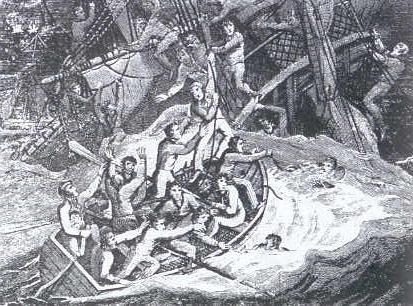
Late in January 1871 a fine French brig, the Ste Philomene
was being towed by a steam tug from Isigny-sur-Mer on the
Normandy coast. The small vessel, just 420 tons, was returning
empty to Cherbourg and had left Isigny at about 2.30pm on
a Saturday afternoon. Everything was proceeding normally as
it made its slow progress along the coast of the Cherbourg
peninsula, but at eight o'clock in the evening the tug's engine
broke down. With much reluctance the master of the Ste
Philomene, Antonie Comner-Nouse, had no alternaive but to
cut the tow rope. The weather had been slowly worsening all
day and within an hour of the vessel losing the tug's assistance,
the wind had reached gale force and very heavy seas were running.
During the night conditions deteriorated further and 'a severe
gale was blowing', making it impossible for the master to bring the
vessel into Cherbourg under its own sail. The Ste Philomene
was driven across the English Channel and by early Sunday
evening it was sighted off Poole. The gale had effectively carried
the vessel over 80 miles off course; the ship's long boat had been
washed overboard and both anchors lost when the master had
attempted to shelter and ride out the storm off Barfleur. During
Sunday night, as the vessel was being swept along the coast, the
master sent up distress signals. These were seen by the
Coastguard at Bournemouth but because of the heavy sea and
'the darkness of the night' it was not possible to distinguish the
vessel's course.
At about six o'clock on Monday morning the Ste Philomene
finally grounded a couple of yards from the cliff near to
Boscombe chine. The master and crew were able to leave the
vessel and 'with great difficulty they waded ashore with the
waters up to their necks'. The French seamen were taken to the Palmerston Arms
at Boscombe, where they were supplied with warm food and dry clothing,
both of which were obviously greatly needed!
Even a local resident came forward to act as an
interpreter. Fortunately not a single life was lost although all
the seamen were suffering from intense cold and exhaustion.
This wrecking occurred at a time when the nascent resort was known
as Boscombe Spa - a name which owed its origin to a
'mildly chalybeate [impregnated with iron salts] spring which
had been strongly recommended by the medical profession'.
The place, along with nearby Southborne-on-Sea, was
attempting to rival Bournemouth as a separate seaside resort.
Sir Henry Drummond Wolff, the Member of Parliament for
Christchurch, had great plans for Boscombe, which ultimately
led to a fine esplanade and pier - the pier was opened in July
1889 by Lady Shelley, the daughter-in-law of the poet.
All who came to view the stranded vessel were of the opinion
that it would only be a matter of time before it became 'a
complete wreck'. However, the master and owner, a Monsieur
Bertram of Agde in Southern France, had other ideas. The Ste
Philomene was only four years old, constructed of 'strong
French oak', and had been insured at Marseilles for £3,000 -
a very high figure for those days. Just two weeks after the
wrecking the vessel had still not broken up and a local ship-building firm from Hamsworthy at Poole - Meadus & Company - were
given the task of getting it off the shore.
The local press reported that this work 'was attended with a good deal of risk...large
tanks having been provided and a number of hands engaged...' Nevertheless
almost five weeks after the unfortunate grounding the Ste Philomene was finally
successfully refloated on a high spring tide. It was achieved 'by
means of rams fixed to her bow and heavy anchors and chains laid in 3
fathoms of water and also by means of 7 pumps worked by
sufficient force...' Of course the rescue attempts had
been attended by great public interest, crowds had
gathered to see this unusual sight. Once the vessel was considered
to be safely hove to at its new anchors, the steam tug Royal Albert
towed it to Meadus' shipyard at Hamworthy. The damage was
said to be severe, the heel and keelson in a sorry state and many
timbers were broken. But considering that the Ste Philomene
had been prey to the elements for about a month or so it was
surprising that the brig was able to be moved at all.
On 15th July the local newspaper was 'pleased to report that
the Ste Philomene had been launched four days previously
having been thoroughly repaired, coppered and completely
re-equipped for the sea'. All that remained was for the rigging to
be completed, which would take a couple of days, and then the
vessel would be ready for the sea. Precious few sailing vessels
survived such a stranding and though its ultimate fate is not recorded
one hopes that the Ste Philomene went on to have a
long and successful career. I am sure that all the members of the
French crew proudly boasted of the time they survived a
wrecking - one of the rare occasions when the cruel sea did not
take its toll!
