It is a sad fact that disasters nearly always make the headlines and during the latter decades of the 19th century there were many such tragedies and headlines, most relating to shipwrecks with quite horrendous losses of life. One of the most infamous shipwrecks of the time happened along the Dorset coast and it earned its notoriety, not for its death toll, which was low judged by the gruesome standards of the time, but because of 'the inhuman behaviour' of the local people after the vessel had been wrecked.
The Royal Adelaide was an iron sailing vessel which had left London Docks in November 1872 after spending the best part of two months loading a variety of general cargo including a large quantity of spirits - rum, brandy, and gin - both in casks and bottles. It was also carrying 35 emigrants bound for a new life in Sydney, Australia. It was not stricly an emigrant vessel in the precise meaning of the word, being rather too small - at just under 1,500 tons - for that type of trade. In several reports it was called a 'clipper' but this was a rather loose term often imprecisely used to describe a fast sailing ship. Its master, Captain I. Hunter, was a most experienced officer, who had frequently made the long journey to Australia. On this occasion he commanded a crew of 32 officers and men.
On the night of 24th November the Royal Adelaide was seen to have passed the Portland lighthouse perhaps a little too close off its starboard bow for comfort and, despite the fact that the glass was dropping quite alarmingly, the captain proceeded down Channel with all possible speed. It was during the night the strong south-westerly wind quickly strengthened to gale force and then within hours developed in such severity that Captain Hunter felt it wiser for the safety of his ship and the passengers to turn back and seek shelter, maybe in Portland Roads, from the worst of the storm.
The wreck of the Royal Adelaide, near Portland. (Illustrated London News)
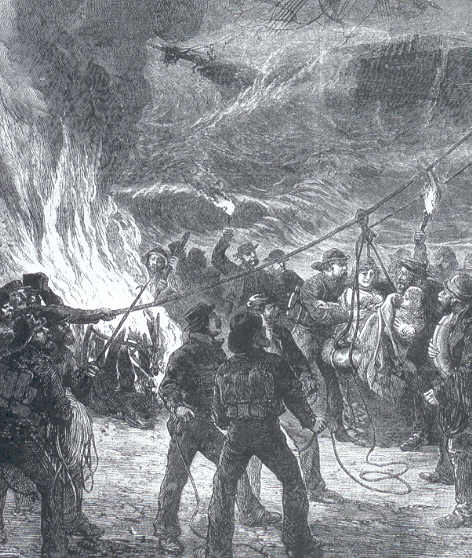
Unfortunately the heavy and blinding rain squalls had blown the vessel off course and the captain found that his vessel had become dangerously 'embayed' in West Bay. During the afternoon of the 25th it became quite plain that the vessel could not weather the storm as it was being driven closer and closer to the western end of Chesil Beach - that long barrier of flint and stone had posed a threat to sailors for centuries. The Coastguard had monitored the progress of the vessel for most of the day, and they now gathered in some strength along the Beach, having lit blue lights as a warning to the captain of the dangers of that stretch of coast. But the Royal Adelaide was wallowing helplessly at the whim of the storm, the heavily rolling vessel proving to be completely unmanageable in the raging seas. To the helpless watchers on the shore it appeared only a matter of time before the vessel struck the Beach.
The rocket apparatus at work
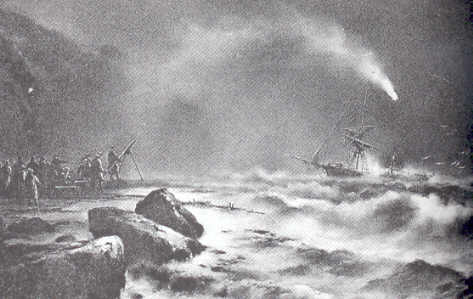
A most vivid eye-witness account of the wreck has been preserved, it appeared in The Illustrated London News for 7 December 1872. Mr Hamilton Williams, a 'gentleman from Weymouth' had heard news of a vessel being 'in great peril in the Bay' and accompanied by two friends he caught a train to Portland and then they climbed along Chesil Beach. On their arrival the scene that greeted them was:
'...Far to leeward we could occasionally discern a glimmering light, and we set off in its direction along the beach as fast as we could run. Presently a blue light flashed up from the vessel, whose outline we could just see blurred and dim through sand. Almost as we came opposite her she drifted broadside on the beach, despite her anchors, which found no holding ground. Fearfully she heaved and rolled in the aweful sea. It seemed as if the delivering rocket was never going off on its message of help; but at last, straight as an arrow, away it sped right through the rigging of the helpless vessel [It had been fired by the Wyke Rocket Brigade]. The cradle was rigged and the coastguard worked like more than men. The passengers and crew were hauled ashore. Through the boiling sea came one after another, grasped ere long they reached the shore by the friendly arm of some stout seamen. Then we began to learn that they had women and children on board, and the fear that the ship might break up before all were saved grew more and more intense. The first mate had already been drowned, madly trying to jump unaided from the ship. A woman too was drowned, falling overboard... Soon with an aweful lurch to seaward, the mainmast went by the board, the mizen topmast having already gone. In a few minutes it was seen that the ship had split right in two, a little abaft of the mainmast. Once commenced the work of destruction was not long, though still the cradle was going to and fro, and still there remained others to be saved. These were all congregated astern; and when the last two or three were already in the cradle, about to try their fate when the rope broke, they fell into the cruel surf and were seen no more... Then we left the shore seeing the ship a hopeless mass of shattered wood; and I do not think that any of us there will ever forget the impression made on us by the wreck of the Royal Adelaide'.
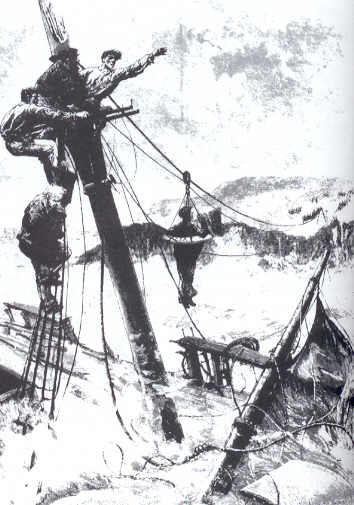
It was thought that over 3,000 people (both men and women) had by then gathered along the Beach to watch the last rites of the vessel. The final person to be rescued was the second mate - the captain had been one of the first to use the cradle. He had made this decision when he realised that most of the passengers were too terrified to trust their lives to such a fragile basket, but when they saw him land safely they followed his example. The last passengers to leave the Royal Adelaide were a married couple with a young child, they had hitherto steadfastly refused to use the basket. However, a man holding a child in his arms was seen to enter the cradle, but the line broke and they were pitched head-first into the sea; the two bodies were never recovered.
Ship to shore rescue by lifebelt and pulley. (Illustrated London News)
As the vessel began to break up, its cargo started to float ashore. First came hats, soap, candles, coffee and then some livestock - it was reported that one pig survived by managing to swim ashore! Almost immediately the people on the Beach began to pick up the goods in a mad frenzy and scuffles broke out as they fought each other over the items of cargo. But when finally the casks and bottles of spirits were washed up a scene of grave tragedy became one of unsavoury drunken debauchery. The spirits were quickly pillaged by the crowds and very soon many had drunk themselves helpless, whilst others risked drowning in their frantic efforts to grab items of cargo before either hiding them in the shingle or carrying them away. This wholesale plunder and the unbridled drinking could not be prevented by the Coastguard because not only were they vastly outnumbered but they were also 'greatly intimidated by the naked aggression and violence of the looters', who were quite prepared to go to any lengths to defend their ill-gotten gains, which they considered belonged to them by 'ancient rights'.
All but six of the emigrant passengers and crew were saved, three of the victims being women. It was estimated that double this number of spectators died from drunkenness or exposure or both, because many slept off their excesses on the Beach through the bitterly cold night. As a Portland poet wrote:
'But alas! poor souls, they drank too deep
Of the brandy and rum - then soon fell asleep
In the wind and the rain, to lie all night,
In a drunken state and an aweful plight.'
Without exception the newspapers of the time were loud in their outright condemnation of such outrageous behaviour. Many claimed that the terrible and frightening happenings had demonstrated human nature at its worst and they considered the conduct 'was not far removed from the beasts of the field'. But what the shocking incident did show was that the age old traditions of the Chesil Beach were not yet completely dead!
It is not known whether those fortunate emigrants who managed to survive this 'most grievous disaster' decided to stay safe and sound in this country or whether they risked yet another sea passage to far distant shores after suffering such a mortifying experience. Perhaps they did try again in the firm belief that lightning was unlikely to strike a second time?
