During the last century no seaside resort that aspired to popularity could hope to prosper without the provision of a pleasure pier. These unique and splendid constructions, peculiar to British shores, were greatly beloved by Victorian and Edwardian holiday makers. Despite the fact that Bournemouth's early fame as a resort had been gained as 'a healthy watering place' for invalids to recuperate, it was fast attracting a greater number of day visitors and summer holiday makers. This growing popularity was no doubt greatly enhanced by the errection of its first pier in 1861 to replace what was nothing more than a basic wooden jetty. Unfortunately this pier suffered from severe storm damage and by 1878 it was replaced with an elegant iron structure costing £21,000, and was formally opened in August 1880. One of its features was a broad landing stage at the seaward end specially designed to accommodate the many pleasure steamers that plied the south coast.
A trip on a coastal paddle-steamer was considered an essential part of a visit to the seaside; the pleasure of coastal cruising was an unforgettable experience. Paddle-steamers with their elegant and comfortable furnishings and spotless engine rooms with gleaming brass equipment were beloved by young and old alike. These steamers, quite rightly, held a special fascination for all those who were fortunate enough to have travelled in them.
The Bournemouth, Swanage and Poole Steamship Company operated a fine fleet of paddle-steamers from Weymouth, covering the south coast from Torquay to Brighton. Perhaps the pride of the fleet was the Bournemouth, which had been built at Leith during the early 1880s at a cost of £14,000, and with a top speed of 16 knots considered 'the fasted steamer on the south coast'. It was a long flush-decked paddle-steamer with two funnels, one fore and one aft of the paddles, each carrying the distinctive markings of the Company - bright yellow with black caps. This splendid vessel made its first trip from Bournemouth pier in May 1884.
On Friday 27th August 1886 at eight o'clock in the morning the Bournemouth left for a trip to Torquay with about 180 passengers on board. Though the weather was rather dull the sea was comparatively calm and smooth, ideal conditions for the day-long cruise. The only port of call was Swanage where another 20 passengers embarked. The vessel arrived at Torquay about one o'clock after a pleasant and uneventful voyage. The return journey commenced at a quarter to four and according to one of the passengers the first half-hour or so was 'nice and sunny'. But then suddenley the vessel ran into dense sea fog, said to be so thick that 'it was impossible to see greater than half a boat's length ahead', although another passenger later claimed that 'we could see no more than ten yards in front of us'. In such conditions these coastal steamers were very vulnerable. By their very nature they operated as close as possible to the coast and without the advantage of radio the captains had to rely solely on the accuracy of their navigation and knowledge of the coast. On the Bournemouth Captain Perrin, the mate and a leading seaman remained on the bridge with several seamen in the bows keeping a sharp lookout.
But these precaustions were to no avail because at ten minutes to seven the vessel struck the rocks to the west side of Portland Bill. As one passenger said 'a terrible shock was felt by all as the boat struck. We were only a few yards from the cliffs, which ran up to a height of 200 feet. Great fright was experienced by some of the lady passengers, who screamed a little but generally they kept up their spirits remarkably well in the circumstances.' The local newspaper was rather more dramatic and reported '...at that moment then shrieked the timid and stood still the brave'! By all accounts the captain and his crew acted with 'quite admirable coolness and self-possession'. The ship's whistle was continually sounded to attract the attention of the Portland Coastguard.
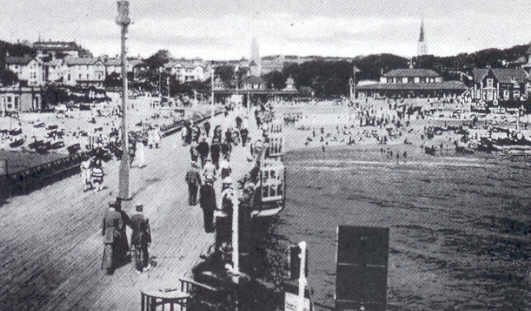
Bournemouth Pier, opened in 1880. In 1886 the paddle-steamer
Bournemouth left on her fateful trip.
The ship's boats were quickly lowered and the women and children loaded into them. As a passenger recalled there were 'some affecting scenes, the seperation of relatives under such circumstances causing much distress.' The boats were rowed to Chesil Beach where the survivors were landed and 'conveyed from thence to Weymouth', although it is not clear by what means of transport.
In the meantime two Coastguard men had managed to climb down the cliffs but were not able to offer much in the way of assistance. However, with their rocket apparatus they did succeed in getting a line aboard and a few of the more intrepid male passengers were landed on the Bill. A message was passed to the Captain that a steam tug had been called out as well as a number of fishing boats from Portland. The small boats immediately started taking off passengers, landing them on the Bill where many opted to walk the five miles to Portland station to board the special train organised to take them to Bournemouth. Other passengers decided to stay on the vessel until the promised tug arrived despite the fact that 'the sea water was coming in rather profusely'! By ten o'clock it was obvious that the vessel had been badly holed and it was considered no longer safe to remain on board, so all the passengers and crew were quickly evacuated. Many of the passengers spent the night on Portland Bill either sleeping in the lighthouses or out in the open on the cliffs. On the following morning they were picked up by another paddle-steamer, the Queen, which finally brought them back to Bournemouth pier.
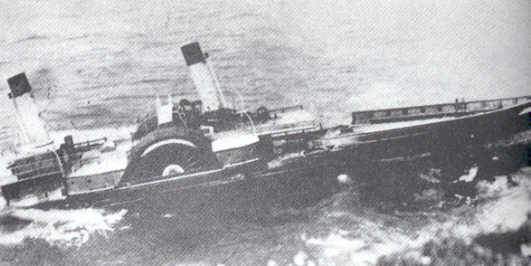
The paddle-steamer Bournemouth on the rocks at Portland Bill, 27 August 1886.
During the previous evening there had been 'scenes of great anxiety' on the pier, where worried relatives and friends had gathered for news of the vessel. Rumours were rife that the vessel had gone down with a great loss of life. It was not too clear which ship had met with the accident because another of the Company's steamers, the Empress, had also been to Torquay that day. The crowds on the pier waited patiently for telegrams to arrive with news of the accident and any details of the survivors. Many of them remained there until late into the night discussing the disturbing news as it was divulged. The special train from Portland did not arrive at Bournemouth station until three o'clock in the morning. It had certainly been a long, exhausting and very frightening day for the poor passengers.
However, not a single passenger or member of crew was lost or even injured in the wreck. Considering the potential for disaster it was an amazing and fortunate outcome. The Bournemouth fared far worse; its back was broken just forward of the engine space and it became a total loss. As it was only insured for £7,000 (just half of the building cost) the accident proved to be very costly for the Company and its shareholders. A special edition of the Bournemouth Visitors' Directory was quickly produced and appeared for sale on the following day; it gave full details of the wreck and even included some of the survivors' accounts - all for the price of one penny! This report was quick to point out that 'only on Whit Monday last the Bournemouth met with another accident on her way to Torquay which had rendered her incapable of service for a considerable time'.
Some of the passengers were later quite critical of Captain Perrin. They maintained that he had sailed the vessel at too high a speed for such conditions and one even claimed that 'we steamed at full speed right on to them [the rocks] like a boat being beached'. Others said that the captain had removed three of the seamen from the bows just before the accident occured, which in their view had endangered their lives. In the end it was found that Captain Perrin had miscalculated the distance the vessel had run and had thus altered course too soon. The sad accident did little to affect the popularity of the Company's paddle-steamers as the following summer 'paddle-steamers moored three and four abreast could be seen at the pier ready to scurry across to Cherbourg or down to Torquay, Swanage and across to the Isle of Wight'.
