|
The coasts of Dorset and Hampshire have a long and rich maritime history, from the medieval port of Lyme in the west to Portsmouth in the far east - a port which can lay claim to Roman origins. From times immemorial the seaways along these coasts have been thronged with vessels of all sizes, shapes and descriptions, both British and foreign. The ancient ports of Lyme, Melcome Regis (Weymouth), Wareham, Christchurch and Southampton greatly owed their early wealth and importance to the wool trade, which brought about much maritime activity. They were closely followed by Bridport and Poole, and from Tudor times especially, Portsmouth developed as a major Naval Port and dockyard ensuring that there would always be a strong Naval presence in these coastal waters. The number of Naval vessels using these waters increased considerably in the last century as Portland also came to the fore as another important Naval port and dockyard. Then from the beginning of the 19th century Lymington fast became the centre of yachting activities in the Solent as pleasure sailing became a very popular social pastime. This activity has now reached such proportions that these coastal waters have, at least during the summer months, become the maritime equivalent of the M25! Southampton, of course, developed as the 'Gateway to the World' with vast passenger liners becoming a familiar sight in Southampton Water and the Solent.
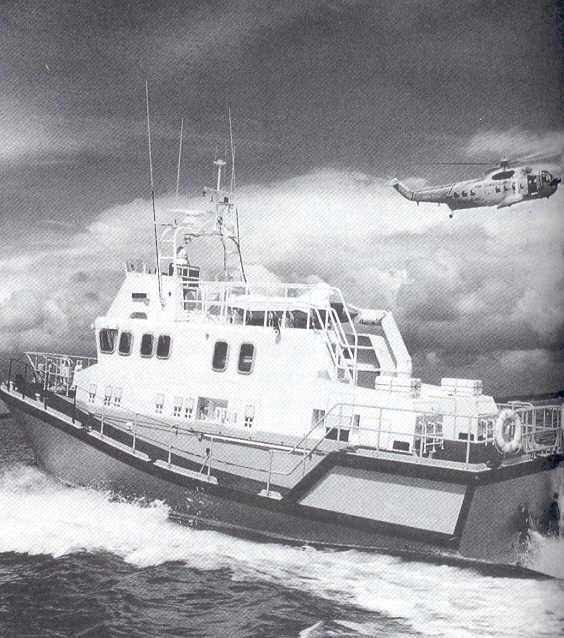
A new RNLI lifeboat in the Solent, 1995. (Peter Orme)
 It is unfortunate that such a long and diverse maritime history has brought in its wake a vast number of shipping accidents and disasters, and perhaps not too surprisingly two of the most famous shipwrecks of all times - the Mary Rose and the Royal George occurred in these waters. Throughout the centuries there have been countless wrecks along these coasts - both large and small; from the early medieval wool, cloth and wine vessels, Dutch and Spanish caravels, East Indiamen, sailing brigs and schooners, steamships, excursion and pleasure vessels, to a wide variety of Naval ships and submarines. Many churchyards along the coast give ample testimony to the terrible death toll extorted by the sea - uniquely there is a coastal church which was built and dedicated to the victims of one tragic shipwreck. Very many of the vessels that came to grief along these shores were not, in fact, bound for the numerous ports that lined the coasts but were destined for more distant ports, and had the misfortune to be caught in the severe winter storms that plague this stretch of the English Channel.
One maritime writer asserted that in the days of sail one voyage in six ended either in stranding on a shore or foundering (sinking) at sea. If this estimation is reasonably accurate then it is surprising not to find more shipwrecks along these shores considering the sheer number of vessels that passed on any given day. Furthermore, the whole stretch of the coast had sufficient natural hazards to pose serious navigational problems, which in unfavourable weather and sea conditions were viewed with dread by even the most experienced seamen. This situation prevailed more so in the days of sail when masters did not have all the advantages of radio and modern navigational aids available to today's seamen - though I have no doubt that many a modern yachtsman would readily agree that these coastal waters still demand the utmost respect.
For centuries Lyme was the only safe anchorage between Portland Roads and Exmouth. The Bay itself is said to be so littered with wrecks that it has been called 'The Bay of a thousand wrecks'. Just further along the coast is that unique long barrier of piled shingle - Chesil Beach. Certainly in the days of sail it frequently proved a death trap to any vessel caught in a winter storm. During one particularly vicious gale in October 1839 no less than seven vessels came to grief on the Beach with a harsh loss of life. No other stretch of coast in the British Isles has resulted in so many deaths by way of shipwreck; indeed Chesil Beach has well justified its grim and macabre sobriquet - Deadman's Bay!
The great and towering stone cliffs of Portland have seen the demise of many a fine vessel especially as the seas around the Bill - the famed Portland Race - are thought to be amongst the most dangerous to negotiate along the whole of the English Channel, with the two-mile long sandbank known as the Shambles waiting to entrap any wayward mariners. Further along the coast the Isle of Purbeck with its formidable headlands and dramatic cliffs offer some of the most splendid scenery along the whole of the Channel. But this very rugged and rock-strewn shore has always taken a harsh toll of shipping. Even the relative calm and sheltered waters of Studland Bay, which was frequently used as a shipping haven in earlier days, has become the last resting place for a number of vessels. Perhaps the most notable is the captured Spanish Armada galleon that sank here in 1588.
Further west the entrance to the relatively calm waters of the Western Solent presents its own special navigational problems. On one side the dreaded bank of pebbles known as the Shingles, and opposite the stark and razor-sharp cliffs of the Needles almost act as silent guardians to the turbulent waters of the Hurst narrows. Although the Isle of Wight provides a very effective breakwater from the worst of the Channel's weather and seas, these 'inland waters' of the Hampshire coast - the Solent, Spithead and Southampton Water - can present their own navigational problems. Quite strong and fierce tides can run along their narrow and crowded channels quite apart from the number of shoals, which have proved the downfall of many vessels. Sailing in these waters involves considerable risks of stranding or collision. However, there is no doubt that the most numerous shipwrecks occurred along the Dorset coast - the statistics tell their own grim story!
For most of the 18th century there were very few navigational aids for mariners using the English and Welsh coasts. Charts were still fairly rudimentary; the Great Britain Coasting Pilot was first published by Collins in 1693 and it was widely used by British seamen throughout the century despite the fact that it was widely criticised for its inaccuracies. The first Admiralty charts appeared in 1801 and their now famous Sailing Directions were first brought out in 1828. Furthermore there were very few lighthouses around the whole of the British coastline and only two existed along the long Dorset and Hampshire coastline - Portland, the first being built in 1716, and the low lights near Hurst Castle in 1786.
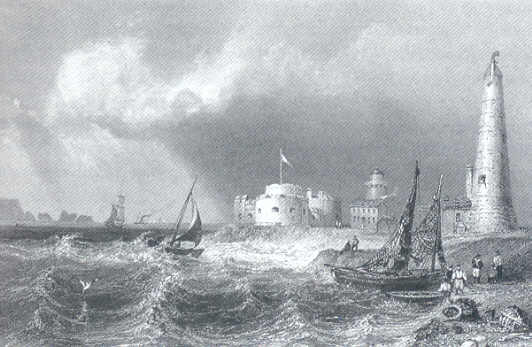
The low lights at Hurst Castle, established 1796
There were also two medieval 'lights' - St Catherine's Chapel at Abbotsbury to serve as a warning to the treacherous Chesil Beach, and a chapel at the top of St Aldhelm's Head. The other lighthouses along the coast all date from the following century as do the light-vessels, although the Nab light at the entrance to Spithead was first established in 1805. It can be said that the odds were heavily stacked against the 18th century mariner. Most masters used local pilots; that is, if they could afford them, and in theory these should have been fully aware of and experienced in the dangers of their particular stretch of coast. Unfortunately many of them were not that skilled as the better class of seamen had either been impressed into the Navy or more likely were engaged in the much more profitable trade of smuggling!
The first organised attempts at life-saving from land and indeed by sea fell to the Customs service. In 1815 the Preventive Waterguard was involved in practical experiments with Captain Manby's mortar apparatus. This was basically a strong line attached to a shell which could be fired fairly accurately up to some 275 yards. The idea was to get a line aboard a wrecked vessel in an attempt to rescue the stranded seamen. By 1819 this apparatus was issued to certain preventive stations situated along particularly dangerous stretches of coast. John Dennett from Carisbrooke on the Isle of Wight adapted Manby's mortar to rocket propulsion and by 1834 all Coastguard stations were issued with Dennett rockets. Later an American, Captain Boxer, produced a much improved rocket apparatus which came into universal use in the last half of the century.
It is interesting to note that it was two Coastguard officers who were in the vanguard of life-saving along the coast. On 8th March 1824 Commander Charles Freemantle RN, who was in in charge of the Coastguard at Lymington, was on the shore at Whitepit near Christchurch where a Swedish brig Carl Jean was in considerable difficulties. The main mast was overside and the vessel was striking so heavily that it looked in imminent danger of breaking up. Freemantle managed to reach the vessel by swimming through the surf with a line attached to his body. Although he had the ship's boats cut clear, heavy seas filled them, rendering them useless. When he suggested other rescue measures, the crew adamantly refused to leave their vessel. Freemantle eventually regained the shore by use of the lifeline but 'was utterly exhausted and insensible'. Shorly after the ship broke up the crew escaped by using the main mast. For his brave rescue attempt Commander Freemantle was awarded the first ever gold medal for gallantry issued by the Royal Lifeboat Institution. Then just a year later Captain Spence of the Coastguard at Lyme Regis had a shore boat specially converted for life-saving purposes, although it was not a great success.
In 1823 Sir William Hillary issued an appeal for a national sea-rescue service:
'...From the calamity of shipwreck no one can say that he may at all times remain free; and whilst he is now providing only for the safety of others, a day may come which will render the cause his own...'
Such was the determination and the conviction of his appeal that in the following year the National Institution for the Preservation of Life from Shipwreck was established. The founder's intention was that this unique service would be funded by voluntary donations and subscriptions, which he thought 'would be found easy in its progress and successful in its results'.
Unfortunately after the initial enthusiasm died down, financial support fell away and by the early 1850s many lifeboats had become run down through lack of funds. During this sad period of decline the Customs cutters became increasingly involved in rescues at sea with the Coastguard predominant on land. Also there were very many instances of local fisherman, pilots and Naval men saving the lives of wrecked seamen and several were awarded cash payments and medals by the Lifeboat Institutions. The Portlanders, with their small lerrets, were particularly active in saving lives around Portland, the Isle of Purbeck and Chesil Beach. The lerret was a six-oared boat without a rudder and normally used without a sail. It had been evolved over the centuries as the most effective boat for launching from a steep and pebbled shore in any kind of weather.
The first 'proper' lifeboat was established in 1826 at Portland, followed a year later by one placed at Studland Bay, though both barely survived for longer than 25 years. During 1850 the fourth Duke of Northumberland made a survey of the lifeboat service throughout the country. His excellent report brought forth the resuscitation of the Institution's fortunes. In 1851 the Duke became its president and three years later the name was changed to the Royal National Lifeboat Institution. Since then it has gone from strength to strength.
The mid-century saw a great upsurge of the Lifeboat Service along the coasts. Stations were established at Lyme (1853), Poole and Hayling Island (1865), Chapmam's Pool (1866), Kimmeridge and Weymouth (1869), Swanage (1875) and Southsea (1886). The latter decades of the century also saw the formation of many local life-saving apparatus companies (LSAs). These companies were manned solely by local volunteers and they largely owe their origins to the days when the Coastguard were forced to request the help of local people to handle their rocket equipment.
It was just as well that the lifeboat service had greatly expanded because during this period there was a staggering number of shipping losses throughout the British Isles. For instance in 1876 no less than 838 vessels were shipwrecked, of which the majority were sailing ships. In the previous decade there were over 5,800 shipwrecks with more than 8,000 lives lost at sea. The situation slowly improved largely due to the many brave and thrilling rescues by members of the Lifeboat Service, although sadly since 1824 no less than 435 lifeboatmen have lost their lives in rescue attempts. As Charles Dickens observed in 1850:
'These [the lifeboatmen] are among the bravest and most skilful mariners that exist. Let a gale rise and swell into a storm; let a sea run that might appal the stoutest heart that ever beat... let them hear through the angry roar of the signal guns of a ship in distress, and these men spring up with an activity so dauntless, so radiant and heroic, that the world cannot surpass it.'
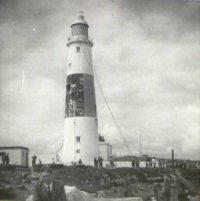
Portland, the Bill and lighthouse. The first lighthouse was built here in 1716
The Royal National Lifeboat Institution is a unique service, completely supported by voluntary subscriptions. Each lifeboat station is administered by its own locally elected committee and the lifeboats are manned by volunteer seamen of a very high quality, who through the years have shown great dedication and bravery in the saving of hundreds of lives. The current lifeboats in use were all designed at the Institution's headquarters at Poole in Dorset. Nowadays the 'Fleet' comprises a variety of types and sizes of vessels from the largest - the 54 feet Arun to the smallest 16 feet fast inflatable boats (ILBs of Inshore Lifeboats). At the time of writing there are lifeboat stations at Weymouth, Swanage, Poole, and Calshot, with ILBs at Lyme, Mudeford, Lymington, Portsmouth and Hayling Island. Indeed the words written by the famous novelist Joseph Conrad in 1923 are just as apposite today as they were 70 years ago. He, of course, should have known the value of the Lifeboat Service having spent so many years at sea:
'No voluntary organization for a humane end has the reputation and the prestige of RNLI...But it is only those who have followed the sea for their livelihood that know with what confidence the Lifeboat Service is looked upon by those for whose benefit it has been funded by the generosity of people who live ashore...I can testify to that feeling, and to the comfort the existance of lifeboat stations, with their ever-ready crews, brings to the hearts of men on board ships of all nations approaching our shores in dangerous weather...'
|
