



Development
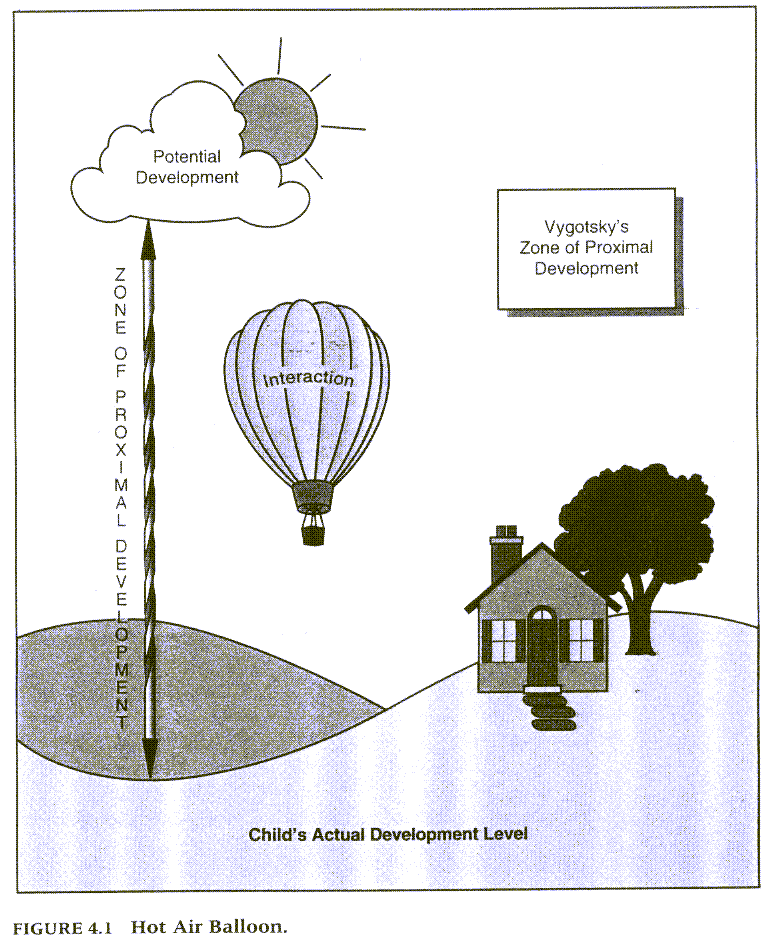
� Vygotsky viewed the zone of proximal development as an important factor affecting the relationship between thought and speech. It is also considered as a way of actually seeing what children are able to know. His definition is as follows:
� "The distance between the actual developmental level as determined by independent problem solving and the level of potential development as determined through problem solving under adult guidance or in collaboration with more capable peers (Wink, 86)."
� Vygotsky's concept of development was complex. He focuses on relationships, connections, and preceding stages. Rather than focusing on specific levels of development, he believed that experience was the main factor in expanding development. The relationship between learning and developing is bi-directional and interrelated. Children then become active participants in their learning through language and social interaction.
� Vygotsky believed that development occurs at critical points in life, in a progressive manner, yet it can have regressive tendencies (Wink, 89).
� Vygotsky believed that instruction tends to lead and support development through the interaction of two kinds of concepts: schooled concepts, and spontaneous concepts. These concepts emerge from the child's observations and experiences (Wink, 90).
� While the processed of learning and development are interrelated, they do not necessarily move at the same pace. It is believed that when educators focus only on the students' actual level, they are orienting the learning to past development (Wink, 95).
1. "Vygotsky (1978) defined the zone as:
the distance between the actual developmental level as determined by independent problem solving and the level of potential development as determined through problem solving under adult guidance or in collaboration with more capable peers" (pg. 86).
2. "The most important point is that the two concepts work in harmony with each other; the spontaneous concepts create and experiential path for the development of the scientific. These scientific, or schooled, concepts offer organization to the child's thinking, paving the way for more learning, and ways for the spontaneous concepts to develop and expand into scientific concepts" (pgs. 93-94).
3. "Vygotsky would say that learning comes first and leads development" (pg. 95).
4. "We encourage educators to risk the safety of the context of the academic world by seeking authentic experiences in the real world of the students. In order to bring the power of the funds of knowledge to the schools, educators need to understand through experience" (pg. 100).
5. "Learning and developing takes places within each learner, but it is also grounded in learning as a collective" (pg. 121).
6. "However, students of today and citizens of tomorrow will need the ability to transfer and transform their knowledge to challenging, unforeseen problems and complex realities. They will need to solve problems that do not yet exist; they will need to be able to find workable solutions, both individually and with others; and they will need to learn dialectically from oppositional thought. Thus, we turn to Vygotsky, the voice from the past, who leads us to the future" (pg. 121).
Questions - Rebecca Freeland
1. According to Vygotsky, what are the changes that characterize development?
2. What does a child's role as an active participant in his/her learning constitute?
3. How do Vygotsky and Piaget differ in their views of cognitive development?
4. What is the relationship between the spontaneous and scientific concepts of learning? How do they relate to the concept of the Zone of Proximal Development?
5. What is meant by the term, funds of knowledge, and how does this term apply to learning and development?
6. How does the concept of the capable peer vary from one context to another?
7. What is the importance of play in a child's Zone of Proximal Development?
8. What are the two educational problems that Vygotsky was concerned with?
9. How would a teacher instruct a class based on the notion of the Zone of Proximal Development?
Recorder - Heather Magiera
The majority of discussion on this chapter focused on the zone of proximal development. We discussed how teachers could asses children without using tests, in order to find their current level of proficiency and to determine their abilities with assistance. We also discussed the differences between Piaget's and Vygotsky's theories of development. We agreed that the major differences revolved the two theorists views regarding children's abilities. Vygotsky granted children more abilities than did Piaget. We also agreed that the role of culture was another important difference between the two theories. Piaget did not emphasize culture in his theory, however, it is a building block in Vygotkian theory. According to Vygotsky, a child's culture determines the course of his or her development. We also discussed the importance of play to children's development, and how Vygotsky's theory has influenced current thought on the development of children.