



Teaching and Learning
Two Senses of the Term Social
*The discussion of thoughts and ideas with others is a social
task as well as a learning task
*Life experiences are also social learning tools, we both
have these experiences ourselves or learn about them
from someone else's experience being shared with us.
Socioculturally Learning and Developing
*Vygotsky's work in pedagogy comes from his views
that development is a dynamic process social by nature.
*The Vygotskian prospective is very complex, and so
is that of the educational system.
A Puzzle of Learning
*Classrooms are part of a complex puzzle,
where the pieces are made up of the teachers,
students, and the community to name a few.
Classrooms as Cultures
*The class itself is a piece of the puzzle which is very
important to the system of learning.
*Each classroom is made up of its own different
parts which makes the learning environment work.
The Puzzle of Pedro
*Pedro's puzzle was unique because it was composed
of his culture, SES, language, and his special education
classes. He just needed to incorporate a knowledgeable teacher.
High-Stakes Testing
*The school systems are demanding one-size-fits-all
students and a curriculum to fit them.
*Standardized testing is the molding to these ideas.
Going to the Movies
*The teachers have to teach the students to the tests,
and it is up to the students to find out what the teacher
is trying to teach them.
Sam: A Teaching Time Line
*This is an account of a first time teacher and how the
first few years of teaching taught him to teach.
The Sociocultural and Pedagogical Puzzle
*The administration, Union, management, and colleague
differences need to connect to each other to be successful.
Discussion Director Part 2 - Terra Warford
Manuel: To Name, to Reflect Critically, to Act (pg.74)
- Students live the majority of their lives in a social context, influenced by
culture, ideas, and assumptions.
- The influences of the social-cultural context move in all directions.
- According to Vygotsky, language reflects both reality and consciousness.
- "Thought and speech turn out to be the key to the nature of human consciousness.
Blame the Victim (pg.77)
- the concept of "Blame the Victim" looks only a the students rather than actually looking at the social context in which the students live and interact on a daily basis.
- In many cases, bilingualism is used as a scapegoat for rationalizing poor performance in schools.
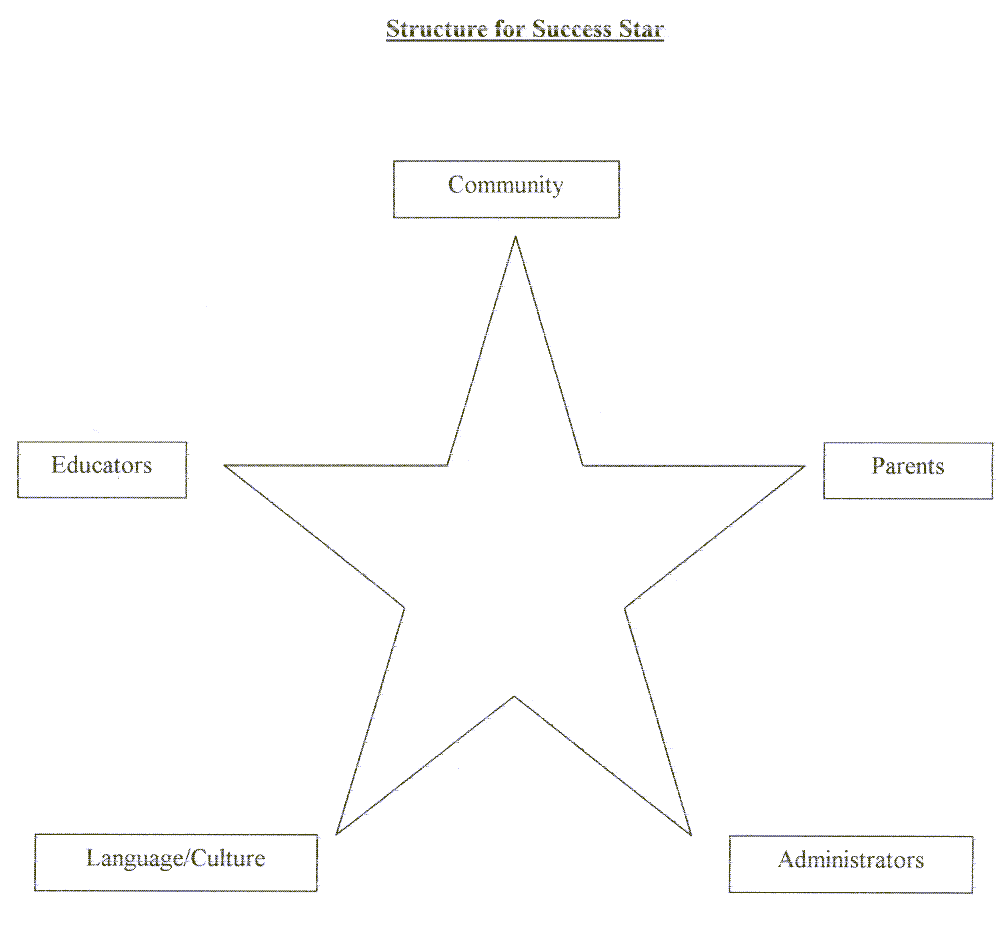
Structure for Success (pg.77)
- teachers created an activity that was used to demonstrate the influence of the social environment of the student.
� five participants chose one of five cards containing a societal function, including,
community, educator, culture and language, administrator, and parents.
� participants listened for the name of their category and than caught a ball of
rope. They continued to throw the rope to another person in group while holding
a section of the it. This showed the connection of all participants in the
community.
Library Mapping (pg.81)
- a summer course of teachers in Foundations of Bilingual Education focused on social, cultural , historical and political areas of learning language in the U.S.
- Maps were used to represent various neighborhoods as a process of acquiring language.
- Part of the assignment was to use the maps to find a library where bilingual books were located.
- Of the 18 university students participating, two came back with esthetically pleasing areas. The bilingual books were easy to find and the librarian's were helpful.
- The rest of the students found poorly conditioned libraries. Most bilingual books were located on high floors and were not easily accessible.
The research showed that it was not that parents did not value reading, but contexts for accessing books was made hard.
Passage 1:
As each of us experiences life, whether it be the macroworld of society or the microworld of the classroom, we are influenced by and we influence the surrounding environment. We create our own life's path as we live it. No one's path is more valuable than another's, nor is it exactly the same as another. (p. 60)
Passage 2:
The individualization of our thinking happens as a result of our inter-mental processing of information. Learning becomes an instrumental processing as we begin to internalize what we have learned through our interactions with others. (p. 61)
Passage 3:
Classroom teachers?have the power to create a supportive sociocultural environment in which students are encouraged to mediate their world?the interrelationship of all students and all languages, in a safe an secure environment, is fundamentally important for literacy and cognitive development. (p. 68)
Passage 4:
?to understand another's speech, it is not enough to understand the words, or even the thoughts; we have to understand the motivation behind the thinking and speech. (p. 74)
Questions - Heather Magiera
Why is the sociocultural environment so important to Vygotsky's theory?
How does prior experience affect learning?
What is a "classroom culture"?
What problems occur when sociocultural contexts are ignored?
How can educators relate to their students in authentic ways?
Reporter/Notes - Therese Moore
� Two Senses of the term Social:
� 1. In terms of learning and developing social incorporates the idea of interpersonal relationships.
� 2. Not only are we social beings, but at the same time, our being social is also cultural and historical through the mediational role of artifacts that we construct.
� Sociocultural Learning and Development
� Vygotsky acknowledged learners as interactive agents in communicative, socially situated relationships.
� He viewed teaching as an active process of exploring student activity
� Classrooms and Cultures
� Social constructivist point of view, teachers, and students construct knowledge of the classroom through their interaction, blazing their own educational paths.
� Inter-mental plane- in relation to think of learning as processes that we carry out first, in relation and cooperation with others.
� Intra-mental plane- is processing as we begin to internalize what we have learned through our interactions with others.
� High-Stakes Testing
� A greater threat to individualized learning is the proliferation of standardized testing as means of judging whether students should advance from one grand to another.
� Adhering to one test to decide a student's future basically ignores the work that shows that individual students do not live large-scale, replicable lives.
� Blame the Victim
� It has continued to grow; it blames the student, instead of critically looking at the sociocultural context and the pedagogy.