



* Explores the centrality of thought and language in all development
Thinking about Words:
* Language can be problematic when discussing Vygotsky's work
* Thought and language more correctly should be Thinking and Speech
* Nothing of language as a semantic and grammatical system, and speech as the action of utilizing the language
* Vygotsky studied the relationship between thinking and speech rather than viewing them as distinct functions
The Vygotskian Venn Diagram:
* Vygotsky was trying to investigate the study of thinking by first locating the component that should be studied that contained all the elements of thinking and speaking in the child's activity.
* Argued that children are social beings from the beginning, and that their egocentric speech is an attempt to verbally figure out an answer to a problem.
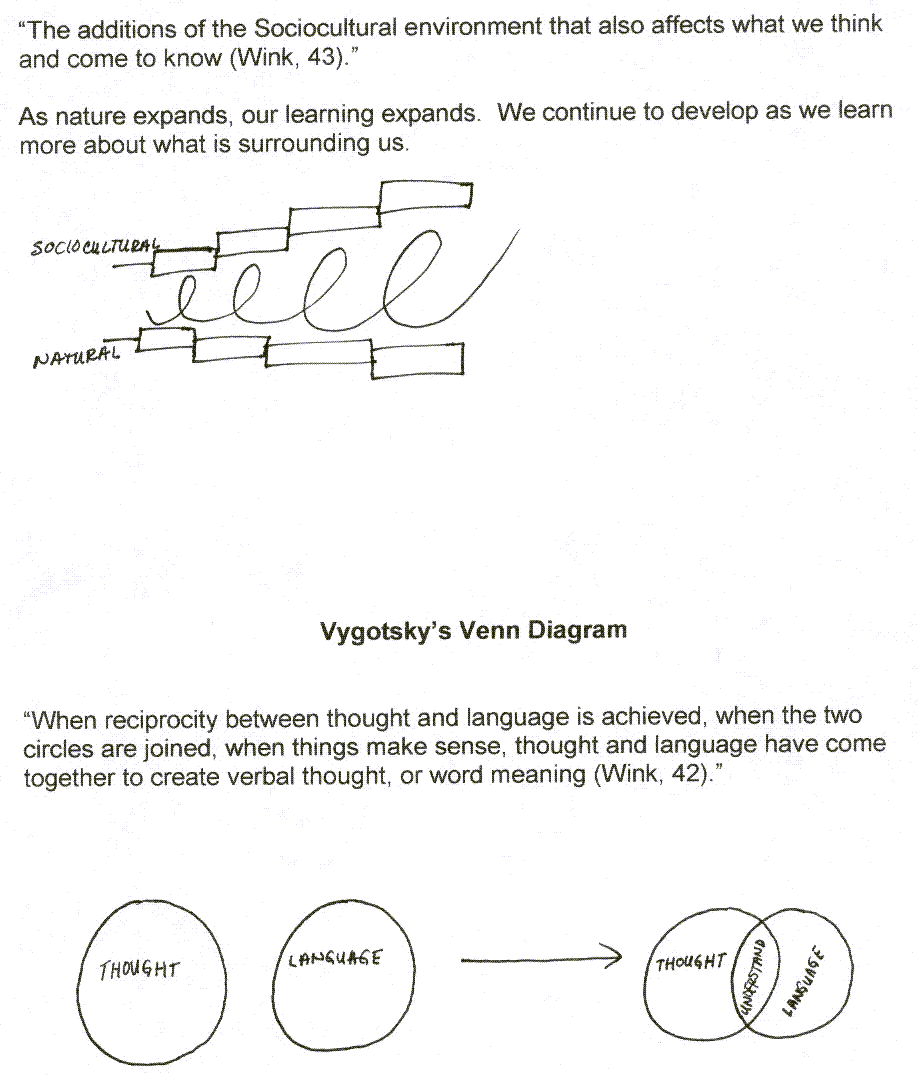
* Represented schematically the relationship of thought and speech with two intersecting circles in which "the overlapping parts, thought and speech coincide to produce verbal thought.
* Vygotskian notion of verbal thought is made visible with this Venn Diagram.
* One circle represents thought; the second represents language; and, where the two overlap, verbal thought occurs.
* Verbal thought: central to understanding connections between thought and language.
* Most elementary form of unity of thought and speech = Word Meaning
* Language was both a tool and a psychological function
* Venn diagram illustrates the union of thought and language, but not dynamic process that was envisioned and referred to in writings.
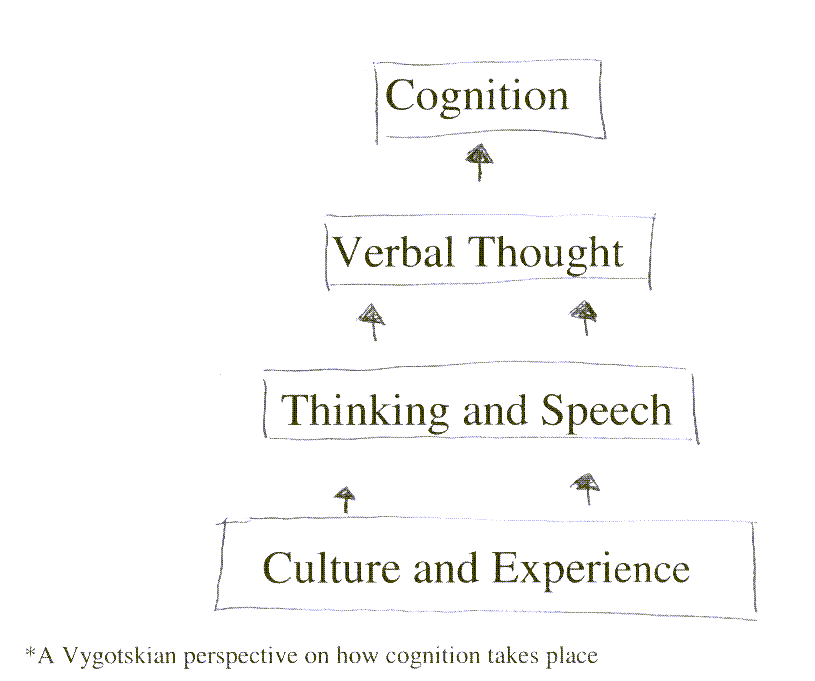
* Both thought and Language were influenced by our sociocultural experience
Expanding the Venn Diagram:
* Another illustration of the reciprocal development of thought and language is included to demonstrate how one graphic can serve as a springboard to another.
* Joan- relationship of thought and language (Figures 2, 3, and 4 of Intro)
* International teacher- Whirlwinds (Figures 2.1, 2.2)
* Harriet- open whirlwind, a new idea can open our minds into different perspectives if we are receptive to it. New idea expands our thinking, and then narrows as we begin to make sense of it. Idea expands again, when we share with others.
* Knowing about is different from experiencing.
* Figure 2.3 The Braid
Cognitive Development and Language:
* Children become active participants in their learning through use of language and interactions with others.
* Vygotsky viewed signs and symbols as mediators of human cognition.
* Use language as a tool for developing thought, and at the same time, we develop language through thought.
* Interaction of thinking and speech results in experience for the learner. Key factor in further impacting the relation of thinking and speech.
* Use of language as mediational tool was central to Vygotsky's cultural-historical perspective.
* Vygotsky brought into focus the nature of our being as cultural, social, and historical, with an emphasis on the communicative practices of the individual as part of a collective.
* Z.P.D. (Zone of Proximal Development)
Autumn Leaves:
* Secret of acquiring an additional language is meaning. Language has to become meaningful.
* Two crucial variables for academic success: knowledge and literacy, both of which transfer across languages.
* Cummins- Research Policy/Research Theory Policy Paradigm
Andrea and Art: More than Just a Language Thing
* Andrea didn't understand why she had to take these classes when she just wanted to be an art teacher. Integrated her knowledge of art with concepts presented in class, while teacher was lecturing. (Figures 2.4 and 2.5)
* Thought in pictures, not in words.
* Using her own language: art
* Graphically singing the symbols that were meaningful in her language and linking them to the thoughts of her class. Made language meaningful for her peers.
* Language is how we make sense of the world. It is how words work to let us see, know, and learn. Language is thought, culture, and identity.
Framework for Critical Praxis:
* Notetaking and Notemaking
* Necessary to have the cultural and educational tools to change and develop as a professional.
* Praxis- union of reflection and action
* Step 1: describe what is taking place in each of the examples. Based on the perspective of the participants in the situation. Look at situation from other's perspective.
* Step 2: Interpret, question why it happened based on your own lived experiences and knowledge you have gained. Must be based on evidence gathered in first step. Offer only potential explanation based on evidence.
* Step 3: transform learning from this experience so that you can improve your own pedagogy and practice. Reflect on what we learned from another's experience, or from reflecting on our own experience, that could result in self- and social transformation in a future situation.
Conclusion:
* Unfolded complex and dynamic relationships between thought and language
* Used visuals and authentic classroom examples to enhance our understanding of Vygotsky.
* Beginning to uncover how the greater sociocultural context influences the learning and development of teachers, students, and schools.
Chapter 2 Thought and Language
This chapter explores the centrality of thought and language in all development. Vygotsky theorized the relationship between cognitive development and language, and he considered external dialogue to be both a psychological tool as well as a psychological function.
� The Vygotskian Venn Diagram
In thought and language Vygotsky represented schematically the relationship of thought and speech with two intersecting circles in which "the overlapping parts, thought and speech coincide to produce verbal thought" The Vygotskian notion of verbal thought is made visible with this Venn diagram: one circle represents thought; the second represents language; and, where the two overlap, verbal thought occurs. Verbal thought is central to understanding the connections between thought and language, just, as it is central in the Venn diagram. (Wink, 42)
� Cognitive Development and Language
During the process of development, children become active participants in their learning through the use of language and interactions with others. We use language, in our action of speaking, as a tool for developing thought, and, at the same time, we develop language through thought. Interaction of thinking and speech results in experience for the learner, and Vygotsky viewed this experience as a key factor in further impacting the relationship of thinking and speech. (Wink, 47)
� Autumn Leaves
However, that is exactly what happens every day in many schools to many students. If they do not make meaning in the time allowed, they do not learn; they may fail; their culture may be blamed for being poorly motivated. Krashen (1996) has pointed out that, when we give children quality of education in their primary language, we give two crucial variables for academic success: knowledge and literacy, both of which transfer across languages. (Wink, 49)
� Andrea and Art: More than just a Language Thing
Language is how we make sense of the world. It is how words work to let us see, and know, and learn. Language is never "just a language thing". Language is a privilege, language is a right; language is a tool; language is a resource. Language is thought; language is culture; language is identity. Often, we only come to realize this when 1) we are in a place where our language does not work so well with others, and/or 2) when someone tries to take our language from us. Denying language is denying access to thought. (Wink, 54)
"Thought is not merely expressed in words; it comes into existence through them. Every thought tends to connect something with something else, to establish a relationship between things. Every thought moves, grows and develops, fulfills a function, solves a problem (Vygotsky, 1986, p. 218).
Selected Passages - Heather Magiera
"Vygotsky studied the relationship between thinking and speech, rather than viewing them as distinct functions."
"During the process of development, children become active participants in their learning through the use of language and interactions with others. Rather than viewing language as merely a semiotic function of cognition, Vygotsky viewed the use of signs and symbols as mediators of human cognition. In other words, we use language, in our action of speaking, as a tool for developing thought, and, at the same time, we develop language through thought."
"Language is how we make sense of the world. It is how words work to let us see, and know, and learn. ?Language is thought, language is culture, language is identity."
Connector Questions For Wink Ch. 2 - Therese Moore
1) What is the difference between Piaget's and Vygotsky's view on children's verbal development? (pg. 42)
2) Describe the Vygotskian Venn Diagram. (pg. 42)
3) How did Vygotsky theorize the relationship between cognitive development and language? (pg. 47)
4) When we give children quality education in their primary language, what are two crucial variables? Describe how Cummins (1999) expands on this. (pg. 49)
5) Do you agree or disagree with Vygotsky's theory on thought and language? Explain why or why not?
Report - Sarah Winther
Here are some of the things our group focused on which were discussed in chapter two of the Wink book:
*The connection between thought and language, and how the written word is connected to these two processes
*Vygotsky's views on the relationship between thinking and speech being connected and not two separate things.
*That children's egocentric speech is an attempt to answer a problem.
*Vygotsky's Venn Diagrams and how this graphic was developed, including which models existed before it.
*The way Vygotsky defines word meaning and how this process connects thought and speech
*Vygotsky's belief that the use of symbols was part of the process of human development.
*The child gaining knowledge is a natural phenomenon.
*Examples from the classroom of how children approach and learn language.
*The story of Andrea's art showing how she was learning; just differently from the other students in the class, yet understanding the same things.
*The Scientific Rainbow and the Vygotskian Volcano drawn by Andrea.
*That language must be meaningful for thought development.
*The note-taking and note- (re) making process.