



Life-Span Developmental Psychology:
Life-Span Theorists:
-Charlotte Buhler theorized that cultural influences were seen as "effects" rather than as components of a developing system
-Erik Erikson viewed personality, biology, and culture as mutually integrating parts of the same system
Modern Approaches to Life-San Development:
Dialectical Life-Span Perspective;
-Riegel departed from Piaget's approach
-Focus on uniqueness of individual persons
-Developmental change stems from conflict between the biological, social, psychological, physical and historical aspects of an individual's life
Selective Optimism:
-With age, the aspects where people experience decline can be compensated for by other abilities
-Seven predisposition and environmental influence on decline in old age: absence of chronic disease, favorable demographic circumstances, intellectually stimulating environment, intellectually able spouse, flexibility and life satisfaction at mid-life, and maintained perceptual speed
Structuralist Models:
-Focus on adult development
-Development guided by an adult's role in society
Contemporary Perspectives on Culture in Relation to Life-Span Development:
Methodology:
-Quantitative research vs. qualitative research
-An individual-sociological frame of reference provides greater focus on the relationship between person and the immediate life context
Cultural Psychology: New and Old:
-Main feature that separates cultural psychologists from cross-cultural traditions is the effort to provide a systematic account of how culture participates in the psychological functioning of human beings.
Relocating Life-Span Development within the Culture:
-Development is constrained by the individual's potential and the influence of society
Synchronic Constraining Devices:
-Internal and external devices complement each other in the given context
Diachronic Canalization Device:
-Limits on an individual's possible future actions or thinking
Conclusion:
-Human Development is multidirectional and contextualized.
-Development occurs through personal routes (accepting or rejecting society's beliefs) and social and cultural structures
A Vygotskian Perspective on Learning and Development
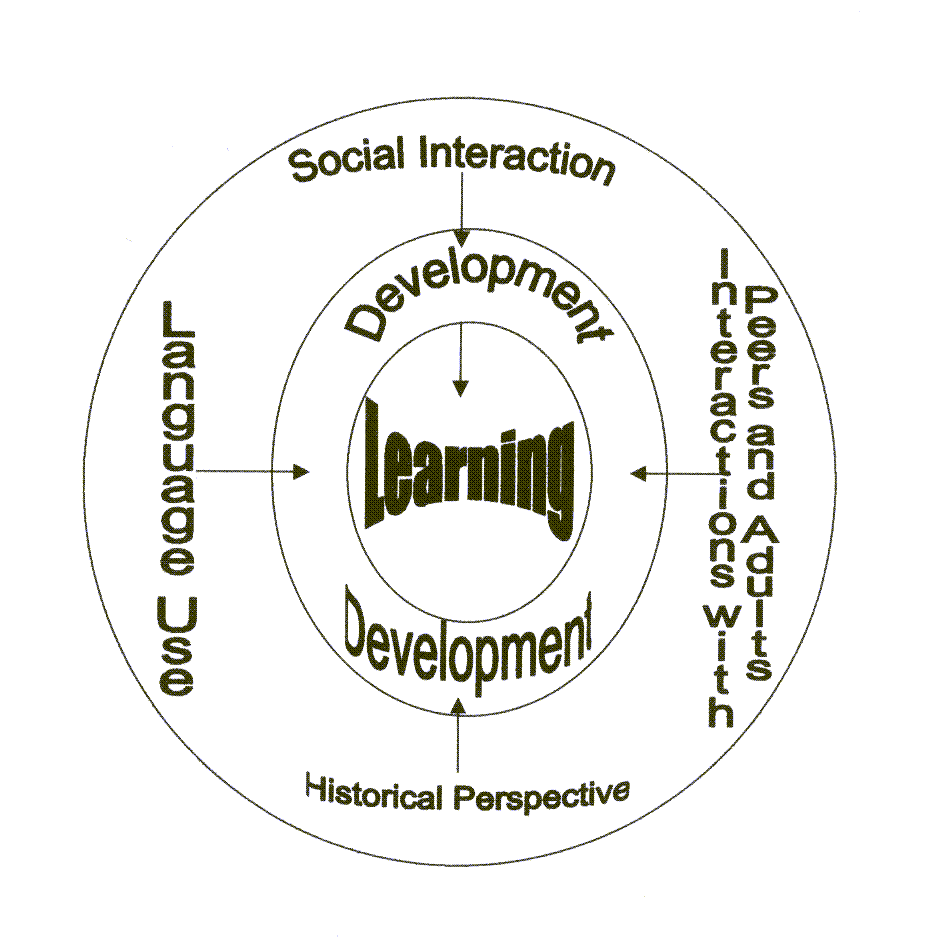
"For Vygotsky, learning is more than just passively receiving information and responding to it; learning includes the ideas generated in the process of dialectical discovery. In addition, from a Vygotskian perspective, learning and development are inherently tied to the sociocultural context." (Pg. 10)
"To summarize the behaviorist perspective: Outside stimulus is the primary agent responsible for learning. Its motto could be: It's the outside stimulus!" (Pg. 10)
"'Cognitive learning theorist focus on the human mind's active attempts to make sense of the world.' From this perspective, teachers attempt to engage students in active learning. The roles of attention, retention of information, and schema learning, connecting new knowledge with old knowledge were all associated with various cognitivists." (Pg. 11)
"If knowledge is individually constructed, then the role of learner is as an experimenter, a researcher, constructing and testing hypotheses. The role of the teacher is the 'guide on the side' to help each individual come to her own conclusions about the experiment." (Pg. 12)
"His view included the concept of children as active participants in the developmental process in which language has a direct affect on cognition. Learning and development are interrelated processes, which begin from the first day of a child's life." (Pg. 23)
Selected Passages - Terra Warford
Discussion Circle 2
Why we Juxtapose Theories and Theorists
" Vygotsky believed that to understand any concept it is vital to trace the concept to its origin, if at all possible. In studying the historical background, we can bake sense of what we are studying, and we bring perspective to what we are learning. We can reflect on what we are doing in classes. Eventually, we can ask ourselves: Why? Multiple ways of talking about educational theory are available for our reflection. What are the various perspectives? What question does each answer for me? What questions are left unanswered?" (Wink, 8)
� Transmission Lens: Behaviorism/Positivism
"The transmission lens, more than any other, has profoundly affected why we do what we do in school? Behaviorist theory posits that learning consists of patterns, memorization, and imitation. This type or learning can be seen as a response to an outside stimulus." (Wink, 9)
� Generative Lens: Cognitive to Interactions to Constructivism
"On the continuum of pedagogy, the cognitive perspective moved beyond the stimulus-response model and made it possible to focus on the actions of individuals in their environment." (Wink, 11)
� Transformative Lens: Social Constructionist
" The social constructionist lens enables us to see the cultural component of language use in relationship to thought, and the individual in relationship to others. This relationship is not only social and cultural, but also historical, because we use the cultural tools of communicative signs and symbols handed down to us to construct our learning." (Wink 12)
� Transforming Transformative: Critical Pedagogy
" At the far end of the continuum is this critical lens that will continue to expand on the various principles and practices that affect educational thought and action?students in the learning theories class noticed that looking concurrently through a social constructionist and a critical lens was like having two eye contacts, one for reading and one for distance. In this case, one eye contact is for critical close work and the other creates a sharp, distant vision. Together they give a critical and focused look at complex realities." (Wink 13)
Major Points of Child Development: Vygotsky/Piaget
"For Piaget, intelligence matured in an observable pattern, allowing the child to adapt to changes in the environment (Phillips, 1975). He believed that understanding occurs through development of the cognitive structures of the individual?Vygotsky (1986), on the other hand, believed that the child's reasoning was socially constructed through interaction with adults and peers. The development of higher cognitive functions was mediated activity, which occurred first during social interaction." (Wink, 30)
Questions- Sarah Noelle Winther
1.) What does Vygotsky's water metaphor stand for, and what is its relevance in the field of Child Development?
2.) What does Vygotsky believe are the connections between language and development?
3.) What does a Vygotskian classroom look like?
4.) What kind of environment does Vygotsky feel is necessary for a child to reach his or her full learning capacity?
5.) How does Vygotsky's view of language and development differ from Piaget's view of language and development?
6.) What would Vygotsky say is the teacher's role in the classroom?
7.) What would a teacher-student relationship be described as in a Piagetian classroom?
8.) What would a teacher-student relationship look like in a Vygotskian classroom?
Preface:
� Water Metaphor: explains perception of teaching, learning, and development within a sociocultural context
� (Figure 1: The Vygotskian Metaphor of Water)
� Overriding theme: language
� Social culture = Socioculture
� Complex relationship of teaching, learning and human development
� Each chapter begins with a quote from Vygotsky
� Visuals/Models
Introduction:
1. 3 Reasons for popularity of Vygotsky's work among intellectual circles (pg. xvii):
2. His emphasis on the active contribution of human to the development of their own consciousness
3. The importance of social interaction in development
4. The notion of the mediational role of language in the communicative process
Who is Vygotsky?
� Background information
� Born in 1896 in Orsha, Belorussia (Northern Russia)
� He wanted to find a deeper understanding of the processes of learning and development
� Highly productive in research and theory building
� Searched for "new psychology"
� 4 major areas of reductionism in psychology (pg. xxi): Reduction to the rational, individual, internal, & innate
� Vygotskian Classroom (pg xxiii): professor speaks not at us, but with us, encourages to explore our thoughts and language, using words to socially construct our own thinking, encouraged to learn from opposites.
Part I: Why Vygotsky? Chapter 1: Theorizing Theories and Thinking Thoughts
� Changes in Education Theory (past/present)
� Vygotsky vs. Piaget (pg. 30): Piaget sees children advancing in development not only necessarily by language, but by hands-on experience and surroundings. Vygotsky did not separate language from action, but reciprocal of each other.