 FRUITFLY DISCUSSION
Abstract
Genotypes of the parents were RRLL and rrll or one homozygous dominant for two traits and the other homozygous recessive for two traits. These genotypes were found by crossing the unknown flies together and recording the resulting offspring. Checking the presence of eye color characteristics and wing shape characteristics, it was found that the first generation ( F1 ) was all long winged and red eyed. The second generation ( F2 ), on the other hand, had a combinations of both eye colors and wing shapes, showing they were not connected in origin. This showed that the cross was in fact a dihybrid cross or the crossing of two separate traits individually. Also the fact that the genotypes in the first generation were all the same is conclusive evidence that the cross was in fact a homozygous dominant and recessive cross.
Introduction
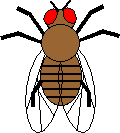
The fruit fly or Drosophila melanogaster ( Scientific Name) is an insect that is ideal for experimental research, especially in the area of genetics. Some characteristics that make them ideal for this is the facts that they are small, don�t eat much, hard to kill, easy to immobilize to count, and produce many offspring easily. Of all of these different characteristics that make the fruit fly good for genetic research the most important of these is the fact that they have many heredity traits that can be observed and crossed.
Discussion
The problem being investigated in this lab is the genotype of the parent generation, which is not known to us, and whether the traits of the flies being passed on is a sex-linked, monohybrid, or dihybrid cross. All of this goes to solve this mystery by showing what the only possible combination would be. The combination of the parent cross was a two trait homozygous dominant flies and two trait homozygous recessive flies. This cross ended up being a dihybrid cross which is when the inheritance originates from two characteristics that are contrasting and simultaneous. The chi-squared analysis chart in question # 7 shows the calculations and numbers needed to decide whether or not the data collected was by chance. Using the calculation of the chi-square analysis, the observed and expected values are used and showed the findings were conclusive. The results found in the experiment showed a classic relation between the two F generations. This gave the needed information to find the parental genotype.
These types of experiments with crossing started with a monk named Gregor Mendel, who is known for �discovering the fundamental principles of genetics by breeding garden peas.� His peas had many different traits that were unconnected, like the flies looked at in this experiment. Some of the pea characteristics included: flower color, seed color, seed shape, pod color, and stem length. Some of the fruit fly characteristics included: eye color, gender, and wing length. Like Mendel it was found in the experiment that the characteristics were inherited separately and with the proper genotype all different combinations could exist. (Campbell, 2000)
The dominant and recessive traits in the fruit flies in this experiment was easy to distinguish. The parental generation, which ended up being a RRLL x rrll cross, produced only red eyed, long winged offspring. This suggested that these traits were in fact dominant, but the parents could have been both homozygous recessive so another cross was necessary. When the second or F2 generation had one of each combination of eye color and wing length, it could be concluded that the red eyed and long winged traits were in fact dominant. Also this showed that the brown eyed and vestigial winged traits were in fact recessive traits.
This cross was concluded to be a dihybrid cross meaning the genes for eye color and wing length were not connected. There was only one combination of the genotype possible for the first or F1 generation. Simply this means that gametogenesis and recombination during fertilization would have no effect on traits inherited. Also the results showed that these traits were not sex-linked traits because gender had no effect on the number of flies that shared a trait. The hypothesis found in this experiment was: The parent generation was homozygous dominant for two traits crossed with a fly that was homozygous recessive for two traits. This hypothesis was proven by our data. Using the chi-squared table it was shown that our data was not due to chance and was very probible.
Bibiography
Campbell, N.A., L.G. Mitchell, and J.B. Reece, 2000. Biology Concepts and Connections. Addison Wesley Longman, San Francisco, pages 156-157.
| Fruitfly Discussion | Fruitfly Facts | Fruitfly Graphs |
| Home | Books | Poet's Corner | Quotes | Artist's Pallet | Photographer's Dream | Science Lab | Favorite Links |