African Rhinos
The White Rhino
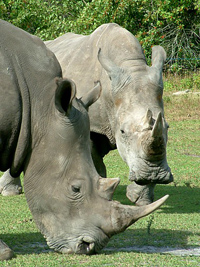 |
| The white rhino resides in Africa's grasslands and grass is its main source of food. It is distinguised by its rather wide, sqaurish mouth. |
The White Rhino shares the distinction, along with the hippopatumus, of being the largest land mammal after the elephant. It can stand as tall as 6 feet and weigh as much as 6000 pounds! The White rhino's name is misleading because it is not white in color. The name actually comes from the Dutch word for "wide mouth", which is widje. It's rather sqaurish, wide mouth is definitely one of its distinguishing features. Its scientifc name, Ceratotherium simum also describes this feature. Simus means "flat nosed in Greek. It has two, large horns. There are two subspecies of white rhinos, one is found in the north and one in the south of Africa. They both reside in open grasslands. In fact, their main source of food is grass, which makes them grazers. The northern species has dwindled to only 5 to 10 individuals who live only in the Garamba national park in The Democratic Republic of Congo. The southern white rhino, on the other hand is the least endangered of all rhino species with approximately 12,000 individuals.
The Black Rhino
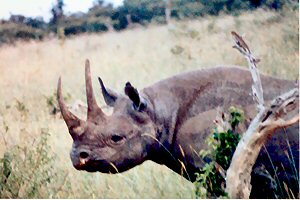 |
| The black rhino is smaller than the white rhino and has the distinguishing feature of a hooked upper lip that enables it to grab branches, leaves and twigs. |
The Black rhino, Diceros bicornis, is much smaller than the White rhino. On average, it stands about 5 feet tall and weighs a mere 4000 pounds. It's a petite little creature in comparison. It has a prehensile lip for grabbing branches, leaves and twigs, which makes it a browser, rather than a grazer. It is also much more endangered. An estimated 3100 black rhinos live in South Africa, Namibia, and Zimbabwe. Like the White rhino, the Black rhino has two horns and is gray in color. It is not black, just as the White rhino isn't white. However, it can look much darker than his natural color after a mud wallowing session!
Asian Rhinos
The Indian Rhino
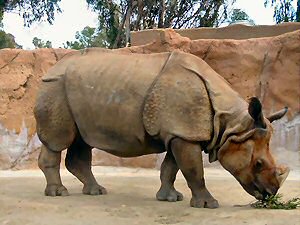 |
| The Indian rhino is distinguished by its armor-like hide and single horn. © 2006, Sandy Higgins.
|
The Indian Rhino is the second largest rhinoceros species. It can reach the size of 6 feet tall and weigh up to 5000 pounds. Imagine weighing 5000 pounds! The Indian rhino resides in Nepal and northeastern India, generally in swampy areas that contain tall, napier grass, otherwise known as elephant grass. Unlike the African rhinos, it has only one horn. In fact, its scientific name is
Rhinoceros unicornis. It is also distinguished by its bumpy, armor-like hide. Yes, the Indian rhino always looks like its gearing up for battle. Like the black rhino, the Indian rhino has a prehensile lip that can be used for grabbing food. There are 2400 Indian rhinos in existence and they are considered a conservation success story, having dwindled to only 200 back in the early 20th century.
The Javan Rhino
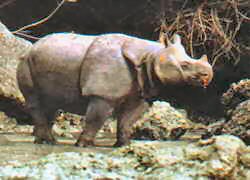 |
| The Javan Rhino is the most endangered, with only about 60 in existence. |
The Javan rhino, Rhinoceros sondaicus, is the most endangered of all the species, with only about 60 in existence. It lives in the tropical forests of the Indonesian Island of Java and is a
browser. It has only one horn and loose, folded skin and looks like a miniature version of the Indian rhino. It only weighs about 3300 pounds.
The Sumatran Rhino
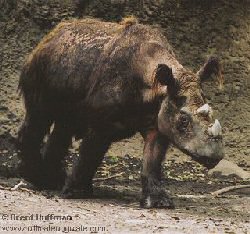
The Sumatran, Dicerorhinus sumatrensis, rhino is the smallest rhino at only 4 ft. tall and about 1760 pounds and is the only species that has a shaggy coat. The other rhinos all are hairless, except for a bit of hair on the tips of their ears and eyelashes. These rhinos are probably the closest descendents of the rhino's ancient ancestor, the Woolly rhinoceros. It is the only Asian rhino with two horns and makes its home in Indonesia and Malaysia. There are about 300 in existence.
Back to top
|