Capability Analysis: How is it made?Step 4 Calculate the percent outside the specifications.To determine the percent of the output which falls outside the specification limits, determine how many standard deviations exist between the grand average and each specification limit. The number of standard deviations is known as Z. Once Z is found for each side of the grand average, it is possible to determine the percentage of output that is outside the specification limits by locating the values for Z in the Standard Normal Distribution Table. a. Calculate the percent of output outside the
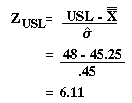
USL.
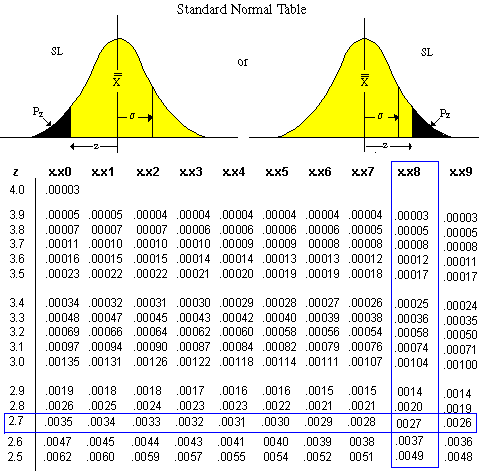
This means that the USL is located 6.11 standard deviations or Z values away from the grand average. Look up the Z value in the Standard Normal Distribution Table (located at the end of this topic) to find the estimated proportion of output that is outside the USL. The proportion (number found in the table) is denoted PZUSL. Turn to the table to find PZUSL. The Z values are listed along the left edge of the table. The unit (number to the left of the decimal) and the tenths digit (first number to the right of the decimal) are listed on the left edge, and the hundredths digit (second number to the right of the decimal) is along the top. The table shows Z values up to only 4. If Z is greater than 4, PZ is virtually 0. b. Calculate the percent of output outside the
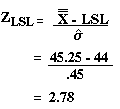
LSL.
This means that LSL is located 2.78 standard deviations or Z values away from the grand average on the left side of the curve. To find the proportion (PZLSL)of output located outside the LSL, 2.78 in the Standard Normal Distribution Table (located below). Go down the left edge of the table to 2.7, then go across to the column marked x.x 8. The number is .0027, which is the proportion of output located outside the LSL. To convert the proportion to a percent, multiply it by 100. Thus the percent of output outside the LSL is .0027 x 100 = .27. Add the percentage to the drawing of the distribution.
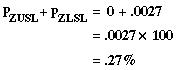
c. Determine the total percent of output outside specification. The total percent of output located outside the specification limits for the example is:
The two values from the Standard Normal Distribution Table, PZUSL and PZLSL, may be added and then multiplied by 100 to get the total percent out of spec. For instance:
� Previous���� ������ Next ������������� How is it made Menu |