
Home page |
Bread |
Cookies |
Pie |
Cake |
Cake is a term with a long history (the word is of Viking origin, from the Old Norse kaka) and denotes a baked flour confection sweetened with sugar or honey; it is mixed with eggs and often, but not invariably, with milk and fat; and it has a porous texture from the mixture rising during cooking. It is not surprising that the frontiers between cake and bread, biscuit and bun are indistinct. The progenitor of all is bread in its simplest form. As techniques for baking and leavening developed, and eating patterns changed, what were originally regarded as froms of bread came to be seen as categories of their own and named accordingly. Certain Roman breads, enriched with eggs and butter, must have achieved a cakelike consistency and thus approached one of these indistinct frontiers. Europe and places such as North America where European influence is strong have always been the center of cakes. One might even draw a line more tightly, fourn English-speaking areas. No other language has a word that means exactly the same as the English 'cake.' The continental European gateau and torte often contain higher proportions of butter, eggs and enriching ingredients such as chocolate, and often lean towaars pastry rathern than cake. Central and East European items such as baba and the Easter kulichare likewise different. The western tradition of cakes applies little in Asia. In some countries western-style cakes have been adopted on a small scale, for example the small sponge cakes called kasutera in Japan. But the 'cakes' which are imporant in Asian are quite different from anything occidental for examples, see mooncakes andrice cakes of the Philippines. The history of cakes, goes a long way back. Among the remains found in Swiss lake villages were crude cakes make from roughly crushed gains, moistened, compacted and cooked on a hot stone. Such cakes can be regarded as a form of unleavened bread, as the precursor of all modern European baked products. Some modern survivors of these mixtures still go by the name 'cake', for instance oat cakes, although these are now considreed to be more closely related to biscuits by virtue of their flat, thin shape and brittle texture. 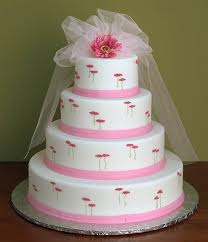 WEDDING CAKE - is the traditional cake served to the guests at a wedding reception (or in parts of England, at a wedding breakfast) after a wedding. In modern Western culture, it is usually a large cake, multi-layered or tiered, and heavily decorated with icing, usually over a layer of marzipan or fondant. Achieving a dense, strong cake that can support the decorations while remaining edible can be considered the epitome of the baker's art and skill. 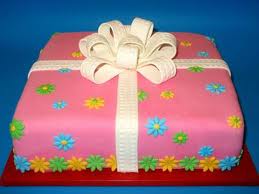 The BIRTHDAY CAKE has been an integral part of the birthday celebrations in Western cultures since the middle of the 19th century. Certain rituals and traditions, such as singing of birthday songs, associated with birthday cakes are common to many Western cultures. The Western tradition of adding lit candles to the top of a birthday cake originates in 18th century Germany. However, the intertwining of cakes and birthday celebrations stretch back to the Ancient Romans. The development of the birthday cake has followed the development of culinary and confectionery advancement. While throughout most of Western history, these elaborate cakes in general were the privilege of the wealthy, birthday cakes are nowadays common to most Western birthday celebrations. Around the world many variations on the birthday cake, or rather the birthday pastry or sweets, exist. The average cost of a professionally made wedding cake in the U.S. in 2005 was $543. 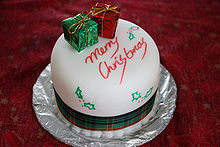 CHRISTMAS CAKE -is a type of fruitcake served at Christmas time in the UK, Ireland, Japan, Philippines and many Commonwealth countries. A Christmas cake may be light or dark, crumbly-moist to sticky-wet, spongy to heavy, leavened or unleavened, shaped round, square or oblong as whole cakes, fairy cakes, or petit fours, with marzipan, icing, glazing, dusting with icing sugar, or plain, etc. A particular favourite of many is the traditional Scottish Christmas cake, the Whisky Dundee. As the name implies, the cake originated in Dundee and is made with Scotch whisky. It is a light and crumbly cake, and light on fruit and candied peel�only currants, raisins, sultanas and cherries. This Christmas cake is particularly good for people who don't like very rich and moist cakes. As with all fruitcakes, the almonds (or other nuts) can be omitted by people who don't like them or those with severe nut allergies. |