 |
| Page 48A |
 |
| "My years have now come to their close, there is nothing remaining of my life. Leaving you now, I shall go. I have taken refuge in the self. O earnest bhikshus, be assiduous; be truly mindful, hold fast to the discipline. By your thinking, make |
| your hearts truly onepointed, keep your hearts steady. Those who are assiduous in this Dharma and discipline will throw off the cycle of birth and death, and bring about the end of suffering." Buddha |
 |
 |
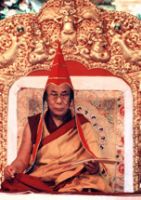
| The Tibetan spiritual leader, the Dalai Lama, answered your questions in a live BBC News Online forum. Last week (February 23, 2000) he celebrated the 60th anniversary of his enthronement by calling for greater efforts to end Chinese rule over Tibet. Tim Marshall, UK: How do you think new technology such as the Internet, will affect man's future? Can it be good or will it simply be an opiate for the masses? Dalai Lama: I think most probably that this technology will be most helpful, to get information clearly. In that way it will make clear what is truth, what is reality and what is false propaganda. I think that each individual should use their own intelligence or mind to investigate further. It should be very useful. James, South Africa: When and under what circumstances do you envisage that the Dalai Lama might be able to return to Tibet? Could it be in your lifetime? Dalai Lama: Certainly. I think according to a rather rapid development of change at the global level, especially in Asia and China because things are changing. My approach is strictly non-violent. I am quite hopeful that not very far in the future some mutually agreeable solution may be found. This is my belief. It is a very complex situation. Laura Arana, USA: What are the most potent actions we can take to help preserve the Tibetan way of life, and to pro-mote compassion within the Chinese government? Dalai Lama: I think the most important way to help the Tibet issue is the education of other people, including our Chi-nese brothers and sisters. What's the reality? The Tibet issue is not as simple as the Chinese government's propaganda. There has been a lot of wrong information regarding Tibetan culture, Tibet history and what is happening inside Tibet and outside Tibet. I think there is still a lot of confusion with the Chinese. So I think that education is very important. Mark M. Newdick, USA/UK: Although your removal from power in 1959 was blatant thievery by the Chinese govern-ment, if you were still in place, what changes would you have enacted? Would you have installed a secular democratic government, gradually withdrawing to a role of strictly spiritual leader? Dalai Lama: When we were in Tibet as early as 1952 I set up one reform committee and started some work for reforma-tion. Obviously the last Dalai Lama also seems as convinced that Tibet needed some change. Even without this new de-velopment I think some change suddenly will take place but I feel this tragic situation, on one side there are some very painful experiences but on the other side there are also some positive results. Malcolm McCandless, Scotland: Do you envisage an Iranian solution, i.e. A spiritual head of state alongside a parlia-mentary democracy, as a possible way forward for a modern Tibet? Dalai Lama: I have already made it very clear that the future of Tibet, as soon as the day arrives when there is some degree of freedom, I will hand over all my authority to the local government. So, that means that the Dalai Lama will no longer be the head of the Tibet government. And that government I would hope would be a new, elected local govern-ment. Then the basic system I would prefer to be secular. That would be much safer, much better. Of course, the major-ity of Tibetans are Buddhist, but within Buddhism there are differences. Then of course there are Christians and Mus-lims and also some non-believers. So I think the best form of government would be secular. |
| anxiously asked some leaders about the situation. Then finally I got the indication that the young Panchen Lama is still alive. This seems to have been confirmed, but still there is no clear information as to where he is. Russell Timmerman, Canada: Sir what is your official relationship to the Karmapa Lama? What is his spiritual and poli-tical role compared to yours? Dalai Lama: Of course, the Karmapa is one of the highest leaders in the community. And then the late 16th Karmapa, since the early 50's, you see we had become very good friends, but anyway, now this new Karmapa before he left Tibet, the last few years, his sort of natural potential or quality was becoming quite positive. Then all of a sudden he reaches Dharamsala, and everybody is surprised. When I met him I noticed his spirit is very clear and strong: the main motiva-tion of his coming, is the service to the Dharma and the Buddha; that goal defines Buddhism, you see, if you will. Of course he is still very young. My major concern is that he must complete his proper education. That is good protection, proper study and practice. If he is properly developed and trained, certainly he can make a great contribution to the Dharma. Andrew Casey, Australia: Do you believe in people 'converting' to Buddhism or seeking to find spiritual values in their own traditions? Dalai Lama: My fundamental belief, it is much safer and better to keep ones own religion. Changing religion or convert-ing is not better. It is far better to learn from other traditions, and then we can sometimes enrich our own traditions. Pervaz, Pakistan: Do you think Islam and Buddhism have a common philosophy? Dalai Lama: Like any other religion there are differences. At the same time, as far as I know, Islam also emphases helping the poor and giving to the poor. These are helping people, helping charity. This is common. Also there is also some deep faith, conviction to ones owns practice. Dan Andrews, Egypt: In what ways can Buddhism help people to understand the growing complexity of modern society? Dalai Lama: I think the sense of Buddhism is in practice, non-violent, based on compassion. Then regarding the Bud-dhist philosophy, what I thinks is unique, is the concept of interdependence. I think this philosophy can help in various fields in the modern world. The concept of interdependence provides us with a holistic view. In that respect the philoso-phy may be appropriate to help understand modern society, yes. |
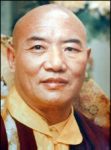
| Adam Foley, England: I mean no disrespect, but with reference to the situation in Tibet, I find it hard to find sympathy with a culture that will not defend itself, its women and children against blatant aggression from the Chinese. In an age when people are quick to attack organised religi-on, why are they afraid to condemn one, which encourages its followers to absolute passivity in the face of a threat to destroy their entire way of life. Surely this is religious 'brainwashing' of the very worst kind? Dalai Lama: I think that in some aspect perhaps non-violent methods may appear to be weak methods. I believe in the long run and in the present situation, the best way in spite of some weakness, I feel, are that non-violent methods are the most effective method in the long run. After all, the closer understanding between Tibet and Chinese is very crucial. Therefore, my ap-proach is strictly non-violent. I think this approach will bring much more support and sympathy from within the Chinese community. This is something very effective and important. Alex Duggan, UK: Do you know if your chosen Panchen Lama, Gendu Choekyi Nyima, is still alive? Dalai Lama: Recently, a few months ago, there was shocking news about his death. But then I |
 |
 |
| Pedro Oliveira, Australia: Do you approve of boycotting products of compan-ies that do business with China as part of the non-violent struggle for Ti-bet's liberation? If so, what should be the role of the younger generation in this process? Dalai Lama: This is really a contradictory and difficult issue. I personally boycott all Chinese products. It's not very positive. Not good. I personally feel that may not really be effective. Secondly, it looks to be a negative at-titude to the Chinese. But at the same time some of our supporters are al-so promoting this boycott. It is one way to express ones feelings; so the best thing is for individuals themselves to decide. My feelings are mixed. |
| Raj V. Iyer, USA: It appears to me that India should be more forthright in supporting Tibetan autonomy. Do you agree? If so, what tangible steps do you expect from the Indian government? Dalai Lama: I usually describe India's policy toward China as an over-cautious policy. At the same time, the govern-ment of India also, whether right or wrong, has adopted a certain policy since the early 1950's. The government is com-mitted to certain polices. I usually tell my Indian friends that the Tibet issue is very much linked with India's future in the long run. Tibet's culture and India's culture are the branches of one big tree. They are very much linked. Vincent Meyer, France: Have you seen the movie "7 years in Tibet?" Did you like it? Did you recognise yourself in the young actor? Dalai Lama: I haven't seen it all, some portion I saw, of course I know Henrich Harrer very well. And certainly he is one of the strongest supporters. Whenever I pass into Europe he often comes to see me. We are still very strong friends. Angela, Scotland: Do you think that having been exposed to Western influences as a young man, it has diluted your practice since there are so much negativity practices in the West? If not, how do you keep your focus? Dalai Lama: Firstly, I don't favour the distinction between East and West. All are human beings, each society has a dif-ferent way of life. So, therefore, on both sides there is good and bad. And also the Buddhist monk, has many things to learn from Western philosophy and Western science. There are many things to help my own practice, and of course some among the environment, there are positive environmental forces, positive things. Ralph Sato, USA: Mindfulness is hard work. I am practising it to reduce my tendency towards frustration and anger. Would meditation help or perhaps just slowing down and practising mindfulness be the better way? Dalai Lama: I myself also find it very difficult to keep mindfulness. Of course, in these practices the time is the mea-sure factor. From my own experiences I suggest we human beings, we have this marvellous potential and determination and we can make effort constantly without loosing focus. But years and years later our minds can change. Even though month by month you can't see any change or development, but continuously over the years, without losing hope or de-termination, then I can see some hope and some development. The important thing is not to lose hope and continue the effort. Wayne Dockery, Germany: Your Holiness, how do you maintain your optimistic attitude about life in general and the prospect for a more autonomous Tibet in the face of life's setbacks? Dalai Lama: My optimism is a general thing. Buddhism has way of thinking, not month or year but aeons. We need some sort of very deep inner sense, as long as space, not with this body but with the spirit. That really gives me some kind of inner strength and determination. That helps me keep my optimism. Among Tibetans and inside Tibet, the spir-it is very strong and our course is a just cause. That is my fundamental belief. So there are reasons to feel hope and op-timism. Jad, Australia: You obviously dream of the day you can return again to your homeland. What place in Tibet appears in your dreams the most? Dalai Lama: Perhaps the Monastery. Sometimes I wish the rest of my life may be spent somewhere in Tibet with clean air, bright sky and hopefully a clean mind. That's my wish. [End of Interview] |
|
| Meditations for Beginners - The Meditation on Light and Breath We sit comfortably, whether on a pillow or on a chair. Our hands rest in our lap, the right on top of the left, palms up and thumbs lightly touching. We keep our back straight without tightness, and our chin pulled in a little. First we calm our mind. We feel the formless stream of air which comes and goes at the tips of our noses, letting thoughts and sounds go by without holding on to them. Now we will meditate in order to experience mind and to gain a distance from our disturbing emotions. Only then can we really be useful to others. A foot and a half in front of our nose, now appears a clear transparent light. While we breathe in, the light moves in a stream down through the center of our body. On its way, the clear light turns ever more red. Stop-ping briefly four fingers below the navel, the transparent light has become totally red. When we exhale naturally, the red light moves upward and becomes gradually more blue. A foot and a half in front of us, the blue transparent light again becomes clear and we inhale it once more. We hold this awareness without tension, while our breath comes and goes naturally. If it is difficult to see the colors, we simply think then: clear light when we inhale, red light when the light stops below the navel and blue when we exhale. After a while we may also focus on the vibrations of our breath. While inhaling we hear the syllable OM. While holding the light below the navel, we hear a deep AH and while exhaling we hear the vibration of HUNG. We stay with this for as long as we like. At the end of the meditation, the world appears fresh and new. We wish that all the good which just happened may become limitless, radiate out to all beings every-where, remove their suffering and give them the only lasting joy, the realization of the nature of mind. Rainbow Light Meditation We sit relaxed and straight, our right hand resting in our left palm and our thumbs lightly touching. If not seated in a chair, our right calf rests on or in front of the left one and we draw our chin slightly in. First, we calm the mind. We feel the formless stream of air, coming and going at the tips of our noses and let thoughts and noises pass without evaluation. Then we want to meditate, to experience mind's richness and gain distance from any disturbing emotion. Not until then can one really help others. At the heart-level in the center of our chest, now ap-pears a tiny rainbow light. Gradually it expands through our body, totally filling it and dissolving all diseases and obsta-cles on its way. When we can stay with this awareness, our body shines like a lamp and light streams in all directions, filling space. It dissolves the suffering of beings everywhere and the world now shines with |
 |
| Tibet's Panchen Lama - Gendhun Choekyi Nyima (kidnapped by China - May 17, 1995 (6 years old). Youngest political prisoner in the world! |
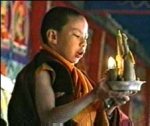 |
| China illegally announced its own Panchen Lama - Norbu Gyancain (Gyaltsen) in December 1995. China has no authority to choose The Panchen Lama. |
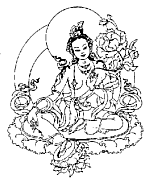
| Green Tara Meditation... We sit up as straight as we can, and feel how our breath comes and goes at the tips of our noses. In the sky in front of us appears a beautiful Green Buddha-lady. She sits on a moon disc and a lotus flower. Her name is Green Tara; she is as big as a mountain and made out of light. She is everything that is kind and |
| great meaning and joy. All are in a pure land, full of limitless possi-bilities. Everything is self-liberating. We emanate this light as long as it feels natural. When we end this meditation, the light returns and absorbs the outer world into open space. It shines into our bodies, which also dissolve and there is now only awareness, with no form cen-ter or end. Then, like a fish jumping from the water, again a world ap-pears. Everything vibrates with meaning, all beings are perfect in es-sence and our body and speech are tools for benefiting others. Finally, we wish that all the conscious good which happened may become limit-less and stream out to everybody. That it will remove their suffering and bring them the only lasting joy: the recognition of the nature of mind. |
 |
|
| generous. We picture her as big as a mountain and made out of light. Her right hand is open and she holds a lotus flower in her left hand. Her left leg is bent and her right leg is stretched forward. We are very happy that she is here and that she helps all beings. After that Green Tara dissolves into light. Then this light dissolves into us. Now we can repeat her mantra as often as we want, out loud or quietly. OM TARE TUTTARE TURE SOHA This means: "Dear Tara, stay with us." When we stop saying the mantra, we sit quietly for a while. Now that the meditation has ended we wish all beings everything good. Tara meditation practice is quick to grant success in obtaining the ultimate happiness of Enlightenment. |
| "There is no fire like desire. There is no hold like anger. There is no net like ignorance. There is no river like craving." Buddha Desire is like an eternal fire that will always burn you, scar you, hurt you. Desire will forever keep you within the ashes of the flame, that burn endlessly. Anger is something that hurts us even greater than a burning flame - it is so subtle and unseen to the eye, it is a pain that strikes at the deepest level of a burning inferno, that even the depths of desire cannot reach. It holds on for an eternity, forcing us to embrace a greater wisdom and knowledge, and utimately abandon our ignorance and cravings for worldly possessions. They are a constant reminder that our lives are like a river that is forever flowing and changing. We can go with or against the unforseen current; either way, it is ultimately our decisions that will determine our burdens and difficulties, or lack thereof, in our truths of existence. �Don't cultivate the company of bad companions. Don't cultivate depraved men. Cultivate companions of good character. Cultivate superior men.� Buddha Dharma (or Dhamma): can mean the word of the Buddha, the Buddha�s teachings: the second of the Three Jewels. This passage is well recognized and repeated in many cultures. It speaks to what all parents offer as wisdom to their children; not as a shallow excuse for dropping friends that under-perform, but, rather as a philosophical approach to elevating one�s own existence. We are made better in our own actions if we surround ourselves with people that at once bring out the best traits in us and also encourage us to act positively by their behavior influencing our behavior. A good analogy is seen in sports. If we compete with those better than us, we often rise to the occasion and perform better than if not pushed by those of mediocre skills. The same holds true, arguably, in the conduct of our own lives. Disclaimer: All images and/or articles retain the original copyrights of their original owners. |
| April 18, 2004 |
 |
 |
 |