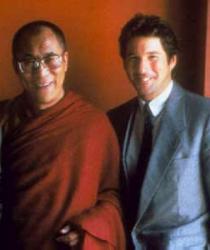
| I am serving the Tibetan cause with the motivation of service to humankind, not for reasons of power, not out of hatred. Not just as a Tibetan but as a human being, I think it is worthwhile to preserve that culture, that nation, to contribute to world society. We Tibetans have an equal right to maintain our own distinctive culture as long as we do not harm others. Materially we are backwards, but in spiritual matters - in terms of the development of the mind - we are quite rich. I am often asked about my Buddhist religion. Most simply, it is the practice of compassion. The Dalai Lama |
 |
 |
| Page 48 |
| I go for refuge to the Dharma I go for refuge to the Sangha For the second time I go for refuge to the Buddha For the second time I go for refuge to the Dharma For the second time I go for refuge to the Sangha For the third time I go for refuge in the Buddha For the third time I go for refuge in the Dharma For the third time I go for refuge to the Sangha This need not be a public utterance, but could be a self-administered declaration. The person making this choice should have a clear understanding of what the Dharma of the Buddha is. Buddhists repeat this formula periodically, as occasion permits, in order to re-dedicate themselves to the Buddhist goal. |
 |
| Becoming a Buddhist It is possible for a person to live as a lay Buddhist without any formal ceremony, declaration or rite. However the traditional formality associated with identifying oneself as a Buddhist is to recite the formula of Going to the Threefold Refuge. This involves the formal utterance of the following statements with full understanding as to their import: I go for refuge to the Buddha |
|
| The Five Precepts - The 'Going for Refuge' formula is very often followed by the formula of 'Taking of the Five Precepts'. These precepts constitute the basic ethical norms Buddhists hope to follow, i.e. forms the layman's code of conduct. They define the ethical rules which a lay Buddhist must follow in daily life. They are not commandments but "rules of training." It is customary to formally state these rules either daily or on formal occasions but it is not the reci-tation of the rules that matter but their observance. In many Buddhist countries the precepts are "administered" for-mally by monks, but this is not necessary. Following we give the precepts, and a few explanatory comments: 1. Non-Destruction of life. (I agree to follow the precept of abstaining from the taking of life). This involves not contri-buting to the death of any living being. This means not only the actual killing but also "causing to kill." However this rule does not require one to be a vegetarian, only that meat consumed should not have been "specially killed" for direct, personal consumption. Meat purchased in the market does not come under the "specially killed" category. 2. Abstention from Theft. (I agree to follow the precept of not taking that which is not given). Theft is interpreted widely as taking that which is not given. It includes fraudulent behaviour generally. 3. Avoidance of Sexual Misconduct. (I agree to follow the precept of abstaining from sexual wrong-doing). Misconduct here means not only overt acts of sexual violence like rape, but also adultery in general. It must be remembered that Buddhism does not endorse any particular kind of marriage, so this precept requires that sexual relations should be con-fined to what is socially and legally acceptable as a marriage relationship. 4. Abstention from Wrong Speech. (I agree to follow the precept of abstaining from wrong speech). Wrong speech in-volves a great many things apart from uttering falsehoods. It includes insulting speech, malicious speech, even gossip. 5. Refraining from Intoxicants. (I agree to follow the precept of abstaining from liquor and spirits that cause inatten-tion). This is generally taken to mean avoiding alcohol, drugs, etc. which tend to "confuse the mind." Some people in-terpret this precept not as an absolute prohibition of alcohol (as in Islam), but only against intoxication and inebriation through the use of alcohol or drugs. While the five precepts are usually stated in negative terms they have their positive counterparts (e.g. the principles of non-injury and loving-kindness, honesty, sexual propriety, truthfulness and sobriety). |
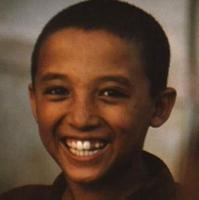 |
| Young monk from Drepung Monastery |
|
| 9. Abstaining from luxurious beds 10. Abstaining from accepting gold and silver The third precept is also expanded to a rule enjoining chastity. The extreme step along this line of renunciation is to be-come a Buddhist monk (which involves following some 220 rules). This will suit only a very few persons in any given Buddhist community. Since monks live on the charity of lay Buddhists, only a very small proportion of Buddhists can be monks. For lay Buddhists, the keeping of the five basic moral precepts of Buddhism, is quite adequate. It must how-ever be kept in mind that keeping these precepts in their totality is quite demanding, but it is a goal that lay Buddhists should aspire to. Buddhists should also seek to engage in short periods of meditation as a regular activity (e.g. 15 - 30 minutes every day). Main Buddhist Tendencies in the West - In the West there are several modes of Buddhism. The main distinction is still between Pali Buddhism and Mahayana. The above was written from the Pali Buddhist perspective which is closest to Ba-sic Buddhism. But it is always advisable to study other Buddhist tendencies which may contain useful insights. Even amongst those drawing inspiration from the Pali sources, there are several practical orientations, three main orienta-tions may be identified: 1. Ethnic Buddhism. This is practised by migrants from Asian countries. There is a heavy admixture of cultural practices associated with Buddhism in the native countries and these are imported along with the Dharma. This stream of Bud-dhism gives great emphasis to faith, worship, rite and ritual. This is seen in such practices as the Buddha-puj�s (ritual offering of food and other things before statues of the Buddha), worship of relics, chanting of suttas as magic incanta-tions, transference of merit to deceased persons, etc. Such Buddhism is usually practised in Temples set up according to Asian cultural archetypes. 2. Meditational Buddhism. This is the kind of meditation that we have called stylised meditation. 3. Rationalist-Humanist Buddhism. Here the Buddha's message is seen as being in conformity with the scientific-hu-maistic spirit of the West. This spirit had a long struggle to liberate itself from the anti-scientific attitude of Christianity and its subordination of man to God. Until Buddhism arrived in the West there was no framework within which these Western tendencies could be rationalised. An important focus of this kind of Buddhism is its secularism and ethical ori-entation. Monks are seen as Buddhist professionals who could devote their time to the intellectual and moral uplift of people and to advance Buddhist thinking into new areas not considered traditionally. But lay persons can play an equally (or even more) active role. This kind of Buddhism is usually practised in secular Buddhist Societies in the West and dis-penses with the need for temples and ritual. Of these three tendencies, Basic Buddhism is most at home with the last mentioned, i.e. the ethico-rationalist-humanist tendency. But the essence of Buddhism is that it is a middle path, not ad-vocating unthinking adherence to any particular extreme. While Basic Buddhism in the West should emphasize the eth-ical, scientific, and humanistic aspects, it should not neglect anything that is good and useful in other tendencies. It is for the individual groups to strike the right balance, keeping in mind that the essence of Buddhism is the search for En-lightenment and with it the elimination of the roots of unwholesome action. |
| Higher Precepts and Meditation - Some Buddhists observe the Eight Precepts once a month (usually on the Full Moon Day, which has traditionally been a day of re-ligious observance amongst Buddhists). The three additional precepts are: 6. Abstaining from eating after mid-day 7. Abstaining from dancing, singing, music and shows 8. Abstaining from garlands, scents, cosmetics and adornment It will be seen that these three additional precepts do not involve weighty moral princi-ples like the 5 basic precepts. They are of use for those who desire some degree of withdrawal from lay life but are not prepared to make a full-time commitment. A fur-ther step in this direction is to take two additional precepts making 10 in all, which are often taken for a longer time than the once-a-month practice of the eight precepts. These two additional precepts are: |
 |
 |
| ly does away with the need for a personal God. Buddhists too have a theory of karma, which is different from that of the Hindus, and which even more unequivocally dispenses with the need for a Deity. The use of the term "God' to denote an abstract reality by monotheistic theologians who have no theory of karma is difficult to justify; one suspects that this is merely a device to explain away the contradictions that arise from the notion of a personal God. In fact the actual prac-tice of theistic religion proceeds as if God is a real person of some kind or other. Just as Buddhism rejects the notion of a Supreme God it also rejects the notion of an abstract God-principle operating in the universe. The notion of Brahman (in the neuter) is not discussed at all in the Buddhist texts, and even in India it may well be a post-Buddhist develop-ment resulting from the attempt to reconcile the belief in God(s) with the powerful critique of the Buddha. It is there-fore the attitude of Buddhism to the notion of a supreme personal God animating the Universe that we must consider. One popular misconception of Buddhism must be dismissed at this point. This is view that the Buddha is some kind of God figure. In the Theravada tradition the Buddha is regarded as a supremely Enlightened human teacher who has come to his last birth in samsara (the Buddhist cycle of existence). Even Mahayana traditions which tend to think in terms of transcendental Buddhas, do not directly make a claim for Buddha as God. Thus the Buddha cannot be consider-ed as playing a God-like role in Buddhism. In the Buddhist texts Mah� Brahm� is the equivalent of God and is represen-ted as claiming the following attributes for himself: "I am Brahm�, the Great Brahm�, the Supreme One, the Mighty, the All-seeing, the Ruler, the Lord of all, the Maker, the Creator, the Chief of all appointing to each his place, the Ancient of days, the Father of all that is and will be." The Buddha dismisses all these claims of Mah� Brahm� as being due to his own delusions brought about by ignorance. Mah�-Brahm� is seen simply as a deva, unenlightened and subject to the samsaric process as determined by his karma. In the Khevadda Sutra he is forced to admit to an inquiring monk that he is unable to answer a question that is posed to him, and advises the monk to consult the Buddha. This clearly shows that the Brahma acknowledged the superiority of the Buddha. In the West, a number of "arguments" have been adduced to prove or disprove the existence of God. Some of these were anticipated by the Buddha. One of the most pop-ular is the "first cause" argument according to which everything must have a cause, and God is considered the first cause of the Universe. The Buddhist theory of causation says that every thing must have preconditions for its existence, and this law must also extend to "God," should such an entity exist. But while the "first cause" claims that God creates everything, it exempts God from the ambit of this law. However, if exemptions are made with respect to God, such ex-emptions could be made with respect to other things also, thereby contradicting the principle of the first cause. But the argument which the Buddha most frequently uses is what is now called the "argument from evil," which in the Buddhist sense could be stated as the argument from dukkha (suffering or unsatisfactoriness). This states that the empirical fact of the existence of dukkha cannot be reconciled with the existence of an omnipotent and omniscient being who is also all good. The following verses from the Bh�ridatta Jataka bring this out clearly: If the creator of the world entire / They call God, of every being be the Lord Brahm� / Why does he order such misfortune / And not create happiness but only discord? / If the creator of the world entire / They call God, of every being be the Lord Brahm� / Why prevail deceit, lies and ignorance / And he such inequity and injustice create? / If the creator of the world entire they call God, of every being be the Lord Brahm� / Then an evil master is he, (O Aritta) / Knowing what's right did let wrong prevail! The Bud-dha argues that the three most commonly given attributes of God, viz. omnipotence, omniscience and benevolence to-wards humanity cannot all be mutually compatible with the existential fact of dukkha (dukkha - suffering) |
|
 |
| The Buddhist Attitude to God - It is first of all necessary to establish what is meant by the term "God." This term is used to designate a Supreme Being endowed with the quali-ties of omnipotence and omniscience, who is the creator of the universe with all its contents, and the chief law-giver for humans. God is generally considered as being concerned with the welfare of his human creatures, and the ultimate salvation of those who follow his dictates. God is therefore a person of some kind, and the question whether such an entity exists or not is fundamental to all theistic systems. In contrast to this notion of a personal God, some modern theologians have interpreted the term "God" as representing some kind of abstract principle of good (or "ground of being"). This view was first developed in the ancient Indian Upanishads where God is equated with an abstract principle (Brahman). The ancient Indian philosophers could entertain such a view because they also had a theory of karma which real- |
|
| Tibetan Children Are Not Allowed To Learn In The Tibetan Language: Even when Tibetan children are able to attend school, other serious obstacles often hurt their academic performance. A primary barrier to academic success for Tibetan children is the overwhelming use of Chinese as the teaching language in most schools in Tibet. In primary and middle schools, Chinese is the dominant language spoken, even though Chinese law guarantees all of its "minority nationalities" the right to learn and use their native language. Most schools stress the alleged superiority of the Chinese language for academic and professional success and relegate the Tibetan language to a position of second-ary importance. Therefore, many children report that they learned Tibetan from first through third grade, but were dis-couraged from studying the language beyond that point. In 1997, the "TAR" Communist Party decided to reverse a pre-vious decision to teach secondary and university courses in Tibetan and instead introduced Chinese language study from the first year of schooling. Simultaneously, the TAR Guiding Committee on Spoken and Written Tibetan was disbanded. School Officials Overtly Discriminate Against Tibetan Children: In "mixed schools" that contain both Tibetan and Chinese children, teachers and school officials often treat Tibetan children differently than Chinese chil-dren. First, at some mixed schools, the Chinese and Tibetan students were segregated and the Chinese received higher quality classrooms. For example, one Tibetan child reported that the "Tibetan" classroom at her school in Lhasa would flood when it rained while the "Chinese" classroom remained dry. Another Tibetan student reported that while Tibetan and Chinese students used the same classroom, the Chinese students had their lesson first, while the Tibetan students waited outside. If the Chinese students' lesson ran too long or it rained, the Tibetans did not receive a lesson. Second, at other mixed schools, Chinese students received pens, tables and rugs for free whereas the Tibetan children had to pur-chase them. Finally, Tibetan children were forced to perform labor and other tasks from which the Chinese children were exempt, such as cleaning toilets, sweeping, cooking for the teacher or being sent on "work errands." Tibetan chil-dren experience racial discrimination when they seek access to education and while they are actually in school. Ironical-ly, since Tibetan parents are disproportionately required to supplement the money their children's' schools and teachers receive from the Chinese government, the poorest sector of the population bears the heaviest financial burden when trying to send their children to school. Further, Tibetans do not have the opportunity to learn about their own culture, language, or history. As a result, Tibetan children find themselves at a severe disadvantage in the academic environ-ment and their performance suffers accordingly. All of these factors combine to paint a bleak picture for Tibetans when seeking employment. Disclaimer: All images and/or articles retain the original copyrights of their original owners. |
| A taste of Tibet in the Indian Himalayas - In this story: Life of mediation, prayer; Sights and sounds of Dharamsala; Meeting the Dalai Lama DHARAMSALA, India Dharamsala is sometimes called Little Lhasa, after the capital of Tibet. Upper Dharamsala, in the Indian Himalayas, is the seat of the Tibetan government-in-exile, the home of the Dalai Lama, and where my teen-age daughter Katrina and I had come to catch a glimpse of a Tibetan way of life no lon-ger found in Tibet itself, in the shadow of China. Unexpectedly, we found ourselves face-to-face with the Dalai Lama. The town rambles up steep hills in a hodgepodge, fairy tale fashion, against a backdrop of peaks of the Himalayas' Dhauladar range. On the streets, one can see monks of all ages, women in traditional striped aprons over long dark skirts, and men in chubas. Student monks on their breaks might be found in discussions over tea. Sacred cows of a small and bushy breed are a constant presence in the town, as are stray dogs and their pups. Monkeys travel in troops from building to building, looking for scraps and handouts. Hawks and vultures soar high overhead, diving for a meal somewhere. According to locals, snow leopards, black bears, foxes and wolves come down from higher altitudes on wint-er nights to prey on weaker animals. Life of mediation, prayer -- Contrasting with a fast-paced life we left temporarily at home, we were now surrounded by people who spend most of their day in meditation and at prayer. This way of life takes place not just at the temples or in their homes; many people walk the winding roads and twisting alleys with pray-er beads in hand, a mantra on their lips, while perhaps spinning hand-held prayer wheels. The spiritual center of the town is the Dalai Lama's temple, Tsuglagkhang, across a small square from his residence. Self-conscious at first, my daughter and I spun large prayer wheels and circumambulated (meaning we walked clockwise around) the outside of the temple before entering. A prayer wheel is a revolving metal cylinder containing thousands of written prayers, and it's said by spinning the wheel you acquire the benefits of the prayers. As we entered the temple, a monk was filling huge butter lamps with liquid fat. Wicks of bamboo and cotton wool burned long and steady in ornate metal goblets. A mag-nificent gilt statue of Shakyamuni Buddha rose behind the Dalai Lama's throne. To the left, facing Tibet, were the jew-el-encrusted statues of Avolokiteshvara, deity of compassion, and of Padmasambhava, who introduced Buddhism to Ti-bet in the 8th century. Sights and sounds of Dharamsala -- Leaving the temple, we joined a |
| crowd of Tibetans walking the Lingkor, the path that winds around the Dalai Lama's residence. We saw more prayer wheels and thousands of prayer flags flying against the deep blue sky. At first I was surprised to see very old people walking this hilly path - I had to stop once or twice to catch my breath - but then remembered that meaningful exercise is part of the daily routine for these people. Tibetans here have exerted ambitious efforts to preserve homeland art and culture. The Norbulinka Institute and its gardens include a traditional temple and museum buildings housing thangka paintings, ornately carved woodwork, carpet weaving and other crafts. The visitor can see craft demonstrations and buy examples in the institute's boutique. |
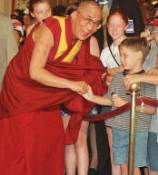
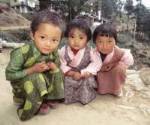
| There is another destination here for the compassionate visitor: the Tibetan Children's Village. It's home to 2,000 or-phaned children (+14,000 in all the TCV settlements), from infants to teen-agers, many of whom have fled Tibet. Much like the arrangement in an Israeli kibbutz, they attend school and live in dormitory-type houses with a "mother" and her helpers. We were drawn back for several visits simply because of all the hugs, smiles and laughter they gave as we played with them. Sponsoring an indi-vidual child is possible, but it was difficult to choose just one, so I volunteered an annual contribution. It was during our stay that the Dalai Lama returned home from a teaching trip to Bodhi Gaya, and we joined the throng lined along Temple Road to greet him with new prayer flags and burning incense. Sitting in the front seat of his yellow Mercedes, he gestured through the window with hands pressed together, giving us his blessings. I was deeply moved by this gesture from the man thought by many to be the living Buddha. Meeting the Dalai Lama -- Little did I know that the afternoon would bring an even closer encounter. Geshe Kalsang Damdul, who had been my Buddhism teacher in Portland and was now our host at the Institute of Buddhist Dialectics, where we stayed, drove by to ask if we had our passports with us. "His holiness has decided to give a public audience to greet the new arrivals from Tibet. You will be able to attend," he said. We were then rushed through the security gate at his residence, handing in our passports, cameras, and the Swiss Army knife I always carry in my pouch. I was able to put some small gifts for people back home on a tray to be blessed. Along with a small group of other visitors, we were ushered into a small gar-den at the side of the house, where we found him waiting, smiling and ready to shake hands with each one of us. I was almost numb, managing only a simple mumbled, "Thank you." Katrina and I then were given red silk protection cords to tie around our necks. For years I had been thirsty for relics of the mysterious Tibet. Now I wanted to stay in this place forever. I didn't want to be an idle tourist dallying in Buddhism. I wanted to participate in the giving of myself that seemed to make these people so content, to do whatever I could to make life better for others. I realized of course, that I could do just that back home in Portland, Oregon. I didn't really need to relocate to this removed Shangri-La of Tibet-an culture to find it. Seeing a society living such principles gave me hope and knowledge that we can make a difference wherever we are. (By Jan Van Raay, April 21, 2000) |
|
 |
 |
| April 18, 2003 |
 |
 |
 |
| Click above to visit our main Buddhism site. More information and images and, NO pop-ups! |