 |
| Page 47A |
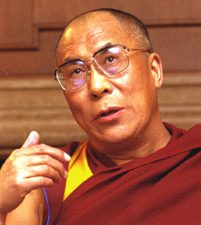 |
| and join in that rivalry, but, after his death, devoted and ambitious followers built around his teaching and prestige what became the Dge-lugs-pa, or Yellow Hat sect, which was gradually drawn into the political arena. In 1578 the Dge-lugs-pa took a step destined to bring foreign interference once more into Tibetan affairs. The third Dge-lugs-pa hierarch, Bsod-nams-rgya-mtsho, was invited to visit the powerful T�med Mongol leader Altan Khan, with whom he revived the patron-priest relationship that had existed between Kublai Khan and 'Phags-pa. From this time dates the title of Dalai ("Ocean-wide") Lama, conferred by Altan and applied retrospectively to the two previous hierarchs. The holder is regarded as the embodiment of a spiritual emanation of the Bodhisattva - Avalokiteshvara, the mythic monkey demon and progenitor of the Tibetans. The succession is maintained by the discovery of a child, born soon after the death of a Dalai Lama, into whom the spirit of the deceased is believed to have entered. Until 1642 the Dalai Lamas were principal abbots of the Dge-lugs-pa, and in that year they acquired temporal and spiritual rule of Tibet. With Altan's help, virtually all the Mon-gols became Dge-lugs-pa adherents, and on Bsod-nams-rgya-mtsho's death they acquired a proprietary interest in the order and some claims on Tibet itself when the fourth Dalai Lama was conveniently discovered in the T�med royal fami-ly. To support their prot�g� the Mongols sent armed bands into Tibet. Their opponents were the Red Hat Lama, head of a Karma-pa subsect, and his patron the Gtsang king. That phase of rivalry ended inconclusively with the early death of the fourth Dalai Lama and the decline of T�med Mongol authority in Mongolia. The next came when G��shi Khan, leader of the Khoshut tribe, which had displaced the T�med, appeared as champion of the Dge-lugs-pa. In 1640 he invaded Tibet, defeating the Gtsang king and his Karma-pa supporters. In 1642, with exemplary devotion, G��shi enthroned the Dalai Lama as ruler of Tibet, appointing Bsod-nams chos-'phel as minister for administrative affairs and himself taking the title of king and the role of military protector. These three forceful personalities methodically and efficiently consolidat-ed the religious and temporal authority of the Dge-lugs-pa. Lhasa, long the spiritual heart of Tibet, now became the poli-tical capital as well. Dge-lugs-pa supremacy was imposed on all other orders, with special severity toward the Karma-pa. A reorganized district administration reduced the power of the lay nobility. The grandeur and prestige of the regime were enhanced by reviving ceremonies attributed to the religious kings, by enlarging the nearby monasteries of 'Bras-spungs, Sera, and Dga'-Idan, and by building the superb Potala palace, completed by another great figure, Sangs-rgyas rgya-mtsho, who in 1679 succeeded as minister regent just before the death of his patron the fifth Dalai Lama. By then a soundly based and unified government had been established over a wider extent than any for eight centuries. The in-stallations of the fifth Dalai Lama at Lhasa (1642) and the Ch'ing, or Manchu, dynasty in China (1644) were almost syn-chronous. Good relations with Tibet were important to the Manchu because of the Dalai Lama's prestige among the Mongols, from whom a new threat was taking shape in the ambitions of the powerful Oyrat of western Mongolia. Else-where Lhasa's expanding authority brought disagreements with Bhutan, which held its own against Tibetan incursions in 1646 and 1657, and with Ladakh, where a campaign ended in 1684 in Tibetan withdrawal to an accepted frontier when the Ladakhi king appealed for help to the Muslim governor of Kashmir. The Dalai Lama's death in 1682 and the discovery of his five-year-old reincarnation in 1688 were concealed by Sangs-rgyas rgya-mtsho, who was intent on continuing the administration without disturbance. He informed the Manchu only in 1696. Emperor K'ang-hsi (reigned 1661-1722) was incensed at the deception. In 1703 he discovered an ally in Tibet and an antagonist to Sangs-rgyas rgya-mtsho when Lha-bzang Khan, fourth successor of G��shi, sought to assert rights as king that had atrophied under his immediate prede-cesors. The behaviour of the sixth Dalai Lama, Tshangs-dbyangs-rgya-mtsho, who preferred poetry and libertine amuse-ments to religion, gave Lha-bzang his opportunity. In 1705 with the Emperor's approval, he attacked and killed Sangs-rgyas rgya-mtsho and deposed Tshangs-dbyangs-rgya-mtsho as a spurious reincarnation. The Tibetans angrily rejected him and soon recognized in east Tibet the infant reincarnation of the dead Tshangs-dbyangs-rgya-mtsho. In 1717 the Oyrat, nominally Dge-lugs-pa supporters, took advantage of Tibetan discontents to intervene in a sudden raid, defeating and killing Lha-bzang. Fear of hostile Mongol domination of Tibet compelled the Emperor to send troops against the Oyrat. After an initial reverse, his armies drove them out in 1720 and were welcomed at Lhasa as deliverers, all the more because they brought with them the new Dalai Lama, Bskal-bzang-rgya-mtsho. For the next 200 years there was no fighting between Tibetans and Chinese; but after evicting the Oyrat the Emperor decided to safeguard Manchu in-terests by appointing representatives - generally known as Ambans - at Lhasa, with a small garrison in support. The Ti-betans, interpreting this as another patron-priest relationship, accepted the situation, which, generally left them to man-age their own affairs. It was only in recurring crises that Manchu participation became, briefly, energetic. Imperial troops quelled a civil war in Tibet in 1728, restored order after the political leader was assassinated in 1750, and drove out the Gurkhas, who had invaded from Nepal in 1792. As Manchu energy declined, the Tibetans became increasingly in-dependent, though still recognizing the formal suzerainty of the emperor, behind which it sometimes suited them to shelter. At no time did the Ambans have administrative power, and after 1792, when Tibet was involved in wars with La-dakh (1842) and Nepal (1858), the Manchu were unable to help or protect them. No Dalai Lama until the 13th approach-ed the personal authority of the "Great Fifth." The seventh incarnation was overshadowed by Pho-lha, a lay nobleman |
| For 70 peaceful years Byang-chub rgyal-mtshan (died 1364) and his two successors ruled a domain wider than that of the Sa-skya-pa. Thereafter, although the Phag-mo-gru Gong-ma (as the ruler was called) remained nominally supreme, violent dissension erupted again. In 1435 the lay princes of Rin-spungs, ministers of Gong-ma and pa-trons of the increasingly influential Karma-pa sect, rebelled and by 1481 had seized control of the Phag-mo-gru court. Already a new political factor had appeared in the Dge-lugs-pa sect. Its founder was a saintly scholar, Blo-bzang grags-pa (died 1419), known, from his birthplace near Koko Nor, as Tsong-kha-pa. After studying with lead-ing teachers of the day, he formulated his own doctrine, emphasizing the moral and philosophical ideas of Atisha rather than the magic and mysticism of Sa-skya - though he did not discard the latter entirely. In 1409 he founded his own monastery at Dga'-ldan, devoted to the restoration of strict monastic discipline. Tsong-kha-pa's disciplin-ary reform appealed to people weary of rivalry and strife between wealthy monaster-ies. Tsong-kha-pa probably did not imagine that his disciples would form a new sect |
| appointed ruler by the Manchu; the eighth was diffident and retiring. But after the Pho-lha fami-ly's regime, Dge-lugs-pa churchmen resumed power and held onto it through a series of monk re-gents for about 145 years. Chinese contacts affected Tibetan culture less than might be expected. They helped to shape the administrative machinery, army, and mail service, which were based on existing institutions and run by Tibetans. Chinese customs influenced dress, food, and manners; china and chopsticks were widely used by the upper classes. The arts of painting, wood carving, and casting figures continued on traditional lines, with much technical skill but few signs of innovation. An important effect of Manchu supremacy was the exclusion of foreigners after 1792. That ended the hopes of Christian missionaries and the diplomatic visits from British India, which had been |
 |
| started in 1774. Tibet was now closed, and mutual ignorance enshrouded future exchanges with its British neighbours in India. (Courtesy ThinkQuest. Not responsible for factual content) |
 |
| The Three Personalities of the Buddha - When the Blessed One had passed away into Nirvana, the disciples came together and consulted what to do in order to keep the Dharma pure and uncorrupted by heresies. And Upali rose, saying: "Our great Master used to say to the brethren: 'O bhikkhus! after my final entrance into Nirvana you must revere and obey the law. Regard the law as your master. The law is like unto a light that shines in the darkness, pointing out the way; it is also like unto a precious jewel to gain which you must shun no trouble, and be ready to bring any sacrifice, even, should it be needed, your own lives. Obey the Dharma which I have revealed to you; follow it care-fully and regard it in no way different from myself.' Such were the words of the Blessed One. The law, accordingly, which the Buddha has left us as a precious inheritance has now become the visible body of the Tathagata. Let us, therefore, re-vere it and keep it sacred. For what is the use of erecting dagobas for relics, if we neglect the spirit of the Master's teachings?" And Anuruddha arose and said: "Let us bear in mind, O brethren, that Gotama Siddhattha has revealed the truth to us. He was the Holy One and the Perfect One and the Blessed One, because the eternal truth had taken abode in him. The Tathagata taught us that the truth existed before he was born into this world, and will exist after he has en-tered into the bliss of Nirvana. The Tathagata said: 'The truth is omnipresent and eternal, endowed with excellencies in-numerable, above all human nature, and ineffable in its holiness.' Now, let us bear in mind that not this or that law which is revealed to us in the Dharma is the Buddha, but the entire truth, the truth which is eternal, omnipresent, im-mutable, and most excellent. Many regulations of the Sangha are temporary; they were prescribed because they suited the occasion and were needed for some transient emergency. The truth, however, is not temporary. The truth is not ar-bitrary nor a matter of opinion, but can be investigated, and he who earnestly searches for the truth will find it. The truth is hidden to the blind, but he who has the mental eye sees the truth. The truth is Buddha's essence, and the truth will remain the ultimate standard by which we can discern false and true doctrines. Let us, then, revere the truth; let us inquire into the truth and state it, and let us obey the truth. For the truth is Buddha our Master, our Teacher, our Lord." And Kassapa rose and said: "Truly thou hast spoken well, O brother Anuruddha. Neither is there any conflict of opinion on the meaning of our religion. For the Blessed One possesses three personalities, and every one of them is of equal importance to us. There is the Dharma Kaya. There is the Nirmana Kaya. There is the Sambhoga Kaya. Buddha is the all-excellent truth, eternal, omnipresent, and immutable. This is the Sambhoda Kaya which is in a state of perfect bliss. Buddha is the all-loving teacher assuming the shape of the beings whom he teaches. This is the Nirmana Kaya, his apparitional body. Buddha is the all-blessed dispensation of religion. He is the spirit of the Sangha and the meaning of the commands which he has left us in his sacred world, the Dharma. This is the Dharma Kaya, the body of the most ex-cellent law. If Buddha had not appeared to us as Gotama Sakyamuni, how could we have the sacred traditions of his doc-trine? And if the generations to come did not have the sacred traditions preserved in the Sangha, how could they know anything of the great Sakyamuni? And neither we nor others would know anything about the most excellent truth which is eternal, omnipresent, and immutable. Let us then keep sacred and revere the traditions; let us keep sacred the memory of Gotama Sakyamuni, so that people may find the truth; for he whose spiritual eye is open will discover it, and it is the same to every one who possesses the comprehension of a Buddha to recognize it and to expound it." Then the brethren decided to convene a synod in Rajagaha in order to lay down the pure doctrines of the Blessed One, to collect and collate the sacred writings, and to establish a canon which should serve as a source of instruction for future genera-tions. |
|
| ern theologians have interpreted the term "God" as representing some kind of abstract principle of good (or "ground of being"). This view was first developed in the ancient Indian Upanishads where God is equated with an abstract principle (Brahman). The ancient Indian philosophers could entertain such a view because they also had a theory of karma which really does away with the need for a personal God. Buddhists too have a theory of karma, which is different from that of the Hindus, and which even more unequivocally dispenses with the need for a Deity. The use of the term "God' to de-note an abstract reality by monotheistic theologians who have no theory of karma is difficult to justify; one suspects that this is merely a device to explain away the contradictions that arise from the notion of a personal God. In fact, the actual practice of theistic religion proceeds as if God is a real person of some kind or other. Just as Buddhism rejects the notion of a Supreme God it also rejects the notion of an abstract God-principle operating in the universe. The notion of Brahman (in the neuter) is not discussed at all in the Buddhist texts, and even in India it may well be a post-Buddhist development resulting from the attempt to reconcile the belief in God(s) with the powerful critique of the Buddha. It is therefore the attitude of Buddhism to the notion of a supreme personal God animating the Universe that we must consi-der. One popular misconception of Buddhism must be dismissed at this point. This is the view that the Buddha is some kind of God figure. In the Theravada tradition the Buddha is regarded as a supremely Enlightened human teacher who has come to his last birth in samsra (the Buddhist cycle of existence). Even Mahayana traditions which tend to think in terms of transcendental Buddhas do not directly make a claim for Buddha as God. Thus the Buddha cannot be consider-ed as playing a God-like role in Buddhism. In the Buddhist texts Mah� Brahm� is the equivalent of God and is represen-ted as claiming the following attributes for himself: "I am Brahm�, the Great Brahm�, the Supreme One, the Mighty, the All-seeing, the Ruler, the Lord of all, the Maker, the Creator, the Chief of all appointing to each his place, the An-cient of days, the Father of all that is and will be." The Buddha dismisses all these claims of Mah� Brahm� as being due to his own delusions brought about by ignorance. Mah�-Brahm� is seen simply as a deva unenlightened and subject to the samsric process as determined by his kamma. In the Khevadda Sutta he is forced to admit to an inquiring monk that he is unable to answer a question that is posed to him, and advises the monk to consult the Buddha. This clearly shows the Brahm acknowledges the superiority of the Buddha. In the West a number of "arguments" have been ad-duced to prove or disprove the existence of God. Some of these were anticipated by the Buddha. One of the most popular is the "first cause" argument according to which everything must have a cause, and God is considered the first cause of the Universe. The Buddhist theory of causation says that every thing must have preconditions for its existence, and this law must also extend to "God" should such an entity exist. But while the "first cause" claims that God creates every-thing, it exempts God from the ambit of this law. However, if exemptions are made with respect to God, such exemptions could be made with respect to other things also hereby contradicting the principle of the first cause. But the argument which the Buddha most frequently uses is what is now called the "argument from evil" which in the Buddhist sense could be stated as the argument from dukkha (suffering or unsatisfactoriness). This states that the empirical fact of the existence of dukkha cannot be reconciled with the existence of an omnipotent and omniscient being who is also all good. The following verses from the Bh�ridatta Jataka bring this out clearly: If the creator of the world entire / They call God, of every being be the Lord Brahm� / Why does he order such misfortune / And not create happiness but only discord? / If the creator of the world entire / They call God, of every being be the Lord Brahm� / Why prevail deceit, lies and ig-norance / And he such inequity and injustice create? / If the creator of the world entire they call God, of every being be the Lord Brahm� / Then an evil master is he, / (O Aritta) Knowing what's right did let wrong prevail! The Buddha argues that the three most commonly given attributes of God, viz. omnipotence, omniscience and benevolence towards human-ity cannot all be mutually compatible with the existential fact of dukkha. |
 |
| The Buddhist Attitude to God - It is first of all necessary to establish what is meant by the term "God." This term is used to designate a Supreme Being endowed with the qual-ities of omnipotence and omniscience, who is the creator of the universe with all its contents, and the chief law-giver for humans. God is generally considered as being concerned with the welfare of his human creatures, and the ultimate salvation of those who follow his dictates. God is therefore a person of some kind, and the question whether such an entity exists or not is fundamental to all theistic systems. In contrast to this notion of a personal God some mod- |
 |
|
| The Relevance of Buddhism - In the modern world Buddhism has to contend with two broad alternatives to itself. These are theism and materialism. Paradoxically, the Buddha had to contend with the very same ideologies in his own day. And now as then Buddhism offers the better alternative for the realisation of the greater happiness of all beings inhabiting the world (and not just humans alone). The relevance of Buddhism for the contemporary era would de-pend on its ability to meet the challenges posed by the contemporary world better than the ri-val ideologies of theism and materialism and very often a combination of the two. The unbri-dled exploitation of the earth's resources, almost amounting to a rape of these resources, has been another example of this greed. Buddhism teaches that man should live in harmony with the Universe. We have seen the extinction of many species of birds, animals and fish, and the threat of extermination of many more, because of the dominance of theistic and materialistic |
| ethics, which have consistently refused to conceded the "right to life" to non-human forms of existence. It is only a step from this position to the exploitation of natural resources to the extent that eco-systems have been destroyed beyond repair, and has put into question the long-term possibility of survival. The lack of tolerance of diverging viewpoints has been one of the most potent causes of misery and war. Even though we would like to think that the worst excesses of sectarian conflict are behind us, we have no real ground to such optimism. The world meeds a measure of Buddhist tol-erance. It has been said that the flavour of the Dhamma is the flavour of freedom (vimutti). The freedom that is meant here is primarily the freedom of the mind unburdened by crippling dogma (be they of ego or of God); but such mental freedom is the basis of all other freedom, even those of the more "worldly" kind, like political, social or economic free-dom. In a world where freedom is constrained in many ways, the liberating effect of the Dhamma is sorely needed. True freedom cannot be attained until the mind is set free. The Dhamma actually provides a therapy for the freeing of the mind from mental defilement. Modern society seems to have aggravated rather than lessened the need for mental pur-ification and calm. The pace of change has quickened, and external pressure on individuals increased. A balanced mind, created by a true understanding of the world and man's place in it, coupled with the practice of the Buddha's path, could serve as a radical new therapy. The importance of the Buddhist principle that a person should be free to believe accord-ing to one's freely formed and informed opinions, can hardly be overstated. The current practice of indoctrinating chil-dren with the religious views of their parents is one that comes to mind. Many religious organisations carry this process into formal schooling, and reinforce it later by using the latest technology of the information revolution. It then be-comes a veritable "brain-washing" no less insidious because it has the full approval of the establishment. The right of a child to have its mind free of religious indoctrination until it can make a decision on this vital matter in full maturity with all the information at its command, is a right that is rarely mentioned, but one in which Buddhists can take a lead. Basic Buddhism is relevant for the problems of modern society in several other ways. But it must be remembered that the traditional practices of Buddhism in several of its schools, including to some extent in the Therav�da tradition, de-parts considerably from the principles enunciated by the Buddha. Here, too, what is needed is a return to the principles and practice of basic Buddhism. |
|
 |
| Delusion - A man was forcing his way through a thick forest beset with thorns and stones. Suddenly to his great consternation, an elephant appeared and gave chase. He took to his heels through fear, and seeing a well, he ran to hide in it. But to his horror he saw a viper at the bottom of the well. How-ever, lacking other means of escape, he jumped into that well, and clung to a thorny creeper that was growing in it. Looking up, he saw two mice - a white one and a black one - gnawing at the creeper. Over his face there was a beehive from which occasional drops of honey trickled. This man, foolishly unmindful of this precarious position, was greedily tasting the honey. A kind person volunteered to show him a path of escape. But the greedy man begged to be excused till he had enjoyed himself. The thorny path is Samsara, the ocean of life. Man's life is not a bed of roses. It is beset with difficulties |
| and obstacles to overcome, with opposition and unjust criticism, with attacks and insults to be borne. Such is the thorny path of life. The elephant here resembles death; the viper, old age; the creeper, birth; the two mice, night and day. The drop of honey correspond to the fleeting sensual pleasures. The man represents the so-called being. The kind person represents the Buddha. The temporary material happiness is merely the gratification of some desire. When the desired thing is gained, another desire arises. Insatiate are all desires. 'Sorrow is essential to life, and cannot be evaded. Nirva-na, being non-conditioned, is [quiescent].' Disclaimer: All images and/or articles retain the original copyrights of their original owners. |
 |
 |
 |
| December 2, 2004 |
 |
| Visit our main Buddhism site. More information, images, and - NO pop-ups! (click image at left) |
 |