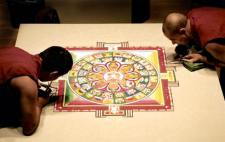
| Learning from the Dalai Lama: Attending The Sacred Kalachakra Initiation The Kalachakra Initiation is the largest and most important Buddhist ritual conferred by His Holiness the Dalai Lama. It is traditionally given to groups of people assembled from around the world, and therefore, is associated with the promotion of world peace. The Kalachakra Initiation is considered a special blessing for all who participate and for the environment in which it is given. Of the thousands of Tibetans, Indians and other Buddhists who attend the Kalachakra, only 200 or fewer are Westerners. In August 2000, the California-based travel company, Spirit of India, escorted 18 Americans to Spiti Valley, a remote region of the In-dian Himalaya bordering Tibet, to participate in the sacred Kalachakra Initiation at the 12th century Ki Monastery. This ceremony at the Ki Monastery was deemed especially significant as it is the closest the Dalai Lama has been to Tibet since his exile. Kalachakra means "Wheel of Time," which refers to the presentation of cycles of time within the Kalachakra Tantra, and is also the name of one of the Buddhist deities that represents particular aspects of the Enlightened Mind. The word tantra means "an everlasting stream of continuity." It forms a part of a system of teachings and practice conferred by the Buddha to his disciples. Traditionally the Kalachakra teachings have been a closely guarded secret with the viewing of the sand mandala as the culmination of a twelve-day initiation ritual. However, the Dalai Lama, recognizing the many misconceptions surrounding Tibetan Buddhist practice, began |
 |
| Page 45A |
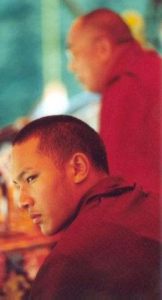 |
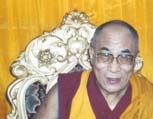
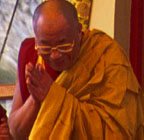
| presentations of the Kalachakra sand mandala to the general public as a cultural offering. Each morning we arose from our tents at 4:30 am, ate a quick bite and hopped in our jeeps for the 45-minute drive up the precariously narrow, wind-ing mountain road toward Ki Monastery (also spelled Key and Kee). Two-thirds of the way there, we would disembark and walk the remaining way up, as only VIP cars could drive all the way to the entrance. The morning walks were a glorious time. All the most devoted pilgrims were on the path with us - husbands and wives with small children on their backs, elders walking tall and strong, giggling young teenage girls. We were greeted with wide smiles and the traditional Tibetan greeting, Tashi Delek! By 6 am, we arrived at the Ki Monastery to lay claim to coveted spots as close to His Holi-ness as possible. It was truly amazing to sit near him in such an intimately Buddhist setting - literally on the mountain top, prayer flags fluttering, scorching sun beating on us. We did not even mind that the program usually began at about 1 pm. As people quickly filled the courtyard space, we were surrounded from all sides by Buddhist pilgrims from every part of India and Nepal - several thousand bodies deep. Throughout the hours of sitting before the Dalai Lama appeared, we huddled on mats under the shade of shared umbrellas as an ongoing exchange of food took place with our neighbors. The baby next to me was crying, so I gave him my boxed juice; his mother gratefully accepted and later, I was passed an apple. I brought extra photos I had made the year before of Ki Monastery and gave them to Tibetans who did not have their own cameras to record the memory of this event. Each bowed a thank you, touched the photo to their forehead and then held it up to the sky. When H.H. the Dalai Lama appeared on the small stage above us, a hush came over the crowd as we all rose in unison and held our hands in prayer. Many began doing prostrations, a physical movement that looks a bit like the yoga sun salutations. His Holiness greeted us with a bow, hands also in prayer; his famous smile and twinkling eyes appeared to greet each and every one of us. The Dalai Lama spoke in the Tibetan language with trans-lations available via transistor radio in English, French, German, Italian and Hindi. From time to time, monks would come through the crowd of about 10,000 to distribute tea and various props pertaining to the rituals, such as protection string, a red band of cloth to signify blinders, a lotus flower and two stalks of Kuscha grass to enhance dreaming. There were times when we would repeat Tibetan chants with the crowd which were punctuated by the playing of Tibetan horns, drums and the Dalai Lama's chuckles. We followed along as best we could, watching the monks and more experienced practitioners. Some of the group members had brought along a book, "Kalachakra: A Rite of Initiation." The book was valuable in explaining in great detail the meaning of each ritual and helped us keep up with where we were in the cere-mony each day. For a Buddhist practitioner, taking the initiation confers permission to begin study and practice of the Kalachakra Tantra with the motivation to free all beings from suffering and actualize realizations of the path to Enlight-enment. For the non-Buddhist, who does not wish to take the empowerment, the initiation can be taken as a blessing. For each individual who participates - Buddhist or not - it is also a renewal of commitment to one's inner spiritual path. New Yorker Alison Murphy states, "I learned a lot about myself in India, really from all the love and affection I felt from everyone in the group. The Kalachakra topped it off, but the people in our party really touched me. I don't think I'll be living my life the way I was before the trip..." (By and courtesy of Barbara Sansone, Spirit of India)) |
| Sariputta's Faith - The Blessed One proceeded with a great company of the brethren to Nalanda; and there he stayed in a mango grove. Now the venerable Sar-iputta came to the place where the Blessed One was, and having saluted him, took his seat respectfully at his side, and said: "Lord! such faith have I in the Blessed One, that methinks there never has been, nor will be, nor is there now any other, who is greater or wiser than the Blessed One, that is to say, as regards the higher wisdom." Replied the Blessed One: "Grand and bold are the words of thy mouth, Sariputta: verily, thou hast burst forth into a song of ecstacy! Surely then thou hast known all the Blessed Ones who in the long ages of the past have been holy |
 |
 |
| Buddhas?" "Not so, O Lord!" said Sariputta. And the Lord continued: "Then thou hast perceived all the Blessed Ones who in the long ages of the future shall be holy Buddhas?" "Not so, Lord!" "But at least then, O Sariputta, thou know-est me as the holy Buddha now alive, and hast penetrated my mind." "Not even that, O Lord!" "Thou seest then, Sari-putta, that thou knowest not the hearts of the holy Buddhas of the past nor the hearts of those of the future. Why, therefore, are thy words so grand and bold? Why burstest thou forth into such a song of ecstacy?" "O Lord! I have not the knowledge of the hearts of all the Buddhas that have been and are to come, and now are. I only know the lineage of the faith. Just as a king, Lord, might have a border city, strong in its foundations, strong in its ramparts and with one gate only; and the king might have a watchman there, clever, expert, and wise, to stop all strangers and admit only friends. And on going over the approaches all about the city, he might not be able so to observe all the joints and crev-ices in the ramparts of that city as to know where such a small creature as a cat could get out. That might well be. Yet all living beings of larger size that entered or left the city, would have to pass through that gate. Thus only is it, Lord, that I know the lineage of the faith. I know that the holy Buddhas of the past, putting away all lust, ill-will, sloth, pride, and doubt, knowing all those mental faults which make men weak, training their minds in the four kinds of mental ac-tivity, thoroughly exercising themselves in the sevenfold higher wisdom, received the full fruition of Enlightenment. And I know that the holy Buddhas of the times to come will do the same. And I know that the Blessed One, the holy Buddha of to-day, has done so now." "Great is thy faith, O Sariputta," replied the Blessed One, "but take heed that it be well grounded." |
|
 |
| PRAYER FLAGS - The hoisting of flags to ensure good fortune is one of the many customs within the nomadic com-munities of Tibet that have changed very little for several thousand years. However, the meaning of this ritual has grad-ually evolved from being of militaristic to religious significance. That the original use of flags in Tibet was militaristic is illustrated by the term Ru-dar or banner. Ru refers to gathering of nomads before moving on together to fresh pastures and thus, in an archaic sense this assembly referred to a kind of army. The banners (ru-dar) found in ancient literature were military flags. The flying of flags began to acquire religious significance in the Bon tradition and it may be ob-served that the actual design of the flags also gradually changed. In the corners of some of these flags were images of a tiger, a snow lion, a garuda, and a dragon, and in the center was a horse, around which was written a Bon mantra and a line which read, "May the horse of good fortune run fast and increase the power of life, influence, fortune, wealth, health, and so forth." This writing of mantras on cloth to produce a flag of religious significance can be traced to the im-maculate g.Yung-drung-gtsang-ma-zhang-zhung, a collection of Bonpo teachings, which say that when a mantra is wrap-ped in five colored silk and placed high in the mountains, it will provide whoever sees it with the good fortune to become Enlightened. If you attach a mantra wrapped in this way to the top of a victory banner and pray to it, worship it, and make precious offerings to it, then, according to tradition, you will accomplish all your goals. The meaning of this Bon mantra needs further investigation. The protective power of mantras is illustrated by the following story. When Buddha was in the Thirty-third realm of the gods, seated on a flat stone, as white as his clothes, Indra, king of the Gods, came and prostrated before him. Indra explained that he and the gods of the Thirty-third realm had suffered a great defeat at the hands of Vemchitra, the king of the anti-gods, and he asked Buddha what he should do. Buddha told him to memo-rize the mantra contained in the prayer Ornament at the Crest of the Victory Banner. Buddha explained that he had re-ceived this mantra from the Tathagata known as Irrepressible and had himself taught it to many disciples. He said that since the time that he learned the mantra he could not remember even a moment when he felt fear or terror, so he told Indra to carry this mantra into battle to ensure victory. Great masters have written ritual texts praising the Dra-lha, a deity who helps in overcoming obstacles and enemies, and the hoisting of Dra-lha flags is meant to cause the Dharma to flourish and to promote the welfare of all sentient beings, especially those who engage in these rituals. In an old Dra-lha story, the gods were enjoying the fruits of the wish-fulfilling tree, which grew in the valley of Mt. Meru. As the tree was rooted in the realm of the anti-gods, they claimed that the fruit was also theirs, and a battle ensued. Indra went to Vaj-rapani and asked him for assistance. Vajrapani told Indra to invite the brothers of Dra-lha and to ask for their help. Nine weapons and nine deities then appeared from the great ocean. Through the worship of these deities Indra was able to defeat the anti-gods and achieve victory. There are many types of Tibetan flags, for example the dar-ding, a long string of flags flown horizontally between trees or buildings, and the dar-chen, a narrow flag which is flown from a pole. Tibetan prayer flags can be of any of these 5 colors, blue, white, red, green, and yellow, which symbolize the sky, clouds, fire, water, and earth respectively. If we relate these colors to the physical elements, then the blue symbolizes water, green symbolizes wood, red fire, and white iron. There is also a tradition of flying flags which represent the elements of your own body. Flags are flown on auspicious days such as Sunday, Monday, Wednesday, Thursday, Friday, and when the |
| stars are in auspicious arrangements according to Tibetan almanac. Flags are flown by fami-lies from all economic backgrounds, and they are flown on such important occasions as the third day of the Tibetan new year, marriages, and official functions. Flags are also hoisted in the event of interferences, or illness, in order to avert further misfortunes. In some parts of Tibet, during the wedding ceremony, the guests gather on the roof of the grooms house and preform a ritual in which the bride touches the prayer flags. These flags are then hoisted on the building housing the protectors near the site for making incense offerings, and from that |
| moment the bride becomes a member of her new family. After the first year of marriage the bride returns to her home and again preforms the same ceremony, and in so doing she separates herself from her original family. Flags are used as protection against harm when traveling. Before passengers enter a boat to cross a river, they preform a ceremony in which flags are attached to the horse shaped figurehead at the bow of the boat. Prayers are said and incense and grain are offered to the gods. In this way they insure safe passage across the river. Originally, flag ceremonies were intended to provide benefit in this life, but as they gradually became more imbued with religious meaning, they came to be associ-ated with benefit in future lives and the achievement of spiritual as opposed to material success. Although the actual ceremonies and rituals have changed very little, the significance or content of the rituals has gradually evolved a spirit-ual element through a mixture of Bon and Buddhist symbolism. (Courtesy Council for Religious and Cultural Affairs of H.H. the Dalai Lama, 1990) |
 |
 |
|
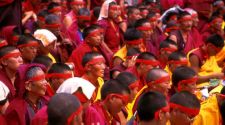 |
| Some of the thousands of monks at Kalachakra ceremony. (Courtesy Spirit of India.) |
| HOW TO LIVE FREE OF FEAR OF DEATH; TIBETAN LAMA SPEAKS OF MORTALITY.. Everybody is worried about dying, the Tibetan teacher Sogyal Rinpoche said. "But to die is extremely simple. You breathe out, and you don't breathe in." A ripple of laughter passed through the 400 people crowded into a conference room at Interface in Cambridge, a center for alternative religious, health and psychological programs. They'd come to see a lama, a Tibetan monk, who is noted for his ability to speak to Westerners and who, in a little less than a year, has sold nearly 100,000 copies of a book of Buddhist teachings, "The Tibetan Book of Living and Dying." Rinpoche - a reli-gious title meaning "precious one" - left his homeland (Tibet) as a child in 1959, studied in Catholic schools in India and in Britain at Trinity College, Cambridge, and set out to bring the ancient tradition of Tibet to bear on the anxieties of men and women in Europe and North America. "I'm not a very good lama," he insisted to an interviewer. He speaks of-ten of his own teachers, his "masters," some of whom he served as translator when they came to the West. The book is the result of doing what his teachers told him, to pass on the ancient teaching to a new world, as "a service to humani-ty." That includes, he says, teaching Westerners "discernment:" which Buddhist teachings to use and which to ignore, how to find a teacher and persevere on the path to Enlightenment. And he is succeeding in drawing new students to Bud-dhism, said Steve Zimmerman of Watertown, who leads classes at Rinpoche's local Rigpa center there. "Because he was raised largely in the West, he has much greater understanding of Westerners." David F. Gibbs, 45, a social worker at the Merrimack Valley Hospice in Lowell, said he once found Tibetan Buddhism "too ritualistic and elaborate, beyond my cultural experience." Now he finds Rinpoche's teaching has helped him "develop more compassion and understanding," in seeing how the people who come to the hospice "are distinct from their behavior, how they are more than what they are thinking or feeling or doing." For part of the 10 years he spent preparing the book, Rinpoche worked in the hospice movement in Britain, helping those who face imminent death as a result of cancer, AIDS or other serious illnesses. He came to believe that much of what is wrong in Western society arises from the denial of death. "I feel this denial of death actually complicates problems that exist in Western society," Rinpoche said in the interview. "It is why there is no long-term vision, not very much thought for the consequences of actions, little or no compassion. People see death as terrible, as tragic. Because they want to live, they see death as the enemy of life and therefore deny death, which then becomes even more fearful and monstrous." Beneath this fear of death lies "the ultimate fear . . . the fear of looking into ourselves," he said. But death can be a friend, he told the crowd at Interface. "Death holds the key to the meaning |
| of life," which is why Trappist brothers regularly greet each other with the Latin phrase memento mori, "remember you are dying," Rinpoche said. "Remembering brings life into focus. It sorts out your priorities, so you do not live a trivial life. It helps you take care of the most important things in life first. Don't worry about dy-ing; that will happen successfully whether you worry about it or not." He warns his students not to think about death "when you are depressed," but rather "when you are on holiday or impressed by music or natural beauty." But he knows that "when I am not practicing," or meditating in a disciplined way, "I am afraid of death." He has worried, too, about the death of the lamas with whom he left Tibet. "A whole |
| generation of legendary masters is passing away - sometimes I wonder what the future is going to hold," he said. Rin- poche is hopeful when he remembers living teachers, such as the Dalai Lama, who wrote the foreword to his book. But he knows that the possible loss of Tibet is another experience of impermanence, of death, like that all human beings must face. His goal is to help the dying, those who care for them, and all who listen, to "face our own mortality and rea-lize how much love, how much compassion is in you," he told an interviewer. "This dying forces you to look into your-self. And in this, compassion is the only way. Love is the only way." (By James L. Franklin, The Boston Globe, September 21, 1993) |
|
| "Buddism has the characteristics of what would be expected in a cosmic religion for the future: it transcends a personal God, avoids dogmas and theology; it covers both the natural and spiritual, as a meaningful unity" Albert Einstein |
|
| Emptiness - EMPTINESS is a mode of perception, a way of looking at experience. It adds nothing to and takes nothing away from the raw data of physical and mental events. You look at events in the mind and the senses with no thought of whether there's anything lying behind them. This mode is called emptiness because it is empty of the presup-positions we usually add to experience in order to make sense of it: the stories and worldviews we fashion to explain who we are and the world we live in. Although these stories and views have their uses, the Buddha found that the questions they raise - of our true identity and the reality of the world outside - pull attention away from a direct experience of how events influence one another in the immediate present. Thus they get in the way when we try to understand and solve the problem of suffering. Say for instance that you're meditating, and a feeling of anger toward your mother appears. Immediately, the mind's reaction is to identify the anger as "my" anger, or to say that "I'm" angry. It then elaborates on the feeling, either working it into the story of your relationship to your mother, or to your general views about when and where anger toward one's mother can be justified. The problem with all this, from the Buddha's perspective, is that these stories and views entail a lot of suffering. The more you get involved in them, the more you get distracted from seeing the actual cause of the suffering: the labels of "I" and "mine" that set the whole process in motion. As a result, you can't find the way to unravel that cause and bring the suffering to an end. If, however, you adopt the emptiness mode - by not acting on or reacting to the anger but simply watching it as a series of events, in and of themselves - you can see that the anger is empty of anything to identify with or possess. As you master the emptiness mode more consis-tently, you see that this truth holds not only for such gross emotions as anger, but also for even the most subtle events in the realm of experience. This is the sense in which all things are empty. When you see this, you realize that labels of "I" and "mine" are inappropriate, unnecessary, and cause nothing but stress and pain. You can drop them! When you drop them totally, you discover a mode of experience that lies deeper still, one that's totally free. To master the empti-ness mode of perception requires firm training in virtue, concentration, and discernment. Without this training, the mind stays in the mode that keeps creating stories and worldviews. And from the perspective of that mode, the teaching of emptiness sounds simply like another story or worldview with new ground rules. In terms of the story of your rela-tionship to your mother, it seems to be saying that there's really no mother, no you. In terms of your worldview, it seems to be saying either that the world doesn't really exist, or else that emptiness is the great undifferentiated ground of being from which we all came and to which someday we'll all return. These interpretations not only miss the meaning |
 |
| These interpretations not only miss the meaning of emptiness but also keep the mind from get-ting into the proper mode. If the world and the people in the story of your life don't really exist, then all the actions and reactions in that story seem like a mathematics of zeros, and you won-der why there's any point in practicing virtue at all. If, on the other hand, you see emptiness as the ground of being to which we're all going to return, then what need is there to train the mind in concentration and discernment, since we're all going to get there anyway? And even if we need training to get back to our ground of being, what's to keep us from coming out of it and suffering all over again? So in all these scenarios, the whole idea of training the mind seems fu-tile and pointless. By focusing on the question of whether or not there really is something be- |
| hind experience, they entangle the mind in issues that keep it from getting into the present mode. Now, stories and worldviews do serve a purpose. The Buddha employed them when teaching people, but he never used the word emptiness when speaking in these modes. He recounted the stories of people's lives to show how suffering comes from the unskill-ful perceptions behind their actions, and how freedom from suffering can come from being more perceptive. And he de-scribed the basic principles that underlie the round of rebirth to show how bad intentional actions lead to pain within that round, good ones lead to pleasure, while really skillful actions can take you beyond the round altogether. In all these cases, these teachings were aimed at getting people to focus on the quality of the perceptions and intentions in their minds in the present - in other words, to get them into the emptiness mode. Once there, they could use the teach-ings on emptiness for their intended purpose: to loosen all attachments to views, stories, and assumptions, leaving the mind empty of all the greed, anger, and delusion, and thus empty of suffering and stress. And when you come right down to it, that's the emptiness that really counts. (Thanissaro Bhikkhu) Disclaimer: All images and/or articles retain the original copyrights of their original owners. |
| April 18, 2004 |
 |
 |
 |