 |
| Page 45 |
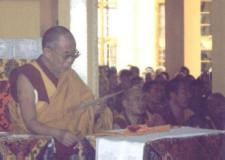 |
| The Dalai Lama leading a prayer session at his temple to pay homage to the victims of the US terrorist attacks. He sent a condolences message to the US President to show his solidarity with Americans during these painful hours in US history. The Tibetan administration closed down for half-a-day to attend the prayers. |
| this senseless act of violence," stated His Holiness. The Nobel Laureate further stressed the "need to think seriously" on the part of all concerned about the "greater interest of the nation and the people in the long run" before taking any steps. His Holiness cautioned against any violent reaction. "I believe violence will only increase the cycle of violence." The exiled leader appealed for a calm and considered response to the attacks, which have unleashed a wave of anger and revulsion across the United States. "But how do we deal with hatred and anger, which are often the root causes of such senseless violence? This is a very difficult question, especially when it concerns a nation and we have certain fixed con-ceptions of how to deal with such attacks. I am sure that you will make the right decision." More than a thousand peo-ple joined His Holiness the Dalai Lama to pray for the victims. |
| Dalai Lama leads prayer for US tragedy (Mcleodganj September 13, 2001) A special prayer for the victims of the terrorist attacks in the United States was led by His Holiness the Dalai Lama yesterday, at Tsuklag Khang, or Main Temple, in Dharamsala. Besides the newly elected Chairman of the Cabinet, Prof. Samdhong Rinpoche, and Mr. Thupten Lungrik, Chairman of the Assembly of Tibetan Peo-ple's Deputies (Tibetan Parliament), the prayer meeting was joined by officials of the Tibetan government in exile and Tibetans living in Dharamsala. Many tourists and local Indians joined the prayer meeting, held around 2 PM. Earlier His Holiness the Dalai Lama sent a letter to President George Bush expressing his "shock and sadness," and solidarity with the American people after hearing the tragic events in New York City and Washington, D.C. "It is a terrible tragedy that so many inno-cent lives have been lost We are deeply saddened. On behalf of the Tibetan people I would like to convey our deepest condolence and solidarity with the American peo-ple during this painful time. Our prayers go out to the many who have lost lives, those who have been injured and the many more who have been traumatised by |
 |
| SEPTEMBER 11, 2001 - A DAY OF INFAMY |
| I N S T R U C T I O N S F O R L I F E 1. Take into account that great love and great achievements involve great risk. 2. When you lose, don't lose the lesson. 3. Follow the three R's: Respect for self, Respect for others and Responsibility for all your actions. 4. Remember that not getting what you want is sometimes a wonderful stroke of luck. 5. Don't let a little dispute injure a great friendship. 6. When you realize you've made a mistake, take immediate steps to correct it. 7. Spend some time alone every day. 8. Open your arms to change, but don't let go of your values. 9. Remember that silence is sometimes the best answer. 10. Live a good, honorable life. Then when you get older and think back, you'll be able to enjoy it a second time. 11. A loving atmosphere in your home is the foundation for your life. 12. In disagreements with loved ones, deal only with the current situation. Don't bring up the past. 13. Share your knowledge. It's a way to achieve immortality. 14. Be gentle with the earth. 15. Once a year, go someplace you've never been before. 16. Remember that the best relationship is one in which your love for each other exceeds your need for each other. 19. Judge your success by what you had to give up in order to get it. |
| The Dalai Lama talks tech... "Computers are one of life's mysteries and great wealth is one of its distractions," he says. (May 18, 2001) The Dalai Lama, master of the mind's inner technology, is con-founded by the external technology that drives the planet. He put it like this: "My computer literacy is zero. It's partly because it wasn't easy to learn, so I just gave up.'' He broke into his booming laugh. This was Wednesday morning in his Peninsula hotel room, where His Holiness Tenzin Gyatso, the 14th Dalai Lama, sat for a private interview with the Mer-cury News about money, technology and an ancient Buddhist prophecy. More about the prophecy later. Back to comput-ers. The Tibetan government in exile he oversees in Dharamsala, India, is well-wired with e-mail, computers and the In-ternet. A Bay Area devotee went to India to help put it together several years ago. It's a little surprising that the Dalai Lama, a famous tinkerer who disassembled and rebuilt watches for fun as a boy, hasn't jumped aboard the technological train. But he cited precedent for his lack of interest: The fifth Dalai Lama, who was named Ngawang Losang Gyatso and lived from 1617 to 1682, once said he didn't "pay much attention to letter-writing skills because he felt he could always find someone to do it for him. Same for computers!'' He's busy enough. The Dalai Lama, who wakes each day about 4 a.m. to pray, read and do prostrations, is in the midst of a five-day Bay Area visit for teachings, talk and ceremony through Sunday at Shoreline Amphitheatre in Mountain View. He arrived for the interview without fanfare, wearing a pair of worn rubber flip-flops, bowing to his visitor and a photographer and settling into a sofa. He folded his feet be-neath him on the cushion, lotus-style. With his closely shaved head, claret robe and spectacles, the Nobel Peace Prize winner, 65, looked to be the "simple monk'' he calls himself. He zoomed in on questions and was never perfunctory with answers, though he sometimes struggled with his English. Then he turned to his longtime translator, Thubten Jinpa, for clarification. The very fact of sitting in a Silicon Valley hotel room led to conversation about the vast sums of money generated here in recent years. Wealthy people sometimes are afflicted with a spiritual "restlessness'' because they rely on comforts at the "sensorial level: good colors, good smells, good companions, including sex. But still, mentally, they are not necessarily happy. . .. The restlessness and unhappiness that occurs at the level of the mind is something that can only be addressed by a means that is mental. . . "Sophisticated machines produce very sophisticated articles,'' he said, "but cannot produce peace of mind. . . If I go shopping and say, 'Please give me peace of mind. I will give you a million dollars,' I think the shopkeeper will laugh.'' Though he is a religious man -- teacher, scholar, monk and, to Ti-betans, the incarnation of divine compassion -- the Dalai Lama says he thinks most people do not derive their values directly from religious traditions. Given that reality, he said, a system of "secular moral ethics'' must be taught to lift the lives and spirits of millions of people. The values he enumerated include nurturing what he calls a "warm heart,'' and a "sense of caring, a sense of sharing,'' as well as "self-discipline and contentment.'' Oh, the prophecy. It said that the dharma -- or teachings -- of Buddhism would pass to the land of the "red-faced peoples'' 2,500 years after the com-ing of the historical Buddha, known as Shakyamuni. According to most calculations, those 2,500 years were up in the 1950s when the Dalai Lama fled Tibet. To some of his friends and followers, that means the Dalai Lama -- now an icon in the West -- is the inevitable expression of the prophecy. Does he believe it? "No.'' He says there is more than one way to interpret the prophecy and to calculate the passage of time since the coming of Lord Buddha. He says the land of the red-faced man might be Tibet. And besides, this is precisely the type of statement the Dalai Lama steps away from. Tibetans call him a living god, but he describes himself as a political and spiritual leader in the real world. Exiled from Tibet in 1959, the monk travels extensively in Europe and North America. Some might assume his goal is to spread Bud-dhism, but he said that's not so: "I'm propagating the value of human beings and religious harmony -- not Buddhism.'' In fact, he said he sometimes feels "a little hesitant'' teaching about Buddhism in the West because he believes every religious tradition arises from a particular historical and cultural context, and, while people can change faiths, it's not |
|
 |
| necessarily advisable. A new tradition might not suit the convert and could end up caus-ing "some confusion and some difficulties.'' That's why it is "better, safer, to keep your own tradition.'' He expanded on this Wednesday at the Shoreline, during the first of three days of teachings on the Heart Sutra, a pagelong discourse at the center of Buddhist thought. Before the Dalai Lama were more than 7,000 people, many of them Buddhist students or converts to Buddhism. Some may have been surprised to hear him say there are certain Buddhist notions that Christians shouldn't necessarily probe, as they could undermine their own beliefs in God as creator.. But there are ways that reli- |
| gions and their "many truths'' can enrich one another. For instance, he mentioned a group of "Christian brothers,'' friends of his, who "incorporated into their Christian practice methods for cultivating single-pointedness of mind . . . meditations and visualizations regarding compassionate behavior.'' Then he said Buddhism would benefit by emulating the Christian tradition of community service in education, health and other fields. That Buddhist institutions have often neglected to serve their communities was brought home by a German friend who visited Nepal and returned complaining that "he saw many large monasteries built by lamas. However, there were very few hospitals and schools built by the monasteries.'' "There's nothing else the Buddhists can say but, 'He's right,''' the Dalai Lama said. At the Shoreline, the Dalai Lama was seated, again lotus-style, on a raised platform behind which stretched a massive backdrop depicting the Himalayas and the Potala Palace, the towering centerpiece of the city of Lhasa, Tibet. The Dalai Lama grew up inside the gilded cage of the palace -- and escaped from it 42 years ago, slipping past the Chinese military and crossing the Himala-yas to safety in India. The men and women in the crowd listened raptly to the Dalai Lama's explanations, spoken in Ti-betan and translated by Jinpa, who wore a sport coat and slacks amid 200 robed monks filling the stage. The scene was bursting with typical colors of Tibet: maroon, saffron, blue. The audience, in shorts, T-shirts and sun hats, seemed to have arrived from a different world. Yet Tom Flynn, director of a Buddhist retreat center in Soquel and a main event or-ganizer, pointed out to the assembly that there was something very right about the day. It was entirely appropriate, he said, for the Dalai Lama to come to Silicon Valley. After all, it used to be called the Valley of Heart's Delight. (Courtesy San Jose Mercury News. By RICHARD SCHEININ, [email protected]) |
|
| "The power of media, whether direct or indirect, is a real power which acts on us, which modifies our behavior, our tastes, and probably our thoughts. Like all authority, it cannot be applied at random. Otherwise, that power could become arbitrary and irresponsible. The power gives media-men responsibility comparable to religious or political responsibility. In their own way, they contribute to the establishment and maintenance of a human community. The well being of that community should be their first concern. "We can speak of an effect and a cause on both the disturbing side and the liberating side. The true sufferings and true causes of sufferings are the effect and cause on the side of things that we do not want; the true cessation and the true paths are the effect and cause on the side of things that we desire. "One thing cannot be doubted, the "possibility of a quality" is within us. It is called prajna. We can deny everything, except that we have the possibility of being better. Simply reflect on that. "Right from the moments of our birth, we are under the care and kindness of our parents. Then, later on in life, when we are oppressed by sickness and become old, we are again dependent on the kindness of others. Since it is the case that at the beginning and end of our lives we are so dependent on others' kindness, how can it be that in the middle we neglect kindness towards others?" The Dalai Lama |
|
| And the Buddha speaks about.. "The Mind" The flickering, fickle mind, Difficult to guard, difficult to con-trol, the wise man straightens, as a fletcher, an arrow. Like a fish drawn from its watery abode and thrown upon land, even so does the mind flutter. Hence should the realm of Mara (the personification of all temptations to evil and distrac-tions from training) be shunned. Good is it to control the mind which is hard to check and swift and flits wherever it de-sires. A subdued mind is conducive to happiness. Hard to perceive and extremely subtle is the mind, it roams wherever it desires. Let the wise man guard it; a guarded mind is conducive to happiness. Faring (to go, travel) afar, solitary, bodi-less, lying in a cave, is the mind. Those who subdue it are freed from the bond of Mara. He whose mind is inconstant, he who knows not the true doctrine, he whose confidence wavers - the wisdom of such a one is never fulfilled. He who is vigilant, he whose mind is not overcome by lust and hatred, he who has discarded both good and evil for such a one there is no fear. Realizing that this body is fragile as a pot and establishing his mind as firm as a fortified city, he should at-tack Mara with the weapon of wisdom. He should guard his conquest And afford no rest to Mara. Soon alas will this body lie upon the ground, unheeded, devoid of consciousness, even as a useless log. Whatever harm a foe may do to a foe, or a hater to a hater, an ill-directed mind can harm one even more. What neither mother, nor father, nor any other rela-tive can do, a well-directed mind does and thereby elevates one. |
| "The Fool" Long is the night to the wakeful, long is the yojana to one who is weary, long is Samsara to the foolish who know not the true doctrine. If, as he fares, he finds no companion who is better or equal, let him firmly pursue his solitary career; there is no fellowship with the fool. 'I have sons, I have wealth;' so thinks the fool and is trou-bled. He himself is not his own, how then are sons, how wealth? The fool aware of his stupidity is in so far wise, but the fool thinking himself wise is called a fool indeed. Though through all his life a fool associates with a wise man, he yet understands not the Dharma, as the spoon, the flavour of soup. Though, for a moment only, an intelligent man associates with a wise man quickly he understands the Dharma, as the tongue, the |
 |
| flavour of soup. Fool of little wit behave to themselves as enemies, doing evil deeds the fruits whereof are bitter. That deed is not well-done, after doing which one feels remorse and the fruit whereof is received with tears and lamenta-tions. Well-done is that deed which, done, brings no regret; the fruit whereof is received with delight and satisfaction. As sweet as honey the fool thinks an evil deed so long as it does not bear fruit; but when it ripens, the fool comes to grief. Month after month the fool may eat his food with the tip of kusa grass; nonetheless he is not worth the sixteenth part of those who have well understood the Dharma. An evil deed committed does not immediately bear fruit, just as milk curdles not at once; smouldering like fire covered by ashes, it follows the fool. The fool gains knowledge only for his ruin; it destroys his good actions and cleaves his head. A foolish monk desires undue reputation, precedence among monks, authority in the monasteries, honour among other families. Let both laymen and monks think, by me only was this done; in every work, great or small, let them refer to me. Such is the ambition of the fool; his desire and pride in-crease. One is the way to worldly gain; to Nirvana another leads. Clearly realizing this, the bhikkhu, disciple of the Buddha, should not delight in worldly favour, but devote himself to solitude. "The Self" If one holds oneself dear, one should protect oneself well. During any of the three watches (of life) the wise should keep vigil. One should first establish oneself in what is proper, and then instruct others. A wise man who acts in this way shall never get defiled. As he instructs others he should himself act. Himself fully controlled, he should control others. Difficult indeed is to control oneself. Oneself indeed is master of oneself, who else could another master be? With oneself perfectly trained, one obtains a refuge hard to gain. The evil, done by oneself, self-begotten and self-produced, crushes the witless one, as the diamond grinds the hardest gem. An exceedingly corrupted man is like a M�lu-va creeper strangling a sal-tree, surely he does unto himself what his enemy would wish for him. Easy to do are those karmas which are bad and not benefitting oneself but those which are good and beneficial are difficult indeed to be per-formed. Who so on account of false views scorns the teaching of the Noble Ones, the Worthy and Righteous Ones, he, the foolish man, destroys himself like the bamboo, seeding, finds its end. By oneself is evil done, by oneself does one get defiled, by oneself is evil left undone, by oneself is one purified. Purity or impurity depends on oneself, no one can purify another. Fall not away from one's own purpose for the sake of another, however great, when once one has seen one's own goal, one should hold to it fast and firm. .... If he sees that by sacrificing a slight happiness he can obtain a greater happiness, then a wise man should sacrifice the lesser happiness with a view to the greater happiness. He who seeks his own happiness by inflicting suffering on oth-ers, does not reach freedom from hatred, caught as he is in the toils of hatred. What IS their affair is put aside. What is NOT their affair gets done. The inflow of thoughts in such brazen and careless people just goes on increasing. They whose recollection of the body is always well established, however, have nothing to do with what is not their affair, al-ways persevering in what IS their affair. The inflow of thoughts in such recollected and aware people simply dies away. After killing mother (desire), father ("I am" conceit) and two warrior kings, and destroying the kingdom along with its subjects, the brahmin goes on his way unperturbed. After killing mother, father and two priestly kings, and killed a tiger as his fifth victim, the brahmin goes on his way unperturbed. A good awakening have ever Gotama's disciples, whose recollection is always established, day and night on the Buddha. A good awakening have ever Gotama's disciples, whose recollection is always established, day and night on the Teaching. A good awakening have ever Gotama's disciples, whose recollection is always established, day and night on the Order. A good awakening have ever Gotama's disciples, whose recollection is always established, day and night on the body. A good awakening have ever Gotama's disciples, whose minds are always rejoicing in non-violence. A good awakening have ever Gotama's disciples, whose minds are al-ways rejoicing in the practice of meditation. It is hard to take up a life of renunciation, and difficult to find satisfaction in it, but it is also difficult to live in bad households, and painful to live with people unlike oneself, when one is forever tangled in suffering and restless. Therefore, don't always be restless, and don't let yourself be tangled in suffering. When a man has faith, is endowed with virtue, and possessed of fame and wealth, wherever he lives he will be honoured. The good are conspicuous a long way off, like a Himalayan peak, while the bad are just not noticed, like arrows shot into the dark. Living alone, sleeping alone, travelling alone, and resolute, alone and self disciplined, should take pleasure in living in the forest. (The Buddha) Disclaimer: All images and/or articles retain the original copyrights of their original owners. |
| April 18, 2004 |
 |
 |
 |