 |
 |
| Page 43 |
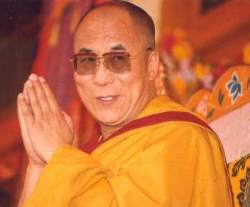
| "If there is love, there is hope to have real families, real brotherhood, real equanimity, real peace. If the love within your mind is lost, if you continue to see other beings as enemies, then no matter how much knowledge or education you have, no matter how much material progress is made, only suffering and confusion will ensue. "Human beings will continue to deceive and overpower one another. Basically, everyone exists in the very nature of suffering, so to abuse or mistreat each other is futile. The foundation of all spiritual practice is love. That you practice this well is my only request. "No religion basically believes that material progress alone is sufficient for humankind. All religions believe in forces beyond material progress. All agree that it is very important and worthwhile to make a strong effort to serve |
| human society. To do this, it is important that we understand each other. In the past, due to narrow-mindedness and other factors, there has sometimes been discord between religious groups. This should not happen again. If we look deeply into the value of a religion in the context of the worldwide situation, we can easily transcend these unfortunate happenings. For, there are many areas of common ground on which we can have harmony. Let us just be side by side - helping, respecting, and understanding each other - in common effort to serve humankind. The aim of human society must be the compassionate betterment of human beings." The Dalai Lama |
 |
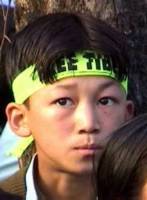
| A New Incarnation - A year after fleeing from Tibet, the Karmapa is lonely, isolated - and starting to speak his mind. In his homeland of Tibet, he was special from birth, though his family wasn't aware of it. But at the tender age of seven, Ugyen Trinley Dorje was proclaimed the 17th incarnation of the Karmapa, the leader of Tibet's oldest Buddhist sect, and young Dorje began a life of utter uniqueness. Spiritually, as the central figure for an entire sect, he was raised in a monastery surrounded by devout followers decades older than himself. Politically, he would eventually confront the choice of becoming either a Tibetan quisling, doing Beijing's bidding, or an independent thorn in China's side like the Dalai Lama, the leader of Tibet's youngest (but most powerful) Buddhist sect. The Karmapa chose the latter, escaping from the Tsurphu Monastery northwest of the capital, Lhasa, 15 months ago to join the Dalai Lama in exile in India. And now Tibet's most celebrated prodigal son leads a life even weirder - and to date, less happy. He spends his days in an empty monastery with his sister, who had escaped earlier from Tibet, a few retainers, a dog and a cockatoo. As a refugee in India, he is technically free to move around and even go abroad. In reality, he needs permission from Delhi and his minders for almost anything he does, including a walk in the monastery grounds. Though he lives in the cool hills of northern India, the weather is too hot for a boy raised in the mountains of Tibet. "Here in India, my mind is a little un-clear," he says. "I think it might be the difference in climate." Be that as it may, the Karmapa's thinking - why he left China, what he plans to achieve in exile - is becoming clearer to the outside world. Following a low-key 15 months of adjustment, the 16-year-old is starting to tell the world about his role in the long-running standoff between China, which wants unadulterated control over Tibet, and an exile movement still hoping for a level of autonomy that can save their culture from being stamped out forever. "There was no doubt in my mind that China was planning to use me," he said in Dharamsala last week. When asked if he left a letter behind when he escaped, as Beijing claims, the Karmapa says he did. And did he write, as Beijing reported, that he was visiting India for the purpose of collecting religious instruments and a black hat, the symbolic crown of the Kagyupa, or Black Hat, sect? "There was no mention in it at all of the black hat," he says. "What would be the purpose of taking it back to China - to put it on Jiang Zemin's head?" By tradition, the Karmapa isn't supposed to engage in politics, but this son of nomads is already emerging as a deft diplomat. He describes the Dalai Lama as "the supreme leader of Tibet" and says he endorses "everything the Dalai Lama stands for"- without actually mentioning autonomy, independence or any other idea that would be a red flag |
| waved at Beijing. If anyone in China had been hoping to work out a separate deal with the boy, they might want to reconsider. The Karmapa insists he will only return to Tibet when the Dalai Lama does. "I will go back with him," he says. The Dalai Lama has helped guide the boy's education in India, urging high lamas of the sect to expose the Karmapa to influences beyond his immediate circle of tutors and religious teachers. "In his separate way, the Karmapa is a prisoner of his Kagyupa sect just as the Dalai Lama was a prisoner of his Gelugpa (Yellow Hat) sect and the Tibetan court in Lhasa," says a close friend of the Tibetan leader. It was only when the Dalai Lama fled to India at the age of 23 that his intellectual liberation got under way. The almost father-son relationship that has developed between the 66-year-old Dalai Lama and the Karmapa has given rise to speculation that over time the barriers that divide Tibet's four main Buddhist sects might disappear -and that the Karmapa might succeed the Dalai Lama as leader of the Tibet freedom movement when he dies. This would be a radical departure from the past, but Tibetans may need to adopt dramatically new approaches to their political lives with China bent on subjugation and, some would argue, cultural genocide. |
 |
| "Tibetan leaders are capable of reinventing themselves when necessary with quite astonishing success," says Tibet expert Robbie Barnett of Columbia University. The boy has gravitas, wisdom and a spiritual maturity that impresses people who meet him - plus a laptop, which he hopes one day to use for e-mail. But the happiest moments of his life, he says, were in childhood before he was "recognized." And what he misses most, he says, is his mother and father. He may be the world's oldest incarnate lama, he may be the embodied hope of a whole people. But at 16 he is also still - just a kid. (MAY 14, 2001, by Michael Fathers, Dharamsala ) |
| THE BODY, SPEECH AND MIND OF BUDDHA... The Body of a Buddha - What is a Buddha? A Buddha is someone who has abandoned all unwholesome action, all obstructions to knowledge and their remnants. When one abandons unwholesome action, an imprint remains on the mind which acts as an obstructions to knowledge, just as when one drops an onion from one's hand, a smell remains on it. The Buddha has abandoned even the last remnants of these obstructions to knowledge. He perceives the reality of all phenoena directly and has fully developed compassion through meditation, so he spontaneously works for the welfare of all beings. Over countless aeons, he has accumulated limitless merit through the practice of the perfections of giving, ethics, practice and effort and has meditated with a firmly stabilized mind on the antidote to the conception of an inherently existent self-emptiness. From the point of view of Tantra, he meditated on deity yoga, employing the many subtle and powerful means of Tantra, which enables one to attain Buddhahood in one lifetime. Although there may be countless Buddhas in any aeon, in the present aeon 1002 Buddhas are to appear as such, of whom four have already appeared. They are already Enlightened, but take birth as humans to demonstrate the twelve deeds of a Buddha and guide sentient beings towards Enlightenment. The tantric path to Enlightenment is peculiar to Shakyamuni's teaching and is otherwise very rare. Shakyamuni taught the sutras to ordinary disciples, in the form of a Buddha. However, he taught superior disciples the tantras in the form of a king or in the aspect of various meditational deities. There are many ways of representing the body of the Buddha. Though they may reveal different aspects, all are the Buddha's body in nature and offerings made to them are equal to those made to Buddhas themselves. Thus, the Buddha may be portrayed as a monk, like Buddha Shakyamuni, as slightly wrathful meditational deities such as Heruka, or Guhyasamaja, or as female deities such as dakinis, as wrathful male or female deities with ugly forms and animal heads, or as embracing consorts. There are also occasions when Shakyamuni Buddha is represented as a rabbit or an elephant, recalling exemplary deeds he performed in such lives during his career as a Bodhisattva. Similarly, religious images are also made of Arhats, those beings who have attained personal liberation, religious protectors and Lamas. If the image is a statue, it can be made of any material, whether clay, stone, wood or metal and while there are no restrictions on size, it must strictly adhere to the prescribed proportions and so forth. Whatever material is used, such images should be respected equally, a statue should not be valued more highly than another because it is made of gold and the other of clay. The same is true of two-dimensional images, which in Tibet were most commonly paintings on cloth, block prints or murals. |
|
 |
| volumes of commentries to teachings contained in the Kangyur composed by Indian scholars, and some commentaries to those written by later Tibetan scholars. Recently, translations of Buddhist texts have also begun to appear in Western languages. No matter what language is used to convey them, what distinguishes such texts or teachings is that their meaning is conducive to sentient beings' achieving Enlightenment. This is reflected in the subjects dealt with by Buddhist teaching. The Buddha is said to have given 84,000 instructions, which elaborate on all the afflictions and the means of overcoming them. When condensed, these can be included in the Three Baskets of Doctrine - so called because the original palm-leaf texts in India were contained in baskets. The Basket of Discourses explains the three trainings of ethics, meditative stabilization and wisdom, the Basket of Discipline explains ethical discipline and meditative stabilization, and the Basket of Knowledge explains the divisions of phenomena. When the Buddha was passing away, some people complained that he was leaving nothing behind to show them the way to Enlightenment. To this the Buddha replied that they would find what they needed in the texts recording the meaning of his words. To show appreciation and respect towards the Buddha's teachings, some texts were written out in gold, silver and other precious substances, especially the Discourse on the Perfection of Wisdom. In general, scriptures are kept carefully in a high clean place, also to denote respect. In temples, the statue of the Buddha, which may form the principal object of offering, is generally flanked by high stacks of books of scriptures which represent his speech. The Buddha's Mind - To represent the Buddha's mind, which is free of all obstacles and has acquired all knowledge, and to gain merit by paying respect to it, people have built stupas. The many aspects of a stupa symbolize many things, such as the ten wholesome actions, great compassion and the ability to help all sentient beings. Stupas were erected at the sites of Buddha Shakyamuni's birth, renunciation, attainment of Enlightenment and his passing into Parinirvana, as well as being built over the relics of previous Buddhas. Circumbulating them is a means of accumulating merit. In Magadha, an Indian kingdom at the time of the Buddha, there was an old stupa reduced to a mere mound. The Buddha circumbulated it, and when asked why, answered that there were holy relics within it. In response to a question from the gods of the Heaven of Thirty-three, the Buddha explained what to place as relics in a stupa. These are the four types of relics: Mantras written out on paper; Physical relics of a Buddha such as hair or nails, or objects used by him; Fragments of his bones, teeth and so forth; Other relics remaining after his cremation. After the Buddha's passing away and the cremation of his body, the people of many kingdoms argued over possession of his remains. A disciple finally settled the dispute by dividing the remains into eight, each portion being enshrined in a stupa in each kingdom. The custom of erecting stupas over the remains of great saints and lamas also continued in Tibet. In some cases, for example the Dalai Lamas, the whole body was enshrined. Stupas can be of any size and can be made of any suitable material. Relics, other than the four described above, such as statues, clothes or scriptures are also acceptable. For example, in Tibet, sets of thousands of stamped clay images would commonly be made to be placed in stupas. |
| The Buddha's Speech or Dharma - From the point of view of experience, the Dharma is ultimately the abandonment of afflictions and obstructions to knowledge in a being's mental continuum. The way to attain this true cessation is to follow a true path. The means of communicating this understanding is the speech of Buddhas and Bodhisattvas, which in written form comprises the collection of scriptures. Both of these are also referred to as the Dharma. When the Buddha spoke, countless beings each found in his words what benefitted him or her most and could understand it in his or her own language. Shortly after the Buddha's passing away, memorised collections of his teachings were recited in four different Indian languages, including Sanskrit. Later these were translated into Tibetan, Chinese, Mongolian, Korean, Japanese and so forth. The Tibetan canon includes the Kangyur, about 108 volumes consisting of translations of Buddha's own words, and the Tengyur, about 200 |
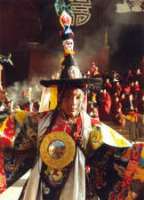
| the Tibetan government. Of these, the principal one is the Nechung oracle. Through him manifests Dorje Drakden (Nechung), the principal protector divinity of the Tibetan government and the Dalai Lama. It is because of this that Nechung Kuten is given the rank of a deputy minister in the exiled Tibetan government hierarchy. In his autobiography, Freedom in Exile, His Holiness the Dalai Lama writes: "For hundreds of years now, it has been traditional for the Dalai Lama, and the Government, to consult Nechung during the New Year festivals. In addition, he might well be called upon at other times if either have specific queries. I myself have dealings with him several times a year This may sound far-fetched to twentieth-century western readers. Even some Ti-betans, mostly those who consider themselves 'progressive,' have misgivings about my continued use of this ancient method of intelligence gathering. But I do so for the simple reason that as I look back over the many occasions when I have asked questions of the oracle, on each one of them time has proved that his answer was correct. This is not to say that I rely solely on the oracle's advice. I do not. I seek his opinion in the same way as I seek the opinion of my Cabinet and just as 1 seek the opinion of my own conscience. I consider the gods to be my 'upper house.' The Kashag constitutes my lower house. Like any other leader, I consult both before making a decision on affairs of state. And sometimes, in addition to Nechung's counsel, I also take into consideration certain prophecies. In one respect, the responsibility of Nechung and the responsibility of the Dalai Lama towards Tibet are the same, though we act in different ways. My task, that of leadership, is peaceful. His, in his capacity as protector and defender, is wrathful. However, although our functions are similar, my relationship with Nechung is that of commander to lieutenant: I never bow down to him. It is for Nechung to bow to the Dalai Lama. Yet we are very close, friends almost. When I was small, it was touching. Nechung liked me a lot and always took great care of me. For example, if he noticed that I had dressed carelessly or improperly, he would come over and rearrange my shirt, adjust my robe and so on. Nechung has always shown respect for me. Even when his relations with the Government have deteriorated, as they did during the last few years of the Regency, he in-variably responds enthusiastically whenever asked anything about me. At the same time, his replies to questions about government policy can be crushing. Sometimes he just responds with a burst of sarcastic laughter. I well remember a particular incident that occurred when I was about fourteen. Nechung was asked a question about China. Rather than answer it directly, the Kuten turned towards the East and began bending forward violently. It was frightening to watch, knowing that this movement combined with the weight of the massive helmet he wore on his head would be enough to snap his neck. He did it at least fifteen times, leaving no one in any doubt about where the danger lay. Dealing with Nechung is by no means easy. It takes time and patience during each encounter before he will open up. He is very reserved and austere, just as you would imagine a grand old man of ancient times to be. Nor does he bother with minor matters: his interest is only in the larger issues, so it pays to frame questions accordingly. He also has definite likes and dislikes, but he does not show them very readily. Nechung has his own monastery in Dharamsala, but usually he comes to me. On formal occasions, the Kuten is dressed in an elaborate costume consisting of several layers of clothing topped by a highly ornate robe of golden silk brocade, which is covered with ancient designs in red and blue and green and yellow. On his chest he wears a circular mirror which is surrounded by clusters of turquoise and amethyst, its polished steel flashing with the Sanskrit mantra corresponding to Dorje Drakden. Before the proceedings begin, he also puts on a sort of harness, which supports four flags and three victory banners. Altogether, this outfit weighs more than seventy pounds and the medium, when not in trance, can hardly walk in it. The ceremony begins with chanted invocations and prayers, accompanied by the urgings of horns, cymbals and drums. After a short while, the Kuten enters his trance, having been supported until then by his assistants, who now help him over to a small stool set before my throne. Then, as the first prayer cycle concludes and the second begins, his trance begins to deepen. At this point, a huge helmet is placed on his head. This item weighs approximately thirty pounds, though in former times it weighed over eighty. Now the kuten's face transforms, becoming rather wild before puffing up to give him an altogether strange appearance, with bulging eyes and swollen cheeks. His breathing begins to shorten and he starts to hiss violently. Then, momentarily, his respiration stops. At this point the helmet is tied in place with a knot so tight that it would undoubtedly strangle the Kuten if something very real were not happening. The possession is now complete and the mortal frame of the medium expands visibly. Next, he leaps up with a start and, grabbing a ritual sword from one of his attendants, begins to dance with slow, dignified, yet somehow menacing, steps. He then comes in front of me and either prostrates fully or bows deeply from the waist until his helmet touches the ground before springing back up, the weight of his regalia counting for nothing. The volcanic energy of the deity can barely be contained within the earthly frailty of the kuten, who moves and gestures as if his body were made of rubber and driven by a coiled spring of enormous power. There follows an inter-change between |
|
 |
| Nechung - The State Oracle of Tibet - Like many ancient civilizations of the world, the phenomenon of oracles remains an important part of the Tibetan way of life. Tibetans rely on oracles for various reasons. The purpose of the oracles is not just to foretell the future. They are called upon as protectors and sometimes used as healers. However, their primary function is to protect the Buddha Dharma and its practitioners. In the Tibetan tradition, the word oracle is used for a spirit which enters those men and women who act as mediums between the natural and the spiritual realms. The mediums are, therefore, known as 'kuten,' which literally means, "the physical basis." In early times it is believed that there were hundreds of oracles throughout Tibet. Today, only a few survive, including those consulted by |
| Nechung and myself, where he makes ritual offerings to me. I then ask any personal questions I have for him. After replying, he returns to his stool and listens to questions put by members of the Government. Before giving answers to these the Kuten begins to dance again, thrashing his sword above his head. He looks like a magnificent, fierce Tibetan warrior chieftain of old. As soon as Dorje Drakden has finished speaking, the Kuten makes a final offering before collapsing, a rigid and lifeless form, signifying the end of the possession. Simultaneously, the knot holding his helmet in place is untied in a great hurry by his assistants, who then carry him out to recover whilst the ceremony continues. Surprising as it may seem, the oracle's replies to questions are rarely vague. As in the case of my escape from Lhasa, he is often very specific. But I suppose that it would be difficult for any scientific investigation either to prove or disprove conclusively the validity of his pronouncements. The same would surely be true of other areas of Tibetan experience, for example the matter of tulkus (reincarnate lamas)." (Courtesy The Gov't. of Tibet in Exile) Disclaimer: All images and articles retain the original copyrights of their original owners. |
 |
 |
 |
| Visit our main Buddhism site. More information, images, and, NO pop-ups! |
 |
 |
 |
| Last Update: March 6, 2005 |