 |
 |
| Page 42A |
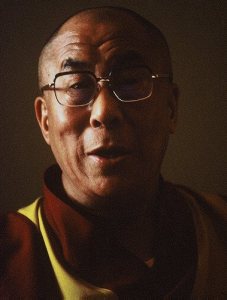
| �No matter whom I meet and where I go, I always give the advice to be altruistic, to have a good heart. From the time when I began to think until now I have been cultivating this attitude of altruism. This is the essence of religion; this is the es-sence of the Buddhist teaching. We should take this good heart, this altruism, as the very basis and internal structure of our practice, and should direct whatever virtuous activities we do towards its increase higher and higher. We should suf-fuse our minds with it thoroughly, and should also use words, or writings, as means of reminding ourselves of the practice. Such words are the �Eight Stanzas for Training the Mind� written by the Ga-dam-ba Ge-shay Lang-ri-tang-ba (1054-1123); they are very powerful even when practiced only at the level of enthusias-tic interest. I recite these verses every day and, when I meet with difficult cir-custances, reflect on their meaning. It helps me� If this helps your mind, prac-tice it. If it does not help, there is no debate; just leave it. The Dharma, or doc-trine, is not for the sake of debate. These teachings were spoken by the great masters in order to help, not for people to quarrel with each other. Were I as a Buddhist to quarrel with a person of some other religion, then I think, if the Buddha were here today, he would scold me. The doctrine is to be brought into our own mental continuum for the sake of taming it. In conclusion, my request, |
| my appeal, is that you try as much as you can to develop compassion, love and respect for others to share others� suffer-ing, to have more concern for others� welfare, and to become less selfish. Whether you believe in God or not, in Buddha or not, does not matter. The important thing is to have a good heart, a warm heart, in daily life. This is the principle of life. The Dalai Lama Eight Stanzas for Training the Mind... 1- With a determination to accomplish the highest welfare for all sen-tient beings who surpass even a wish-granting jewel, I will learn to hold them supremely dear. 2- Whenever I associate with others I will learn to think of myself as the lowest among all and respectfully hold others to be supreme from the very depths of my heart. 3- In all actions I will learn to search into my mind and as soon as an afflictive emotion arises endangering myself and others will firmly face and avert it. 4- I will learn to cherish beings of ill nature and those pressed by strong sins and sufferings as if I had found a precious treasure very difficult to find. 5- When others out of jealousy treat me badly with abuse, slander, and so on, I will learn to take all loss and offer the victory to them. 6- When one whom I have benefited with great hope unreasonably hurts me very badly, I will learn to view that person as an excellent spiritual guide. 7- In short, I will learn to offer to everyone without exception all help and happiness di-rectly and indirectly and respectfully take upon myself all harm and sufferings of my mothers. 8- I will learn to keep all these practices undefiled by the stains of the eight worldly conceptions and by understanding all phenomena as life illu-sions be released from the bondage of attachment. |
| A Way of Peace through India and Florence - As an American contemplative Christian I am grateful to have been included as a participant in the Ways to Peace pilgrimages to India and Florence. I grew up Lutheran in the 1950�s, in a denomination that had effectively repressed its contemplative heritage when it severed its connection with Rome during the Reformation. Through the gateway of zazen and Taoist meditation (as a Dartmouth undergraduate in the late 60�s), I found out that just sitting and doing nothing could be, in the spiritual dimension, doing something. This was a startling revelation for a Midwestern, working class guy like me who had always been taught that being non-pro-ductive, even for a moment, was sloth, a shameful sin. With the help of writers Thomas Merton, Alan Watts, and D.T. Suzuki, I gradually realized that perhaps meditation could also be a bone fide Christian experience. It was St. John of the Cross who finally escorted me across the threshold into the mainstream of the Catholic mystical tradition. It was St. John who taught me that "emptiness" can indeed be a kind of Zen spaciousness, but also a living dimension of Presence in which God is working to purify my mind and heart. Under the tutelage of some counter-cultural Carmelite monks in New Hampshire, I joined the Catholic church and became a Third Order Carmelite in 1973. Since 1984 I have worked and played in the fields of the Buddhist-Christian dialogue. Today I am the director of a lay Christian contemplative community called the Empty Bell in Watertown, Massachusetts. Part of our mission is to bring Christians and Buddhists together. I have taken part in many interfaith dialogues over the years. In the 1970�s and 80�s most of these sessions were between Japanese Zen Masters and scholars and Roman Catholic theologians, monks and nuns. However, in the last ten years, the audience has become more discerning and more diverse. Today, many more Protestants and lay peo-ple are involved in interfaith meditation and sharing. Many Americans who grew up Christian have flocked to the work of Vipasyana (Insight Meditation) Buddhist teachers Joseph Goldstein (Insight Meditation and Seeking the Heart of Wisdom), Sharon Salzberg (Loving-Kindness) and Jack Kornfield (A Path With Heart) and to the popular work of Tibet-an Buddhists Chogyam Trungpa (Cutting Through Spiritual Materialism), Pema Chodron (Start Where You Are, and The Wisdom of No Escape) and the Dalai Lama (The Art of Happiness and The Meaning of Life). Sometimes these Christians have left their own tradition to become Buddhist. But increasingly, Christians realize that they can integrate Buddhist insights into their own spiritual life. Of all the Buddhist traditions (and there are many), it is the Tibetans who have most actively reached out to Christians. In Florence the Dalai Lama told us that while he is in dialogue with all the great world religions, he cherishes a special relationship with Christians. In some important spiritual dimensions, we |
| other holy teachings in our tradition with the open-heartedness that Jesus manifested and taught. Fr. Laurence and the Dalai Lama go forward in this Buddhist-Christian dialogue with the understanding that they are not trying to convert one another. They are simply doing what friends do, sharing with one another what is most important to each, not want-ing anything from the other. Fr. Laurence stands firm in his Christian faith, and the Dalai Lama told us clearly, "I do not want to become a Christian." They exemplified for me a very powerful and precious model of how one might com-pletely open one�s mind and heart to someone very different, all the while not losing one�s own self, vision and commit-ments. There is in both men a capacity to listen deeply to the other without pre-judgment, and to let some new truth emerge, while at the same to know his own identity and mission in life. This is an extremely subtle and mature skill, a way of being that calls each of us to a higher standard of love, wisdom and compassion. As a psychologist I can say that this high standard may not be attainable by everyone. One must have roots within one�s self, and indeed possess a self before one can throw the self�s doors open to the Other. Perhaps many people in this world are too wounded to appreci-ate the depth of compassionate surrender that the Dalai Lama and Fr. Freeman practice and advocate. Many of us have fragile egos and fearful, hardened hearts that cannot often tolerate this level of openness. Still, I believe that the way of love is attainable in a suffering, often violent world. Certainly, those of us who feel drawn to deeper disciplines of the mind and heart can learn from Buddha and Jesus and the masters in their respec-tive traditions. But there seemed to be agreement in India and Florence that even the most powerful spiritual disciplines cannot be practiced in isolation within ourselves or even within our own communities. Because more and more of our local problems are global prob-lems, we must create communities of presence and compassion that transcend the boundaries of our unique, inherited religious faiths. The Way of Peace has offered me some hints of how this might be possible. Thank you. (Courtesy of Dr. Robert A. Jonas @ http://www.emptybell.org) |
 |
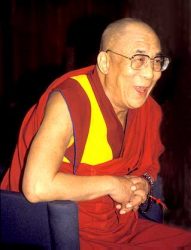 |
| Christians have more in common with the Tibetans than with Zen or Vipasyana practi-tioners. Though Tibetan Buddhists do not believe in our God, they seem more friendly to the devotional sensibility of Christians, and in their Tibetan tantric practices more inclined to see the fundamental importance of the 'I-Thou' encounter. Like us Chris-tians, the Tibetans sense a deep relationality in their "emptiness." As a participant in the India and Florence portions of the Way of Peace I thought that Fr. Laurence Free-man and the Dalai Lama were ideal representatives of their different religions. They are both smart, educated and well-informed, sincerely disciplined in their practices of meditation and prayer, and, perhaps most importantly, generous and kindly toward one another. Both seem happy in one another�s company. Both men can stretch their arms wide enough to hold with compassion and patience the incredible diversity within their own communities. They both manifest a gracious humility about their work and their views. I will always remember the moment when His Holiness the Dalai Lama was leav-ing our place of dialogue near Florence, the Villa Saint Leonardo Al Palco, a Benedic-tine "Opere Ritiri Spiritual, to give a talk in Florence. As he descended the stone stairs in the orangeing light of late afternoon, a group of about 20 European admirers waited |
| breathlessly for him near the edge of the parking lot. In front of him, behind him and beside him walked armed Italian police and above us hovered a blue and white police helicopter. One young European woman in the group stood out for me. As the Dalai Lama approached she bent forward, smiling broadly. She shuffled forward into his path, holding out a white scarf. As he approached her with his palms pressed together in greeting to the group, the woman looked up at him with such intensity that her eyes might have popped out of her head. On her face I saw a fluid, complex mix of emotion - hope, fear, love, reverence, and so much longing--perhaps to touch His Holiness, perhaps to be blessed or healed by him. Her need seemed so great that, in embarrassment for her I averted my eyes. She seemed too far outside herself, perhaps wanting more from this man, Tenzin Gyatso (the Dalai Lama), than he could possibly deliver. I thought of the messianic political expectations that, in a time of great despair, were put upon Jesus. Indeed, the power of the Holy Spirit, Jesus himself became a doorway to God, who he said was greater than him. But as we�ve learned over the centur-ies, even Jesus can be idealized in a way that prevents his followers from realizing their own complete gifts of the Spirit. Jesus�s message, especially in the Gospel of John, was to wash our feet, be our friend, and to share everything that he had with us. Christ-in-us gives away the special, higher place. Many ethnic Tibetans and Euro-American Tibetan Bud-dhists believe that this man Tendzin Gyatso, is a god, though he himself tells us with a compassionate smile, "I am only a simple monk." Still, in India and Florence I wondered how one person, being the recipient of such fervent devotion, idealization and projection, can remained centered. In this moment, on the steps of our monastery, I saw how the Dalai Lama�s behavior is so completely congruent with his statements about himself. He may see many things in the eyes and bodies of his followers, but in his wisdom he always sees to still another depth, to the origin of the person�s subjectivity. And in each person�s depths, no matter how wounded he or she is, he sees the Buddha-nature waiting to be born. And that is what he bows to in each person. I watched as His Holiness paused to be with the group on the terrace. His body-guards and the many police waited and watched with some anxiety. I�m sure that in each person�s eyes, in the eyes of the woman, His Holiness saw the hope and wisdom of the Buddha because that is where he sees from. So, even now, though he was already late for his address to thousands of people in the city, an engagement packed into a strenuous schedule with us, and between an exhausting trip to England and another approaching trip to Munich, the Dalai Lama lingered, bowing to each person and to the woman, and then exchanging the traditional greeting of the white scarves. I thought, "What a simple, gracious human being!" When asked what is the source of his happiness and wisdom His Holi-ness replies that it is entirely due to the practices of meditation that are the gift of his tradition. Each morning he arises before dawn to meditate and to pray, and he finds additional quiet times each day. But in a way, he is always meditating, very much in the flow of what we Christians would call "unceasing prayer." One morning, after accompanying His Holi-ness to Florence for a public talk, Fr. Laurence told us that when His Holiness finally joined him in the waiting limou-sine after walking slowly through a gauntlet of admiring, clapping and crying Florentines, he immediately began to pray. And that is how he stays focused in his heart. All his experience must come through the heart of prayer, through Buddha�s desire for the liberation of all beings from the bonds of illusion, attachment and ignorance. In his humanness, the Dalai Lama has his own teachers to whom he feels responsible. One of them is the great Buddhist teacher and hermit, Milarepa. Once at the Florence dialogue His Holiness told the story of how Milarepa was so unattached to fame that he wanted to die unknown in a cave. "But,"he added, "I am not as perfect as Milarepa. I will get a gold watch." In the presence of His Holiness, Tenzin Gyatso, no one can take him or herself too seriously. In India, when someone in our group asked His Holiness why the Tibetans seem so happy while most Christian ministers and priests seem so dour, His Holiness, who doubtless has observed the same fact, graciously shifted the spotlight to such differences within his own Buddhist community. But later, when comic relief was needed again, Fr. Freeman offered his response with a smile, saying, "I want to come back to the question about the stiffness of Christian leaders [evoking much laughter in the room]. Just to disprove the theory, I will tell a joke. It�s about Pope John XXIII in the early 1960�s. A reporter asked him, �How many people work in the Vatican?� And he answered, "About 10%." Always, in India (in the shadow of Chi-na and its occupied Tibetan territory) and in Florence (almost within sight of the vapor trails of the NATO jets attacking Milosevic�s army) our critically important talks went on in an atmosphere of good humor. Of course, the dialogues in India and Florence touched upon many serious teachings of spiritual practice from the Buddhist and Christian tradi-tions. In Florence we discussed the differing roles of icons, the imagination, and of scripture in each tradition. We spent many fascinating moments lingering on subtle linguistic distinctions, such as the true nature of Buddhist and Christian "emptiness." But I think that both leaders and most of the participants came to emphasize the importance of acting with compassion in each moment toward one-self, others, and all sentient beings in creation. There was general agree-ment that merely adhering to dogmatic state-ments of faith in either tradition is, in itself, not an authentic spirituality. Nor is having the "correct" theology sufficient. Buddha, Jesus and the great teachers in both traditions hope that we |
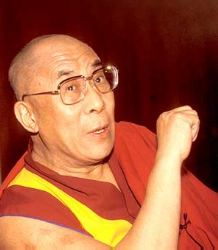 |
| will become something and live something, not merely think something or feel something. In Florence both Fr. Freeman and the Dalai Lama emphasized how im-portant it is to have a daily practice of meditation, a practical way to discipline our unruly minds. As a Christian who is familiar with Jesus� many admonitions to love and to have compassion, I was particularly struck by the Dalai Lama�s detailed observations of compassion. He said that there are three parts to compassion: 1) Intending to attain perfection and Enlightenment for the benefit of others. 2) Opening to genuine empathy and connectedness to others, even our enemies. 3) Seeking and acquiring a good, sound intellectual understanding of suffering. His Holiness, in characteristic humility, shared how even after his many years of com-mitment and practice, he is still learning the depths of these dimensions of compas-sion. Fr. Laurence appreciated His Holiness�s comments, not only for having learn-ed some facts about Buddhist practice, but also for hearing such a deep resonance with the teachings of Jesus. We too seek the compassion of Christ and his self-emptying for others. We too seek Christ�s presence in relationship with our ene-mies. And we too seek to integrate an intellectual understanding of scripture and |
|
| His Holiness 17th Karmapa - Urgyen Trinley Dorje In the tradition of the Karmapas His Holiness Rang-jung Rigpe Dorje, the 16th Gyalwa Karmapa had predicted his own successor by writing a sacred letter disclosing his incarnation. He specified the time and circumstances of his birth, the names of his parents and the location where he could be found. After the cremation ceremonies of the 16th Karmapa it was discovered that he had left two footprints in the ashes and they faced north to Tibet. The 17th Karmapa was born on June 26, 1985, the wood ox year, as described in the prediction letter. The 16th Karmapa had told his disciples in the West that the Chinese will welcome him with the greatest respect when he returns to his monastery in Tibet, and that is exactly what happened. He also told another dis-ciple that he will be back soon to help rebuild Tsurphu. Karmapa often talked to his close disciples about his love for Ti-bet and that his reincarnation will definitely be born purely Tibetan. He also said that his 17th incarnation will be much greater than his 16th and he will have a much bigger work to do in his life. Above all, His Holiness the Dalai Lama said, "there is a special meaning behind the Karmapa's decision to be reborn in Tibet" and therefore all the relevant proce-dures should be done very properly! On the day the search party arrived at Kalek Monastery, Karmapa awoke very ear-ly and said to his mother: "My monks are coming. Now I am ready to go to my monastery. It would be good if I could take with me a few gifts from Kalek Monastery." Fully convinced by their research that the group had indeed found the 17th Karmapa, Lama Domo, head of the search party, gave the father a copy of the sacred letter to read, and for the first time Karma Dondrup realized with certainty that his son was the reincarnation of the great 16th Karmapa. After- |
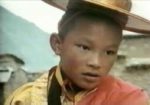 |
| wards Tsurphu Monastery informed Tai Situ Rinpoche and Gyaltsab Rinpoche. On June 9, 1992, Tai Situ Rinpoche and Gyaltsab Rinpoche informed His Holiness, the Dalai Lama about the details of the search and discovery of the 17th Gyalwa Karmapa. Even before the two Rin-poches informed him, the Dalai Lama had had a vision where he saw green mountains covered with meadows, and on the right and the left of the valley were two streams, while in the air the name "Karmapa" resounded. His Holiness felt great happiness and a deep joy through this vi-sion. Based on his impeccable wisdom, His Holiness the Dalai Lama gave his confirmation of |
| the reincarnation. On June 30, 1992, he granted the official letter with his seal, the Bhuktam Rinpoche. After he was escorted to Tsurphu on June 15th he had his hair-cutting ceremony in the Jokhang in Lhasa in the early hours of Au-gust 2, 1992. This was presided by Tai Situpa and Goshir Gyaltsab, and the gifts from His Holiness the Dalai Lama were presented to the Karmapa. According to the prophesy of Guru Rinpoche, found in the treasure of Chogyur Dechen Lingpa, the name, "Pal Khyabdak Rangjung Gyalway Nyugu Drondul Trinley Dorje Tsal Chokle Nampar Gyalway De," was offered to the Karmapa during this profound ceremony. His Holiness 17th Karmapa was enthroned at Tsurphu Mon- |
| His Holiness 17th Karmapa was enthroned at Tsurphu Monastery, the main seat of all the Gyalwa Karmapas on 27th September 1992. The Buktham Rinpoche, the sacred letter of prediction and the prediction of the Nechung oracle were offered to the 16th Gyalwa Karmapa among many other special ritual offerings during the enthronement ceremony. The first section involved the reading of letters from officials in the government, and the official certificate was offered to His Holiness the 17th Kar-mapa, along with the offering of white scarves ("khatas"). The second part was the traditional religi-ous ceremony, which lasted for a much longer period of time, at least over four hours. This time Kar-mapa sat high on his throne. Tai Situ Rinpoche explained the religious significance of the enthrone- |
 |
| ment as a consecration in both Tibetan and English. The sacred investiture was followed by traditional offerings to His Holiness Karmapa from the more than 300 Tulkus and monastery representatives of Dharma centers and governments spanning four continents, including our own two resident lamas, Venerable Lama Karma Samten and Venerable Lama Karma Shedrup, accompanied by a party of five Karma Choeling members. |
|
| For high-ranking lama who fled to India, 'Sun of Freedom Rises'... (May 1, 2001) Dharmsala, India -- As a refugee home goes, it's not bad: The snow-flecked Himalayas are in the distance and the rooms are decorated with mag-nificent applique pictures of deities and brocade furniture. But for a 15-year-old high-ranking Tibetan Buddhist monk who was confined to the Gyuto Monastery until winning refugee status recently, it was like a prison. Now, "it's as though the sun of my freedom is starting to rise," says Ugyen Thinley Dorje, the 17th Karmapa - and the only senior lama to be recognized by both China and the Dalai Lama, the supreme leader of Tibetan Buddhists. Since his escape from Tibet in January 2000 after an 875-mile trek over the Himalayas, the Karmapa has been living in Dharmsala, the northern Indian home of the Tibetan government-in-exile. The Karmapa's arrival came at a sensitive time for India, just as its often-tense relations with China were on the mend. This was the reason his movements were restricted for so long, and may still account for his reluctance to criticize China. In February, he was granted refugee status by the In-dian government and has taken advantage of his freedom by undertaking a pilgrimage to some of India's Buddhist holy sites. He spends his time writing poetry and studying Buddhism, computers and English. "I think that nowadays in this world the study of languages is very important and also the study of the technology that we employ in our daily lives, so these are two interests of mine," he told a news conference Friday. "I know a little bit about how to use a computer, al-though not that much, and I don't yet have Internet access." The English lessons appear to be paying off, as he smiled and nodded at questions well before they had been translated for him. At the end of the news conference, he read a pre-pared statement in competent if accented English. And his answers to questions suggested a maturity beyond his years. Still, the Karmapa dismisses speculation that he is being groomed to one day succeed the Dalai Lama, now 66, as leader of Tibetan Buddhists. "I'm fairly young now and I must complete my studies, my education in Buddhism," he said. Al- |
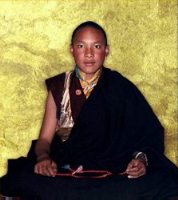 |
| though the Karmapa is now free to travel around most of India, he has been barred from visiting two places. One is Sherabling Monastery, the home of his tutor, Tai Situ Rinpoche, just 30 miles away. He called the ban on visiting Sherabling "baffling." There was speculation it was due to security con-cerns. The other is Sikkim state, bordering China, where a monastery founded by his predecessor is at the center of a bitter dis-pute over succession - a faction in the Kar-mapa's Karma Kagyu sect has put forward a |
| rival claimant to be the true incarnation of the Karmapa. The Karmapa said his great-est desire was to take a seat at the Rum-tek Monastery in Sikkim. But with the re-gion at the center of a territorial dispute be-tween India and China, this seems unlikely any time soon. As for returning to Tibet, the Karmapa said that he would only do that in the company of the Dalai Lama. In the meantime, the Karmapa said he hoped to travel overseas, both for his own education and to impart the teachings of the Buddha. |
|
| After His Enlightenment, He went to the Deer Park near the holy city of Benares and shared His new understanding with five holy men. They understood immediately and became His disciples. This marked the beginning of the Buddhist community. For the next forty-five years, the Buddha and his disciples went from place to place in India spreading the Dharma - His Teachings. Their compassion knew no bounds, they helped everyone along the way, beggars, kings and slave girls. At night, they would sleep where they were; when hungry they would ask for a little food. Wherever the Buddha went, he won the hearts of the people because he dealt with their true feelings. He advised them not to accept his words on blind faith, but to decide for themselves whether his teachings are right or wrong, then follow them. He encouraged everyone to have compassion for each other and develop their own virtue, "You should do your own work, for I can teach only the way." He never became angry or impatient or spoke harshly to anyone, not even to those who opposed him. He always taught in such a way that everyone could understand. Each person thought the Buddha was speaking especially to him. The Buddha told His followers to help each other on the Way. Following is a story of the Buddha living as an example to his disciples... Once the Buddha and Ananda visited a monastery where a monk was suffering from a contagious disease. The poor man lay in a mess with no one looking after him. The Buddha himself washed the sick monk and placed him on a new bed. Afterwards, He admonished the other monks. "Monks, you have neither mother nor father to look after you. If you do not look after each other, who will look after you? Whoever serves the sick and suffering, serves me." Disclaimer: All images and/or articles retain the original copyrights of their original owners. |
 |
 |
 |
| Visit our main Buddhism site. More information, images, and, NO pop-ups! |
 |
|
 |
| Last lUpdate: 11/29/04 |