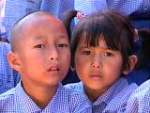
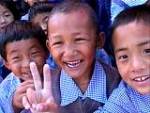
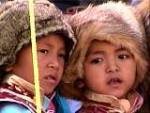
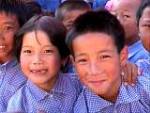
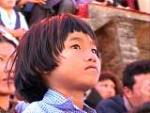
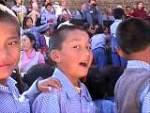
Tibetan Children's Villages - 40th Anniversary Celebration 1960-2000 The children on this page are just a very small number of the 20,000+ Tibetan orphans now living in the Tibetan Children's Villages (in India). Tibetan Children's Village (TCV)is an integrated community for the care and education of orphans, semi-orphans and destitute Tibetan children in exile. It is a registered, non-profit charitable institution with its parent organization based in Dharamsala, northern India. TCV has many brances spread across India, with over 20,000+ (and increasing daily) children under its care. It is also a member of SOS Kinderdorf International, Vienna. All the children
Page 42
The World...Don't practice an ignoble way of life, don't indulge in a careless attitude. Don't follow a wrong view, and don't be attached to the world. Wake up and don't be careless, but lead a life of well-doing. He who follows righteousness lives happily in this world and the next. Lead a life of righteousness, and not a life of wrongdoing. He who follows righteousness lives happily in this world and the next. Look on the world as a bubble, look on it as a mirage. The King of Death never finds him who views the world like that. Come; look at the world as a gilded royal carriage, in which fools get bogged down, while men of understanding have no attachment to it. Even if previously careless, when a man later stops being careless, he illuminates the world, like the moon breaking away from a cloud.
When a man's bad deeds are covered over by good ones, he illuminates the world, like the moon breaking away from a cloud. Blinded indeed is this world. Few are those who see the truth. Like a bird breaking out of the net, few are those who go to heaven. Wild swans take the path of the sun. Men with powers travel through space, but the wise step right out of the world, by conquering Mara and his host. When a man has already violated one rule, when he is a liar and rejects the idea of a future world, there is no evil he is not capable of. Miserly people certainly do not go to heaven. Fools for sure do not praise generosity, but the wise man who takes pleasure in giving is thereby happy hereafter. Better than being sole king of the whole earth, better than going to heaven or sovereignty over the whole universe is the fruit of becoming a stream-winner. Buddha
in TCV live in groups called a "Khim-tsang" - a typical Tibetan home with two foster parents. Each of these homes (Khim-tsangs) is a self-contained family group with its own house, kitchen and other facilities. Children are rasied as "brothers" and "sis-ters" and share the household chores with their foster parents. During the day, children attend the school which is in the village, and in the evening they return to their Khim-tsangs to be with their "family." In addition to looking after the physical, mental and spiritual needs of the children, TCV seeks to: 1- provide the best of modern education - along with a deep and intimate understanding of the rich cultural heritage of Tibet. 2- cultive a sense of national identity that will enable the children to share the hope of the Tibetan people to return someday to a free and independent Tibet. 3-help young boys and girls become self-reliant, contributing members of society and the world community. THUKJE-CHE is a Tibetan word for Thank You. "I want to thank all those individuals and organizations who have very kindly contributed in enabling TCV to become what it is today. I am confident that the staff and all concerned will further enable Tibetan Children's Villages in achieving our long-term, important goals.The Dalai Lama
.
ANANDA - The Buddha had no regular attendant during the first twenty years of His min- istry. Several monks used to attend the Buddha, accompany Him on alms rounds and carry His extra robes and bowl. The monks who served Him were Nagasamala, Nagita, Upavana, Sunak-hatta, Cunda, Sagata, Radha and Meghiya. These monks did not always obey His instructions. For example, one day when the Buddha and Venerable Nagasamala came up to a junction, the Venerable Nagasamala decided to go one way although the Buddha suggested that they should go the other way. The monk went along the road of his choice where he was robbed and beaten by highway robbers. He came back to the Buddha to be reminded of his disobedience and be consoled. On another day, as the Buddha was on His way to the village of Jantu, Venerable Meghiya who accompanied Him wanted to stop by a mango grove and practice asceticism. Thrice the Buddha advised him against this, but he went his way. Eventually he returned to the Buddha and confessed that he had failed in his practice because almost all the time he was in the grove, three kinds of evil thoughts disturbed his mind: thoughts of sensual desires, ill-will and thoughts of cruelty. When the Buddha came to the Jetavana Monastery in Savatthi, He said, "Now I am old, Bhikkhus. When I say, 'Let us go this way,' some go the other way; some drop my bowl and robe on the ground. Choose out one disciple to attend always on me." The Buddha was fifty-five years of age at that time. The Venerable Sariputta and Moggallana both volunteered their services, but the Buddha did not accept as they had other valuable services to perform to the world. The offers of other disciples were also turned down. As Venerable Anan-da was silent, waiting to be nominated by the Buddha Himself, other monks advised him to of-fer his services. The Buddha said, "It is not necessary for Ananda to be induced by others. He will serve me on his own accord." Venerable Ananda agreed to serve the Buddha regularly sub-ject to eight conditions: 1- He should not be given the robes received by the Buddha. 2- He should not be given the food received by the Buddha. 3- He should not sleep in the Fragrant Chamber of the Buddha. 4- He should not be asked to go with the Buddha to accept alms on in-vitation. 5- The Buddha should consent to invitations received by him. 6- The Buddha should give him permission to introduce visitors that come from afar to see the Buddha. 7- He should be allowed to consult the Buddha whenever he had any doubts to clarify. 8- The Buddha should repeat to him the discourses preached in his absence. After the Buddha consented to these eight conditions, Venerable Ananda became the regular attendant of the Buddha for twenty-five years. Venerable Ananda was the son of King Suddhodana's younger brother, and there-fore a cousin of the Buddha. He entered the Order of monks during the second year of the Buddha's ministry. Not long after, he attained the first stage of Sainthood (Sotapatti) on hear-ing the sermon given by Venerable Punna Mantaniputta. From the time he became the Bud-dha's personal attendant, he served the Buddha with devotion and care - up to the Master's last moments. Day and night, he served the Master. At night he would go round the place where the Buddha was resting to prevent His sleep from being disturbed. At the time of the awarding of ranks on the disciples, the Buddha recognized the Venerable Ananda as first among monks who are learned, mindful, well behaved and determined. He was greatly responsible for the es-tablishment of the Order of nuns (Bhikkhunis) and the planting of the Ananda Bodhi tree which still survives today near the Jetavana Monastery. Although Venerable Ananda had the rare privilege to listen to every sermon of the Buddha, he did not attain his Arahantship until after the Buddha had passed away. Venerable Ananda lived to one hundred and twenty years of age before he passed away. "I consider children to be the seeds of our future Tibet and it is inspiring to note that most of our establishments in exile are today manned by young educated Tibetans. I would like to stress here once again that we are now at a stage to make long-term plans of self-reliance in various specialized fields during our period of exile and more importantly, when we are able to return to Tibet with freedom. We need to make a concerted effort in this direction. I want to thank all those individuals and organizations who have very kindly contributed in enabling TCV to become what it is today. I am confident that the staff and all concerned will further en-able Tibetan Children's Villages in achieving our long-term, important goals. "I would like, on behalf of the Tibetans in and outside Tibet, to sincerely thank our supporters and friends. We are going through immeasurable hardship and suffering that is unprecedented in our history. The sympathy, support, and help that the people of the world, led by India, have accorded to us will forever be remembered and recorded in history." The Dalai Lama
Celebrities mark Tibetan uprising - Celebrities Richard Gere, Goldie Hawn and Annie Lennox are taking part in commemorations to mark the 40th anniversary of the Tibetan uprising against Chinese rule. Hollywood actors Gere and Hawn have visited the northern Indian town of Dharamsala to hear a speech by Tibet's exiled spiritual leader, the Dalai Lama. In London, singer Lennox is preparing to take part in a public reading. The events mark 40 years since a group of Tibetans started a rebellion against Chinese rule in the country. Troops crushed the revolt, but thousands of Tibetans were killed in the fighting and the Dalai Lama fled to India. In a 20-minute speech, heard by thousands of sup-porters, the Dalai Lama condemned Chinese repression in Tibet, and appealed for the Beijing Government to open talks on Tibet's future. Anniversary 'depressing and encouraging' After the speech, Richard Gere said: "I've been here for many, many years during the anniversary, but this one for me is the most depressing and the most en-couraging. It is depressing that in 40 years there has been little progress on the human rights front. The human rights situation is getting worse. Currently they (the Chinese) are carrying out a systema-tic genocide." But he felt there was growing international support for the Tibetan cause. "It is a clear case of David and Goliath and the world is now supporting David." Goldie Hawn said of the Dalai Lama: "His gift to the world is to remind all beings on this earth of their own potential to experience kindness and compassion. It hurts my heart that these gentle people have been the object for abuse. I meditate for the freeing of Tibet, and therefore the freeing of mankind." In recent years the Tibetan campaign has become a favourite cause for celebrities, particularly in the US.
"If we have a positive mental attitude, then even when surrounded by hostility, we shall not lack inner peace. On the other hand, if our mental attitude is more negative, influenced by fear, suspicion, helplessness, or self-loathing, then even when surrounded by our best friends, in a nice atmosphere and comfortable surroundings, we shall not be happy. So, mental attitude is very important: it makes a real difference to our state of happiness." The Dalai Lama
Karma concerns everyone. We make it, a great deal of it, every day while we are awake. We decide whether or not to get up - karma. (Good karma if one gets up vigorously, bad karma if slothfully or grudgingly.) Let's have a cup of tea, breakfast - maybe some greed is involved, so bad karma. We sympathize with someone's sickness and give help - good karma. We get flustered because the bus is late to take us to work - bad karma. Once we're there perhaps we get impa-tient with someone, or angry with them, or threaten them - worse and worse karma. But perhaps we are generous and kindly to someone there - excellent karma. Work brings on dull mental states, then we shake ourselves out of that listlessness and resentment (bad karma) and vigorously try to get back to mindfulness (good karma). In the crowded bus returning home someone stamps on one's foot, one curses - bad karma - but after quick reflection one realizes "Ah, no mindfulness" and this is good karma. At home at last, one comforts the sick, then plays with the children and tells them some Jataka stories - all good karma. But then, tired and dull, one switches the radio (and/or television) on and, not listening to it, leaves it on as a sound to drown silence; then one eats too much and feels lethargic - bad karma. But perhaps instead one pays respect to the Buddha-image, does some chanting and then meditates - all kinds of good kar-ma. When the body is tired one goes to sleep holding some meditation subject in mind - good karma. All these decisions, choices and desires are karmas made in the mind. More karma is made when one talks after having decided. Still more karma is added if after this one acts as well. "Good" and "bad" karma are distinguished by the roots of the actions. What is one's motivating force when one helps the sick? This is a case where there are various possibilities. Is it just be-cause one wants rich Aunty's money when she dies, or out of genuine compassion? Obviously, in the latter case much better karma is made. But there are examples where there is no doubt. One's toes are stamped on and one curses: this can never be good karma simply because it is rooted in hatred. Or one gobbles down too much food - just greed-rooted karma in this case. Again those dull or day-dream periods at work, not looking at things as they are at all, this is rooted in delusion. When any of the mentally defiled states of mind has arisen, when these three "roots of evil" are in control, then bad karma is sure to be made. Once it is made there is no way of erasing it or changing it and some day or other it will begin to fruit. The fruit of bad karma is never happiness, as we can read in these discourses. It always comes up as pain, anguish, frustration, or the limitation of opportunities. Who wants them? Then make no more bad karma! Every-one has laid in a stock already quite capable of giving rise to sufferings for lifetimes to come. There is no need to in-crease it. Everyone wants happiness! But it too arises conditionally. Now a great producer of happiness is the making of good karma. What is good about it? It is rooted in non-greed (generosity, renunciation), or in non-hate (loving-kind-ness, compassion) or finally in non-delusion (wisdom, understanding). The sure way to gain happiness, then, is to make good karma, as much as possible every day. It is only people who make a real effort to grow in Dharma (that is, to make good karma), who have any chance to succeed in meditation on the path to final liberation. Whatever one's goal in this life - happiness here and now, a good rebirth in the future, or to end the whole birth and death process by attainment of Nirvana, one cannot go wrong by making good karma. And what about those who do not believe in karma and its fruits? They still make it whether they believe or not! And they get the fruits of the karma they make, too. But the doing, not the believing, is the important thing.
"Do good, get good, do evil, get evil.
Disclaimer: All images and/or articles retain the original copyrights of their original owners.