 |
| Page 41A |
| (We were sent the folllowing story and thought it was quite interesting and so, even though it is dated 1997, we decided to reproduce it here...) Frank Wolf- As a U.S. congressman (R-Va), he has been involved in world human rights issues for years, in particular, religious persecution. In August 1997, Worlf travelled as a tourist to Tibet and with a home video camera and an inter-preter, he talked to many Tibetans. His unofficial visit enraged China. Q: Why did you want to go Tibet? And why did you go there the way you did, as a tourist? Wolf: Well, there are a number of reasons. First, we have in Congress a Freedom from Religious Persecution bill which puts the government of the United States on record against the persecu-tion of people of all faiths. Christians, Jewish, Moslem, Buddhist, Bah�'� Faith, etc. And we've heard many stories and testimony over absolute oppressive persecution of the Tibetan Buddhists. Secondly, some people told me how bad it was.... So rather than taking somebody at their word we wanted to go and get a firsthand experience and we went with-out asking permission from the Chinese government. I didn't go as a congressman, I just went as a tourist who was just looking at - the other sites. The Chinese government has denied visas to American congressmen whowanted to go and if they ever did grant you a visa, you would have a Chinese handler, a watcher who would be with you. Certainly the Tibet-an people would feel very uncomfortable speaking with you if you had a member of the Chinese military or the secret police or the security police with you. And so we went in on a tourist visa. We had with us a member of my staff and we also had an individual who is an American citizen but was raised in a Tibetan monastery and is totally fluent in Tibetan. And he was able to communicate with Tibetan people and so when we would go in and talk to them, they would tell us anything and everything we wanted to know and the Chinese government did not send somebody with us because we were just there - as tourists with cameras around our neck. Q: What did you see when you got there? Wolf: We saw a country that has been subjugated. I mean the Chinese have dominated the country now so much that Lhasa which is the capital - the forbidden city if you will - is no longer really a Tibetan city. It is actually a Chinese city. There are more Chinese I believe in Lhasa than there are Tibetans. We saw a lot of karaoke bars and the tackiness that has gone with some of the development that has taken place in China. We saw the growth industry - we had somebody take us out to look at all the prisons and we talked to people about the brutality in the prisons Further, we saw a lot of Tibetan buildings had been demolished. In fact, in front of the Potala which is the palace that the Dalai Lama lived in before he left the country, they bulldozed all of the Tibetan buildings and have turned them into a miniature Tiananmen Square with a Chinese MIG in the middle of it. It's very gross. I mean it's terrible. In the Tibetan market they bulldozed a lot of the homes, so we saw all that and in talking to people they were very concerned what was taking place with their cul-ture and we saw a number of monasteries that had been destroyed, some during the cultural revolution and some there-after. We saw a people that had been dominated by an outside force, by the Chinese government; the Chinese police and military are very very prevalent. There are cameras up on the tops of a number of buildings and they watch the Ti-betan people very closely, almost like the KGB did in the Soviet Union. Q: What was your impression of the current re-pression? Wolf: There is tremendous repression. We spoke to Tibetan monks and we spoke to people on the street, we would go up to them and say we're from the United States - speaking in Tibetan, not in English . They would call us off to the side, begin to tell us a member of their family had been in prison or tortured. Most of the monasteries or all the monasteries have a cadre of Chinese military that run the monasteries. It would be like your local church or synagogue or mosque - your minister or priest or rabbi would not run it, the military police would run it. Most of the monasteries limited the amount of monks that could be there. One woman we talked to was very outspoken. She cried and wept, never knowing that I was a congressman, and she said please tell President Clinton to help us - when the United States government speaks out and puts pressure on the Chinese government things get better. Prisoners get released but when the United States government is silent as it is now - you know things - things get worse. Also, the Tibetan people listen to Radio Free Asia and Voice of America. So they do know how things are going in the United States and that we are speaking out for them and they really look to us. These are some of the things that we saw. In addition, we saw ab-solutely beautiful and magnificent countrysides and beautiful mountains and that probably they are just a few of those still left untouched by the Chinese. It probably is, I think, one of the most beautiful places I've ever seen. Q: Can you put this in personal terms? How did the repression and what you saw affect you? Wolf: My personal view is one of an-ger, one of sadness. I mean you literally weep for the people there. Imagine living in an oppressive society where a domineering military occupation governs your every move, similar to what the Soviets did in East Berlin and to what they did in Poland. And I think perhaps the Chinese are more brutal than the Soviets. Secondly, it was sad to see this rich culture diminished - the word that was used by one individual was that cultural genocide was taking place. Also, the Chinese government is wreaking havoc with the environment. They're stripping areas of minerals and gold and similar materials. So my feeling is one of sadness and it has just rekindled or just made me more committed to doing every-thing I can, both to pass this bill that we have, the Freedom from Religious Persecution, which will help the people of Tibet, as well as people in other countries. But also to speak out on this issue. And we would hope that people would adopt prisoners of conscience. There are about 700 prisoners who we know of and we have their names and addresses of the prisons where they are being held, thereby allowing Americans to adopt them. We will write the Chinese govern- ment, we'll write the prisoners in prison, we'll write so the world knows that people in the United States care. If you re-call, this was a program that was done in the 70s and the 80s for the Soviet dissidents. Many groups and congregations and synagogues and individual civic groups adopted people of conscience in the Soviet Union and wrote to them and I was in one of the gulags in the Soviet Union during Communism and strangely enough the prisoners there said that by people in the West writing them made their life better. Sometimes the letters got to them. Many times the letters just got to the prison warden. Sometimes it just got to the Bureau of Prisons, but it made their lives better. I'm committed to do everything that I can to help the people and I think we've made a series of recommendations, I think more con-gressional delegations should attend. I think the Chinese government should open Tibet to the press. I think the press should have free rein to go wherever they want to go and film wherever they want to film and I think the more people in official capacity - should visit Tibet. I also would hope that our Bureau of Prisons and that Amnesty International and that Human Rights Watch and the other groups would be permitted to visit the prisoners and that the International Red Cross, which does such an outstanding job on this issue, would be invited to visit the prisons and interview the prisoners and see what the conditions are. I think the more we expose it and shed light on it, the greater the opportunity that things will get better for the Tibetan people. Q:How have things changed in the past few years in Tibet? Wolf: Well |
 |
| All is ephemeral, - fame and the famous as well. Accept the things to which fate binds you, and love the people with whom fate brings you together, but do so with all your heart. Never let the future disturb you. You will meet it, if you have to, with the same weapons of reason which today arm you against the present. When you arise in the morning, think of what a precious privilege it is to be alive - to breathe, to think, to enjoy, to love. Anything in any way beautiful derives its beauty from itself and asks nothing beyond itself. Praise is no part of it, for nothing is made worse or better by praise. How much more grievous are the consequences of anger than the causes of it. Marcus Aurelius Antoninus (121-180) Roman Emperor |
 |
| A mind that is sound and healthy is prepared to digest all sorts of accidents. A wise man, therefore , must neither run giddily nor impatiently and contemptuously into his grave. He must look on death as nature's business and wait her leisure. |
 |
|
 |
| when I was in Tibet it's fair to say that things have gotten worse than they were in the last several years. I think the Chinese are applying pressure and tightening the screws and the persecution is increasing. So if you look at it in the big picture, there were times that the Chinese were there and perhaps things were getting a little bit better. Now the Chinese are really there - they're flooding Tibet with Chinese and the condi-tions for the individual Tibetan is much worse today than it was three, four, five, six years ago. Their culture is being diminished. Many of the children are being sent to China so that they can learn and be taught in the Chinese language. The monks who transfer the teaching and the culture are being diminished. There are fewer and fewer people who are permitted to be monks. One woman cried and said "our monks are the people who teach us and now they're fewer and fewer." Surely the individual freedom to move around the country, individual freedom is gone. The standard of living is very, very low. And if you are caught with a picture of the Dalai Lama or perhaps you're saying free a prisoner or doing some demonstrating - you automatically go to jail for a long time. We asked some of the people who spoke to us what would happen if the pub-lic security police were to see us talking? These people took us back into private rooms and they said they would go to jail. They would go to jail for years and yet they took |
| that risk to talk to us to get the word out. So for the individual Tibetan it's very bad. Q: And what about the exiled Da-lai Lama - what is his status in Tibet? Wolf: When I was in Tibet, people would come up and ask us for pictures of the Dalai Lama although it is against the law to have pictures of the Dalai Lama. In all the monasteries we visited, there were no pictures of the Dalai Lama, they had all been removed, they were destroyed. I would have to tell you that the support of the Tibetan people for the Dalai Lama is total and complete. They support him both as their spiritual leader and also as their political leader. I've seen statements where the Chinese government states there is not support for the Dalai Lama. That's just not true. And although it is against the law to have a picture, in many places, there was a picture of the Dalai Lama. We did not bring any pictures - we did not want to violate the law and to live under police scrutiny while in Tibet, but the people desperately want to have a picture of the Dalai Lama yet all the pictures in the monasteries have been taken out. The Chinese are trying to eradicate the very exitence of the Dalai Lama. They're trying to decrease the faith. And, as you know, in 1995, the Panchen Lama was kidnapped and has been taken some-where in Beijing or wherever. I think the Chinese government knows that the support for the Dalai Lama is very, very strong and they're trying to do everything they can to eradicate or weaken that support. Frankly, the Chinese govern-ment, made up of a 1.2 billion people, has absolutely nothing to fear from five-and-half to six million Tibetans. I don't believe that the Tibetans are of any threat to the Chinese government. They are only looking for independence; they're looking for freedom. All they want is the freedom to continue to worship, as they have for so many years, and retain their culture, and have something that everyone wants, everywhere in the world - and that's freedom. Q: What do you hope will be the outcome of your visit? Wolf: The outcome of the visit we hope will do several things. First, I've provid-ed every member of congress, both the house and the senate, with a copy of my report. I've been very pleased with the number of members of congress who are interested in this issue, who are saying, "I want to learn, I want to know." Secondly, I hope we can heighten the sensitivity on this issue whereby the American people and those in the West will be educated on the persecution of the people in Tibet - but also the persecution of people in other countries. In main-land China there are Catholic priests in jail. Thirdly, hopefully the Clinton Administration which you know has delink-ed human rights and trade which I think is a fundamentally immoral policy - hopefully the Clinton Administration will raise the issue of the persecuted Buddhists in Tibet and will raise it with the president of China when he comes to visit and will continue to raise it, not only privately, not only with a little whisper, but publicly. But lastly, I hope it opens up Tibet, whereby the press and other other congressional delegations can go and have an exchange of thoughts and to keep asking questions, especially about the prisons? What's going on? Why are you torturing? I think that will have a good effect. And the whole purpose is to shine a spotlight on this issue. One problem is Tibet is far away. It is hard to get to and, the Chinese government continues to harass groups that want to go and so, I think, it's easy if it's not in front of us, if it doesn't stir our conscience to to just say, "Well, I I don't know what's going on; so, I'm not going to face it. Q: What can Americans, in particular, do? Wolf: Americans can do a lot. One thing they can do is contact their congressmen and their senators. They can also urge the Clinton Administration to speak out on this issue. This can be an issue of conscience. You know the words of the Declaration of Independence.... 'We hold these truths to be self- evident, that all men are created equal, that they are endowed by their Creator with certain unalienable Rights, that among these are Life, Liberty, and the pursuit of Happiness.' Those words were not only for Americans, they were men-tioned in Tiananmen and they're also for the people of Tibet. I think by speaking out and raising this issue it helps to move the congress and also it helps to move the administration. And lastly, I would hope there are theaters showing the various movies that are going to come out this fall that all these groups supporting a Free Tibet will stand outside with a one-page fact sheet about what's going on in Tibet and on the other side, the name, picture and address of the prisoner of conscience, with the hope that people will say, "I will adopt this person." "I will adopt this man/woman and I will write to him/her and bring focus and public attention to this issue." If that happens, I believe ultimately the people of Tibet will be successful in gaining their independence. If you had asked people in 1985, "Will the Berlin Wall fall? Will Communism go down?" Many people would have said, "Well maybe some day, I may not live to see it but I think it eventually will." Communism failed and I believe that with pressure, the oppression of the people of Tibet will fail and they will get their independence. Q: What do you think might be the impact from the two Hollywood films about Tibet (Kundun and Seven Years in Tibet). Wolf: I would hope the two films are effective in sensitizing the West to the fact that oppression and persecution are taking place in Tibet by the Chinese military and the secret police and result in the American people becoming mobilized and perhaps getting the Clinton Administration to change its fundamentally im-moral policy with regard to this terrible situation. Lastly, mobilizing the congress to deal with this issue and I would hope that the various student groups that are interested in this issue will not just be interested, but will also stand out-side all the movie theaters and pass out a flyer with one side telling what the conditions are in Tibet and on the other side information about dopting a prisoner of conscience and writing to them and also urging people to write to their con-gressmen and their senators and the Clinton Administration asking that they speak out on this issue of Tibet. Q: What do you think a company like Disney should do if threatened by China for making a film about the Dalai Lama? Wolf: Disney should do what any company has the right to do - do the right thing. If Disney allows itself to be backed down by the oppression and the threats of the Chinese government, do you realize what that means for the First Amendment and the freedom of speech and the freedom-in-general in this country? It will mean the bullies have been able to sneak into the United States and change our way of thinking. My understanding is that Disney will not back down; that they are going to continue with the production of the movie(s). I would hope that they would not change and I don't expect that they will. Q: There's a U.S.- China summit coming up in a few weeks, should it be taking place? Should there be |
 |
| loudspeakers in the prisons and the guards basically said, "See, nobody cares about you." Q: So what is the best way to change China's behavior - can we change China's behavior? Wolf: The Chinese are now developing weapon systems that are a direct threat to America and are a direct threat to American men and women that served in the military. They're also selling weapons to countries that are in opposition to the United States. So there is a military threat. That ought to be raised. There's also a threat with regard to human rights. In 1986, 250,000 people rallied on the mall here in Washington on behalf of the Soviet dissidents. That was a message that we deeply care. Ronald Reagan, if you recall, in Orlando, gave the 'evil empire' speech where he called the Soviet Union the evil empire as it was truly the evil empire. When I went to Perm Camp 35, the Gulag in the Soviet Union ...the men in the Gulag knew of Ronald Reagan's speech, they knew that the West was speaking out for them. The knew that people cared and so by speaking out and continual-ly pushing the ball of human rights out front defines who we are and what kind of country we are. God has blessed this country because we've been faithful to these fundamental values. And I think once we cease to be faithful to these fun-damental values of life, liberty, pursuit of happiness, human rights, respect for individuals, are we beginning to see something diminish in this country? So I think these have to be issues that we always talk about. We can talk about other issues too but we have to talk about these issues. I think Jimmy Carter did a good job of raising these issues. I think Ronald Reagan did an outstanding job of raising these issues. Under the Clinton Administration there's some-times mention, but there's an old expression, 'big hat and no cattle.' There's no delivery, there's no enforcement. There's no server, there's no commitment behind it. And the Chinese are able to read this and they say they really don't care about these issues so we can continue to arrest monks and priests, torture nuns, do whatever we want, be-cause the Clinton Administration doesn't really care. Q: But there is also the China business lobby. What are you up against? Wolf: Well, there are a lot of business people that are seeking trade at any cost and I think that's wrong. I am a free trader, I'm a conservative republican member with a very pro free trade record. But I think there are some things that that are beyond trade and one is morality, it's speaking up - as I said earlier, I think God has blessed this country because we have stood firm for these fundamental values and once we cease to stand firm for them... then the blessings may not always be here - be with us. So as a pro-business person, fine, but would you want to sell barbwire to the commandante of Dachau? Would you want to sell poison gas to Auschwitz? That in essence is what we are doing - we're selling poison gas and barbwire - and these products are going to those people who are torturing people. So I think trade is fine but there are some things that free trade does not cover and you have to stand basically on morality. Q: What's your dream for Tibet? Wolf: Well, I think the Tibetan people have a dream, like anyone else. They want freedom. They want their children to worship in freedom, they want to be free to travel, they do not want to be fearful. They want to respect whoever they want to respect and that their culture will be maintained and their way of life can continue. I think these are universal desires. And I ultimately think it will turn out well. I think there will be a time when the people of Tibet will have their freedom - hopefully sooner and not later. (Please remember that this article was written in 1997.) |
| preconditions? Wolf: I personally don't believe that we should be meeting with the Chinese President in the United States. Perhaps it may be appropriate outside, but I think - again there are Catholic bishops and priests in jail in China. They're persecuting the Muslims badly in the northwest portion of China. They're certainly plundering Tibet. In China there are more slave labor camps than they actually had in the Soviet Union when Solzhynitsyn wrote his book, Gulag Archipelago. Can you imagine if you were a Catholic priest in China? If you were a Tibetan monk in China and you were in prison and being tortured and you had heard that the President of the United States, President Clinton, had met with one of the individuals who is responsible for bringing the troops out in Tianemen and crushing the plea for democ-racy. That would demoralize you. I spoke to a a young lady who was in prison when Clinton changed his policy in dealing with human rights and trade. They blasted that out over the |
|
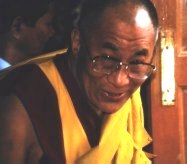
| Ethics for a Secular Millenium - An Interview with His Holiness the Fourteenth Dalai Lama... In the West there are many different schools of Buddhism. Where do we find common ground? I would like to say that we are all students of one teacher - the Buddha. One very kind, wise teacher. That is most important. As followers or students of this great teacher, we should take his own life as a model. His sacrifice - leaving his palace and remaining in the forest for six years. He worked hard in order to become Enlightened. When the Buddha started teaching, he con-sidered his audience�s mentality, their mental disposition, and then, accordingly, gave teachings. Sometimes, we put less emphasis on the Buddha�s way of life. We prefer a more luxurious life-style. Sometimes, when we explain or teach Buddha-dharma, there�s a slight attitude of imposing one�s own view. All the traditions in Buddhism have their own unique aspects. But in essence, we are all students of the same teacher. People everywhere in the world are very in-spired by your refusal to give in to anger or despair or revenge about the situation in your country. In this country, we can display more anger about a car that pulls out in front of us on the highway than you do about China. We see that for you this has something to do with deep religious training. Can you get so far away from the kind of anger that we experience every day without religious training? In my own case, if the car is delayed, I am also irritated. But for more serious things, perhaps I have more patience and calm. Of course, the training of mind - or religious belief, and cer-tainly in my case, as a Buddhist - is one method. Training involves not just one single method but many methods. It�s like building a huge airplane. It takes so many pieces that all have to fit together to make it work. In the same way the transformation of our minds - or setting the right kind of mental attitude - takes time. So certainly in my daily life, in my mental attitude toward myself, toward other fellow human beings, toward problems, toward enemies - there are per-haps some differences because of the long process of training in various methods. You�ve often said that we should remain in our own traditions. Can you say what you mean by that? Generally speaking, it is better to keep one�s own tradition. It is more suitable. But among some people - in the West they are usually Christians, Jews, and to some extent Muslims - there is an interest in Buddhism. Sometimes, because of their individual mental dispositions, they do not find much in their own tradition that is effective, but they still want a spiritual practice. They feel a strong pull to-ward Buddhism, and then, of course, it is their right to follow Buddhism. After all, all religions belong to humanity. What�s important is that once we make a decision to follow another religion we should keep in our minds that we must avoid criticizing our own previous tradition. We must show respect for it. What do you think is going on in the West that makes Buddhism so attractive to us? Variety, maybe. People always want something new, something new. New fur-niture, new fashions, a new color for their hair. All these things. Some even want to change their face (laughter). They |
 |
| just like something new. That�s one factor. Another more serious factor is that people sometimes are very skeptical about religious beliefs. Then they discover that some of the Asian traditions rely on work, or intelligence, and do not ask people to simply ac-cept the teachings on faith. There is a lot of explanation that follows investigation, so for those who are skeptical of purely faith-based systems, the Asian traditions can be very attractive. That�s one reason. Then, another thing: All major religious traditions have teachings on the practice of compassion, love, forgiveness, but the Buddha has be-come a symbol of nonviolence around the world, a symbol of compassion. All ancient masters teach the same message, but the Buddha�s message is not just for humanity alone; it is for all sentient beings. It puts a strong emphasis on respect for all forms of life. And I think that this is perhaps why the Buddha has become a universal symbol of |
| compassion and nonviolence and why so many are attracted to Buddhism. Do you think that Buddhism can temper some of the violence in this country? I think so. How do you think the values of our country will affect Buddhism? As far as Buddhist philosophy or concepts are concerned, I don�t think there�ll be any substantial change. But the ancient Indian traditions have tried to explain cosmologies. So here, modern science - the science of cosmology, and also biol-ogy, neurobiology, psychology and physics - will be very helpful in developing a deeper understanding of reality in these fields. Then there is the Vinaya, the monastic code. In the Vinaya, the Buddha gave equal rights to male and female. But then, in some forms of practice, it looks like there is some discrimination. In the past, we just took these things for granted. There was no self-consciousness about it. In the West, there�s a lot of consciousness about equality, espe-cially when it comes to the rights of women. This situation could help to open our minds. And perhaps to have some dis-cussion or make some correction or modification. But there�s one problem: One single person cannot decide to make changes to the Vinaya. This kind of decision must be made with a group of sanghas, a group of bhikshus - because this is the monastic practice of the Thai or Theravada system, the Tibetan system, the Chinese system, and [in this regard] they are essentially the same. So logically, this needs change or modification by an international sangha group. Other-wise, it is a little difficult for us Tibetans to make change alone. For many years I have been eager to have an interna-tional gathering of bhikshus from all Buddhist countries, especially for the Vinaya traditions, in order to have discus-sions about the Buddha�s teachings and today�s reality. In the United States one of our realities is capitalism. You have said that capitalism is too focused on money. Does this present special problems for the study of Buddhism and for the transmission of Buddhism into a Western value system? I don�t think so. Whether socialist or capitalist, generally peo-ple everywhere are concerned with money. I think it�s the same. Easterner, Westerner, capitalist, socialist - every- where, generally speaking, people are always drawn toward money and material comfort. You have said so many times that your religion is kindness. And sometimes we hear this to mean something other than "religion" as we know it. I believe that it is very useful or important to have a nonreligious way of approaching a nonbeliever in order to give him peace of mind. And in that way to give it to the community and to humanity as a whole. In any case, the majority of the world�s population of six billion people has little interest or seriousness when it comes to religion. That majority, that group of people, has a greater influence on society - or a more important role in society - than those who are re-ligious do. I get the impression that when people are not much interested in religion they also neglect values like com-passion, a sense of sharing, a sense of caring - all the things that people consider to be a religious message and reject. That�s a mistake. These are secular ethics, not a religious message, and they are for everyone. Everyone can under-stand that being human, you want a happy life, a happy family, to be a happy individual. But material things will not provide you with genuine inner peace or inner happiness. Human values are essential. We must find a way to present basic human values to everyone - and present them not as religious matters but as secular ethics that are essential whether you are religious or not. (by Helen Tworkov, 2001) Disclaimer: All images and/or articles retain the original copyrights of their original owners. |
 |
 |
 |
| Visit our main Buddhism site. More information, images, and, NO pop-ups! |
 |
| Last Update: 11/29/04 |