| "Making offerings to me now and making offerings to a statue of me in the future will be of equal merit... This is due to the blessing power of the Buddha, but ordinary beings cannot understand this." Shakyamuni Buddha |
| Page 41 |
 |
 |
| Words of Buddha - The Thousands - Better than a thousand meaningless words is one sensible word if hearing it one becomes peaceful. Better than a thousand meaningless verses is one word of verse if hearing it one becomes peace-ful. Better than reciting one hundred verses of meaningless words is one poem if hearing it one becomes peaceful. If a person were to conquer in battle a thousand times a thousand people, if another conquers oneself, that one is the great-est conqueror. Conquering oneself is better than conquering other people; not even a god, a spirit, nor Mara with Brah-ma, could turn into a defeat the victory of one who always practices the discipline of self-control. If a person month after month for a hundred years should sacrifice with a thousand offerings, and if but for one moment that person paid rever-ence to one whose soul is grounded in knowledge, better is that reverence than a hundred years of sacrifices. If a per-son for a hundred years should worship Agni in the forest, and if but for one moment that person paid reverence to one whose soul is grounded in knowledge, better is that reverence than a hundred years of worship. Whatever a person sac-rifices in this world as an offering or as an oblation for a whole year in order to gain merit, the whole of it is not worth a quarter. Reverence shown to the virtuous is better. To the one who always reveres and respects the aged, four things in-crease: life, health, happiness, and power. Better than a hundred years lived in vice and unrestrained is living one day if a person is virtuous and contemplative. Better than a hundred years lived in ignorance and unrestrained is living one day if a person is wise and contemplative. Better than a hundred years lived in idleness and weakness is living one day if a person courageously makes effort. Better than a hundred years of not perceiving how things arise and pass away is living one day if a person does perceive how things arise and pass away. Better than a hundred years of not perceiving immortality is living one day if a person does perceive immortality. Better than a hundred years of not seeing the su-preme path is living one day if a person does see the supreme path. |
 |
 |
| Let no one be discouraged by the belief there is nothing one man or woman can do against the enormous array of the world's ills - against misery and ignorance, injustice and violence... few will have the greatness to bend history itself, but each of us can work to change a small portion of events, and in the total of all those acts will be written the history of this generation... It is from numberless, diverse acts of courage and belief that human history is shaped. Each time a person stands up for an ideal, or acts to improve the lot of others, or strikes out against injustice, he sends forth a tiny ripple of hope, and, crossing each other from a million different centers of energy and daring, these ripples build a current that can sweep down the mightiest walls of oppression and resistance. John F. Kennedy |
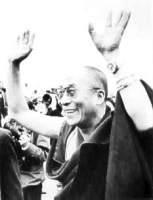
| "There are many afflictive emotions such as conceit, arrogance, jealousy, desire, lust, closed-mindedness, and so on. But of all of these, hatred or anger is singled out as the greatest evil. This is done for two reasons. One is that hatred or anger is the greatest stumbling block for a practitioner who is aspiring to enhance his or her altruism and attain a good heart. Second, when hatred or anger are generated they have the capacity to destroy one's virtue and calmness of mind. "I love friends, I want more friends. I love smiles. That is a fact. How to develop smiles? There are a variety of smiles. Some smiles are sarcastic. Some smiles are artificial-diplomatic smiles. These smiles do not produce satisfaction, but rather fear or suspicion. But a genuine smile gives us hope, freshness. If we want a genuine smile, then first we must produce the basis for a smile to come." The Dalai Lama |
|
| FAITH - Those who seek refuge in the three treasures, the Buddha, the Dharma and the Sangha, are called the disci-ples of Buddha. The disciples of Buddha observe the four parts of mind-control - the precepts, faith, offering and wisdom. The disciples of Buddha practice the five precepts: not to kill, not to steal, not to commit adultery, not to lie, and not to take intoxicants of any kind. The disciples of Buddha have faith in the Buddha's perfect wisdom. They try to keep away from greediness and selfishness and to practice offering. They understand the law of cause and effect, keeping in mind the transiency of life and conform to the norm of wisdom. A tree leaning toward the east will naturally fall eastward and so those who listen to the Buddha's teaching and maintain faith in it will surely be born in the Buddha's Pure Land. It has rightly been said that those who believe in the three treasures of the Buddha, the Dharma and the Sangha are called the disciples of Buddha. The Buddha is the one who attained perfect Enlightenment and used His attainment to emanci-pate and bless all mankind. The Dharma is the truth, the spirit of Enlightenment and the teaching that explains it. The Sangha is the perfect brotherhood of believers in the Buddha and Dharma. We speak of Buddhahood, the Dharma and the Brotherhood as though they are three different things, but they are really only one. Buddha is manifested in His Dharma and is realized by the Brotherhood. Therefore, to believe in the Dharma and to cherish the Brotherhood is to have faith in the Buddha, and to have faith in the Buddha means to believe in the Dharma and to cherish the Brother-hood. Therefore, people are emancipated and Enlightened simply by having faith in the Buddha. Buddha is the perfectly Enlightened One and He loves everyone as though each were His only child. So if anyone regards Buddha as his own par-ent, he identifies himself with Buddha and attains Enlightenment. Those who thus regard Buddha will be supported by His wisdom and perfumed by His grace. Nothing in the world brings greater benefit than to believe in Buddha. Just hear- ing Buddha's name, believing and being pleased even for a moment, is incomparably rewarding. Therefore, one must please oneself by seeking the teaching of Buddha in spite of the conflagration that fills all the world. It will be hard to meet a teacher who can explain the Dharma; it will be harder to meet a Buddha; but it will be hardest to believe in His teaching. But now that you have met the Buddha, who is hard to meet, and have had it explained to you what is hard to hear, you ought to rejoice and believe and have faith in Buddha. On the long journey of human life, faith is the best of companions; it is the best refreshment on the jealousy; and it is the greatest possession. Faith is the hand that receives the Dharma; it is the pure hand that receives all the virtues. Faith is the fire that consumes all the impurities of worldly desires, it removes the burden, and it is the guide that leads one's way. Faith removes greed, fear and pride; it teaches courtesy and to respect others; it frees one from the bondage of circumstances; it gives one courage to meet hardship; it gives one power to overcome temptations; it enables one to keep one's deeds bright and pure; and it enriches the mind with wisdom. Faith is the encouragement when one's way is long and wearisome, and it leads to Enlightenment. Faith makes us feel that we are in the presence of Buddha, and it brings us to where Buddha's arm supports us. Faith softens our hard and selfish minds and gives us a friendly spirit and a mind of understanding sympathy. Those who have faith gain the wisdom to recognize the Buddha's teaching in whatever they hear. Those who have faith gain the wisdom to see that everything is but the appearance that arises from the law of causes and conditions, and then faith gives them the grace of patient acceptance and the ability to conform to their conditions peacefully. Faith gives them the wisdom to rec-ognize the transiency of life and grace not to be surprised or grieved at whatever comes to them or with the passing of life itself, knowing that, however conditions and appearances may change, the truth of life remains always unchanged. Faith has three significant aspects: repentance, a rejoicing and sincere respect for the virtues of others, and a grateful acceptance of Buddha's appearance. People should cultivate these aspects of faith; they should be sensitive to their fail-ings and impurities; they should be ashamed of them and confess them; they should diligently practice the recognition of the good traits and good deeds of others and praise them for their sake; and they should habitually desire to act with Buddha and to live with Buddha. The mind of faith is the mind of sincerity; it is a deep mind, a mind that is sincerely glad to be led to Buddha's Pure Land by His power. Therefore, Buddha gives a power to faith that leads people to the Pure Land, a power that purifies them, a power that protects them from self-delusion. Even if they have faith only for a moment, when they hear Buddha's name praised all over the world, they will be led to His Pure Land. Faith is not some-thing that is added to the worldly mind - it is the manifestation of the mind's Buddha-nature. One who understands Bud-dha is a Buddha himself; one who has faith in Buddha is a Buddha himself. But it is difficult to uncover and recover one's Buddha nature; it is difficult to maintain a pure mind in the constant rise and fall of greed, anger and worldly pas-sion; yet faith enables one to do it. Within the forest of the poisonous Eranda trees, only Eranda trees are said to grow, but not the fragrant Chandana. It is a miracle if a Chandara tree grows in an Eranda forest. Likewise, it is often a mir-acle that faith in Buddha grows in the heart of the people. Therefore, the faith to believe in Buddha is called a "rootless" faith. That is, it has no root by which it can grow in the human mind, but it has a root to grow in the compassionate mind of Buddha. Thus, faith is fruitful and sacred. But faith is hard to awaken in an idle mind. In particular, there are five doubts that lurk in the shadows of the human mind and tend to discourage faith. First, there is doubt in the Buddha's wisdom; second, there is doubt in the Buddha's teaching; third, there is doubt in the person who explains the Buddha's teachings; fourth, there is doubt as to whether the ways and methods suggested for following the Noble Path are reli-able; and fifth, there is a person who, because of his arrogant and impatient mind, may doubt the sincerity of others who understand and follow the Buddha's teachings. Indeed, there is nothing more dreadful than doubt. Doubt separates peo-ple. It is a poison that disintegrates friendships and breaks up pleasant relations. It is a thorn that irritates and hurts; it is a sword that kills. The beginnings of faith were long ago planted by the compassion of Buddha. When one has faith, one should realize this fact and be very grateful to Buddha for His goodness. One should never forget that it is not be-cause of one's own compassion that one has awakened faith, but because of the Buddha's compassion which long ago threw its pure light of faith into human minds and dispelled the darkness of their ignorance. He who enjoys the present faith has entered into their heritage. Even living an ordinary life, one can be born in the Pure Land, if he awakens faith through the Buddha's long continued compassion. It is, indeed, hard to be born in this world. It is hard to hear the Dhar-ma; it is harder to awaken faith; therefore, everyone should try one's best to hear the Buddha's teachings. |
 |
| Before my Enlightenment, while I was still only an unenlightened Bodhisattva, I thought: In the case of material form, of feeling (of pleasure, pain or neither), of per-ception, of formations, of consciousness, what is the gratification, what is the danger, what is the escape? Then I thought: In the case of each, the bodily pleasure and mental joy that arise in dependence on these five aggregates are the gratification; the fact that these things are all impermanent, painful, and subject to change is the danger; the dis-ciplining and abandoning of desire and lust for them is the escape. As long as I did not know by direct knowledge, as it actually is, that such was the gratification, such the |
|
| danger, and such the escape, in the case of these five aggregates affected by clinging, so long did I make no claim to have discovered the Enlightenment that is supreme in the world with its desires, its Maras (the personification of all temptations to evil and distractions from training) and its divinities, in this generation with its monks and Brahmans, with its princes and men. But as soon as I knew by direct knowledge, as it actually is, that such is the gratification, such the danger, and such the escape, in the case of these five aggregates affected by clinging, then I claimed to have discov-eed the Enlightenment that is supreme in the world with its deities, its Maras and its divinities, in this generation with its monks and Brahmans, with its princes and men. Being myself subject to birth, aging, ailment, death, sorrow, and de-filement, seeing danger in what is subject to those things and seeking the unborn, unaging, unailing, deathless, sorrow-less, undefiled supreme surcease of bondage, Nirvana, I attained it. The knowledge and vision was in me: My deliver-ance is unassailable; this is my last birth; there is now no renewal being. Seeking but not finding the House Builder, I traveled through the round of countless births; O painful is birth ever and again. House Builder, you have now been seen; you shall not build the house again. Your rafters have been broken down; your ridgepole is shattered. My mind has attained the peace of Nirvana and reached the end of every kind of craving. |
|
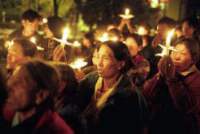
| LHASA, Tibet - The snows had scarcely melted last June when 24- year-old Joama and her three male cousins, yak her-ders in the remote mountains of northern Tibet, embarked on the most sublime journey of their lives. Their departure was not marked by any ceremony. "We just started out," she recalled. The four began mumbling mantras and raised their hands to heaven. They dropped to their knees and flung their bodies forward, fully prone against the damp earth. Then they stood up, took three small steps, and repeated the sequence. For more than five months now they have pro-strated themselves this way, all day every day, inch-worming their way to Lhasa and its holy sites. They slowly made their way through more than 100 miles of some of the world's harshest terrain, starting from above 14,000 feet, then followed a highway 200 more miles into Lhasa. They reached the city in early November. These days, they are inching their way along busy sidewalks as they follow the three hallowed circuits around the Jokhang Temple, the holiest site in Tibetan Buddhism, in advance of praying at its inner shrines. Only here, it seems safe to say, could such a roadside spec-tacle attract little notice. Thousands of Tibetans undertake similar pilgrimages each year, not to mention the far greater numbers who reach holy sites by bus, tractor or ordinary treks of weeks or months. While Buddhist devotion may be fading among younger, urban residents, it remains a resilient source of joy for most Tibetans out on the grasslands and the mountains, persisting through the temple-burning of Mao's Cultural Revolution, the controls on the staffing and ac-tivities of monasteries, the Chinese Communists' condemnation of the exiled Dalai Lama and the growing incursions of modern culture. "This has been our lifelong dream," said Joama, who spoke on the sidewalk as she paused for tea. "I'm not married yet, so I was able to free up the time." Joama and her companions said that once they finish at the Jokhang in late November, they will circle then pray inside the nearby Potala palace. There they will join the throngs who bow be-fore the tombs of former Dalai Lamas - successive incarnations of Tibetan Buddhism's most revered leader who lived and worked for centuries in this imposing building on a hill. In the Potala, as other pilgrims do, they will surely press their foreheads on an unlabeled chair that was used by the 14th Dalai Lama before he fled China in 1959, as Chinese troops cracked down on a popular uprising. The 14th Dalai Lama may have been gone more than 40 years, but he re-mains an almost palpable presence, his continued adoration only spotlighted by the government's campaign to eliminate his image. "Can you give me a picture of the Dalai?" whispered a shopkeeper in the town of Nagqu, 200 miles north of Lhasa and a stopover for many pilgrims. "I have one but I need another one," she said, adding that many neighbors had got rid of theirs, fearing trouble with the police. The lama pictures that are on public display in Lhasa and elsewhere be-tray a continuing test of wills between devout Tibetans and the authorities. Officials insist that Tibetans enjoy freedom of worship - so long as it does not involve loyalty to the Dalai, described as a deceitful "separatist." Today, in part as a proxy for the forbidden Dalai, many temples, shops and homes in Tibet display pictures of the 10th Panchen Lama, who occupied the second highest position in Tibetan Buddhism. The Panchen was deeply respected by the people - but he has also been dead for 12 years. By featuring the late Panchen, people are also stating their resentment of the government's effort to control his succession. Angered in 1995 when the Dalai announced, from exile, that a new incarnation of the |
| Panchen had been discovered, Chinese officials put that boy under house arrest, where he remains. They forced resident leaders to select another candidate, whom few Tibetans have accepted as valid and whose picture is virtually nowhere to be seen. Some pilgrims carry secret pictures of the Dalai, but whatever their inner loyalties, their laborious travels are not intended to score political points. They look more sad than angry when they touch the Dalai's empty chair. Rather, their quest is for an inner harmony that can be approached by giving up one's pride - and prostration is an ultimate symbol of submission. "This is the best way to make a pilgrimage," said Tserenduba, 41, who was camped with nine other men and women beside the highway some 150 miles north of Lhasa, resting after 40 days of travel by prostration. The group, also from a distant mountain village, estimated it |
 |
| might take them 90 more days, well into the icy winter, to reach the capital. "When we move this way, it shows our complete dedication," the man said, squinting from sunlight reflected off an overnight snowfall. "At the end of a day, all our bodies are in pain. But we'll feel great joy when we reach Lhasa and pray in the temples." In a common arrange-ment, seven of his group, ranging in age from 18 to 60, are prostrating while three accompany them in support, pulling a cart with tents and provisions. Other groups carry back-packs and subsist mostly on alms as they go. As Tserenduba's group prepared to start again, the seven lucky ones strapped on protective leather aprons to save their knees and put thick mitts on their hands. Like many pilgrims, Tserenduba is not versed in the depths of Buddhist theory. He knows what he believes and feels. Asked why he was making such an arduous trip he shrugged and said, "We're doing this so our future can be better." When they finish their religious duties in Lhasa, he said, they will look for a truck so they can hitch a ride. "We'll just go home," he said. (Novembr 15, 2001) |
 |
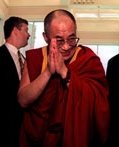
| "Mandala, in general, means that which extracts the essence. There are many usages of the term mandala according to context. One type of mandala is the offering of the entire world system, with the major and minor continents mentally constructed, to high beings. Also, there are painted mandalas, mandalas of concentration, those made out of colored sand, mandalas of the conventional mind of enlightenment, and so forth. Because one can extract a meaning from each of these through practicing them, they are all called mandalas. Although we might call these pictures and constructed depictions mandalas, the main meaning is for oneself to enter into the mandala and extract an essence in the sense of receiving blessing. It is a place of gaining magnificence. Because one is gaining a blessing and thereupon developing realizations it is called an extraction or assumption of something essential. "To be aware of a single short-coming within oneself is more useful than to be aware of a thousand in somebody else. Rather than speaking badly about people and in ways that will produce friction and unrest in their lives, we should practice a purer perception of them, and when we speak of others, speak of their good qualities. "Our experiences and feelings are mainly related to our bodies and our minds. We know from our daily experience that mental happiness is beneficial. For instance, though two people may face the same kind of tragedy, one person may face it more easily than the other due to his or her mental attitude. "Our judgements, even concerning ordinary things, are frequently clouded by our emotions. For example, we often see the actions of our loved ones - even if they are harmful - as wonderful, whereas we judge even the positive actions of a person we dislike as pretentious and false. We cannot rely upon our perceptions; it is a fact that we misapprehend many situations. If this is general fact, how can we still stubbornly maintain that our perceptions about our own spiritual masters must be true?" The Dalai Lama Disclaimer: All images and/or articles retain the original copyrights of their original owners. |
 |
| Visit our main Buddhism site. More information, images, and, NO pop-ups! |
|
 |
 |
 |
| Last Update: 11/30/04 |