| Buddha, O Blessed One, O Holy One, O Perfect One, thou hast revealed the truth, and the truth has appeared upon earth and the kingdom of truth has been founded. Righteousness is the place in which truth dwells, and here in the hearts of mankind aspiring after the realization of righteousness, there is ample space for a rich and ever richer revelation of the truth. This is the Gospel of the Blessed One. This is the revelation of the Enlightened One. This is the bequest of the Holy One. Truth is the essence of life, for truth endureth beyond the death of the body. Truth is eternal and will still remain even though heaven and earth shall pass away. There are not different truths in the world, for truth is one and the same at all times and in every place. Truth teaches us the noble eightfold path of righteousness, and it is a straight path easily found by the truth-loving. Happy are those who walk in it. |
 |
| Page 40A |
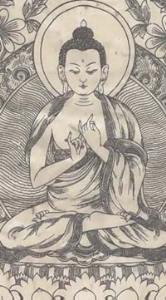
| The Sick Bhikkhu... An old bhikkhu of a surly disposition was afflicted with a loathsome disease the sight and smell of which was so nauseating that no one would come near him or help him in his distress. And it happened that the World-honoured One came to the vihara in which the unfortunate man lay; hearing of the case he ordered warm water to be prepared and went to the sick-room to administer unto the sores of the patient with his own hand, saying to his disciples: "The Tathagata has come into the world to befriend the poor, to succour the unprotected, to nouish those in bodily affliction, to give sight to the blind and Enlighten the minds of the deluded, to stand up for the rights of orphans as well as the aged, and in so doing to set an example to others. This is the consummation of his work, and thus he at-tains the great goal of life as the rivers that lose themselves in the ocean." The World-honoured One administered unto the sick bhikkhu daily so long as he stayed in that place. And the governor of the city came to the Buddha to do him reverence, and having heard of the service which the Lord did in the vihara asked the Blessed One about the previous existence of the sick monk, and the Buddha said: "In days gone by there was a wicked king who used to extort from his subjects all he could get; and he ordered one of his officers to lay the lash on a man of eminence. The officer little thinking of the pain he inflicted upon others, obeyed; but when the victim of the king's wrath begged for mercy, he felt compassion and laid the whip lightly upon him. Now the king was reborn as Devadatta, who was abandoned by all his fol-lowers, because they were no longer willing to stand his severity and he died miserable and full of penitence. The officer is the sick bhikkhu, who having often given offence to his brethren in the vihara was left without assistance in his dis-tress.The eminent man, however, who was unjustly beaten and begged for mercy was the Bodhisatta; he has been re-born as the Tathagata. It is now the lot of the Tathagata to help the wretched officer as he had mercy on him." And the World-honoured One repeated these lines: "He who inflicts pain on the gentle, or falsely accuses the innocent, will in-herit one of the ten great calamities. But he who has learned to suffer with patience will be purified and will be the cho-sen instrument for the alleviation of suffering." The diseased bhikkhu on hearing these words turned to the Buddha, confessed his ill-natured temper and repented, and with a heart cleansed from error did reverence unto the Lord. |
 |
 |
 |
 |
| on life and death and the evils of decay. Concentrating his mind he became free from confusion. All low desires vanish-ed from his heart and perfect tranquillity came over him. In this state of ecstacy he saw with his mental eye all the mis-ery and sorrow of the world; he saw the pains of pleasure and the inevitable certainty of death that hovers over every being; yet men are not awakened to the truth. And a deep compassion seized his heart. While the prince was pondering on the problem of evil, he beheld with his mind's eye under the jambu-tree a lofty figure endowed with majesty, calm and dignified. "Whence comest thou, and who mayest thou be?" asked the prince. In reply the vision said: "I am a sa-mana. Troubled at the thought of old age, disease, and death I have left my home to seek the path of salvation. All things hasten to decay; only the truth abideth forever. Everything changes, and there is no permanency; yet the words of the Buddhas are immutable. I long for the happiness that does not decay; the treasure that will never perish; the life that knows of no beginning and no end. Therefore, I have destroyed all worldly thought. I have retired into an unfre-quented dell to live in solitude; and, begging for food, I devote myself to the one thing needful." Siddhattha asked: "Can peace be gained in this world of unrest? I am struck with the emptiness of pleasure and have become disgusted with lust. All oppresses me, and existence itself seems intolerable." The samana replied: "Where heat is, there is also a possibility of cold; creatures subject to pain possess the faculty of pleasure; the origin of evil indicates that good can be developed. For these things are correlatives. Thus where there is much suffering, there will be much bliss, if thou but open thine eyes to behold it. Just as a man who has fallen into a heap of filth ought to seek the great pond of water cov-ered with lotuses, which is near by: even so seek thou for the great deathless lake of Nirvana to wash off the defilement of wrong. If the lake is not sought, it is not the fault of the lake. Even so when there is a blessed road leading the man held fast by wrong to the salvation of Nirvana, if the road is not walked upon, it is not the fault of the road, but of the person. And when a man who is oppressed with sickness, there being a physician who can heal him, does not avail himself of the physician's help, that is not the fault of the physician. Even so when a man oppressed by the malady of wrong-doing does not seek the spiritual guide of Enlightenment, that is no fault of the evil-destroying guide." The prince listened to the noble words of his visitor and said:"Thou bringest good tidings, for now I know that my purpose will be accomplished. My father advises me to enjoy life and to undertake worldly duties, such as will bring honour to me and to our house. He tells me that I am too young still, that my pulse beats too full to lead a religious life." The venerable figure shook his head and replied: "Thou shouldest know that for seeking a religious life no time can be in-opportune." A thrill of joy passed through Siddhattha's heart. "Now is the time to seek religion," he said; "now is the time to sever all ties that would prevent me from attaining perfect Enlightenment; now is the time to wonder into homelessness and, leading a mendicant's life, to find the path of deliverance." The celestial messenger heard the reso-lution of Siddhattha with approval. "Now, indeed," he added, "is the time to seek religion. Go, Siddhattha, and accom-plish thy purpose. For thou art Bodhisatta, the Buddha-elect; thou art destined to Enlighten the world. "Thou art the Tathagata, the great master, for thou wilt fulfil all righteousness and be Dharmaraja, the king of truth. Thou art Bha-gavat, the Blessed One, for thou art called upon to become the saviour and redeemer of the world. "Fulfil thou the per-fection of truth. Though the thunderbolt descend upon thy head, yield thou never to the allurements that bequile men from the path of truth. As the sun at all seasons pursues his own course, nor ever goes on another, even so if thou for-sake not the straight path of righteousness, thou shalt become a Buddha. "Persevere in thy quest and thou shalt find what thou seekest. Pursue they aim unswervingly and thou shalt gain the prize. Struggle earnestly and thou shalt con-quer. The benediction of all deities, of all saints, of all that seek light is upon thee, and heavenly wisdom guides thy steps. Thou shalt be the Buddha, our Master, and our Lord; Thou shalt Enlighten the world and save mankind from per-dition." Having thus spoken, the vision vanished, and Siddhatta's heart was filled with peace. He said to himself: "I have awakened to the truth and I am resolved to accomplish my purpose. I will sever all ties that bind me to the world, and I will go out from my home to seek the way of salvation. "The Buddhas are beings whose words cannot fail: there is no departure from truth in their speech. "For as the fall of a stone thrown into the air, as the death of a mortal, as the sunrise at dawn, as the lion's roar when he leaves his lair, as the delivery of a woman with child, as all these things are sure and certain - even so the word of the Buddhas is sure and cannot fail. "Verily I shall become a Buddha." The prince returned to the bedroom of his wife to take a last farewell glance at those whom he dearly loved above all the treasures of the earth. He longed to take the infant once more into his arms and kiss him with a parting kiss. But the child lay in the arms of his mother and the prince could not lift him without awakening both. There Siddhattha stood gazing at his beautiful wife and his beloved son, and his heart grieved. The pain of parting overcame him powerfully. Although his mind was determined, so that nothing, be it good or evil, could shake his resolution, the tears flowed freely from his eyes, and it was beyond his power to check their stream. But the prince tore himself away with a manly heart, suppressing his feelings but not extinguishing his memory. The Bodhisatta mounted his noble steed Kanthaka, and when he left the palace, Mara stood in the gate and stopped him: "Depart not, O my Lord," exclaimed Mara. "In seven days from now the wheel of empire will appear, and will make thee sovereign over the four continents and the two thou-sand adjacent islands.Therefore, stay, my Lord." The Bodhisatta replied: "Well do I know that the wheel of empire will appear to me; but it is not sovereignty that I desire. I will become a Buddha and make all the world shout for joy." Thus Siddhattha, the prince, renounced power and worldly pleasures, gave up his kingdom, severed all ties, and went into homelessness. He rode out into the silent night, accompanied only by his faithful charioteer Channa. Darkness lay upon the earth, but the stars shone brightly in the heavens. |
| The Light of the World... There was a certain Brahman in Kosambi, a wrangler and well versed in the Vedas. As he found no one whom he regarded his equal in debate he used to carry a lighted torch in his hand, and when asked for the reason of his strange conduct, he replied: "This world is so dark that I carry this torch to light it up, as far as I can." A samana sitting in the market-place heard these words and said: "My friend, if thine eyes are blind to the sight of the omnipresent light of the day, do not call the world dark. Thy torch adds nothing to the glory of the sun and thy intention to illumine the minds of others is as futile as it is arrogant." Where-upon the Brahman asked: "Where is the sun of which thou speakest?" And the samana replied: "The wisdom of the Tathagata is the sun of the mind. His radiancy is glorious by day and night, and he whose faith is strong will not lack light on the path to Nirvana where he will inherit bliss everlasting." The Bodhisatta's Renunciation... It was night. The prince found no rest on his soft pil-low; he arose and went out into the garden. "Alas!" he cried, "all the world is full of darkness and ignorance; there is no one who knows how to cure the ills of existence." And he groaned with pain. Siddhattha sat down beneath the great jambu-tree and gave himself to thought, pondering |
 |
 |
| GENERAL OUTLINE OF MEDITATION - Tibetans explain meditation with a play on words: "There exists no meditation but only habit" (the Tibetan word Gom means meditation whereas Kom means habit, usage). To achieve a good meditation doesn't derive from a spontan-eous gift, but it is rather the result of an intensive training, like the good pianist who always needs to practise scales. Meditation is a mind training because the mind is forced to remain fixed on a certain object, without too much constraint but not too loosely either. The first goal of medi-tation is thus a perfect concentration. When it is well established, then it becomes possible to fo-cus on contemplating the proper nature of all phenomena and of one's own mind. We can thus at-tain awakening which consists in comprehending the ultimate essence of emptiness that is within everything. Awakening is the liberation of a Buddha and it represents the goal of all the buddhist practices, whatever means are used to reach it. To reach that aim, it is necessary to go through a certain number of stages. Our intention here is to describe a simple form of meditation, in order for you to get a better understanding of the ordinary working of your mind. Buddhists can draw a |
| great benefit from such a meditation because they are able to link it to other teachings received concerning emptiness or compassion. Other people will draw a more limited benefit but it may make them wish to go further. STANDARD MEDITATION - PROSTRATIONS: It is advised to start the meditation by prostrating at least three times in the direction of one's shrine or to a Buddha image. Then, one gets seated on a meditation cushion and in a good pos-ture. Legs are crossed in the Vajra posture or in a more comfortable position, the two hands resting in meditation, with the back of the right one into the palm of the left one resting below the level of the navel. The spinal column must be perfectly erect like the head on the same line and the eyes half-closed with the tongue stuck against the palate. It is necessary to breathe calmly and to keep one's attention focussed. People who, due to their age or their health, are hav-ing difficulties in sitting on the floor, can sit on a chair, provided they keep their body upright and they do not lean against the back of the chair. A good body posture is essential during meditation; it is said that if you keep your body straight, then all body channels can be straight and let freely flow all energies and fluids. Only when this flowing takes place freely can one experience the union of bliss and emptiness which is the mark of a good meditation. TAKING REFUGE: You now repeat at least 21 times in English or in Tibetan, the following refuge prayer: PALDEN LAMA TAMPA NAMLA CHAP SU CHIWO / Into the glorious and holy Lamas, we take refuge. DZOPEY SANJAY CHOMDEN DEY NAMLA CHAP SU CHIWO / Into the perfectly accomplished Buddhas, we take refuge. TAMPEY CHO NAMLA CHAP SU CHIWO / Into the holy Dharma, we take refuge. PAPEY GEDUN NAMLA CHAP SU CHIWO / Into the supreme Community, we take refuge... You should not forget that all sentient beings, including your own parents, as well as yourself, all together are repeating this prayer and taking refuge from the bottom of your hearts. GENERAT- ING THE ENLIGHTENMENT THOUGHT: One should repeat: "It is for the sake of all sentient beings that I must attain Buddhahood. To that end, I shall turn towards virtue all actions of my body, speech and mind." THE FOUR LIMITLESS MEDITATIONS: You repeat: "May all living beings be in possession of happiness and of its cause. May they all never meet unhappiness and its cause. May they never be separated from happiness devoid of suffering. May they all always remain in equanimity free from bias towards their own side and hostility towards others." CALM ABIDING MEDITA-TION (Tib. Shine): This is a meditation meant to appease thoughts and generate great concentration. The real attain-ment is achieved through an attitude of detachment from all mundane objects. Therefore it is advised to train in a soli-tary and quiet place provided with all favourable conditions for practice. Different techniques and objects of meditation may be used. We shall describe here a practice that may be used by non-buddhists. Focussing one's attention on the breathing process: This meditation is meant to help gaining control and pacification over one's mind process, by focus-sing one's attention on the breathing process. You must try to keep your mind free of all disturbing thought during suc-cessive cycles of 21 breathing. Each cycle consists of a phase of breathing in, a phase of keeping air inside and a phase of breathing out. The exercise described can also be alternated with the following variants: During each breathing cycle of 21, you can count the number of thoughts arising and disturbing your concentration. You can for instance use a rosary to do it. The counting is to be started anew on each cycle, and each time, you try to improve the quality of your concen-tration through a diminished number of thoughts. You may also be willing to practice discriminating between positive and negative thinking, as a way to diminish the negative one. You can make use of a heap of black and white pebbles and start piling them up for each of your thoughts, black for negative ones and white for the positive. Generally speak-ing, negative thinking is all thinking motivated by desire, hatred and ignorance. If any such motivation doesn't appear very clearly, negative thinking can also be defined as everything that is harmful to others. The result of the counting must be checked after each cycle of 21 and started again. The first result achieved by beginners with this type of medita-tion is to realise their total lack of control over their own mind. If this meditation is continued daily for some time, the mind is gradually brought under control and put to rest focussed on the object desired. Buddhists make use of the con-trol gained over the mental process, to examine the ultimate truth of emptiness of all existing things, including the mind itself. Such a practice should only be undertaken by experienced disciples who have already received this teaching from their own master. This second stage of meditation is called Deep Insight (tib. Lhathong), and it is the only one capable of completely uprooting the three negative poisons, i.e. desire, hatred and ignorance. |
| who regard all helpless sentient beings as your only child; please consider the truth of my anguished pleas. Buddha's full teachings dispel the pain of worldly existence and self-oriented peace; may they flourish, spreading prosperity and hap-piness throughout this spacious world. O holders of the Dharma: scholars and realized practitioners; may your ten fold virtuous practice prevail. Humble sentient beings, tormented by sufferings without cease, completely suppressed by seemingly endless and terribly intense, negative deeds, may all their fears from unbearable war, famine, and disease be pacified, to freely breathe an ocean of happiness and well-being. And particularly the pious people of the Land of Snows who, through various means, are mercilessly destroyed by barbaric hordes on the side of darkness, kindly let the power of your compassion arise, to quickly stem the flow of blood and tears. Those unrelentingly cruel ones, objects of compas-sion, maddened by delusion's evils, wantonly destroy themselves and others; may they achieve the eye of wisdom, know- ing what must be done and undone, and abide in the glory of friendship and love. May this heartfelt wish of total free-dom for all Tibet, which has been awaited for a long time, be spontaneously fulfilled; please grant soon the good fortune to enjoy the happy celebration of spiritual with temporal rule. O protector Chenrezig, compassionately care for those who have undergone myriad hardships, completely sacrificing their most cherished lives, bodies, and wealth, for the sake of the teachings, practitioners, people, and nation. Thus, the protector Chenrezig made vast prayers before the Buddhas and Bodhisattvas to fully embrace the Land of Snows; may the good results of these prayers now quickly ap-pear. By the profound interdependence of emptiness and relative forms, together with the force of great compassion in the Three Jewels and their Words of Truth, and through the power of the infallible law of actions and their fruits, may this truthful prayer be unhindered and quickly fulfilled. (This prayer, Words of Truth, was composed by His Holiness Tenzin Gyatso, the Fourteenth Dalai Lama of Tibet, on 29 September 1960 at his temporary headquarters in the Swarg Ashram at Dharamsala, Kangra District, Himachal State, India. This prayer for restoring peace, the Buddhist teachings, and the culture and self-determination of the Tibetan people in their homeland was written after repeated requests by Tibetan government officials along with the unanimous consensus of the monastic and lay communities.) |
 |
|
| A Prayer Composed by his Holiness, Tenzin Gyatso, the fourteenth Dalai Lama of Tibet, Honoring and Invoking the Great Compassion of the Three Jewels; The Buddha, the Teachings, and the Spiritual Community... O Buddhas, Bodhisattvas, and disciples of the past, present, and future: Having remarkable qualities immeasurably vast as the ocean, |
| "Now, whatever time you can commit to the practice of Dharma - be it one year, one month, one week, or one day - the motivation with which you do it is extremely important. It should be done with bodhicitta, the mind of awakening; this means telling yourself that you are going to do it for the benefit of all beings. Having this inner attitude as the basis of all practices is very important. While progressing on the path, properly speaking, the most important thing, if one can do it, is to understand as much as possible the nature of the mind and do each practice with this understanding as the basis. If one can do recitations and physical practices with the speech and body while meditating on the nature of mind, these will bring even great benefit." by Kalu Rinpoche "The very purpose of religion is to control yourself, not to criticize others. Rather, we must criticize ourselves. How much am I doing about my anger? About my attachment, about my hatred, about my pride, my jealousy? These are the things which we must check in daily life. |
|
| "Everyone wants happiness; nobody wants to suffer. Many problems around us are a mental projection of certain negative or unpleasant things. If we analyze our own mental attitude, we may find it quite unbearable. Therefore, a well-balanced mind is very useful and we should try and have a stable mental state. "If one's life is simple, contentment has to come. Simplicity is extremely important for happiness. Having few desires, feeling satisfied with what you have, is very vital: satisfaction with just enough food, clothing, and shelter to protect yourself from the elements. And finally, there is an intense delight in abandoning faulty states of mind and in cultivating helpful ones in meditation." "If we only concentrate on scientific development, without concerning ourselves with spiritual development - if we lose a sense of human value - it will be dangerous. After all, the aim of scientific progress itself is to benefit humankind. If scientific development goes wrong and |
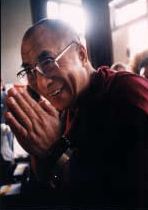 |
| brings more suffering and more tragedy on humankind, this is unfortunate. I believe that mental development and material development must go side by side. The Dalai Lama Disclaimer: All images and/or articles retain the original copyrights of their original owners. |
 |
 |
 |
| Visit our main Buddhism site. More information, images, and, NO pop-ups! |
 |
| Last Update: 11/30/04 |