 |
 |
| Page 35 |
| their vows and encourage gambling. For the past two years a number of Chinese, especially young women, have been taught the Tibetan language and "trained" to target monks in big monasteries. The Potala Palace, which has security cameras throughout, has been singled out because any encounter between a monk and a prostitute can be filmed and publicized. There is also growing concern that the Chinese have managed to force large numbers of monks to act as in-formers. Tibetan dissident groups claim that up to 40% of monks are effectively "Chinese military wearing red robes." Among young lay Tibetans the reputation of monks is already suffering. One Tibetan said: "Monks play mah-jong, they wear gold watches. They dress in monks' clothes during the day to beg and then change into civilian clothes at night. I have lost trust in Tibetan people, even friends, even my family. No one trusts anyone any more." Attempts to place prostitutes inside the monasteries are the latest tactic employed by the Chinese in their 40-year campaign to eradicate Tibetan culture and religion. The Chinese authorities in Llasa have recently stepped up their hard-line religious policies aimed at forcing Tibetans - particularly monks and nuns - to abandon their Buddhist faith and allegiance to their exiled leader, the Dalai Lama, in an attempt to suppress dissent. Since 1994, religious policies have focused on 're-educating' monks and nuns, and work units are sent into monasteries and nunneries, even in remote areas, to 'manage' the resi-dents. The primary objective of the campaign is to turn Tibet into an atheist country. The London-based organization Tibet Information Network claims that at a meeting of the Communist propaganda department in Lhasa earlier this year it was decreed: "Atheism is necessary to promote economic development and to strengthen the anti-Dalai Lama campaign." The three-year campaign will use the media and work units to promote atheism. Opposition groups note that the propaganda drive was launched on the same day as the Beijing authorities reaffirmed their stated policy of pro-tecting freedom of religious belief in Tibet. In reality there is little freedom of expression, religious or otherwise. Monks and nuns face daily harassment. When I visited a nunnery near Lhasa, eight cars full of police and officials ar-rived. I heard later that they plan to send half the nuns back to their local communities. The policy of sending monks and nuns home is spreading dissent, even inside prisons. Last May, a visit to Drapchi prison in Lhasa by an EU delega-tion that included the British ambassador from Beijing triggered a violent demonstration by inmates. Over a dozen died and a month later, a further seven nuns, the suspected ring leaders of the protest, were found dead in their cells. The Drapchi deaths were not raised last week at the annual meeting of the UN Human Rights Commission in Geneva, and Tibet was scarcely mentioned. Despite continued abuses across the mainland, the EU decided not to censure China's hu-man rights record. According to the latest TIN study of prison conditions, there is a greater risk of death inside prison than ever before. State-of-the-art torture equipment is being used, I was told - cattle prods have been replaced by pow-erful electric shock batons. This type was used repeatedly on one nun who, after three years in detention, can no longer get up to dress herself. She is expected to die of her wounds within a year. (By Jenny Morris, Lhasa, 28 March 1999) |
| China uses prostitutes to bring shame on Tibetan monks - THE Chinese authorities are attempting to flood Tibetan monasteries with prostitutes and gamblers as part of their latest attempt to bring disgrace upon the monks and to discredit their Buddhist faith. The main target of the new Chinese campaign is the Potala Palace, formerly home to generations of Dalai Lamas. Well-placed Tibetan sources say Chinese prostitutes are now being sent to tempt monks to break |
| China fears prospect of blue-eyed Dalai Lama - CHINA will not recognise a future Dalai Lama born outside its territory, an official adviser to Beijing has said, directly challenging the current Dalai Lama's vow that his reincarnation would be "in the free world." Tao Chang-song, of the state-sponsored Tibet Contemporary Research Centre in Lhasa, couched China's objection in the anti-Western terms currently in vogue in Beijing. Mr Tao told the South China Morning Post in Hong Kong: "Since the 14th Dalai Lama has been living in exile from his native Tibet for 40 years, it is feared that after his death, a Western boy with blue eyes and golden hair may be identified as the next reincarnation. "No foreigners would be recognised as the reincarna-ted Dalai Lama Any reincarnation - or soul boy - had to be a Tibetan born in Chinese territory. "He must be patriotic and have no intention to split the country." Such rules would also exclude the large population of Tibetan exiles loyal to the Dalai Lama, many of whom live in the north In- |
 |
 |
| dian hill town of Dharamsala. The Dalai Lama fled to India after a failed uprising against the Chinese in Tibet in 1959. Mr Tao disclosed that a task force had been set up to plan Beijing's strategy in the event of the death of the Dalai Lama, who is 66. After the death of a high lama, clerics are sent to find the reincarnation, looking for boys with the correct physical features, born at the right time amid appropriate omens. (By David Rennie, Beijing, 24 June 1999) |
 |
 |
 |
 |
| Falun Gong general faces 17 years jail (Hong Kong) (Once again, China tries to deny people their human rights.) A military tribunal has sentenced a 74-year-old Chinese air force gen-eral to 17 years in prison for his role in the banned Falun Gong spiritual group, a Hong Kong rights organisation said yesterday. General Yu Changxin's sentence is one of the heaviest since the Communist Party outlawed the traditional Chinese mystical group last summer and follows an 18-year sentence given to Falun Gong leader Li Chang last month. Yu, an instructor at the China Air Force Command Institute, was tried secretly by a Beijing military tribunal on 6 Janu-ary, the Information Centre for Human Rights and Democratic Movement in China said. "Yu Changxin is an important military official with high authority who has performed outstanding service to the air force. Many retired military lead-ers expressed dissatisfaction to (Chinese President) Jiang Zemin (over the sentence)," the centre said. According to Yu's family, the general has appealed against his sentence. Yu, who has followed the Falun Gong movement since 1992, was secretly detained on 1 July last year for his alleged role in organising a protest on 25 April by some 10,000 Falun Gong followers around the Communist Party's Zhongnanhai headquarters in central Beijing. He was convicted of "using a sect to destroy the implementation of the law," and "illegal management." His family said he denied his involvement in organising the demonstration. He also allegedly helped Falun Gong spiritual leader Li Hongzhi, exiled in the United States, to "illegally" print and publish Falun Gong material, while organising the meteoric expansion of the group. Yu was a leading air force pilot during the 1970s, but became noted for establishing theories and methods that resulted in a dramatic reduction in air safety mishaps, the centre said. The Falun Gong group, established by Li Hongzhi in 1992, has advocated high moral values and spiritual purity as the key to good health (similar to the more popular Tai Chi) and boasts tens of millions of members in China. (15 January 2000) |
|
| The Enlightenment Narratives of the Buddha's Enlightenment fall into two main parts. The first is filled with inner struggle as the future Buddha mortifies his body and is then assaulted in the initial stages of his Enlightenment meditation by the "evil one." Though this phase is expressed in folkloric form, it is an intensely human story. The Buddha is not represented as su-perhuman; no revelatory light is suddenly switched on for him. Enlightenment occurs only when he has witnessed and transcended the darkness of universal negativity. The second phase takes place in a serenity which is therefore achiev-ed rather than given. The Buddha's freedom from self and knowledge of truth - a condition described as Nirvana - arises from within his hard-won equanimity. It is at this moment that the Bodhisattva (future Buddha) becomes Buddha (one who has woken). The knowledge revealed in his meditation becomes the heart of his doctrine: the Middle Way. This way is a path of no extremes; it demands recognition of "things as they are." It enshrines the four truths about human suf-fering that underlie all Buddhist teaching. These early Buddhist formulations are easy enough to comprehend intellect-ually. But subjective understanding of the Buddhist revelation requires investigation, study and meditation. MANTRAS To sing, chant and repeat magical syllables for the conjuring of power has always been in the repertoire of ancient socie-ties. Tribal hunters sing magical songs to heal, to change the weather, to bring animals close to them. Hindu ceremonies are traditionally accompanied by the recitation of mantras (auspicious verbal formulae) sometimes taken from the Ve-dic books. One theory maintains that the whole universe is composed of sound, and that OM, the greatest of the man-tras, both evoke all reality and brings the adept into the direct experience of the divine. Tantric Buddhists adopted many Hindu mantras and devised many of their own. The great mantra of Tantrism is OM MANI PADME HUM. Literally, this means "O jewel in the lotus!" There are several ways of interpreting this. On one level, jewel and lotus are Dharma and Buddha. On another level, jewel and lotus refer to the sacred intercourse of the Buddha and his shakti, or Avalokitesh-vara (Chinese - KuanYin, Japanese - Kannon) with Tara. While mani (jewel) and padme (in the lotus) are Sanskrit words in grammatical relationship, OM and HUM are syllables whose meaning can not be translated. The six syllables of the mantra correspond to the six perfections of a Bodhisattva. (The Bodhisattva is an adept of the "six perfections" (paramitas) of generosity, patience, meditation, morality, energy and wisdom. The most significant of these is generosi-ty.) |
|
|
| the Chinese state news agency, quoted Raidi, the most senior ethnic Tibetan in the administration, as saying that, when the exiled Dalai Lama dies, several boys who might be his reincarnation will be found. One will be chosen by drawing lots from a golden urn, then his status will be confirmed by "ratification by the Chinese central government." Accord-ing to traditional Buddhist tenets, high lamas have fore-knowledge of when and where they will be reborn, and frequent-ly leave detailed, if cryptic, instructions as to where they will be found. Search parties carry possessions of the deceased lama, which the reincarnation should be able to recognise. The move, reported in Chinese state media, threatens to lead to the creation of rival Dalai Lamas. The Chinese alternative, blending religious ritual and political power, was first used in November 1995, when China imposed on Tibet its chosen reincarnation of the Panchen Lama, the second most senior cleric in Tibetan Buddhism. The boy failed to attract popular support in Tibet, despite intensive "patriotic education" campaigns, backed by arrests and intimidation in monasteries. A rival small boy chosen by the exiled Dalai Lama as the new Panchen Lama was taken into custody by Chinese officials, along with his family. He has never been seen again, though China insists he is alive and well. His name is Gendhun Choekyi Nyima and he was born on April 25, 1989 and is considered THE YOUNGEST POLITICAL PRISONER IN THE WORLD! The Dalai Lama retains popular support in exile. The Tibetan government-in-exile denounced the plans as "a new imposition which will never be accepted by the Tibetan people." Xinhua, the Chinese state news agency, quoted Raidi, the most senior ethnic Tibetan in the adminis-tration, as saying that, when the exiled Dalai Lama dies, several boys who might be his reincarnation will be found. China's propaganda machine sets great store by the golden urn at the heart of its "ritualm" which was sent to Tibet by an 18th century Chinese emperor. Tibet's history has been intertwined with China's for centuries. Powerful Chinese rulers have long tried to sway the choice of powerful lamas with varying degrees of success. But Kesang Takla, the sec-retary for international relations of the Tibetan government-in-exile, said the urn had no legally binding force, and had been rarely used since the time of the eighth Dalai Lama, 200 years ago. "There were occasions when it was used to solve disputes. But they did not have to go to China to seek formal approval for reincarnations," she said. "The Chinese Communists have no religious faith, and no right to interfere in rituals that are based on Buddhism, and are very spirit-ual," she said. Mrs Takla repeated predictions that the next Dalai Lama would be born in exile. "We believe that high lamas have some freedom over where they are born." China says it will reject any "foreign" Dalai Lama. (by David Rennie in Beijing, 09/08/2001) |
| China turns screw again on Tibetan culture - Communist regime will choose the Dalai Lama when Tibet's spiritual leader dies. China set out its plans yesterday to appoint a puppet Dalai Lama when Tibet's spiritual leader dies. The Communist regime will ignore the Tibetan Buddhist method of identifying his reincarnation and instead use a "historical ritual" cobbled together, at the behest of its own officials, from Tibetan and Chinese traditions. The move, reported in Chinese state media, threatens to lead to the creation of rival Dalai Lamas. The Dalai Lama retains popular support in exile. The Tibetan government-in-exile denounced the plans as "a new imposition which will never be accepted by the Tibetan people." Xinhua, |
|
| "No religion basically believes that material progress alone is sufficient for humankind. All religions believe in forces beyond material progress. All agree that it is very important and worthwhile to make a strong effort to serve human society. "To do this, it is important that we understand each other. In the past, due to narrow-mindedness and other factors, there has sometimes been discord between religious groups. This should not happen again. If we look deeply into the value of a religion in the context of the worldwide situation, we can easily transcend these unfortunate happenings. For, there are many areas of common ground on which we can have harmony. Let us just be side by side- helping, respecting, and understanding each other- in common effort to serve humankind. The aim of human society must be the compassionate betterment of human beings." |
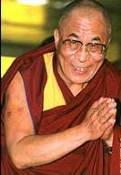 |
| "You can train your mind by analyzing the shortcomings of anger as well as from other people's experiences. It is also useful to look at history. Whenever I examine human tragedy, I find that in most cases it is the result of human behavior- negative emotions, such as anger, hatred, jealousy and extreme greed. All good things that are constructive, happier human experiences, are mostly motivated by respect for others' rights and concern for others' well-being - compassion, love and kindness. "It is essential to study and acquire an education. Training the mind is a process of familiarization. In the Buddhist context, familiarization, or meditation, refers to the positive transformation of the mind, that is, to the elimination of its defective qualities and the improvement of its positive qualities. Through meditation we can train our minds in such a way that negative qualities are |
| generated and enhanced. "Physically you are a human being, but mentally you are incomplete. Given that we have this physical human form, we must safeguard our mental capacity for judgment. For that, we cannot take out insurance; the insurance company is within: self-discipline, self-awareness, and a clear realization of the disadvantages of anger and the positive effects of kindness." The Dalai Lama |
|
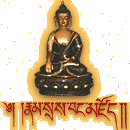
| What is Buddhism? To abstain from all evil... To cultivate every virtue... And to tame one�s mind... This is the teaching of the Buddhas. Buddhism is a religion and a philosophy; but most of all, it is a way of life. The historical Buddha - Shakyamuni, the sage of the Shakyas - lived and taught in north central India approximately twenty-five hundred years ago. Born as Prince Siddhartha Gautama, he abandoned all worldly possessions to practice radical asceticism. After realizing its equal inadequacy, he decided to follow the Middle Way. He is seen by Buddhists as a great being who achieved his highest des-tiny: Enlightenment. The Buddha is not the name of a person; it is a title derived from the root �bodh� - to wake. Thus Buddha literally means awakened, developed, and Enlightened, and the Buddha means the Enlightened one. The Buddha taught that every one of us has the same destiny, and can achieve it if we make the effort. The purpose of the Buddha�s teaching is to guide us on the road to our Enlightenment; hence, it is to be applied to our daily living, not kept as an in-teresting theory. �If you see a sign-post on a road, follow it and you will reach your goal; it you sit down beneath it and gaze at it, you will get nowhere.� The Buddha was not the first being ever to become Enlightened, nor was he seen as unique or exceptional. He was a teacher and a friend who is still greatly respected because he brought to perfection the human qualities of purity, wisdom, and compassion: but he is not a savior, nor is he worshipped as a god. Statues and depictions of the Buddha are symbols reminding us that our true nature is the same as that of the Buddha - Enlighten-ed. Compassion and Wisdom - The essence of the Buddha�s teaching is compassion. Compassion is the discerning ability to help in an appropriate man-ner; it is not a sentimental emotion. It is vital, active knowledge of what is appropriate in a given situation. Compassion begins with being open first to ourselves, to our inner experience, and thus accepting ourselves. Then we apply that openness to the world around us, to individuals, to events, to situations. Compassion is all-embracing caring that arises within the mind of an Enlightened being, a caring that sees all forms of life and of beings as equal. It can only arise in a mind that is completely open, a mind that is not narrowed by preferences, judgments , intolerance, or by blocking off. We can all reach the stage of Enlightened compassion; the first step is to start accepting ourselves and others without judgment. The Buddha did not set out to found a religion or convert people to any belief system or dogma. His mission was to show people the way to liberation from sorrow and suffering. To this end he taught a system of ethical and altru-istic living, which he recommended to all people. The emphasis within the system is on refraining from any harmful or destructive behavior, and engaging in every possible form of kind, loving, and compassionate conduct. The way to libera-tion included teaching on meditation, which is a scientific system of relaxed refection and mind culture that leads the practitioners to a direct experience of their true nature. A deepening of this experience calls forth the wisdom that is within all of us. Through meditation and reflection, compassion and wisdom blossom within the mind, leading to full Enlightenment - liberation from any further possibility of suffering. Tolerance - A cardinal feature of Buddhism is the emphasis on respect for the religions of others and tolerance of all people, regard-less of race, creed, or culture. It is above all a religion of peace. In the third century BCE, the Buddhist emperor Asho-ka carved in rock: One should not honor one�s own religion and condemn the religion of others, but one should honor other�s religions. So doing, one helps one�s own religion to grow and renders service to the religions of others, too. In acting otherwise, one digs the grave of one�s own religion and also does harm to other religions. |
|
| The First Dalai Lamas - Two separate theories of reincarnation explain the Dalai Lama's spiritual identity. The first is that the deceased lams's spirit is reborn in a child. The chosen baby is enthroned and later initiated and trained as a Ge-lug-pa monk before he takes office. This notion of reincarnation differs from older Buddhist theory which teaches that rebirth is determined by personal karmic elements. The second theory, that each Dalai Lama is an incarnation of Avalokiteshvara, probably originated in the 17th century. Since Tibet's first "dharma king" was also thought to be an incarnation of Avalokiteshvara, the connection suggested between each Dalai lama and Tibet's first Buddhist benefactor is a powerful one. Disclaimer: All images and/or articles retain the original copyrights of their original owners. |
 |
| Visit our main Buddhism site. More information, images, and, NO pop-ups! |
 |
| Last Update: 11/30/04 |