| Page 34A |
 |
 |
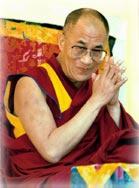 |
| "If you think only of yourself, if you forget the rights and well-being of others, or, worse still, if you exploit others, ultimately you will lose. You will have no friends who will show concern for your well-being. Moreover, if a tragedy befalls you, instead of feeling concerned, others might even secretly rejoice. By contrast, if an individual is compassionate and altruistic, and has the interests of others in mind, then irrespective of whether that person knows a lot of people, wherever that person moves, he or she will immediately make friends. And when that person faces a tragedy, there will be plenty of people who will come to help." The Dalai Lama |
 |
| The Sheltering Tree of Interdependence - A Buddhist Monk's Reflections on Ecological Responsibility - By The XIVth Dalai Lama 1. O Lord Tathagata born of the Iksvakus / Peerless One / Who, seeing the all-pervasive nature / Of interdependence / Between the environment and sentient beings / Samsara and Nirvana / Moving and unmoving / Teaches the world out of compassion. 2. O the Savior / The One called Avalokitesvara / Personifying the body of compassion / Of all Buddhas / We beseech thee to make our spirits ripen / And fructify to observe reality / Bereft of illusion / 3. Our obdurate egocentricity / In-grained in our minds / Since beginningless time / Contaminates, defiles, and pollutes / The environment / Created by the common karma / Of all sentient beings. 4. Lakes and ponds have lost / Their clarity, their coolness / The atmosphere is poisoned / Nature's celestial canopy in the fiery firmament / Has burst asunder / And sentient beings suffer diseases / Unknown before. 5. Perennial-snow mountains, resplendent in their glory / Bow down and melt into water / The majestic oceans lose their ageless equilibrium / And inundate islands. 6. The dangers of fire, water, and wind are limitless / Sweltering heat dries up our lush forests / Lashing our world with unprecedented storms / And the oceans surrender their salt to the elements. 7. Though people lack not wealth / They cannot afford to breathe clean air / Rain and streams cleanse not / But remain inert and powerless liquids. 8. Human beings / And countless beings / That inhabit water and land / Reel under the yoke of physical pain / Caused by malevolent diseases / Their minds are dulled / With sloth, stupor, and ignorance / The joys of the body and spirit / Are far, far away. 9. We needlessly pollute / The fair bosom of our mother earth / Rip out her trees to feed our short-sighted greed / Turn-ing our fertile earth into sterile desert. 10. The interdependent nature / Of the external environment / And people's inward nature / Described in the Tantras / Works on Medicine, and astronomy / Has verily been vindicated / By our present experience. 11. The earth is home to living beings; / Equal and impartial to the moving and unmoving / Thus spoke the Buddha in truthful voice / With the great earth for witness. 12. As a noble being recognizes the kindness / Of a sentient mother / And makes recompense for it / So the earth, the universal mother / Which nurtures all equally / Should be regarded with affection and care. 13. Forsake wastage / Pollute not the clean, clear nature / Of the four elements / And destroy the well being of people But absorb yourself in actions / That are beneficial to all. 14. Under a tree was the great Sage Buddha born / Under a tree he overcame passion / And obtained Enlightenment / Under two trees did he pass in Nirvana / Verily, the Buddha held the tree in great esteem. 15. Here, where Manjusri's emanation / Lama Tson Khapa's body bloomed forth / Is marked by a sandalwood tree / Bearing a hundred thousand images of the Buddha. 16. Is it not well known / That some transcendental deities / Eminent local deities and spirits / Make their abode in trees? 17. Flourishing trees clean the wind / Help us breathe the sustaining air of life / They please the eye and soothe the mind / Their shade makes a welcome resting place. 18. In Vinaya, the Buddha taught monks / To care for tender trees / From this, we learn the virtue / Of planting, of nurturing trees. 19. The Buddha forbade monks to cut / Cause others to cut living plants / Destroy seeds or defile the fresh green grass / Should not this inspire us / To love and protect our environment? 20. They say, in the celestial realms / The trees emanate / The Buddha's blessings / And echo the sound / Of basic Bud-dhist doctrines / Like impermanence. 21. It is trees that bring rain / Trees that hold the essence of the soil / Kalpa-Taru, the tree of wish fulfillment / Virtu-ally resides on earth / To serve all purposes. 22. In times of yore / Our forbears ate the fruits of the trees / Wore their leaves / Discovered fire by attrition of wood / Took refuge amidst the foliage of trees / When they encountered danger. 23. Even in this age of science / Of technology / Trees provide us shelter / The chairs we sit in / The beds we lie on / When the heart is ablaze / With the fire of anger / Fueled by wrangling / Trees bring refreshing, welcome coolness. 24. In the tree lie the roots / Of all life on earth / When it vanishes / The land exemplified by the name / Of the Jambu tree / Will remain no more / Than a dreary, desolate desert. 25. Nothing is dearer to the living than life / Recognising this, in Vinaya rules / The Buddha lays down prohibitions / Like the use of water with living creatures. 26. In the remoteness of the Himalayas / In the days of yore, the land of Tibet / Observed a ban on hunting, on fishing / And, during designated periods, even construction / These traditions are noble / For they preserve and cherish / The lives of humble, helpless, defenseless creatures. 27. Playing with the lives of beings / without sensitivity or hesitation / As the act of hunting or fishing for sport / Is an act of heedless, needless violence / A violation of the solemn rights Of all living beings. 28. Being attentive to the nature / Of interdependence of all creatures / Both animate and inanimate / One should never slacken in one's efforts / To persevere and conserve nature's energy. 29. On a certain day, month, and year / One should observe the ceremony / Of tree planting / Thus, one fulfills one's responsibilities / Serves one's fellow beings / Which not only brings one happiness / But benefits all. 30. May the force of observing that which is right / And abstinence from wrong practices and evil deeds / Nourish and augment the prosperity of the world / May it invigorate living beings and help them blossom / May sylvan joy and pris-tine happiness / Ever increase, ever spread and encompass all that is. During the course of my extensive traveling to countries across the world, rich and poor, east and west, I have seen peo-ple reveling in pleasure, and people suffering. The advancement of science and technology seems to have achieved little more than linear, numerical improvement; development often means little more than more mansions in more cities. As a result, the ecological balance � the very basis of our life on earth � has been greatly affected. On the other hand, in days gone by, the people of Tibet lived a happy life, untroubled by pollution, in natural conditions. Today, all over the world, including Tibet, ecological degradation is fast overtaking us. I am wholly convinced that, if all of us do not make a concerted effort, with a sense of universal responsibility, we will see the gradual breakdown of the fragile ecosystems that support us, resulting in an irreversible and irrevocable degradation of our planet, Earth. These stanzas have been composed to underline my deep concern, and to call upon all concerned people to make continued efforts to reverse and remedy the degradation of our environment. The poem is being released on the occasion of the presentation of a statue of Buddha to the peo-ple of India; and to mark the opening of the International Conference on Ecological Responsibility: A Dialogue with Buddhism. Bhikshu Tenzin Gyatso, The XIVth Dalai Lama. |
|
| more to the good of the motherland, Tibetans and Tibetan Buddhism." Norbu's legitimacy is disputed by the exiled Ti-betan leader, the 14th Dalai Lama, who lives in India. In 1995 he chose another boy of the same age as the reincarna- tion of the 10th Panchen Lama. 'Custody' Exiled Tibetan activists back the Dalai Lama's choice for Panchen Lama who they say has been kidnapped by the Chinese authorities The boy, Gedhun Choekyi Nyima, disappeared after the Dalai Lama's endorsement and has been labeled by pro-Tibet groups as the world's youngest political prisoner. Suspicions that the boy had been kidnapped were heightened in May 1996 when the Chinese leadership admitted to holding him and his family in "protective custody." No international agencies or human rights organizations (including the United Nations) have been allowed to visit the boy or his family, and their condition remains uncertain. Chinese authorities have given assurances that the boy and his family are in good health. Pro-independence forces in Tibet say Beijing's suppression of the rival claimant is another part of its effort to control the Tibetan people, their religion, and their nation. The Pan-chen Lama plays an important role in Tibetan Buddhism - primarily because it falls to him to choose the next reincarna-tion of the Dalai Lama when the incumbent dies. |
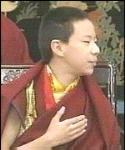 |
| China's Panchen Lama makes rare TV appearance (February 11, 2002) BEIJING, China - After years of living in seclusion and amid tight security, the boy endorsed by Beijing as Tibet's 11th Panchen Lama has made a rare appearance on Chinese television. (Norbu is rarely seen in public and is kept under tight security near Beijing.) Gyancain Norbu, chosen by the Chinese authorities as the second-highest spiritual authority in Tibetan Buddhism, was shown being received by the Chinese leadership. Norbu was seated next to Li Ruihuan, the increasingly influen-tial chairman of the Chinese People's Political Consultative Conference. He offered gifts to Li and expressed his gratitude to the Communist Party and the central government for their care and at-tention to him. In return, Li gave a New Year gift saying he hoped the boy, "would contribute yet |
|
| The Buddhist Path... The Buddha's path of practice is called the Noble Eightfold path. The eight components of this path, as presented in traditional order, could be briefly described as follows: 1. Right View (Understanding). This is the right way of interpreting and viewing the world. It involves the realisation of the three signata in all phenomena, and of the Four Noble Truths as being applicable to the human condition. More generally it involves the abandonment of all dogmatically held wrong views. 2. Right Intention (Thought). The Buddha argued that all human thought and action spring from basic "intentions," "dispositions," or "roots," which are capable of deliberate cultivation, training and con-trol. The three roots of wrong, unwholesome or "unskilful" action are: Greed, Aversion and Delusion. The right inten-tion which the Buddhist path requires, is an intention which is free from these roots. The Buddha called the intention "that is free from greed and lust, free from ill-will, free from cruelty." 3. Right Speech. Since speech is the most pow-erful means of communication, the Buddha emphasises the cultivation of right modes of speech. These have been de-scribed as avoiding falsehood and adhering to the truth; abstaining from tale-bearing and instead promoting harmony; refraining from harsh language and cultivating gentle and courteous speech; avoiding vain, irresponsible and foolish talk, and speaking in reasoned terms on subjects of value. Naturally right speech includes in the modern context right ways of communication whatever the medium used. 4. Right Action. This refers to wilful acts done by a person, whether by body or mind. Under the former it involves such forms of ethical conduct as not killing (or harming) living beings, theft, sexual wrong-doing, etc. On the positive side, right action, also called wholesome deeds (kusalakamma), involves acts of loving-kindness (mett�), compassion (karun�), sympathetic joy (mudita), generosity (c�ga), etc. 5. Right Liveli-hood. This involves not choosing an occupation that brings suffering to others, e.g. trading in living beings (including humans), arms, drugs, poisons, etc.; slaughtering, fishing, soldiering, sooth-saying, trickery, usury, etc. This provides the economic blueprint for a truly Buddhist society. 6. Right Effort. This has been described as "the effort of avoiding or overcoming evil and unwholesome things, and of developing and maintaining wholesome things" (�y�n�tiloka). Right effort enables an individual to cultivate the right frame of mind in order to accomplish the ethical requirements under right speech, right action and right livelihood. It is generally presented as a factor of mental training, enabling individu-als to develop the sublime states of loving-kindness (mett�) compassion (karun�), sympathetic joy (mudita), and equa-nimity (upekkha). However it has a general applicability and the effort could be directed to all wholesome activities. 7. Right Mindfulness. This is the basic Buddhist technique of cultivating awareness. The classic sutta on the subject is the satipah�na sutta which will be considered briefly in the next chapter. Although viewed as a meditation component in fact right awareness has a wider applicability. 8. Right Concentration. This is the concentration of mind associated with wholesome consciousness which could be achieved through the systematic cultivation of meditation. Progress along this line is indicated by the achievement of the different levels of "absorption" (jh�nas). Of these eight components of the Path, the first two have usually been grouped under wisdom (pa���), the next three under morality (s�la), and the last three under mental development (bh�van�). This classification is not quite satisfactory, but it does present a broad grouping that is useful in many contexts. The first of these components (right view) is generally considered the most im-portant, but there is no particular order of importance when it comes to the others. However different traditions and exponents have put different degrees of stress on the different components. It will be seen that there is no single com-ponent of the path that can be called "meditation." However, in the course of time, the component of mental develop-ment came to be regarded as meditation. |
|
 |
| wisdom?" Thus he spoke, and the Superior Avalokiteshvara, the Bodhisattva, the great being, replied to the Venerable Shariputra as follows: "Shariputra, whatever son or daughter of the lineage wishes to engage in the practice of the pro-found perfection of wisdom should look perfectly like this: subsequently looking perfectly and correctly at the emptiness of inherent existence of the five aggregates also. Form is empty; emptiness is form. Emptiness is not other than form; form also is not other than emptiness. Likewise, feeling, discrimination, compositional factors and consciousness are empty. Shariputra, like this all phenomena are merely empty, having no characteristics. They are not produced and do not cease. They have no defilement and no separation from defilement. They have no decrease and no increase. There-fore, Shariputra, in emptiness there is no form, no feeling, no discrimination, no compositional factors, no conscious-ness. There is no eye, no ear, no nose, no tongue, no body, no mind; no form, no sound, no smell, no taste, no tactile ob-ject, no phenomenon. There is no eye element and so forth up to no mind element and also up to no element of mental consciousness. There is no ignorance and no exhaustion of ignorance, and so forth up to no ageing and death and no ex-haustion of ageing and death. Likewise, there is no suffering, origin, cessation or path; no exalted wisdom, no attain-ment and also no non-attainment. Therefore Shariputra, because there is no attainment, Bodhisattvas rely on and abide in the perfection of wisdom; their minds have no obstructions and no fear. Passing utterly beyond perversity, they attain the final state beyond sorrow. Also, all the Buddhas who perfectly reside in the three times, relying upon the perfection of wisdom, become manifest and complete Buddhas in the state of unsurpassed, perfect and complete Enlightenment. Therefore, the mantra of the perfection of wisdom, the mantra of great knowledge, the unsurpassed mantra, the equal-to-the-unequalled mantra, the mantra that thoroughly pacifies all suffering, since it is not false, should be known as the truth. The mantra of the perfection of wisdom is proclaimed: tayata gate gate paragate parasamgate bodhi soha (Gone, gone, gone beyond, gone completely beyond, awakened, so be it!) Shariputra, a Bodhisattva, a great being, should train in the profound perfection of wisdom like this." Then the Blessed One arose from that concentration and said to the Su-perior Avalokiteshvara, the Bodhisattva, the great being, that he had spoken well. "Good, good, O child of the lineage. It is like that. Since it is like that, just as you have revealed, the profound perfection of wisdom should be practiced in that way, and the tathagatas will also rejoice." When the Blessed One had said this, the Venerable Shariputra, the Su-perior Avalokiteshvara, the Bodhisattva, the great being, and that entire assembly of disciples as well as the worldly beings - gods, humans, demi-gods and spirits - were delighted and highly praised what had been spoken by the Blessed One. (The noble "Heart of the Perfection of Wisdom Sutra" is complete.) A Practice to Dispel Hindrances - To those from the pure and supreme places who enjoy space (emptiness), / Who pos-sess the five clairvoyances and can magically emanate, / Care for us practitioners, like a mother for her child. / I prostrate to the assembly of dakinis of the three places. / ah ka sama radza sada rasa maraya pey (recite several times), / tayata gate gate paragate parasamgate bodhi soha / By the truth of the existence of the Three Jewels, may all inner and outer hindrances and adversities be overcome! (clap) / May they become non-existent! (clap) / May they be pacified! (clap) / May all negative forces opposed to the Dharma be completely pacified! / May the eighty thousand obstacles be pacified. May we be separated from all adverse conditions and may we obtain conducive circumstances and everything good. May there be auspiciousness, happiness and well-being here, right now! Disclaimer: All articles and images retain the original copyrights of their original owners. |
| Heart of Wisdom Sutra - Thus I have heard: at one time, the Blessed One was dwelling in Rajagriha on Massed Vultures Mountain together in one method with a great assembly of monks and a great assembly of Bodhisattvas. At that time, the Blessed One was absorbed in the concentration of the countless aspects of phenomena called Profound Illumination. At that time also Superior Avalokiteshvara, the Bodhisattva, the great being, was looking perfectly at the practice of the profound perfection of wisdom, perfectly looking at the emptiness of inher-ent existence of the five aggregates also. Then, through the power of Buddha, the Venerable Shariputra said to the Superior Avalokiteshvara, the Bodhisattva, the great being, "How should a child of the lineage train who wishes to engage in the practice of the profound perfection of |
 |
 |
 |
| Visit our main Buddhism site. More information, images, and, NO pop-ups! |
 |
| Last update: 11/30/04 |