 |
| Page 32 |
| Auspicious drawing - The auspicious drawing symbolizes the mutual dependence of religious doctrine and secular affairs. Similarly, it represents the union of wisdom and method, the inseparability of emptiness and dependent arising at the time of path, and finally, at the time of Enlightenment, the complete union of wisdom and great compassion. |
| Victory banner - The victory banner symbolizes the victory of the activities of one's own and others' body, speech and mind over obstacles and negativities. It also stands for the complete victory of the Buddhist Doctrine over all harmful and pernicious forces. |
| Right-coiled white conch - The white conch which coils to the right symbolizes the deep, far reaching and melodious sound of the Dharma teachings, which being appropriate to different natures, predispositions and aspirations of disciples, awakens them from the deep slumber of ignorance and urges them to accomplish their own and others' welfare. |
 |
 |
 |
 |
 |
 |
 |
 |
| An Altar - To have or have not... An altar is not essential for Buddhist meditation, but if creating and maintaining an altar appeals to you, then it is an appropriate devotional practice of Buddhism. The different Buddhist traditions have culturally influenced iconography and symbols, which vary in style. A Zen altar is generally very simple, while a Tibetan altar has a whole array of offerings and images. One is not better than the other; they are just following their own tradition. We can choose to follow one tradition purely, or drawn on several traditions for different meditations or texts. For example, if we decide that we wish to practice only Theravada Buddhism, then it is best to have an altar that re- |
| flects this, and our images will be Thai, Burmese, or Sri Lankan in style. If we are just starting and are not quite sure which school of Buddhism suits us best, then we can make a simple altar with any Buddhist images that attract us. One reason to make an altar with images upon it is to create an atmosphere conductive to our meditation. We can make our altar on a low table or shelf, on which we can put a statue of one of the Buddhas, or hang a Buddhist picture on the wall. Although we wish to make it beautiful as an offering to the Buddhas, we must remain aware that these paintings and statues have a religious significance; they are not just pretty pictures and ornaments for decoration. Another reason to have an altar is to make offerings on a daily basis, or every time we use our room or space for meditation. When we place offerings on our altar, we don't just put physical objects down, we also make inner offerings. This means we are mindful of why we are doing meditation - to awaken to our true nature - so we offer this pure intention to the Buddhas as well. Traditionally, we offer objects that are pleasing to the senses and have a pure quality. Appropriate offerings are a small bowl of water and a few flowers, also we light a candle and burn some incense. (When doing either of these two, do not leave unattended or near anything that is flammable.) We make the offerings as beautiful as we can, since we offer them to Buddha and to our own potential for Enlightenment. There is no point in offering inferior objects, or ne-glecting to change the water daily; such forgetfulness and carelessness would be quite disrespectful. |
 |
 |
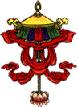
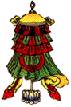
| Precious umbrella - The precious umbrella symbolizes the wholesome activity of preserving beings from illness, harmful forces, obstacles and so forth in this life, and all kinds of temporary and enduring sufferings of the three lower realms, and the realms of men and gods in future lives. It also represents the enjoyment of a feast of benefit under its cool shade. |
| Lotus flower - The lotus flower symbolizes the complete purification of the defilements of the body, speech and mind, and the full blossoming of wholesome deeds in blissful liberation. |
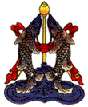
| Golden fish - The golden fish symbolizes the auspiciousness of all living beings in a state of fearlessness, without danger of drowning in the ocean of sufferings, and migrating from place to place freely and spontaneously, just as fish swim freely without fear through water. |
| Wheel - The golden wheel symbolizes the auspiciousness of the turning of the precious wheel of Buddha's doctrine, both in its teachings and realizations, in all realms and at all times, enabling beings to experience the joy of wholesome deeds and liberation. |
| Vase of treasure - The treasure vase symbolizes an endless rain of long life, wealth and prosperity and all the benefits of this world and liberation. |
| The Eight Auspicious Symbols - |
| Katas (silk scarves) - No Tibetan custom is as well known as the offering of a kata or white scarf in greeting. The kata is an auspicious symbol. It lends a positive note to the start of any enterprise or relationship and indicates the good in-tentions of the person offering it. Katas are offered to religious images, such as statues of the Buddha, and to lamas and government officials prior to requesting their help in the form of prayers or other services. The offering of the kata in-dicates that the request is not marred by corrupt thoughts or ulterior motives. There are eight types of katas. Three sizes of elaborate dzod tak, which is a silk kata with auspicious designs woven into it; the Mongolian kata, which is bright blue; the ashi kata, which is plain silk; the subshi, which is loosely woven cotton; the sothar and the khachi. There are also instances of using katas on inauspicious occasions. One of these is the tying of a kata around the neck of a corpse. It is said that once, when a wealthy man suddenly died, his servant, not knowing what else to do, tied his cow's woolen halter around the corpse's neck and that this later became a tradition. It is also customary to tie a kata around the neck of a deceased lama, as a sign of petitioning his quick return and the unmistaken recognition of his reincarna-tion. The Tibetan custom of throwing tsampa in the air - There are no written records of the origin of the tradition of throw-ing tsampa in the air, only oral accounts. It is said to have begun before the introduction of Buddhism, when the people of ancient Tibet observed animistic forms of religion and used the food-stuffs they produced as offerings to their gods. As the B�n religion became more established, the custom of throwing tsampa in the air became a more widespread and established ritual. In the 7th century C.E., it was employed formally at the enthronement of kings and the appointment of ministers, and came to be a mark of joy and prosperity at weddings. By about the 13th century, it had become cus-tomary to mark all important occasions of Tibetan life, such as marriages, birthdays and other auspicious occasions, by tossing a pinch of tsampa into the air. It became especially significant in celebrations of the New Year (Losar). An au-spicious dialogue would take place between two people, the one making the offering would then take a pinch from the tip of a mound of tsampa and throw it in the air crying out, "Tashi Delek." The person receiving it would then recite the following verse: "Tashi Delek, good fortune and good health, may you achieve unchanging happiness, and may it ever increase." Throwing tsampa in the air in this way is an expression of good wishes for your own and others happiness and the overcoming of all obstacles. |
|
|
| Grass roots control stepped up with education of Chinese and Tibetan cadres... At least 70 Chi-nese cadres are learning Tibetan at the University of Tibet in Lhasa as part of a program to prepare them for future leadership roles in Tibet at village and county level. This is one of a number of measures being taken by the Chinese authorities to step up their control of rural areas in Tibet, including a continued emphasis on intensive ideological train-ing for Tibetan cadres. The need for skilled and educated workers has been a constant theme of the current campaign to develop China's western regions, including the Tibet Autonomous Region (TAR) and Tibetan areas in Qinghai, Sichuan, Gansu and Yunnan. There is concern among Tibetans in Lhasa, however, that the regional and local authorities give more weight to ideological soundness than to technical expertise, and that the skills acquired by Tibetan cadres during training in China have little practical application to the current socio-economic realities in Tibet. Tibetans are also con-cerned about the continuing replacement of Tibetan cadres with Chinese at the grass roots level of the administration. The 70 Chinese cadres currently being trained at the University of Tibet in Tibetan language and nationalities policy are tipped to be appointed to various administrative positions in farming and nomadic areas of the TAR following completion of the three-year course. Tibet University officials publicly welcomed the students with formal speeches, stating that it is the first time that so many Chinese have been admitted to the Tibetan language department since it was established. University officials also reportedly said that the policy of enrolling Chinese to the Tibetan language department at the University would be continued and strengthened in future, and that in the context of the current campaign to develop the western regions of China, Chinese graduates of the department would be able to make a significant contribution. The University reportedly told students that these Chinese graduates "would be particularly instrumental in consolidat-ing and defending social stability and peace in Tibet." A Tibetan who is now living in exile and who previously lived in Lhasa told TIN: "Cities in the TAR such as Lhasa and Shigatse are now similar to Chinese cities. Now the Chinese want to transform and control rural Tibetan areas in the same way, and the most important instrument for doing so is the Ti-betan language." The training of Tibetan cadres in China has been focused on political and ideological education rather than on practical skills appropriate for the development of local economies at a grass roots level. Another Tibetan source who is now living in exile said: "Tibetans who have been deputed to undergo specialist training in different parts of China have undergone political indoctrination rather than focusing on the realities of local situations prevailing in the Tibetan areas where they are to work. These Tibetans do learn about scientific and technical means of raising [in-dustrial] economic productivity but these are based on Chinese policies of development, and are aimed at pushing for-ward the campaign to popularize 'scientific' means of improving economic productivity, replacing the traditional meth-ods of production practiced among the farming and nomadic communities of Tibet. These policies are frequently incom-patible with either the current economic realities [in Tibet] or the cultural life of the Tibetan people. Upon their return to Tibet at the end of their training, these Tibetan cadres find that they cannot apply what they had learned during their couple of years training in China. The regional and local authorities show greater respect and preference to those cadres who have acquired thorough ideological grounding in Communism than to those who have acquired specialist experience and technical skills. "Tibetan leaders and cadres who are deemed to be politically trustworthy are allowed to retain their positions and undergo training through further workshops alongside Chinese appointees. Those who are suspected to be politically disloyal, however, are removed or transferred to posts that have the same status, but less importance and power. The authorities frequently use the pretexts of "poor understanding of administration and management" or "poor educational level and inefficiency," when a cadre is removed from his or her post due to concerns over "political unreliability." (11 January 2001) |
|
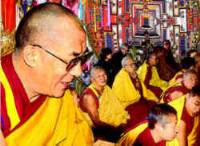
| "I am just a simple monk. No more, no less. "My religion is kindness. "The main cause of depression is not a lack of material necessities, but a deprivation of the affection of others. "When we encounter some problem and when someone is about to harm us, then immediately we cultivate anger. Anger comes as a helper or assistant because it makes us bold and courageous and we can retaliate and hit back. When attachment comes, it comes like our best or closest friend. So they are part of our mind, an innate part, and normally we take them for granted and do not bother much about them when they arise within us. Since they come as our friend or helper, therefore, anger and attachment can really deceive us. "Human relations based on mutual compassion and love are fundamentally important to human happiness. "Human potential is the same for all. Your feeling, 'I am of no value,' is wrong. Absolutely wrong! You are deceiving yourself. We all have the power of thought - so what are you lacking? If you have willpower, then you can do anything. It is usually said that you are your own master. "If is said that if you want to know what you were doing in the past, look at your body now; if you want to know what will happen to you in the future, look at what your mind is doing now. "There were once two monks - a teacher and his student. In order to give some encouragement to his student, the teacher said, 'One day we will definitely go for a picnic.' After a few days, it was forgotten. The student later reminded the teacher of his promise but the teacher responded by saying that he was too busy to go for a picnic for a while. A long time passed; no picnic. When reminded again, the teacher said, 'Not now. I am far too busy.' So one day the student saw a dead body being carried off; and the teacher asked him, 'What is happening?' and the student replied, 'Well, that poor man is going on a picnic!' so, unless you make specific time for something that you feel committed to, you will always have other obligations. "Some psychologists say that we should not repress anger but express it - that we should practice anger! Here we should make a distinction between mental problems that should and should not be expressed. Sometimes you may be truly wronged and it is right for you to express your grievance instead of letting it fester inside you. But you should not express it with anger." "On the basis of external action, it is difficult to distinguish whether an action is violent or nonviolent. Basically, it depends on the motivation behind the action. If the motivation is negative, even though the external appearance may be very smooth and gentle, in a deeper sense the action is very violent. On the contrary, harsh actions and words done with a sincere, positive motivation are essentially nonviolent. In other words, violence is a destructive power. Nonviolence is constructive." The Dalai Lama |
 |
|
 |
 |
| April 18, 2004 |
| By the accident of fortune a man may rule the world for a time, but by virtue of love and kindness he may rule the world forever. Lao-Tse It is one of the most beautiful compensations of this life that no man can sincerely try to help another without helping himself. Ralph Waldo Emerson So long as we love we serve; so long as we are loved by others, I would almost say that we are indispensable; and no one is useless while they have a friend. Robert Louis Stevenson |
| Be not forgetful to entertain strangers for thereby some have entertained angels unawares. Hebrews 13:2 It is not only for what we do that we are held responsible, but also for what we do not do. Moliere Wherever there is a human being, there is an opportunity for kindness. Seneca, Roman Philosopher Nothing is so strong as gentleness, and nothing is so gentle as true strength. Ralph Sockman Disclaimer: All images and/or articles retain the original copyrights of their original owners. |
| "How sure his pathway in this wood, Who follows truth's unchanging call! How blessed, to be kind and good, And practice self-restraint in all! How light, from passion to be free, And sensual joys to let go by! And yet his greatest bliss will be When he has quelled the pride of 'I.'" Buddha "Through many births I sought in vain The Builder of this House of Pain. Now, Builder, You are plain to see, And from this House at last I'm free; I burst the rafters, roof and wall, And dwell in the Peace beyond them all." Buddha |
|
| The greatest good you can do for another is not just share your riches, but reveal to them their own. Disraeli Too often we underestimate the power of a touch, a smile, a kind word, a listening ear, an honest compliment, or the smallest act of caring, all of which have the potential to turn a life around. Leo Buscaglia The world you desired can be won. It exists, it is real, it is possible, it is yours. Ayn Rand "Namaste" This simple word uttered with a gesture of folded hands is among the finest salutations mankind has ever been able to vocalize. It simply means: I honor the place in you In which the entire Universe dwells, that place of Love and Light, and of Truth and of Peace. When you are in that place in you, and I am in that place in me, we are One. |
 |
 |
| Visit our main Buddhism site. More information, images, and, NO pop-ups! (Click on image at left.) |
 |