 |
| Page 31A |
 |
| A Tibetan Lama Answers Questions... Q: Given the fact that in your tradition there exist states of clarity and there are reports of people experiencing this more subtle state of mind, my ques-tion is two-fold: first, do you think that such non-cognitive states of mind could in theory be observed with our external tools? For example, if we were to place a meditator who is in a state of clear light into one of our modern machines with magnetic resonance, using new brain-imaging techniques, would we be able to see something, some sign of this subtle state? Perhaps we do not yet know how to do this but, in theory, do you think it would it be pos-sible? If so, what, in your opinion, would be the relation between the two lev-els, gross and subtle, in the field of interdependence? We do not want to suc-cumb to a new dualism, that of grossness and subtlety. What is the nature of causality between these two levels? A: I think it may be difficult to measure |
| the activity specific to the mind that consists of reflecting one's object and knowing it. But as the experiences of the gross consciousness appear in the activity of the brain and can therefore be observed as such, it seems to me that it should also be possible to study the physical manifestations of the more subtle states of mind. The subtle level of con-sciousness, referred to by the term "clear light," appears among other things at the moment of death. Those who have practised ahead of time are able to remain voluntarily in this state for several days after death, and for the duration of this time their bodies do not decompose. Modern scientific instruments would be able to observe this phenomenon, and in fact this has already occurred in India. Although it seems to me that it would be difficult to observe the subtle mind in its entirety using these methods, I think all the same that this might give us an idea. To answer the second question, concerning the relation between the gross mind and the subtle mind, you must know that the degree of subtlety of the mind will depend in part on the degree of subtlety of its physical support and on the particular ruling condition, the six senses. But the faculty shared by all perceptions - to reflect an object and know it - comes from the subtle mind. In this way it is possible to understand the fundamental relation that exists between the subtle and gross levels of the mind. Sensory and mental consciousnesses are produced depending on ruling conditions specific to each of the six senses: vis-ual sense for visual perceptions, mental faculty or sense for mental knowledge, etc. Because the grossness of their sup-port is greater, sensory perceptions are relatively gross compared to mental consciousnesses. Still, all have the ability to reflect their object and know it, an aptitude which derives from their common underlying foundation, the subtle mind, clear light. The tantric texts of Buddhism comment on the manner in which the gross levels of the mind are linked to the subtle mind. It is explained how eighty states of consciousness correspond to four stages of absorption of the gross mind into the subtle mind, during death for example. The links between the different levels of the mind are illustrated, but it is a very complex subject which would be difficult to go into at this point. Q: I am particularly interested in the question of the validation of phenomena by consciousness, and therefore in the conditions of their integration. I would like to ask if, apart from certain limited analogies - which are very interesting - between the Dharma and contemporary sciences, Buddhism has something more fundamental to offer the West. I am thinking here of the practice of medita-tion in particular: a renewed open-mindedness and sense of space and time which might give scientific information ac-cess to a more truly conscious "reality, "so that it would no longer be merely a fascinating "fiction" related to matter/ energy, the space/time curve, the non-substantiality of phenomena, etc. A: I have no immediate answer to your ques-tion, but I do have a few ideas to put before you. It would be interesting to refer some of these ideas to certain types of phenomena mentioned by Buddhist philosophical texts. There are physical phenomena, forms, which are not made up of gross matter (one of the properties of which is solid obstruction), but which are, rather, subtle forms, which may be classified into five categories. The first are forms deriving from an assembly, infinitesimal particles such as atoms. Their form is described as being spherical, but their colour is not mentioned. Next we have the mental appearances of space, that is the appearance with which the sky appears to mental perception. I think that modern science could pro-vide more explanations on this subject and have greater success in making it comprehensible. Will it, in reality be par-ticles of space or of light? These two first types of subtle physical phenomena are accepted by all and are not solely cre-ations of the mind. The third type of subtle form includes those which are imagined and might appear, for example, to a person meditating, but which only the meditator can see and which cannot fulfill their usual functions. The next cate-gory is that of forms created by the powers of concentration; these are phenomena which originate from the four physi-cal elements through the force of meditation practised by those who have been very successful in developing their pow-ers of concentration. These phenomena may be experienced not only by the meditator but also by other people. Through meditating in this way it is possible to create fire, for example fire which can fulfill its function of burning and heating. It may seem strange, to say the least, that forms can be produced through the power of concentration. I do not know e-xactly how they can be interpreted or understood, but I do not think they last for very long after they have been creat-ed, probably only for the duration of the meditation. These third and fourth types of form should give scientists matter for reflection! If these phenomena exist, how are they produced? Up to now we have talked about information contained in the Sutras. We could also examine them in the light of the Tantras, the esoteric aspect of Buddhism which deals at length with the nature of more or less subtle energies. Q: What is the concept of time in Buddhism? A: Excuse me, I |
 |
| veloped by the mind on the basis of an imputation, the continuity of an event or phenomenon. This philosophical view describes, therefore, an abstract concept whose function is dependent on the continuum of phenomena. From this point on, to try to explain time as an autonomous entity, independent from an existing object, proves impossible. That time is a relative phenomenon and can claim no independent status is quite clear; I often give the example of external objects which can be easily conceived of in terms of the past or future, but of which the very present seems inconceivable. We can divide time into centuries, decades, years, days, hours, minutes, and seconds. But as the second is also divisible into multiple parts, milliseconds for example, we can easily lose our grasp of the notion of present time! As for conscious-ness, it has neither past nor future and knows only present moments; it is the continuum of a present moment being transformed into another present moment, whereas with external objects the present disappears in favour of notions of past and future. But further pursuit of this logic will lead to absurdity, because to situate past and future we need a frame of reference which, in this case, is the present, and we have just lost its trace in fractions of milliseconds. Q: If consciousness has neither beginning nor end, and if it is not permanent, does it age like an old house, changing with each moment? And if it has neither form, nor colour, nor odour, bow can it be transformed? A: First of all, let us try to agree on the problematic notion of consciousness, of the mind. We have only a gross and partial intellectual understand-ing of consciousness. Our desire to perfect that understanding through analytical research will lead us to the discovery of the luminous, clear, and knowing nature of consciousness. It is extremely important to know how to identify clearly the object we are analysing, in this case the nature of consciousness. Once we identify the nature of consciousness with its immaterial and non-obstructive characteristics, we will be able to use it to confront external objects and a third cate-gory of phenomena, abstract concepts such as the notions of time and change which have neither the nature of consci-ousness nor that of material objects. Keeping these three classifications well in mind - physical objects, the mind, and abstract mental constructs - we will be able to identify consciousness by comparing it to the two other categories of phe-nomena. Once we have clear knowledge of its nature, it will not only be possible to have a conscious experience of the process of change occurring within consciousness, but also to understand how consciousness and the experience of con-sciousness depend on a preceding moment of consciousness. Only the preceding instant of consciousness may lead to a subsequent moment of consciousness nothing else has that faculty. I do not think we can talk about the continuity of consciousness solely in terms of chronology. The very idea of chronology, and thus aging, only has meaning in relation to material phenomena, such as the body. On the level of different individual consciousnesses, such as sensory faculties, we can use the term "aging" to refer to the physiological basis, the body of a human being; in the case of sensory con-sciousnesses, aging in large part progresses in keeping with the individual's physiological condition. The two evolutions are not independent. To speak of the "aging of sensory consciousnesses" is possible if we associate this affirmation with a biological, physiological process, something we cannot do when we speak of mental consciousness. I think it is very important to reflect on the nature of consciousness, to know the different types of consciousnesses and their natures. Buddhist scripture holds that sensory perceptions, such as visual consciousness, are direct and not conceptual; a visual perception perceives a form, without however discerning between its good or bad, desirable or undesirable, aspects. The discernment takes place on a conceptual level, which constitutes a far more interpretative process than. that of simple sensory perception. As far as mental consciousness, the world of conceptual thought, is concerned, we distinguish differ-ent levels of subtlety, from the gross to the most subtle, well-documented in the tantric system The brain, neurons, syn-apses, etc., are connected to consciousness, and this opens onto a vast terrain for investigation when we connect them with what tantric literature calls energy (Tibetan: lung; Sanskrit: prana). Research into the exact nature of the relation between the brain, consciousness, and energy proves to be very interesting. When all the functions of the brain have stopped and physiological conditions have disappeared, it would seem that a form of the process of consciousness contin-ues to exist. This has been observed in the experience of certain realized lamas whose bodies, although declared clinical-ly dead, do not decompose and remain fresh for several days or even several weeks. At this stage, the Buddhist point of view maintains that the individual is not altogether dead, that he is continuing to evolve through the process of death, and that he remains in a state of subtle consciousness. I think scientists ought to seek logical explanations for these cases when the body does not decompose even when the functions of the brain and the body have stopped. The texts also give accounts of meditators who have learned to develop a supernatural ability to create physical objects with their mind, or produce elements such as fire and air, perceived not only by their creator but also, apparently, by other people. Other types of mentally created objects are only perceived by the meditator. I do wonder what the substantial, material cause of these external objects might be. If there is a result - a mentally created physical object - it must be preceded by a cause and conditions of the same nature. I also wonder if these objects exist solely during the practitioner's medita-tion, and cease to exist as soon as he leaves his meditative absorption. I cannot say what the material cause of this type of mentally created object might be. It is a question I address to the monastic community: can consciousness become a substantial cause of material objects? The Tantras, such as that of Guhyasamaja, speak of the illusory body and its sub-stantial cause, which is purported to be subtle energy, as subtle energy is part of the material world. I must say that this problem leaves me puzzled. Q: Is there a primordial cause for all causes? A: No. Generally, causes have no origin, and |
| misunderstood the Tibetan translation of the question; in our language the words for "demon" and "time" are pronounced almost identically, and I was about to give you a talk about what a demon is from a Buddhist point of view! Regarding the Buddhist concept of time, our philosophy has. adopted several positions. The Sautrantika school, also known as the "Holders of Discourse," affirms that all phenomena and events exist only in the present moment. For this school, past and future are nothing other than simple concepts, simple mental constructs. As for the Madhyamika-Prasangika school, the Consequence School of the Middle Way, it generally explains time in terms of relativity, as an abstract entity de- |
 |
 |
 |
 |
 |
|
| for this reason effects have none either. We can nevertheless say, in the context of a very specific point, that in some cases causes and effects have a beginning. When we establish that the continuum of the mind is without beginning, to want to discern a beginning to causes would be an obvious contradiction! You know, Buddhist logicians are quite rigorous. From the moment they accept that the mind has no beginning they can affirm logically and resolutely that neither causes nor effects have one ei-ther. |
 |
| still like to fight. They appear in the heavens or on earth as people or animals. / Hell / Hungry ghosts are beings who suffer from constant hunger. / Hell-beings. These are the six states on the wheel of life. At the top are the heavens, where everyone is happy. Below are the hells where the suffering is unbearable. Beings can rise or fall from one path to another. If one does good deeds, one will be born into the paths of gods, humans, or asuras. If one does evil deeds, one will be born into the paths of animals, hungry ghosts, or hell-beings. From one life to the next one can suddenly change from an human to an animal or from a ghost to a hell-being, according to the things one has done. How to Escape the Turning Wheel... The wheel of life and death is kept turning by the three poisons of greed, hatred, and stupid-ity. By cutting off the three poisons, we can escape the wheel and become Enlightened. There are four stages of Enlight-enment. Buddhas- Perfect in Enlightenment. / Bodhisattvas- Enlighten themselves as well as others. /Pratyekabuddhas- Hermits who retreat from the world to Enlighten themselves. / Arhats- Enlighten themselves. |
| THE WHEEL OF LIFE... Buddhists do not believe that death is the end of life. When one dies, one's consciousness leaves and enters one of the six paths of rebirth. Heavenly Beings / Humans / Asuras are beings who have many good things in life, but |
|
| Question: What exactly is the purpose and usage of the meditation practices of visualization in Vajrayana Buddhism? Answer: Visualization practices are grounded in the concept of Buddha-Nature. The nature or essence of all sentient beings is identical and no different from that of a Buddha. We all have the same potential seed and inherent nature to become Enlightened but due to our own afflictions we do not realize Enlightenment. Since we all have Buddha nature, visualization practice helps us develop that and enables us to "see" our Buddha nature. This is because during a visuali-zation practice, you first envision a Buddha or a Bodhisattva such as the Bodhisattva of Compassion Chenrezig. So, for example, you envision Chenrezig above your head and at that point you are thinking "Chenrezig is a Bodhisattva, sep-arate from myself." That is the stage in which you are generating or creating (visualizing) the Enlightened being as sep-arate from oneself. Then, when one recites the mantra, you envision yourself as Chenrezig. Therefore, you are no lon-ger thinking Chenrezig is separate from you. You are saying, "I am the Bodhisattva of Compassion." That is the stage in which you have completed the practice. The purpose of envisioning oneself as an Enlightened being is that since we all have Buddha nature (we inherently are Enlightened, inherently we are Chenrezig or another Buddha or Bodhisattva). By doing visualization practice, you are identifying your true nature as being that of Chenrezig, you are affirming and clearing away your mental afflictions by recognizing that you have Buddha nature. Visualization is used so the practi-tioner "pretends" they are an Enlightened bein, but in fact you really are an Enlightened being essentially, we all are truly and inherently Enlightened beings, but we fail to realize this. Visualization helps us, because you really are not pretending in the end. One can also say that it aides the practitioner in developing the qualities of an Enlightened being, for instance, if you meditate on Chenrezig and do that practice which consist of aiding sentient beings, then when you are not meditating you will develop a compassionate attitude. You will bring the meditation into daily life. So although you formally leave the meditation, the meditation won't leave you. Visualization/Deity practice takes time to develop. It covers both calm abiding meditation (which is the visualizations that you are meditating on) and the insight meditation (when you rest the mind in equanimity, recognizing that there is no differentiation between oneself and the Enlightened being). |
|
| Tibetan Buddhism stems from the influence of two major sources, Buddhism and yoga. Initially brought to Tibet by Padmasambhava in the 8th Century, Tibetan Buddhism incorporates both Hindu yogic and Tantra practices as well as the classical teachings of The Buddha. It concentrates on the removal of suffering from all beings, with the understand-ing that no one person can alleviate individual suffering until all other beings have been liberated from it as well. The path of traditional Buddhism is based on morality, concentration, wisdom, and denunciation of the personal ego. The second path, the Tantric path, is the cornerstone of Tibetan Buddhism, blending the Buddhist sutra (sacred text) teach-ings with those of the Hindu yoga and Tantra. The Tantric path seeks to transform basic human passions of desire and aversion into spiritual growth and development. Thus, instead of denying primal sexual and sensual urges as in tradi- tional Buddhism, the practice of Tantra accepts these urges as sacred life force energy, which is purified and transform-ed into wholesome and healthy forces connecting the individual with higher spiritual awareness. In order to be success-ful with Tantric work, one must have skill in both self-control and acceptance of self and others. Tibetan Tantra, also known as Vajrayana, draws on the core teachings of both Mahayana and Hinayana, two schools of Buddhism. Mahayana Buddhism emphasizes the help that the gods and the Bodhisattvas can give to people to help them escape samsara, the continual cycle of death and rebirth. Mahayana doctrines teach selflessness, the Bodhisattva stages, perfections and prayers to achieve perfect alignment for the sake of all sentient beings. Hinayana, sometimes called �the little way," emphasizes personal emancipation rather than being concerned with the burdens of others. While those who practice Hinayana initially do not do so with the intent of obtaining Buddhahood, eventually this path too may lead to Mahayana and Enlightenment. Mahayana is made up of two vehicles, the Paramitayana and the Mantrayana. Paramitayana is a �Cause vehicle� in which there is no meditation on oneself in regard to the four complete purities of abode, body, prop-erty and activities, representative of a Buddha�s palace, body, wealth and deeds. Mantrayana is the �Effect vehicle,� in which there is meditation on oneself as being a physical representation of the four complete purities. In Mantrayana, therefore, one meditates on oneself as being a divine mansion, a divine entourage, divine ritual implements, and the divine deeds of purifying the cosmos and its inhabitants in the same manner as a Buddha. There are four types of Man-trayana: inferior, middling, superior, and most excellent. These four classes of Tantra are designed to meet the needs of four types of disciples. The four classes are similar to �four doors:� Ritual Tantra, Conduct Tantra, Yoga Tantra, and Unexcelled Yoga Tantra. The Kalachakra belongs to the Unexcelled Yoga Tantra class. Kalachakra Meditational Deity Vishva-mata "The Lord of Time" Kalachakra: Wheel of Time For more than 2,500 years, the Kalachakra teachings have been preserved in India and Tibet. Kalachakra Tantra comprises the innermost essence of the 84,000 categories of the teachings of The Buddha. Its major purpose is to assist us in purifying our body, speech and mind. There is a special connection between Kalachakra and the land of Shambhala in regard to a future golden age of Dharma. It carries a profound message for the all the people on Earth at this time in history. The three levels of the Kalachakra Tantra are known as external, internal and alternative, each of which is a wheel of time. The external or outer Wheel of Time con-cerns laws of time and space of our three dimensional, physical world and deals with astronomy, astrology and mathe-matics. It is also called �The procession of the external solar and lunar days.� The internal Wheel of Time is concerned with the human body, including its energy system. The alternative Wheel of Time includes the doctrine, path and initia-tions of Shri Kalachakra, its circular Mandala abode, and its results. The disciple who takes the Kalachakra initiations should have knowledge of the three principle aspects of the Mahayana path: renunciation of samsara (continuing cycle of death and rebirth), bodhichitta, and an understanding of emptiness. �Bodhichitta is the desire for true, perfect En-lightenment for the sake of others.� |
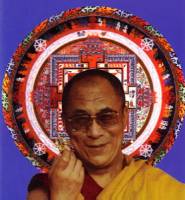 |
| The Kalachakra Mandala The Tibetan word for Mandala is �kilkhor,� meaning �center of the circle.� Mandalas may incorporate colored sand, jewels, flowers, colored stones, or dyed rice. As each grain of sand in the Mandala is charged with the blessings of the ritual purpose and process, the entire Mandala carries an incredible spiritual energy. Each Mandala is a sacred mansion of its own. Both the deity residing at the center of the Mandala and the Mandala in its entirety are perceived as sacred expressions of the En-lightened mind of The Buddha. Each person engaging in the initiation ceremony is nour-ished through the process of visualizing and contemplating the Mandala. There are 722 deities in the Kalachakra Mandala, symbolizing various manifestations of consciousness and reality. The Dalai Lama has explained that the Kalachakra deities represented in the Mandala create a favorable atmosphere that reduces tension and violence in the world. Kalachakra Mantra The Kalachakra deity resides in the center of the Mandala in his pal- |
| ace consisting of four Mandalas, one within the other: the Mandalas of body, speech, and mind, and in the very center, wisdom and great bliss. The palace is divided into four quadrants, each with walls, gates and a center and a specific col-or. The colors represent the elements and mental types. Black in the east is associated with the element of air and wind. The south is red, representing the element of fire. The west is yellow and associated with the element of earth. The north is white, representing the element of water. The square palace containing the 722 deities is located on the concentric circle representing Earth. The other circles representing water, fire, wind, space and consciousness extend beyond the wall of the palace. The Kalachakra sand Mandala is dedicated to both individual and world peace and physical balance. The Dalai Lama explains: �It is a way of planting a seed, and the seed will have karmic effect. One doesn�t need to be present at the Kalachakra ceremony in order to receive its benefits.� |
|
| WORDS OF TRUTH... By His Holiness the Dalai Lama - Honoring and Invoking the Great Compassion of the Three Jewels; the Buddha, the Teachings, and the Spiritual Community... O Buddhas, Bodhisattvas, and disciples of the past, present, and future: Having remarkable qualities Immeasurably vast as the ocean, who regard all helpless sentient beings as your only child; please consider the truth of my anguished pleas. Buddha's full teachings dispel the pain of worldly existence and self-oriented peace; may they flourish, spreading prosperity and happiness throughout this spacious world. O holders of the Dharma: scholars and realized practitioners; may your ten fold virtuous practice prevail. Humble sentient beings, tormented by sufferings without cease, completely suppressed by seemingly endless and terribly intense, negative deeds, may all their fears from unbearable war, famine, and disease be pacified, to freely breathe an ocean of happiness and well-being. And particularly the pious people of the Land of Snows who, through various means, are mercilessly destroyed by barbaric hordes on the side of darkness, kindly let the power of your compassion arise, to quickly stem the flow of blood and tears. Those unrelentingly cruel ones, objects of compassion, maddened by delusion's evils, wantonly destroy themselves and others; may they achieve the eye of wisdom, knowing what must be done and undone, and abide in the glory of friendship and love. May this heartfelt wish of total freedom for all Tibet, which has been awaited for a long time, be spontaneously fulfilled; please grant soon the good fortune to enjoy the happy celebration of spiritual with temporal rule. O protector Chenrezig, compassionately care for those who have undergone myriad hardships, completely sacrificing their most cherished lives, bodies, and wealth, for the sake of the teachings, practitioners, people, and nation. Thus, the protector Chenrezig made vast prayers before the Buddhas and Bodhisativas to fully embrace the Land of Snows; may the good results of these prayers now quickly appear. By the profound interdependence of emptiness and relative forms, together with the force of great compassion in the Three Jewels and their Words of Truth, and through the power of the infallible law of actions and their fruits, may this truthful prayer be unhindered and quickly fulfilled. (This prayer, Words of Truth, was composed by His Holiness Tenzin Gyatso, the Fourteenth Dalai Lama of Tibet, on 29 September 1960 at his temporary headquarters in the Swarg Ashram at Dharamsala, Kangra District, Himachal State, India. This prayer for restoring peace, the Buddhist teachings, and the culture and self-determination of the Tibetan people in their homeland was written after repeated requests by Tibetan government officials along with the unanimous consensus of the monastic and lay communities.) |
|
| OM MANI PADME HUM by His Holiness the Dalai Lama.... It is very good to recite the mantra Om mani padme hum, but while you are doing it, you should be thinking on its meaning, for the meaning of the six syllables is great and vast. The first, Om is composed of three letters, A, U, and M. These symbolize the practitioner's impure body, speech, and mind; they also symbolize the pure exalted body, speech, and mind of a Buddha. Can impure body, speech, and mind be transformed into pure body, speech, and mind, or are they entirely separate? All Buddhas are cases of beings who were like ourselves and then in dependence on the path became Enlightened; Buddhism does not assert that there is anyone who from the beginning is free from faults and possesses all good qualities. The development of pure body, speech, and mind comes from gradually leaving the impure states and their being transformed into the pure. How is this done? The path is indicated by the next four syllables. Mani, meaning jewel, symbolizes the factors of method - the altruistic intention to become Enlightened, compassion, and love. Just as a jewel is capable of removing poverty, so the altruistic mind of Enlightenment is capable of removing the poverty, or difficulties, of cyclic existence and of solitary peace. Similarly, just as a jewel fulfills the wishes of sentient beings, so the altruistic intention to become Enlightened fulfills the wishes of sentient beings. The two syllables, padme, meaning lotus, symbolize wisdom. Just as a lotus grows forth from mud but is not sullied by the faults of mud, so wisdom is capable of putting you in a situation of non-contra-diction whereas there would be contradiction if you did not have wisdom. There is wisdom realizing impermanence, wis-dom realizing that persons are empty, of being self-sufficient or substantially existent, wisdom that realizes the empti-ness of duality - that is to say, of difference of entity between subject an object - and wisdom that realizes the emptiness of inherent existence. Though there are many different types of wisdom, the main of all these is the wisdom realizing emptiness. Purity must be achieved by an indivisible unity of method and wisdom, symbolized by the final syllable hum, which indicates indivisibility. According to the sutra system, this indivisibility of method and wisdom refers to wisdom affected by method and method affected by wisdom. In the mantra, or tantric, vehicle, it refers to one consciousness in which there is the full form of both wisdom and method as one undifferentiable entity. In terms of the seed syllables of the five Conqueror Buddhas, hum is the seed syllable of Akshobhya - the immovable, the unfluctuating, that which can-not be disturbed by anything. Thus the six syllables, om mani padme hum, mean that in dependence on the practice of a path which is an indivisible union of method and wisdom, you can transform your impure body, speech, and mind into the pure exalted body, speech, and mind of a Buddha. It is said that you should not seek for Buddhahood outside of yourself; the substances for the achievement of Buddhahood are within. As Maitreya says in his Sublime Continuum of the Great Vehicle (Uttaratantra), all beings naturally have the Buddha nature in their own continuum. We have within us the seed of purity, the essence of a 'One Gone Thus' (Tathagatagarbha), that is to be transformed and fully develop-ed into Buddhahood. Disclaimer: All images and/or articles retain the original copyrights of their original owners. |
| February 2, 2004 |
 |
| Visit our main Buddhism site. More information, images, and, NO pop-ups! |