 |
| Page 31 |
| However young, the seeker who sets out upon the Way, shines bright over the world. But day and night, the person who is awake, shines in the radiance of the Spirit. Meditate. Live purely. Be quiet. Do your work, with mastery. Like the moon, come out from behind the clouds! SHINE! Live in joy, in love, even among those who hate. Live in joy, in health, even among the afflicted. Live in joy, in peace, even among the troubled. Look within. Be still. Free from fear and attachment, know the sweet joy of the Way. In this sad world of ours, sorrow comes to all, and it often comes with bitter agony. Perfect relief if not possible, except with time. You cannot now believe that you will ever feel better. But this is not true. You are sure to be happy again. Knowing this, truly believing it, will make you less miserable now. I have had enough experience to make this statement. Abraham Lincoln |
 |
| "The image we have of ourselves readily tends to be complacent. We look at ourselves with indulgence. When something unpleasant happens to us, we always have the tendency to cast the blame on others, or on fate, a demon, or a god. We |
| shrink from descending into ourselves, as the Buddha recommended. "If an individual has a sufficient spiritual base, he won't let himself be overwhelmed by the lure of technology and by the madness of possession. He or she will know how to find the right balance, without asking for too much, and know how to say: 'I have a camera, that's enough. I don't want another.' The constant danger is to open the door to greed, one of our most relentless enemies. It is here that the real work of the mind is put into practice. "For a Bodhisattva to be successful in accomplishing the practice of the Six Perfections - generosity, ethical discipline, tolerance, joyous effort, concentration, and wisdom - cooperation with and kindness toward fellow beings are extremely important. "A blossoming tree becomes bare and stripped in autumn. Beauty changes into ugliness, youth into old age, and fault into virtue. Things do not remain the same and nothing really exists. Thus, appearances and emptiness exists simultaneously." The Dalai Lama |
|
| Bridge Builder An old man going down a lone highway, Came in the evening cold and gray, To a chasm vast and deep and wide, hrough which was flowing a sudden tide. The old man crossing in the twilight dim; That swollen stream held no fears for him; But he turned when safe on the other side, And built a bridge to span the tide. "Old man," said a fellow pilgrim near, "You are wasting your strength with building here; Your journey will end with the ending day; You never again must pass this way; You have crossed the chasm deep and wide - Why build you this bridge at the eventide?" The builder lifted his old gray head. "Good friend, in the path I have come," he said, "There followeth me today, A youth whose feet must pass this way. This swollen stream which has naught to me, To that fair-haired youth may a pitfall be; He, too, must cross in the twilight dim; Good friend, I am building the bridge for him." (Will Dromgoole) |
| Champions... Who are these people, These doers of deeds, These dreamers of dreams, Who makes us believe? Who are these people, Who still win the day, When the odds are against them, And strength fades away? These people are champions, For they never give in. A heart beats within them, That is destined to win. They follow their dreams, Though the journey seems far, From the top of a mountain, They reach out to a star. And when they have touched it, When their journey is done, They give to us hope, From the victories they've won. So here's to the champions, To all their great deeds, They follow their hearts, And become winners indeed. (Tom Krause) |
|
| The Hunt for Baby Buddhas - Beijing has joined the game... As I follow a group of Tibetans into the crypt of the 9th Panchen Lama at the Tashilunpo Monastery, I spy four large pictures of past and present Panchens. But something isn't quite right. Feigning ignorance, I ask one of the visiting monks: "Who is in the photos?" "That is the 9th Panchen," he replies. "And that is the 10th - but he died mysteriously, maybe poisoned." "What about the two boys?" I ask. "Ahhh . . . he is the 11th," he says, pointing to the picture of a 10-year old. "And he is the 11th," he continues, indicating another child. I respond innocently: "There are two 11th Panchen Lamas?" He grins, a bit embarrassed. "I cannot say more," he whispers before moving off to join the other pilgrims. In Tibet, even reincarnation is a political game. In this famous - and closely watched - monastery in Tibet's second city, the faces of two boys hang on the wall. But which is the real reincarnation of the Panchen Lama - the one recognized by Beijing, and cosseted and molded there? Or the other, named by the Dalai Lama but kept under house arrest by China? Whatever the explanations for links with lives past, the reincarnation of important Tibetan lamas is tied up with present-day politics and the struggle over the future of the disputed land. Setting its atheist ideology aside, Beijing has joined the reincarnation game - in the hope that its chosen lamas will be loyal to Chinese rule. "It is naive to consider the reincarnation system to be purely religious," says Matthew Kapstein, an American author and academic who has studied Tibetan practices. "It has always had powerful political and economic dimensions." And when it impinges on the Dalai Lama's successor, the stakes are enormous. From exile, the 14th Dalai Lama is both the symbol of the Tibetan people - and anathema to Beijing. He has already said he will be reborn outside Tibet, which would presumably make his successor harder for China to control. But finding the next Dalai Lama will not be so difficult, insists Thupten Ngodub, 43, known as the Nechung Oracle. As Tibet's state seer, he will perform the task. "We have a tradition of how to do that," he said. Like his predecessor, who recognized the present Dalai Lama, he will go into a trance. Signs will then emerge indicating the right child. The job may be easier if the search is, as the Dalai Lama wants, narrowed to the exiled community. Before, seekers had to range over all of remote northwestern China. But in Tibetan Buddhism, reincarnation is not just the preserve of the high and mighty. Thousands of lesser spiritual leaders with special gifts as teachers purportedly choose to be reborn to help all living beings realize Enlighten-ment. Some have popped up in the West. Hollywood action star Steven Seagal stepped into a new role three years ago: the reincarnation of Chungdrag Dorje, a Tibetan lama. A hairdresser named Catherine Burroughs was recognized as Jetsunma Ahkon Lama, a 17th-century saint. And some nomads in eastern Tibet believe U.S. President Bill Clinton is the reincarnation of a revered tulku, Gamyat Shepa. Such suppositions often invite skepticism and scorn, especially among Westerners. Seagal was accused of "buying" his title; Catherine Burroughs was dubbed the "Buddha from Brooklyn." Even so, a handful of Western psychiatrists, risking the ridicule of their peers, have been researching peo-ple who claim memories of past lives. Eighty-year-old Ian Stevenson, who teaches psychiatry at the University of Virginia, has collected thousands of case studies. He has cross-referenced his subjects' stories with remembered people whom they could not have known in their present lives. Most serious scientists ignore Stevenson, though he has won over some skeptics. Washington Post editor Tom Shroeder spent a year with him researching a book titled Old Souls, The Scientific Evidence for Past Lives. Shroeder is impressed that Stevenson makes no extravagant claims about previous lives. He doesn't even insist that reincarnation exists. Instead, he just reports his subjects' "amazingly mundane" recollections of ordinary life. The hunt for reincarnations is the very definition of "inexact science." "There may be a religious aspect to it," says Tibet scholar Kapstein. "But in the end, things probably don't work out much worse than most forms of succession in human affairs." The Dalai Lama insists that the search for his successor will be carried out correctly. But with the Chinese government in on the hunt, he knows the final result may not be perfect. (Julian Gearing) |
|
|
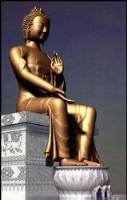 |
| Maitreya, The Buddha of the Future (Japanese - Miroku; Chinese - Miluo Fo; Tibetan - Byamspa; Vietnamese - Dilac; Korean - Mi-rug) According to some Buddhist traditions, the period of the Buddhist Law is divided into three stages: a first period of 500 years, of the turning the Wheel of the Law; a second period of 1,000 years, of the deterioration of the Law, and a third period of 3,000 years (called Mappo in Japan), during which no one practices the Law. After this, Buddhism having disappeared, a new Buddha will appear who will again turn the Wheel of the Law. This future Buddha is still in the Tusita heaven, in the state of a Bodhisattva. Gautama Buddha himself will enthrone him as his successor. The name means 'benevolence' or 'friendship.' He is now living his last existence as a Bodhisattva. In anticipation of his imminent arrival, he is sometimes considered as a Buddha and given the title of Tathagata. Maitreya is the only celestial Bodhisattva recognized by the sects of the Theravada school, who represented him from the outset. His images appear in Gandhara, perhaps even before those of the Buddha (with whom he was perhaps confused): he is represented standing or seated, as an ornamented Buddha, with long thin hair on the shoulders or tied in a chignon on his head, his hands in Dharmacakra mudra when seated, or in Vitarka and Varada mudras when standing. In Tibet, when he is represented seated, his legs hang (in the European manner) and he is clothed as a Buddha. This is the form he assumes in Java in the eighth-century temple - the Chandi Mendut. His representations abound throughout Buddhist Asia. Yet, he is usually shown as a Bodhisattva, standing and adorned with jewels, rather than seated. In certain images representing him in the sky Tusita, he appears seated with his legs in Padmasana. He is recognized by wearing a small stupa in his headdress. His attributes may vary, and he may hold a vase or a wheel (cak-ra) placed on lotus flowers. A scarf is always tied around his waist. Sometimes an antelope skin covers his left shoulder. He often |
| forms a triad with Shakyamuni and Avalokiteshvara; in fact, in Sri Lanka, sculptures thought to depict Avalokiteshvara have been reinterpreted as showing Maitreya. In Korea and Japan, where his cult enjoyed great favor from the sixth century, he is often confused (as in China) with Amitabha and Shakyamuni. In sculpture, he was sometimes confused with Nyoirin Kannon in Japan, a form of Avalokiteshvara. He was also given the name of Jishi Bosatsu, 'He who is full of pity.' He was first likened to Kami Hachiman, a deification of the Japanese Emperor Ojin (third century), and was later considered an incarnation of Amitabha, serving as an intermediary between Gautama (the world of mortals) and Amitabha (the world of the beyond). Acolytes of Maitreya: Asanga and Vasubandhu. Besides the triads, Maitreya is often represented with two acolytes: Asanga (Japanese - Muchaku), founder of the Hosso sect, and Asanga's brother Vasubandhu (Japanese - Seshin). Tradition relates that Maitreya descended from the Tusita heaven at the request of Asanga and his brother to teach them the content of the five sutras. These two Arhats then composed many other Enlightening shastras for the followers of the doctrines of the Mahayana. In Japan, Asanga is sometimes called Genjo and is then confused |
| with the Chinese pilgrim Xuanzang. Asanga lived in India, in Pataliputra (present-day Patna, in the state of Bihar), with his brother in the fourth century. They are represented in the form of monks, and are given the title of Bodhisattva. In Japan, the cult of Maitreya and of his acolytes is little maintained except by the Zen and Shingon sects. |
|
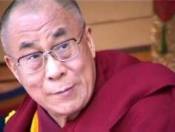
| Tibetans keep their faith - The Tibetan people have faith in the Dalai Lama's leadership (On 10 March 1959 the Tibetan people rose up in arms against the communist Chinese occupation of their country. The uprising failed and in the chaos that followed the Tibetan spiritual and temporal leader, the Dalai Lama, fled - to a life of exile in India. He was followed by tens of thousands of his people. The Dalai Lama and his followers set up camp across the border in northern India. Since 1959, the Chinese have been doing their utmost to crush the Dalai Lama's influence in Tibet, most recently through a policy of promoting atheism. But in the Dalai Lama's home in exile, in the northern Indian town of Dharamsala, the people refuse to give up faith.) As I sat on the roof of the recep-tion center for new arrivals from Tibet, I had a wonderful view of a perfectly symmetrical mountain covered in snow. It glistened in the winter sunlight, a stunning backdrop to the muddle of buildings clinging to the hillside below. But for the new arrivals, it is a reminder of much bigger mountains - the ones they walked across on the journey from their homeland. The frostbite on their fingers and toes is another reminder, as are their empty pockets - large sums of mon-ey having been handed to guides, border police and corrupt officials. Yet, the reception center is full of young people like Pasang. Pasang made the journey across the highest mountains in the world because he wants to see the Dalai La-ma. He's 17-years old, with scruffy, spiky hair and a boyish face, and he's filled with passion and frustration. He comes from southwestern Tibet where he studied Chinese for six years, so that he might qualify for further education. He says he passed his exams but was refused a place because someone else, who didn't pass, had more money than he did. The main pastime for young people in Tibet, he says, are drinking, gambling and prostitution. But, he believes, even if you are the worst of sinners, once you see the Dalai Lama, you will be cleansed and from then on you will be a kinder per-son, because the Dalai Lama is the human embodiment of the God of compassion. Pasang wasn't born when the Dalai Lama left Tibet, 40 years ago, and nowadays possession of the Buddhist leader's photograph is a ticket to a prison sen-tence. How, I asked Pasang, do you worship someone who is banned? "The faith is in our hearts," he said simply. Under the Chinese policy of patriotic re-education, Tibetan monks and nuns are ordered to denounce the Dalai Lama and pledge their unity to the motherland. Tenzin Gelek, who crossed the mountains with Pasang, was a monk, but when the work-team visited his monastery, he refused to follow the order. As we chat in the crowded hall of the reception center, his excitement at the prospect of seeing his leader is tangible. Westerners such as Richard Gere, who attended the Dalai Lama's spring blessing, have brought attention to the cause. Pasang and the others are to go to the Dalai La-ma's bungalow and receive a blessing. Like all the new arrivals before them, they will line up and wait for their turn when the Dalai Lama lays his hands on their heads and puts a ceremonial white silk scarf around their neck. For many, these seemingly simple gestures are worth all the risks on a three-week journey over the Himalayan mountains. As some, after receiving their blessing, will then make the journey back to Tibet, the Dalai Lama sometimes gives them a talk. Lately he's been telling his devotees that it's all right to denounce him if they're asked to by the Chinese, he knows the truth. Tenzin says he would find this very hard to do, but if its the wish of His Holiness, he might. I asked Pasang and Tenzin how optimistic they were about the future of their country. Pasang said confidently: "I'm sure that under the leadership of the Dalai Lama we will get our independence from China." I asked him how, when after 40 years the Dalai Lama was no closer to achieving such a thing than when he left. Pasang seemed to wither before my eyes - "I don't think we will become free," he whispered, "the Chinese will never leave." Tenzin butted in - "I'm so worried about what will happen when His Holiness dies, what will become of us?" "I'm going to join the army and fight the Chinese," Pasang declared. "No" said Tenzin, "violence isn't the answer." Last year the number of new refugees, like Pasang and Tenzin, doubled from the year before. After four decades, the faith of the Tibetans hasn't been dim-med, despite the best efforts of the Chinese. I wonder how this battle of the Tibetan hearts and minds will be waged over the next 40 years. I wonder if the death of the Dalai Lama will give the Chinese the chance to succeed or if the stubborn determination of young people will be passed on to the next generation, just as it has been since 1959. (by Joanna Ross, March 10, 1999) |
 |
|
| "We cannot learn real patience and tolerance from a guru or a friend. They can be practiced only when we come in contact with someone who creates unpleasant experiences. According to Shantideva, enemies are really good for us as we can learn a lot from them and build our inner strength. "The very purpose of religion is to control yourself, not to criticize others. Rather, we must criticize ourselves. How much am I doing about my anger? About my attachment, about my hatred, about my pride, my jealousy? These are the things which we must check in daily life. "What is the Bodhisattva's Way of life? It is the way of life that follows naturally from |
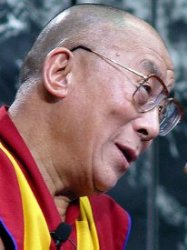
| having cultivated the awakening mind of bodhicitta. Omniscience is achieved only through the process of purifying the disturbing emotions within your mind. It cannot be achieved merely through wishes and prayers. We have to train in eliminating all the specific disturbing emotions within your mind. We have to train in eliminating all the specific disturbing emotions by relying on specific antidotes. All the activities of a Bodhisattva can be included in two major categories: the practice of skillful means and the practice of wisdom. If the practices of giving, ethics, and so forth are to be perfected, they should be supported and influenced by the practice of wisdom. Without the practice of wisdom, the first of five of the six perfections cannot actually become practices of perfection. "If one's life is simple, contentment has to come. Simplicity is extremely important for happiness. Having few desires, feeling satisfied with what you have, is very vital: satisfaction with just enough food, clothing, and shelter to protect yourself from the elements. And finally, there is an intense delight in abandoning faulty states of mind and in cultivating helpful ones in meditation. "Another kind of love and compassion is not based on something appearing beautiful or nice, but based on the fact that the other person, just like oneself, wants happiness and does not want suffering and indeed has every right to be happy and to overcome suffering. On such a basis, we feel a sense of responsibility, a sense of closeness toward that being. That is true compassion. This is because the compassion is based on reason, not just on emotional feeling. As a consequence, it does not matter what the other's attitude is, whether negative, or positive. What matters is that it is a human being, a sentient being that has the experience of pain and pleasure. There is no reason not to feel compassion so long as it is a sentient being. "Every noble work is bound to face problems and obstacles. It is important to check your goal and motivation thoroughly. One should be very truthful, honest, and reasonable. One's actions should be good for others, and for oneself as well. Once a positive goal is chosen, you should decide to pursue it all the way to the end. Even if it is not realized, at least there will be no regret. "Anger and hatred cannot bring harmony. The noble task of arms control and disarmament cannot be accomplished by confrontation and condemnation. Hostile attitudes only serve to heat up the situation, whereas a true sense of respect gradually cools down what otherwise could become explosive. We must recognize the frequent contradictions between short-term benefit and long-term harm." The Dalai Lama Disclaimer: All images and/or articles retain the original copyrights of their original owners. 3/29/04 |
| Courtesy Chamb Meehan |
 |
 |
| March 29, 2004 |
 |
| Visit our main Buddhism site. More information, images, and, NO pop-ups! |
 |
 |