 |
| Page 30A |
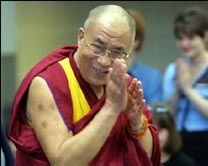 |
| ging socks his humility. The first two days of the Dalai Lama's stay in Utah were marked by throngs of the faithful and the curious turning out to see and hear a global celebrity. Reporters met him early Thursday morning at Salt Lake In-ternational Airport to grill him about Tibetan politics and the future of the planet. Local Tibetans lined the streets out-side the Governor's Mansion to greet and honor him. Doctors, nurses, patients and families squeezed into a couple of rooms at Primary Children's Hospital in Salt Lake City; several thousand participated in an interfaith prayer service with him at Abravanel Hall; Utah's political and civic dignitaries broke bread with him; and 11,000 packed into the Huntsman Center at the University of Utah to hear him discuss "Ethics for a New Millennium." Nearly 20,000 more will see him when he gives a Buddhist teaching at the Huntsman Center in the morning, addresses students and faculty at Utah Valley State College in Orem and meets with the Tibetan community in the afternoon. In every venue, many have found more than just charisma. Whether speaking from an armchair in a sports arena, or perching on the edge of a dais during lunch at a hotel ballroom, the Dalai Lama creates a sense of approachability, even intimacy, that draws adults and children as if he were an old friend. The Dalai Lama is unpretentious, though he knows how to play to the camera or elicit smiles from his audience. With journalists, he answered each question as if it were being asked for the first time - making careful, thoughtful comments on Tibet's future, the status of women in Buddhism and China's quest for the 2008 Olympics. He punctuated his remarks with an infectious grin. He laced his sermons with parables and Tibetan say-ings. He wove Buddhist metaphysics into his speeches about ethics. He spoke seamlessly and without notes. Throughout his stay in Utah, the Dalai Lama displayed an intimacy with humanity. He touched people's faces or grasped their arms - acting familiarly with dignitaries such as Utah Episcopal Bishop Carolyn Tanner Irish and Pamela Atkinson, a member of the State Board of Regents and a tireless advocate for the disadvantaged. As he moved among adults and children waiting to greet him, the Dalai Lama locked eyes with each individual and captured them in what seemed an infinite mo-ment. But Utahns also got much more; they were treated to philosophical ruminations from a Buddhist scholar who chal-lenged superficial Western thinking at every turn. When he speaks of compassion, he means more than just being nice or feeling sorry for people in trouble. It is the capacity to watch thousands of family, friends and Buddhist followers bru-tally murdered by Chinese Communists, whom he called "cruel liars," while acknowledging in the next breath that "Communists are humans, too." On a more down-to-earth note, he said, "Mammals like tigers or lions are built for preying on other animals. They have teeth and nails." But humans belong to the "peaceful animals," he said. "Our two hands are made for hugging, not for making boxing fists." No matter where he went, the Dalai Lama emphasized that conflicts can be resolved through "conversation, respect for others and a warm heart." At times, journalists - whose focus is perforce on conflict - seemed to ask everything but the right questions. Where Westerners see strife and com-petition, he sees unity and possibility. One reporter asked if Buddhism could take hold in a place such as the United States, where individuality is a credo. "There is no contradiction between Buddhism and individualism, in general," he said through a translator. "In Buddhism, if you work for the benefit of others, out of altruistic motivation, in fact you yourself stand to gain from this." Does he mind his "rock star" status among Americans? He furrowed his brow for a minute, then shrugged. "He said he doesn't really give it much thought," the translator said. If the next incarnation of the Dalai Lama were found in the United States, would he have the right kind of values? "I don't know. I don't know. That is beyond my control," he said. What would he do to broker peace in the Middle East? "Some people would say he has nothing particular to say," replied the translator. Then the Dalai Lama thought for a moment. "There is too much suspicion," he said, slowly. "Personal relations make a difference. Maybe important leaders of both sides [could be] brought to a pleasant place to talk without any political agenda, without any other work, just to simply rest, play chess and [get to] know each other personally, then eventually truly become friends." Political battles often begin with religi-ous differences, and the Dalai Lama has spent a career addressing such conflicts. He did so vividly on Friday during the interfaith service at Abravanel Hall. After a performance by the International Children's Choir, the hourlong service began with Clifford Duncan of the Ute Tribe in traditional dress singing and blessing the gathering. Next, dozens of lead-ers from an array of faiths, including LDS, Baptist, Lutheran, Episcopal, Jewish, Muslim, Catholic, Baha'i - nearly all dressed in black or muted colors - filed in and filled the hall. Finally the Dalai Lama entered, dressed in robes of vibrant maroon, yellow and gold, smiling and bowing, waving and pressing his palms together in the traditional Tibetan greeting. Seeing scores of Tibetans in the first rows, he stepped nearly to the edge of the stage. He bowed to the audience, flashed a grin and bowed deeply again. "My brothers and sisters," he began. "It is a great pleasure to be together, particularly in this joint prayer session." He then launched into a half-hour sermon, gesturing and pointing like a teacher and occa-sionally fingering the orange prayer beads wrapped around his wrist. Religious faith is one of the "defining characteris-tics of human beings and that has been true for thousands of years of human history," he said. And even at the begin-ning of the 21st century, he said, faith traditions that span the centuries still have a place. He knows that, he said, be-cause even though many people in prosperous countries have every material possession they could possibly want, "still |
| The Dalai Lama: Keeping the Faith - The Dalai Lama, spiritual and political leader of exiled Tibetans, is both more and less than what people expect. He is at once anachronistic and modern. He speaks with the authority of one who has spent at least one lifetime - and conceivably 13 previous ones - seeking wisdom. Yet he insists he is no one special. "Some people expect too much," he said in an interview. "That's not realistic." And any notion that he has some kind of supernatural healing powers "is disgraceful. Totally wrong," he insists. The 14th Dalai Lama presides over a kingdom that exists only in the memory of his people, who defer to him in everything. Yet he pushes them toward democracy. His maroon and yellow robes bespeak his authority; his brown, world-worn shoes and sag- |
| his own tradition has helped the Dalai Lama grapple with the great differences among the world's religions. "The spirit-ual needs of millions of believers worldwide are met in different faith traditions," he said. "Each is valuable and neces-sary, responding to diverse spiritual inclinations." Whether to accept a religion is an individual decision, but those who choose to embrace a faith tradition should implement its teachings "seriously and deeply." He simply dismissed "New Age" religion, which takes bits and pieces of other traditions. "I don't think it is right." Even those who believe an Al-mighty God created the world, he said, should celebrate religious diversity because it "may have been created for the benefit of all creation. It is originating from the same source." After the Dalai Lama's remarks, leaders of religions ranging from Catholicism to Baha'i offered their own prayers. The service ended as the Dalai Lama sonorously chanted an eighth-century dedication prayer in Tibetan. "For as long as space endures, and for as long as living beings remain, until then may I too abide to dispel the misery of the world." People stood in quiet reverie after the Dalai Lama bowed and then exited the stage. "I expected a simple, peaceful man talking about simple, eternal, universal truths," Suzi Nielsen of Salt Lake City said afterward. "I didn't hear anything new, but I loved the feeling of being in the presence of a spiritual man." Salt Laker Ardean Watts was more effusive. "This was an occasion to be savored," he said. "Who could not say 'amen' to his message?" Then he added, "It's not what I learned that I will take away, but what I felt." (By Peggy Fletcher Stack,t 2001, Salt Lake Tribune) |
 |
| they are not free from suffering." "I notice some people have mental unrest, suspicion, doubt, sense of insecurity," he said. "If material wealth solved all problems, then such people should have no worry, right?" The audience laughed, but squirmed a bit. "When I see some beautiful articles that I want, like a watch, if I concentrate on it, attachment grows," he said. "Even in Tibet the image still comes." Pause for a moment, he said, and ask, "Do I really need this? Of-ten, no," he said to more laughter, adding that contentment means sacrificing short-term needs like watches to achieve enduring satisfaction. These principles are taught by every religious tra-dition, yet still there are conflicts among the faiths. Even within Buddhism there are sometimes contradictory schools of thought that evolved from the same teacher. Seeing those divisions in |
 |
| The Preacher's Mission... And the Blessed One said to his disciples: "When I have passed away and can no longer address you and edify your minds with religious discourse, select from among you men of good family and education to preach the truth in my stead. And let those men be invested with the robes of the Tathagata, let them enter into the abode of the Tathagata, and occupy the pulpit of the Tathagata. The robe of the Tathagata is sublime forbearance and patience. The abode of the Tathagata is charity and love of all beings. The pulpit of the Tathagata is the comprehension of the good law in its abstract meaning as well as in its particular application. The preacher must propound the truth with unshrinking mind. He must have the power of persuasion rooted in virtue and in strict fidelity to his vows. The preacher must keep in his proper sphere and be steady in his course. He must not flatter his vanity by seeking the com-pany of the great, nor must he keep company with persons who are frivolous and immoral. When in temptation, he should constantly think of the Buddha and he will conquer. All who come to hear the doctrine, the preacher must re-ceive with benevolence, and his sermon must be without invidiousness. The preacher must not be prone to carp at oth-ers, or to blame other preachers; nor speak scandal, nor propagate bitter words. He must not mention by name other disciples to vituperate them and reproach their demeanour. Clad in a clean robe, dyed with good colour with appropriate undergarments, he must ascend the pulpit with a mind free from blame and at peace with the whole world. He must not take delight in querulous desputations or engage in controversies so as to show the superiority of his talents, but be calm and composed. No hostile feelings shall reside in his heart, and he must never abandon the disposition of charity toward all beings. His sole aim must be that all beings become Buddhas. Let the preacher apply himself with zeal to his work, and the Tathagata will show to him the body of the holy law in its transcendent glory. He shall be honoured as one whom the Tathagata has blessed. The Tathagata blesses the preacher and also those who reverently listen to him and joyfully accept the doctrine. All those who receive the truth will find perfect Enlightenment. And, verily, such is the pow-er of the doctrine that even by the reading of a single stanza, or by reciting, copying, and keeping in mind a single sen-tence of the good law, persons may be converted to the truth and enter the path of righteousness which leads to deliver-ance from evil. Creatures that are swayed by impure passions, when they listen to the voice, will be purified. The ignor-ant who are infatuated with the follies of the world will, when pondering on the profundity of the doctrine, acquire wis-dom. Those who act under the impulse of hatred will, when taking refuge in the Buddha, be filled with good-will and love. A preacher must be full of energy and cheerful hope, never tiring and never despairing of final success. A preacher must be like a man in quest of water who digs a well in an arid tract of land. So long as he sees that the sand is dry and white, he knows that the water is still far off. But let him not be troubled or give up the task as hopeless. The work of removing the dry sand must be done so that he can dig down deeper into the ground. And often the deeper he has to dig, the cooler and purer and more refreshing will the water be. When after some time of digging he sees that the sand be- |
| delight and joy. Quicken them, edify them, and lift them higher and higher until they see the truth face to face in all its splendour and infinite glory." When the Blessed One had thus spoken, the disciples said: "O thou who rejoicest in kindness having its source in compassion, thou great cloud of good qualities and of benevolent mind, thou quenchest the fire that vexeth living beings, thou pourest out nectar, the rain of the law! We shall do, O Lord, what the Tathagata commands. We shall fulfill his behest; the Lord shall find us obedient to his words." And this vow of the disciples re-sounded through the universe, and like an echo it came back from all the Bodhisattas who are to be and will come to preach the good law of Truth to future generations. And the Blessed One said: "The Tathagata is like unto a powerful king who rules his kingdom with righteousness, but being attacked by envious enemies goes out to wage war against his foes. When the king sees his soldiers fight he is delighted with their gallantry and will bestow upon them donations of all kinds. Ye are the soldiers of the Tathagata, while Mara, the Evil One, is the enemy who must be conquered. And the Tathagata will give to his soldiers the city of Nirvana, the great capital of the good law. And when the enemy is over-come, the Dharma-raja, the great king of truth, will bestow upon all his disciples the most precious crown which jewel brings perfect Enlightenment, supreme wisdom, and undisturbed peace." |
 |
| comes moist, he accepts it as a token that the water is near. So long as the people do not listen to the words of truth, the preacher knows that he has to dig deeper into their hearts; but when they begin to heed his words he apprehends that they will soon attain Enlightenment. Into your hands, O ye men of good family and education who take the vow of preaching the words of the Tathagata, the Blessed One transfers, intrusts, and commends the good law of truth. Receive the good law of truth, keep it, read and re-read it, fathom it, promulgate it, and preach it to all beings in all the quarters of the universe. The Tathagata is not avaricious, nor narrow-minded, and he is willing to impart the perfect Buddha-knowledge unto all who are ready and willing to receive it. Be ye like unto him. Imitate him and follow his example in bounteously giving, showing, and bestowing the truth. Gather round you hearers who love to listen to the benign and comforting words of the law; rouse the unbelievers to accept the truth and fill them with |
|
| When things go wrong as they sometimes will; When the road you're trudging seems all uphill; When the funds are low, and the debts are high And you want to smile, but have to sigh; When care is pressing you down a bit- Rest if you must, but do not quit. Success is failure turned inside out; The silver tint of the clouds of doubt; And you can never tell how close you are; It may be near when it seems so far; So stick to the fight when you're hardest hit- It's when things go wrong that you must not quit. "Don't Quit," Author Unknown |
| "May you live every day of your life." Jonathan Swift "Gather round you hearers who love to listen to the benign and comforting words of the law; rouse the unbelievers to accept the truth and fill them with delight and joy. Quicken them, edify them, and lift them higher and higher until they see the truth face to face in all its splendour and infinite glory." Buddha "Pessimism is only the name that men of weak nerves give to wisdom." - Bernard De Voto "There will one day spring from the brain of science a machine or force so fearful in its potentialities, so absolutely terrifying, that even man, the fighter, who will dare torture and death in order to inflict torture and death, will be appalled, and so abandon war forever." - Thomas Edison |
| "There is a Tibetan story of a fellow who, while circumambulating a temple, saw someone sitting in meditative posture. He asked the meditator what he was doing, and the meditator answered, "I am cultivating patience." Then that person said something very harsh to the meditator and the meditator at once answered back angrily. This response came because although he had been cultivating patience, he had not encountered anyone who was harming him or speaking badly to him; he had no chance to practice patience. Thus, the best of all situations for the practice of patience is an enemy, and for this reason someone engaged in the Bodhisattva practices should treat an enemy with tremendous respect. "A wider of more altruistic attitude is very relevant in today's world. If we look at the situation from various angles, such as the complexity and inter-connectedness of the nature of modern existence, then we will gradually notice a change in our outlook, so that when we say 'others' and when we think of others, we will no longer dismiss them as something that is irrelevant to |
| "The beginning of wisdom is to call things by their right names." Chinese Proverb "He who joyfully marches to music in rank and file has already earned my contempt. He has been given a large brain by mistake, since for him the spinal cord would fully suffice. This disgrace to civilization should be done away with at once. Heroism at command, senseless brutality, and all the loathsome nonsense that goes by the name of patriotism, how violently I hate all this, how despicable and ignoble war is; I would rather be torn to shreds than be part of so base an action! It is my conviction that killing under the cloak of war is nothing but an act of murder." - Albert Einstein "Peace is the happy natural state of man; war is corruption and disgrace." James Thomson "The pursuit of peace and progress cannot end in a few years in either victory or defeat. The pursuit of peace and progress, with its trials and its errors, its successes and its setbacks, can never be relaxed and never abandoned." Dag Hammarskjold "It isn't enough to talk about peace. One must believe in it. And it isn't enough to believe in it. One must work at it." Eleanor Roosevelt "The more we sweat in peace - the less we bleed in war." Vijaya Lakshmi Pandit "But peace does not rest in the charters and covenants alone. It lies in the hearts and minds of all people. So let us not rest all our hopes on parchment and on paper, let us strive to build peace, a desire for peace, a willingness to work for peace in the hearts and minds of all of our people. I believe that we can. I believe the problems of human destiny are not beyond the reach of human beings." John F. Kennedy |
|
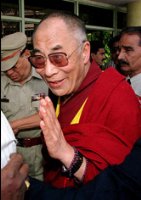 |
| us. We will no longer feel indifferent. "One's motivation at the beginning is very important, because whether or not one's practice becomes successful and effective depends upon the initial motive and attitude. For the development of the right attitude, the practice of refuge and the generation of bodhicitta are vital. Through the practice of the two one should be able to bring about some discipline and transformation within one's mind. "Love and kindness are the very basis of society. If we lose these feelings, society will face tremendous difficulties; the survival of humanity will be endangered."The Dalai Lama |
|
| Sariputta's Faith... The Blessed One proceeded with a great company of the brethren to Nalanda; and there he stay-ed in a mango grove. Now the venerable Sariputta came to the place where the Blessed One was, and having saluted him, took his seat respectfully at his side, and said: "Lord! such faith have I in the Blessed One, that methinks there never has been, nor will be, nor is there now any other, who is greater or wiser than the Blessed One, that is to say, as regards the higher wisdom." Replied the Blessed One: "Grand and bold are the words of thy mouth, Sariputta: verily, thou hast burst forth into a song of ecstacy! Surely then thou hast known all the Blessed Ones who in the long ages of the past have been holy Buddhas?" "Not so, O Lord!" said Sariputta. And the Lord continued: "Then thou hast perceiv-ed all the Blessed Ones who in the long ages of the future shall be holy Buddhas?" "Not so, Lord!" "But at least then, O Sariputta, thou knowest me as the holy Buddha now alive, and hast penetrated my mind." "Not even that, O Lord!" ] "Thou seest then, Sariputta, that thou knowest not the hearts of the holy Buddhas of the past nor the hearts of those of the future, Why, therefore, are thy words so grand and bold? Why burstest thou forth into such a song of ecstacy?" "O Lord! I have not the knowledge of the hearts of all the Buddhas that have been and are to come, and now are. I only know the lineage of the faith. Just as a king, Lord, might have a border city, strong in its foundations, strong in its ramparts and with one gate only; and the king might have a watchman there, clever, expert, and wise, to stop all strangers and admit only friends. And on going over the approaches all about the city, he might not be able so to ob-serve all the joints and crevices in the ramparts of that city as to know where such a small creature as a cat could get out. That might well be. Yet all living beings of larger size that entered or left the city, would have to pass through that gate. Thus only is it, Lord, that I know the lineage of the faith. I know that the holy Buddhas of the past, putting away all lust, ill-will, sloth, pride, and doubt,knowing all those mental faults which make men weak, training their minds in the four kinds of mental activity, throroughly exercising themselves in the sevenfold higher wisdom, received the full fruition of Enlightenment. And I know that the holy Buddhas of the times to come will do the same. And I know that the Blessed One, the holy Buddha of to-day, has done so now." "Great is thy faith, O Sariputta," replied the Blessed One, "but take heed that it be well grounded." Disclaimer: All images and/or articles retain the copyrights of their original owners. |
 |
 |
 |
| April 18, 2004 |
| Visit our main Buddhism site. More information, images, and, NO pop-ups! |
 |