 |
| Page 28 |
 |
| "You must believe and understand the truthful words of the Thus Come One." And once more he said to the great as-sembly: "You must believe and understand the truthful words of the Thus Come One." At that time the Bodhisattvas and the great assembly, with Maitreya as their leader, pressed their palms together and addressed the Buddha, saying: "World-Honored One, we beg you to explain. We will believe and accept the Buddha's words." They spoke in this man-ner three times, and then said once more: "We beg you to explain it. We will believe and accept the Buddha's words." At that time the World-Honored One, seeing that the Bodhisattvas repeated their request three times and more, spoke to them, saying: "You must listen carefully and hear of the Thus Come One's secret and his transcendental powers. In all the worlds the heavenly and human beings and asuras all believe that the present Shakyamuni Buddha, after leaving the palace of the Shakyas, seated himself in the place of practice not far from the city of Gaya and there attained an-nuttara-samyak-sambodhi. But good men, it has been immeasurable, boundless hundreds, thousands, ten thousands, millions of nayutas of kalpas since I in fact attained Buddhahood. Suppose a person were to take five hundred, a thou-sand, ten thousand, a million nayuta asamkhya thousand-million-fold worlds and grind them to dust. Then, moving eastward, each time he passes five hundred, a thousand, ten thousand, a million nayuta asamkhya worlds he drops a particle of dust. He continues eastward in this way until he has finished dropping all the particles. Good men, what is your opinion? Can the total number of all these worlds be imagined or calculated?" The Bodhisattva Maitreya and the others said to the Buddha: "World-Honored One, these worlds are immeasurable, boundless, one cannot calculate their number, nor does the mind have the power to encompass them. Even all the voice-hearers and pratyekabuddhas with their wisdom free of outflows could not imagine or understand how many there are. Although we abide in the stage of avivartika, we cannot comprehend such a matter. World-Honored One, these worlds are immeasurable and boundless." At that time the Buddha said to the multitude of great Bodhisattvas: "Good men, now I will state this to you clearly. |
| At that time the Buddha spoke to the Bodhisattvas and all the great assembly: "Good men, you must be-lieve and understand the truthful words of the Thus Come One." And again he said to the great assembly: |
| Suppose all these worlds, whether they received a particle of dust or not, are once more re-duced to dust. Let one particle represent one kalpa. The time that has passed since I attained Buddhahood surpasses this by a hundred, a thousand, ten thousand, a million nayuta asamkh-ya kalpas. Ever since then I have been constantly in this saha world, preaching the Law, teach-ing and converting, and elsewhere I have led and benefited living beings in hundreds, thou-sands, ten thousands, millions of nayutas and asamkhyas of lands. Good men, during that time I have spoken about the Buddha Burning Torch and others, and described how they entered Nirvana. All this I employed as an expedient means to make distinctions. Good men, if there |
 |
| Courtesy Chamb Meehan |
| are living beings who come to me, I employ my Buddha eye to observe their faith and to see if their other faculties are keen or dull, and then depending upon how receptive they are to salvation, I appear in different places and preach to them under different names, and describe the length of time during which my teachings will be effective. Sometimes when I make my appearance I say that I am about to enter Nirvana, and also employ different expedient means to preach the subtle and wonderful Law, thus causing living beings to awaken joyful minds. Good men, the Thus Come One observes how among living beings there are those who delight in a little Law, meager in virtue and heavy with de-filement. For such persons I describe how in my youth I left my household and attained anuttara-samyak-sambodhi. But in truth, the time since I attained Buddhahood is extremely long, as I have told you. It is simply that I use this ex-pedient means to teach and convert living beings and cause them to enter the Buddha way. That is why I speak in this manner. Good men, the scriptures expounded by the Thus Come One are all for the purpose of saving and emancipa- ting living beings. Sometimes I speak of myself, sometimes of others: sometimes I present myself, sometimes others; sometimes I show my own actions, some- times those of others. All that I preach is true and not false. Why do I do this? The Thus Come One perceives the true aspect of the threefold world exactly as it is. There is no ebb or flow of birth and death, and there is no existing in this world and later entering extinction. It is neither substantial nor empty, neither consistent nor diverse. Nor is it what those who dwell in the threefold world perceive it to be. All such things the Thus Come One sees clearly and without error. "Because living beings have different natures, different desires, differ-ent actions, and different ways of thinking and making distinctions, and because I want to enable them to put down good roots, I employ a variety of causes and conditions, similes, parables, and phrases and preach different doctrines. This, the Buddha's work, I have never for a moment neglected. Thus, since I attained Buddhahood, an extremely long period of time has passed. My life span is an immeasurable number of asamkhya kalpas, and during that time I have constantly abided here without ever entering extinction. Good men, originally I practiced the Bodhisattva way, and the life span that I acquired then has yet to come to an end but will last twice the number of years that have already passed. Now, however, although in fact I do not actually enter extinction, I announce that I am going to adopt the course of ex-tinction. This is an expedient means which the Thus Come One uses to teach and convert living beings. Why do I do this? Because if the Buddha remains in the world for a long time, those persons with shallow virtue will fail to plant good roots but, living in poverty and lowliness, will become attached to the five desires and be caught in the net of de-luded thoughts and imaginings. If they see that the Thus Come One is constantly in the world and never enters extinc-tion, they will grow arrogant and selfish, or become discouraged and neglectful. They will fail to realize how difficult it is to encounter the Buddha and will not approach him with a respectful and reverent mind. Therefore as an expedient means the Thus Come One says: 'Monks, you should know that it is a rare thing to live at a time when one of the Bud-dhas appears in the world.' Why does he do this? Because persons of shallow virtue may pass immeasurable hundreds, thousands, ten thousands, millions of kalpas with some of them chancing to see a Buddha and others never seeing one at all. For this reason I say to them: 'Monks, the Thus Come One is hard to get to see.' When living beings hear these words, they are certain to realize how difficult it is to encounter the Buddha. In their minds they will harbor a longing and will thirst to gaze upon the Buddha, and then they will work to plant good roots. Therefore the Thus Come One, though in truth he does not enter extinction, speaks of passing into extinction. Good men, the Buddhas and Thus Come Ones all preach a Law such as this. They act in order to save all living beings, so what they do is true and not false. Sup-pose, for example, that there is a skilled physician who is wise and understanding and knows how to compound medi-cines to effectively cure all kinds of diseases. He has many sons, perhaps ten, twenty, or even a hundred. He goes off to some other land far away to see about a certain affair. After he has gone, the children drink some kind of poison that make them distraught with pain and they fall writhing to the ground. At that time the father returns to his home and finds that his children have drunk poison. Some are completely out of their minds, while others are not. Seeing their |
| ly cured of their sickness. Those who are out of their minds are equally delighted to see their father return and beg him to cure their sickness, but when they are given the medicine, they refuse to take it. Why? Because the poison has pene-trated deeply and their minds no longer function as before. So although the medicine is of excellent color and fragrance, they do not perceive it as good. The father thinks to himself: My poor children! Because of the poison in them, their minds are completely befuddled. Although they are happy to see me and ask me to cure them, they refuse to take this excellent medicine. I must now resort to some expedient means to induce them to take the medicine. So he says to them: 'You should know that I am now old and worn out, and the time of my death has come. I will leave this good medicine here. You should take it and not worry that it will not cure you.' Having given these instructions, he then goes off to another land where he sends a messenger home to announce, 'Your father is dead.' At that time the children, hearing that their father has deserted them and died, are filled with great grief and consternation and think to them-selves: If our father were alive he would have pity on us and see that we are protected. But now he has abandoned us and died in some other country far away. We are shelterless orphans with no one to rely on! Constantly harboring such feelings of grief, they at last come to their senses and realize that the medicine is in fact excellent in color and frag-rance and flavor, and so they take it and are healed of all the effects of the poison. The father, hearing that his children are all cured, immediately returns home and appears to them all once more. Good men, what is your opinion? Can any-one say that this skilled physician is guilty of lying?" "No, World-Honored One." The Buddha said: "It is the same with me. It has been immeasurable, boundless hundreds, thousands, ten thousands, millions of nayuta and asamkhya kalpas since I attained Buddhahood. But for the sake of living beings I employ the power of expedient means and say that I am about to pass into extinction. In view of the circumstances, however, no one can say that I have been guilty of lies or falsehoods." |
 |
| father from far off, all are overjoyed and kneel down and entreat him, saying: 'How fine that you have returned safely. We were stupid and by mistake drank some poi- son. We beg you to cure us and let us live out our lives!' The father, seeing his chil-dren suffering like this, follows various prescriptions. Gathering fine medicinal herbs that meet all the requirements of color, fragrance and flavor, he grinds, sifts and mixes them together. Giving a dose of these to his children, he tells them: 'This is a highly effective medicine, meeting all the requirements of color, fragrance and flavor. Take it and you will quickly be relieved of your sufferings and will be free of all ill-ness.' Those children who have not lost their senses can see that this is good medicine, outstanding in both color and fragrance, so they take it immediately and are complete- |
 |
 |
 |
 |
| April 20, 2004 |
| A COUNTRY TORTURED! 'Re-education' digs at roots of a people's heritage... In a language not their own, schoolchildren study a history not of their elders. It's all part, Tibetans say, of China's attempt to erase their culture. When Thubten Tsering, a Tibetan teacher, read the textbook approved for his middle-school classroom, he saw that it contained a lie. "In 1949,'' read one passage approved by Chinese authorities, "Tibet was peacefully united into the motherland of China. Tibetans were freed from sadness as wide as an ocean.'' Tsering, 27, lingered over the word peace-fully. He knew older Tibetans who had fought Chinese soldiers and tanks as they invaded and occupied Tibet over a 10-year period, beginning in 1949. They had been imprisoned and tortured for many years. Many others were killed. But Tsering dared not impart his knowledge to the class. Now, with the responsibility of teaching a new generation of Tibet-an children, Tsering was forced to watch them grow up with little knowledge of their true history. It seemed to him that the Chinese, after occupying his country for 47 years, were erasing Tibetan culture. The class Tsering taught - the Ti-betan language - was the only subject his students took in their native language. Everything else in school was taught in Chinese. And Tsering was forced to teach his class by using Chinese Communist Party propaganda. When teaching con-junctions, for example, Tsering was expected to use this sentence as a model: "Tibet is a part of China and it cannot be separated from the motherland.'' In 1994, Tsering wrote a mild letter of complaint to the local Chinese authorities, urg-ing improvements in the way Tibetan was taught as a second language. When there was no response, Tsering organized a protest rally. The authorities responded. First, Tsering was thrown in jail. Then, he said, he was tortured. In fact, he said, virtually every other day of his six-month prison term, he was beaten or tortured. Police shocked his hands, face, arms, legs, chest and stomach with an electric cattle prod. Sometimes he fainted. "Then they'd pour a bucket of cold water on my body, I'd regain consciousness, and they'd use the electric cattle prod on me again,'' Tsering said in an in-terview in India. Throughout Tibet, hundreds of Tibetan teachers and students have been arrested, jailed and tortured by the Chinese because their views are considered "counterrevolutionary.'' It is common for the Chinese authorities who rule Tibet to arrest and torture Tibetans who take such nonviolent actions as singing freedom songs or putting up posters urging independence for Tibet. In their attempts to eradicate Tibetan culture and religion, Tibetans say, Chi-nese authorities have relied on a system of arbitrary arrest and torture. But they have also used another, more subtle, tactic: "reeducation.'' Part of this reeducation is aimed at wiping out the Tibetan language and replacing it with Chi-nese. The campaign intensified Nov. 18, 1996, when the top Chinese official in Tibet ordered Communist cadres to "push socialist teachings and focus on political and ideological education.'' In interviews over the |
| lawed freedom of speech and assembly in Tibet, and has cracked down on Tibetans who question Chinese policy or de-mand Tibetan independence. The Chinese government - through official publications and the writings of former Chair-man Mao Tse-tung - said as early as the 1950s that it intended to overhaul Tibet's educational system because it was based largely on Buddhist philosophy. Mao decried Buddhism, and all religions, as "poison.'' Before the Chinese occu-pation - which China calls a "liberation'' of Tibet from a feudal theocracy - more than 6,000 monasteries and nunneries served as schools and universities. The Tibetan government also ran lay schools. The Chinese said they considered these schools nurturing grounds for "feudal oppression.'' The traditional schools had taught the Tibetan language, which dates to the year 700, as well as ancient Tibetan culture and history. The Chinese replaced the Tibetan school sys-tem with "People's Schools,'' where teachers taught Communist Party ideology - in Chinese. Lama Kyap, a Tibetan who was a teacher until he was arrested in front of his class in 1993, said schools in Tibet are now primarily a vehicle for Chinese propaganda. "In schools, children are taught about Chinese history, about the superiority of Chinese culture,'' Kyap said. "But they are told nothing about Tibet's own grand culture and history. What they teach in school is all lies.'' Kyap was arrested without charge or explanation. While in jail, he said, he was beaten and tortured. When he was released in 1994, he and his family fled to India. Today, Tibetan is the language of instruction only in village primary schools. In almost all middle schools and high schools, Chinese is the language of instruction. China says it is neces-sary to teach math and sciences in Chinese because Tibetan does not have terms for many mathematical and scientific concepts. Under one controversial Chinese government program, begun in the mid-1980s, each year thousands of the brightest Tibetan students go to high school in China. They get a better education, but they also become steeped in Communist Party ideology. Tibet University in Lhasa is Tibet's only college. More than one-third of the students there are Chinese. Courses at the university are taught in Chinese except for those in the Tibetan language department. Be-tween 1959 and 1966, the Chinese government launched numerous "thought control'' efforts, which resulted in hun-dreds of qualified teachers being sent to jail. In 1966, Tibetan was labeled the language of religion and its teaching was forbidden until 1979, when schools were permitted to give one class a day in the Tibetan language. The Chinese govern-ment called Tibetan language and grammar texts "books of blind faith. '' They were replaced by books citing Mao's thoughts. The Chinese-approved books make no reference to the 1949 occupation and the killing of 1.2 million Tibetans by the Chinese between 1949 and 1979 - an estimate provided by the Tibetan government-in-exile and generally accept-ed by international human-rights groups. Nor do they mention the thousands of Tibetans who have sought indepen-dence and, as a result, have been arrested, jailed and tortured by the Chinese. "Children were taught that Tibetan re-ligion was blind faith, Tibetan customs and habits 'old green thinking,' Tibetan was a 'useless, backward language,' old Tibetan society was 'extremely backward, savage, oppressive,' '' said Tempa Tsering, an official of the Tibetan govern-ment in exile. To this day, Tibetan teachers, students, monks, nuns and lay-people worry that their entire history and culture will be forgotten by the next generation. "The Chinese are trying to destroy Tibetan culture and put their own culture and language in the schools,'' said Sonam Dolkar, a Tibetan seamstress now living in India. "In Tibet, many children have been born after the invasion. I worry that they will think of themselves as Chinese.'' In September, the top Chinese official in Tibet, Chen Kuiyuan, gave a speech in Lhasa in which he talked about the "final battle'' against the Dalai Lama, Tibet's spiritual and political leader. He also criticized Tibetan culture. "Certain habits in the way they dress, eat, live, travel, as well as in their production methods, culture and marriage system, are quite outmoded and un-healthy,'' Chen said. Those habits must be rejected, Chen concluded. |
| last two years, hun- dreds of Tibetans in India, Tibet and Nepal have said that China has targeted Tibet's education system as a way of cementing Chinese dominance. Not only in classrooms, but in monasteries, nunneries, jails and public meetings, Chinese officials preach that Tibet was nev-er an independent country and that Tibetans are better off under Chinese rule. While both the United Nations and the U.S. government consider Tibet a part of China, the U.S. Congress passed a resolution in 1991 saying Tibet had been an independent nation before China began occupying Tibet in 1949. Both the United Nations and the United States have repeatedly asked China to stop eroding the culture, language, religion and identity of the Tibetan people. But no one out-side Tibet has taken direct steps to stop the Chinese from arresting and torturing Tibetans. Lu Wen Xiang, press secretary at the Chinese Embassy in Washington, said last week that it was not government policy to torture prisoners. Lu said that reports of human-rights abuses in Tibet came from biased sources. Tibet for centuries was a remote country known primarily for its tow-ering mountains and devout Buddhists. Since the Chinese occupation, China has effectively out- |
| Reality of the law In June 1993, Lama Kyap, 32, a teacher with 13 years' experience, help-ed to open a school in Siling, Tibet, called Tibetan Children's Village. The school stressed Tibet-an language and culture. The Chinese had granted written permission to open the school - even though Kyap had been arrested previously for demonstrating for Tibetan independence. A month after the school opened, a Chinese police officer arrested Kyap as he was teaching a class. He was never told why he was arrested, Kyap said in an interview in India. Kyap said he was taken in handcuffs to Qinghai Hu Zhu District Prison and escorted to a small, dark cell with no windows or bars. He said he stayed there for 32 days. During that time, Kyap said, he was taken out of his cell to another room for questioning about once every three days. He said the room was decorated with instruments of torture. Handcuffs, foot cuffs, thumb cuffs, elec- |
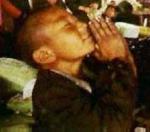 |
| Oh, if only more children would pray! |
| tric prods and wooden sticks hung from the walls. Foot chains were on the floor. Each time he was taken there, Kyap said, he was placed in a chair and secured with cuffs and a belt. Kyap said three police officers in the room asked him: "How did you get the money to start the school? Did it come from the Tibetan government-in-exile in India? Do you have any contact with the Tibetan government-in-exile? Does that government know about this school or tell you how to teach it? Do you have any contact with Tibetans who are in exile?'' Kyap said he told police that he did not have any con-tact with Tibetans in India, and that he and others had raised money for the school inside Tibet. Later, Kyap said, two teenage guards beat and kicked him in his cell. They put him in handcuffs and pressed electric cattle prods on his neck, forehead and hands for about half an hour. He said he fell down as the electricity surged through his body. Later that night, Kyap said he noticed blood oozing from his legs - the result of being kicked or beaten. He now has a four-inch-long scar below his right knee. After a subsequent interrogation session, Kyap said, he was beaten by two teenage guards for about half an hour. He said the guards struck him heavily and repeatedly on the top right side of his head with rods about two feet long. Eventually, he said, he passed out. When he regained consciousness, he was lying on the floor. He said he got up and a guard hit him again, this time on the chest. When the beatings stopped, Kyap said, the guards sprayed his airtight room with a chemical used to kill house lice. "There was no air in that room, and for two days I inhaled those chemicals,'' he said. "My lips were dry, and I developed sores in my throat.'' After 32 days in jail, Kyap was taken by police to the Qinghai Tibetan Hospital. As a result of the shocks from the electric cattle prods, Kyap's heart was beating faster than normal - 140 beats per minute, compared to the usual 75 beats per minute for a man his age. In addition, Kyap said, his blood pressure was very high, his hands shook, and they were hot and sweaty. He said he was hospitalized for 2 1/2 months. While in the hospital, Kyap said, he was again questioned by police. He said the police visited about 10 times. At the end of Kyap's hospital stay, he was released and sent home. The polygraph-er found that Kyap was telling the truth about all details of his arrest and torture. A doctor found that three scars on Kyap's legs were consistent with his account of torture. Kyap suffers from post-traumatic stress disorder as a result of torture, the doctor said. Before helping to open the school in 1993, Kyap had taught law to Chinese government officials. "The Chinese make laws,'' Kyap said, "but they routinely go against them. For example, it is written in the law that the accused must meet the accuser. But in practice it is different.'' At home, he said, he was often followed by Chinese agents. A friend in the government confirmed that he was being carefully watched. "I had no mental peace,'' Kyap said. "My friends, my parents agreed that I had to go to India.'' Kyap and his wife, carrying their baby daughter, trekked out of Tibet and arrived in India in 1994. "I left with a heavy heart,'' said his wife, Dorjee Tso. "But we had no choice. My husband could no longer live in Tibet.'' "No freedom... none" Tashi Dawa, then 17, a senior at the Dhanak Lomthen High School in Dranang, Tibet, took a history quiz in December 1992. Just as he expected, one of the questions sought the number of "regions'' under Chinese rule. The answer, as provided by his history book, was 56. But Dawa and his classmate Nyima (his only name) had decided in advance that they would write 55. Their history teacher, Liu Laoshi, collected the papers and looked over the responses. "Why did you write only 55 regions?'' he asked. Dawa and his friend explained that Tibet was an independent country, and not a region of China. They said that they were being taught his-tory from a Chinese perspective, and that they wanted to learn Tibetan history. A third student, Kelsang Tsering, said that he, too, would like to learn Tibetan history. Police arrived at the school and took Dawa and Nyima to the principal's office, where they were scolded, Dawa said. Later, at lunchtime, Dawa and Nyima told other students about the incident. According to Dawa, students in the school yard began shouting: "We agree with them! We want more Tibetan teachers, fewer Chinese teachers!'' After lunch, all students attended a meeting in the auditorium. On the stage was the princi-pal, Tashi Gyantso, as well as Dawa, Nyima, Kelsang Tsering and 30 other students. "These students are for the Dalai Lama and against the Chinese,'' Dawa recalled the principal saying. "As of today they are expelled.'' The 33 students were taken by police to a storeroom. One of the policemen placed an iron rod on an electric heater, making it red-hot, Dawa said. The officer then branded three of the students - pressing the iron on the bridges of their noses, according to Dawa. "One branded us, one held our hands behind our back,'' Dawa recalled. "The iron felt very hot, and it became even more painful after two days. It took seven days before the burning feeling went away.'' "A dark scar formed at the bridge of each student's nose," Dawa said. Afterward, police drove Dawa and Nyima to the Lokha Prison. There, Da-wa and Nyima shared a cell. Every day for three months, Dawa said, police beat him in an interrogation room. At other times, Nyima also was taken out of the cell and beaten, Dawa said. "Nyima was hurt even worse than me,'' Dawa said. "His leg was broken, and he couldn't bend it because it was so painful.'' The most severe beating Dawa received, he said, was at the end of his third month in prison. On that day, he said, four police officers kicked him repeatedly with their boots, mainly in his back and stomach. "With the butts of their rifles," Dawa said, "police beat him on his head. The beating that day lasted more than an hour," Dawa said. Dawa said that the pain was "much worse after the beating than during the beating. I was very angry. I felt there is no freedom in Tibet, none at all.'' Four days later, he was released from prison. Dawa said he tried to join a monastery after getting out of jail, but was rejected because of his arrest. He said he spent a brief time in a hospital in Lhasa because his injuries were causing so much pain. He also tried several other jobs in Tibet, but, he said, none worked out because of his arrest record. In January 1995, he decided he could no longer live a productive life in Tibet. He trekked out of Tibet to India. For months afterward, Dawa said, he suffered from a burning sensation while urinating. Today, he still has pain in his stomach. Though he feels hungry, he often feels he cannot eat. He said he also suffers from severe headaches and pain in his eyes. He did not experience headaches pri-or to his beatings in prison, he said. A doctor, who is from the University of Washington School of Medicine - examined Dawa in Dharmsala, India. He said a mark remains on the bridge of his nose from the iron. The doctor also said Dawa's stomach pain and headaches are evidence of mild depression. The polygrapher found that Dawa told the truth in all de-tails about his arrest and torture. Burned repeatedly Tsering Youdon, a 16-year-old Tibetan girl, returned from vaca-tion to her school in Lhasa on Feb. 25, 1994, to find it surrounded by police. Officers told students that the school's headmaster, Buddhist monk Zhabdung Lobsang Tsultrim, was in prison. They said the monk had taught students "coun-terrevolutionary ideas'' - that Tibet had been and should be an independent country. Police told the students to gather their belongings quickly and go home. Four days later, in the evening, four uniformed police officers walked through the unlocked door of Youdon's home in Lhuntse, a three-hour drive from Lhasa. Police told the family that they had to take Youdon to the police station, Youdon recalled in an interview in India. "We just want to advise her and ask her some questions,'' one police officer said. "Her school was closed because of bad ideas among the students, but it wasn't the fault of the students; they are too young.'' Youdon's mother began crying. "If she is not to be blamed, don't take her,'' she said, according to Youdon. "If you must take someone away, take me.'' Police said they needed her daughter. "Don't cry, Mom,'' Youdon said. "Nothing will happen to me, because I did nothing wrong.'' Youdon said that at a po-lice station in Lhasa, she was led to a narrow, dark room, with only a mattress inside. "Now you have all your freedom here,'' she recalled a police officer telling her sarcastically. "Enjoy your freedom.'' Around 10 a.m. the next day, she said, she was led to a room where three policemen sat around a desk; atop the desk was an electric iron. She said one police officer handcuffed her right hand to his. The officer behind the desk asked her, at first politely, what the monk had taught at school. Had he taught her to say she wanted freedom for Tibet? She said no, that he only taught the Tibet-an language, math and music. "Are you sure?'' the policeman asked. At that moment, Youdon said, another policeman grabbed her left arm. A third policeman placed the hot iron onto the lower portion of her leg, over her thin cotton pants, she recalled. When Youdon screamed and tried to move her leg away from the iron, the officer held her leg firmly and kept the iron on it, she said. Today, there is a white scar at that spot on her leg, about four inches by three inches. She |
| fer?'' When Youdon didn't answer, she said, a police officer threw her against the desk and kicked her in the stomach with his boot. Youdon hit her head on the desk. Today she has scars above her forehead and on her left cheek that she said came from that beating. Youdon said she was released later that day. Her aunt, who picked her up from the police station, took her to Lhasa Hospital. There, a doctor applied ointment to her left leg and hand and put a dressing on her wounds. He also cleaned up her bloody forehead and cheek, she recalled. By the end of 1994, Youdon said, she had found she could not return to school or get a job because of her arrest. She decided to make the trek to India, where she is now in school. An American doctor examined Youdon in India last month. The doctor identified scars and burn marks that he said were consistent with the torture she described. The polygrapher found that Youdon was telling the truth regarding her arrest and torture. (Additional story on next page...) Disclaimer: All images and/or articles retain the original copyrights of their original owners. |
 |
| said the police officer kept the iron on her leg for about five minutes. Could she try harder to recall what the monk had taught about seeking independence for Tibet? Youdon said she insisted that he hadn't taught such things. The hot iron was placed on her leg for several more minutes - on the same spot. She said she screamed and tried to move the iron away with her left hand, burning her hand. Today she has a round scar over one knuckle, and another scar near her thumb. After a while, she said, police placed the iron on her left thigh, leaving it there for about five minutes. As the iron burned her skin, she said, the police officer behind the desk warned her: "All the students there were talking about freedom. If you ask for freedom, you ask for trouble.'' The next day, police continued their interrogation. "Why don't you speak up?'' one asked. "Why do you choose to suf- |
 |
 |
| Click at left to visit our Main Buddhism site. Much more information and images. And, NO pop-ups! |
|
|