 |
 |
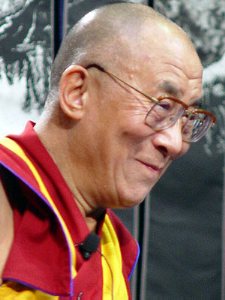 |
| "As a basis for change, we need to recognize that as long as we live in this world we will encounter problems, things that obstruct the fulfillment of our goals. If, when these happen, we lose hope and become discouraged, we diminish our ability to face these difficulties. If, on the other hand, we remember that not just we but everyone has to undergo suffering, this more realistic perspective will increase our determination and our capacity to overcome troubles. By remembering the suffering of others, by feeling compassion for others, our own suffering becomes manageable. Indeed, with this attitude, each new obstacle can be seen as yet another valuable opportunity to improve our mind, another opportunity for deepening our compassion! With each new experience, we can strive gradually to become more compassionate; that is, we can develop both genuine sympathy for others' suffering and the will to help remove their pain. As a result, our own serenity and inner strength will increase. "Every day, think as you wake up, Today I am fortunate to have woken up, I am alive. I have a precious human life; I am not going to waste it, I am going to use all energies to develop myself, to expand my heart out to others, to achieve Enlightenment for the benefit of all beings, I am going to have kind thoughts towards others, I am not going to get angry or think badly about others, I am going to benefit others as much as I can" The Dalai Lama |
 |
| December 18, 2003 |
| Meditations... We have been receiving requests for a children's meditation. Well here it is; everything you need to know! Want a good tip? Meditating with your friends is the most fun! Find a quiet place and get comfortable. Then read the meditation and try to picture the words as you say them. Meditation on Great Liberatrice... We sit up as straight as we can, and feel how our breath comes and goes at the tips of our noses. In the sky in front of us appears a beautiful Green Buddha-lady. She sits on a moon disc and a lotus flower. Her name is Green Tara; she is as big as a mountain and made out of light. She is everything that is kind and generous. We picture her as big as a mountain and made out of light. Her right hand is open and she holds a lotus flower in her left hand. Her left leg is bent and her right leg is stretched forward. We are very happy that she is here and that she helps all beings. After that Green Tara dissolves into light. Then this light dissolves into us. Now we can repeat her mantra as often as we want, out loud or quietl - OM TARE TUTTARE TURE SOHA. This means: " Dear Tara, stay with us." When we stop saying the mantra, we sit quietly for a while. Now that the meditation has ended we wish all beings everything good. |
|
| The One-hundredth Prince [Obedience to a Wise Teacher] Once upon a time, there was a king who had one- hundred sons. The youngest, the one-hundredth, was Prince Gamani. He was very energetic, patient and kind. All the princes were sent to be taught by teachers. Prince Gamani, even though he was the one-hundredth in line to the throne, was lucky enough to have the best teacher. He had the most learning and was the wisest of them of all. He was like a father to Prince Gamani, who liked, respected and obeyed him. In those days, it was the custom to send each educated prince to a different province. There he was to develop the country and help the people. When Prince Gamani was old enough for this assignment, he went to his teacher and asked which province he should request. He said, "Do not select any province. Instead, tell your father the king that if he sends you, his one-hundredth son, out to a province, there will be no son remaining to serve him in his home city." Prince Gamani obeyed his teacher, and pleased his father with his kindness and loyalty. Then the prince went again to his teacher and asked, "How best can I serve my father and the people, here in the capital city?" The wise teacher replied, "Ask the king to let you be the one to collect fees and taxes, and distribute benefits to the people. If he agrees, then carry out your duties honestly and fairly, with energy and kindness." Again the prince followed his teacher's advice. Trusting his one-hundredth son, the king was glad to assign these functions to him. When he went out to perform the difficult task of collecting fees and taxes, the young prince was always gentle, fair and lawful. When he distributed food to the hungry, and other necessary things to the needy, he was always generous, kind and sympathetic. Before long, the one-hundredth prince gained the respect and affection of all. Eventually, the king came to be on his deathbed. His ministers asked him who should be the next king. He said that all his one-hundred sons had a right to succeed him. It should be left up to the citizens. After he died, all the citizens agreed to make the one-hundredth prince their next ruler. Because of his goodness, they crowned him King Gamani the Righteous. When the ninety-nine older brothers heard what had happened, they thought they had been insulted. Filled with envy and rage, they prepared for war. They sent a message to King Gamani, which said, "We are all your elders. Neighbour countries will laugh at us if we are ruled by the one-hundredth prince. Either you give up the kingdom or we will take it by war!" After he received this message, King Gamani took it with him to his wise old teacher, and asked his advice. It just so happened that this honorable gentle teacher was the reborn Enlightenment Being. He said, "Tell them you refuse to wage war against your brothers. Tell them you will not help them kill innocent people you have come to know and love. Tell them that, instead, you are dividing the king's wealth among all one-hundred princes. Then send each one his portion." Again the king obeyed his teacher. Meanwhile the ninety-nine older princes had brought their ninety-nine small armies to surround the royal capital. When they received the king's message and their small portions of the royal treasure, they held a meeting. They decided that each portion was so small it was almost meaningless. Therefore, they would not accept them. But then they realized that, in the same way, if they fought with King Gamani and then with each other, the kingdom itself would be divided into small worthless portions. Each small piece of the once-great kingdom would be weak in the face of any unfriendly country. So they sent back their portions of the royal treasure as offerings of peace, and accepted the rule of King Gamani. The king was pleased, and invited his brothers to the palace to celebrate the peace and unity of the kingdom. He entertained them in the most perfect ways - with generosity, pleasant conversation, providing instruction for their benefit, and treating all with even-handed courtesy. In this way the king and the ninety-nine princes became closer as friends than they had been as brothers. They were strong in their support of each other. This was known in all the surrounding countries, so no one threatened the kingdom or its people. After a few months, the ninety-nine brothers returned to their provinces. King Gamani the Righteous invited his wise old teacher to live in the palace. He honored him with great wealth and many gifts. He held a celebration for his respected teacher, saying to the full court, "I, who was the one-hundredth prince, among one-hundred worthy princes, owe all my success to the wise advice of my generous and understanding teacher. Likewise, all who follow their wise teachers' advice will earn prosperity and happiness. Even the unity and strength of the kingdom, we owe to my beloved teacher." The kingdom prospered under the remainder of the generous and just rule of King Gamani the Righteous. The moral is: One is rewarded a hundred-fold for following the advice of a wise teacher. |
 |
|
 |
| "It is natural for the immature to harm others. Getting angry with them is like resenting a fire for burning." Shantideva A BAG OF NAILS Once upon a time there was a little boy with a bad temper. His father gave him a bag of nails and told him that every time he lost his temper, he should hammer a nail in the fence. The first day the boy had driven 37 nails into the fence. But gradually, the number of daily nails dwindled down. He discovered it was easier to hold his temper than to drive those nails into the fence. Finally, the day came when the boy didn't lose his temper at all. He proudly told his father about it and the father suggested that the boy now pull out one nail for each day that he was able to hold his temper. The days passed and the young boy was finally able to tell his father that all the nails were gone. The father took his son by the hand and led him to the fence. "You have done well, my son, but look at the holes in the fence. The fence will never be the same. When you say things in anger, they leave a scar just like this one. You can put a knife in a man and draw it out, it won't matter how many times you saay 'I'm sorry,' the wound is still there." (The definition of Anger is: Being unable to bear the object, or the intention to cause harm to the object. Anger is defined as aversion with stronger exaggeration. |
|
| The Bull Called Delightful [All Deserve Respect]... Once upon a time, in the country of Gandhara in northern India, there was a city called Takkasila. In that city the Enlightenment Being was born as a certain calf. Since he was well bred for strength, he was bought by a high class rich man. He became, very fond of the gentle animal, and called him 'Delightful.' He took good care of him and fed him only the best. When Delightful grew up into a big fine strong bull, he thought, "I was brought up by this generous man. He gave me such good food and constant care, even though sometimes there were difficulties. Now I am a big grown up bull and there is no other bull who can pull as heavy a load as I can. Therefore, I would like to use my strength to give something in return to my master." So he said to the man, "Sir, please find some wealthy merchant who is proud of having many strong bulls. Challenge him by saying that your bull can pull one hundred heavily loaded bullock carts." Following his advice, the high class rich man went to such a merchant and struck up a conversation. After a while, he brought up the idea of who had the strongest bull in the city. The merchant said, "Many have bulls, but no one has any as strong as mine." The rich man said, "Sir, I have a bull who can pull one-hundred heavily loaded bullock carts." "No, friend, how can there be such a bull? That is unbelievable!" said the merchant. The other replied, "I do have such a bull, and I am willing to make a bet." The merchant said, "I will bet a thousand gold coins that your bull cannot pull a hundred loaded bullock carts." So the bet was made and they agreed on a date and time for the challenge. The merchant attached together one-hundred big bullock carts. He filled them with sand and gravel to make them very heavy. The high class rich man fed the finest rice to the bull called Delightful. He bathed him and decorated him and hung a beautiful garland of flowers around his neck. Then he harnessed him to the first cart and climbed up onto it. Being so high class, he could not resist the urge to make himself seem very important. So he cracked a whip in the air, and yelled at the faithful bull, "Pull, you dumb animal! I command you to pull, you big dummy!" The bull called Delightful thought, "This challenge was my idea! I have never done anything bad to my master, and yet he insults me with such hard and harsh words!" So he remained in his place and refused to pull the carts. The merchant laughed and demanded his winnings from the bet. The high class rich man had to pay him the one-thousand gold coins. He returned home and sat down, saddened by his lost bet, and embarrassed by the blow to his pride. The bull called Delightful grazed peacefully on his way home. When he arrived, he saw his master sadly lying on his side. He asked, "Sir, why are you lying there like that? Are you sleeping? You look sad." The man said, "I lost a thousand gold coins because of you. With such a loss, how could I sleep?" The bull replied, "Sir, you called me 'dummy'. You even cracked a whip in the air over my head. In all my life, did I ever break anything, step on anything, make a mess in the wrong place, or behave like a 'dummy' in any way?" He answered, "No, my pet." The bull called Delightful said, "Then sir, why did you call me 'dumb animal', and insult me even in the presence of others? The fault is yours. I have done nothing wrong. But since I feel sorry for you, go again to the merchant and make the same bet for two-thousand gold coins. And remember to use only the respectful words I deserve so well." Then the high class rich man went back to the merchant and made the bet for two-thousand gold coins. The merchant thought it would be easy money. Again he set up the one-hundred heavily loaded bullock carts. Again the rich man fed and bathed the bull, and hung a garland of flowers around his neck. When all was ready, the rich man touched Delightful's forehead with a lotus blossom, having given up the whip. Thinking of him as fondly as if he were his own child, he said, "My son, please do me the honor of pulling these one-hundred bullock carts." Lo and behold, the wonderful bull pulled with all his might and dragged the heavy carts, until the last one stood in the place of the first. The merchant, with his mouth hanging open in disbelief, had to pay the two-thousand gold coins. The onlookers were so impressed that they honored the bull called Delightful with gifts. But even more important to the high class rich man than his winnings, was his valuable lesson in humility and respect. The moral is: Harsh words bring no reward. Respectful words bring honor to all. |
|
 |
| Have you visited our Main Site yet? If not, click above. |
| True Love... Some of you might think 'Oh, I want to have nothing to do with Jesus, nothing to do with the Bible.' This is a very angry, emotional attitude to have towards Christianity. If you really understood, you would recognize that what Jesus taught was 'Love!' It is as simple, and as profound, as that. If you had true love within you, I am sure you would feel much more peaceful than you do now. How do you normally think of love? Be honest. It is always involved with discriminations isn't it? Just look around this room and see if anyone here is an object of your love. Why do you discriminate so sharply between friend and enemy? Why do you see such a big difference between yourself and others? In the Buddhist teachings, this falsely discriminating attitude is called dualism. Jesus said that such an attitude is the opposite of true love. Therefore, is there any one of us who has the pure love Jesus was talking about? If we do not, we should not criticize his teachings or feel they are irrelevant to us. We are the ones who have misunderstood, perhaps knowing the words of his teaching but never acting on them. There are so many beautiful sentences in the Bible, but I do not ever recall Jesus ever said that without your doing anything whatsoever - without preparing yourself in some way - the Holy Spirit would descend upon you, whoosh! If you do not act the way he said you should act, there is no Holy Spirit existent anywhere for you. What I have read in the Bible has the same connotation as the Buddhist teachings on equilibrium, compassion and changing one's ego attachment into love for others. It may not be immediately obvious how to train your mind to develop these attitudes, but it is certainly possible to do so. Only our selfishness and closed-mindedness prevent us. With true realizations, the mind is no longer egotistically concerned with only its own salvation. With true love, one no longer behaves dualistically: feeling very attached to some people, distant from others, and totally indifferent to the rest. It is so simple. In the ordinary personality the mind is always divided against itself, always fighting and disturbing its own peace. Cheek up inside now and discover how you look at your neighbors. Visualize first a friend and then an enemy and see how your mind reacts. Instinctively we feel attachment for the one called 'friend' and aversion for the one called 'enemy', but such reactions are the opposite of peace. They are negative and do nothing but produce suffering. The teachings on love are very practical. Do not put religion somewhere up in the sky and feel you are stuck down here on Earth. If the actions of body, speech and mind are in accordance with loving kindness, you automatically become a truly religious person. To be religious does not mean you attend certain teachings. If you listen to teachings and misinterpret them, you are in fact the opposite of religious. And it is only because you do not understand a certain teaching that you abuse religion. Lack of deep understanding leads to partisanship. The ego feels 'I am Buddhist; therefore Christianity must all be wrong.' This is very harmful to true religious feeling. You do not destroy a religion with bombs but with hatred. More importantly, you destroy the peacefulness of your own mind. It does not matter whether you express your hatred with words or not. Words do not mean anything. The mere thought of hatred automatically destroys your peace. Similarly, true love does not depend on physical expression. You should realize this. True love is a feeling deep in within you. It is not just a matter of wearing a smile on your face and looking happy. Rather, it arises from a heart-felt understanding of every other being's suffering, and radiates out to them indiscriminately. It does not favor a chosen few to exclusion of everyone else. This is true love. Furthermore, if someone hits you and you react with anger or great alarm crying, 'What has happened to me?' this also has nothing to do with a mind knowing the meaning of true love. It is just the ignorant preoccupation of the ego with its own welfare. How much wiser it is to realize, 'Being hit does not really harm me. My delusion of hatred is an enemy that harms me much more than this'. Reflecting like this allows true love to grow. (By Lama Thubten Yeshe) |
|
 |
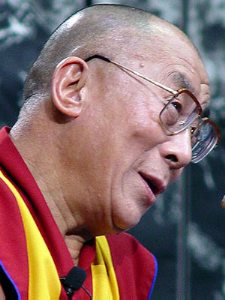
| What does the Dalai Lama mean? He is a living prince of peace, a teacher of intelligence, an inspirer of goodness of heart, a reincarnation of the Buddha of universal compassion. He comes to join us in our world today, offering us hope and help in our stressed-out lives and calling upon us to take up our own wild joy of universal responsibility. Robert Thurman Thought For The Day... Do not think that time merely flies away. Do not see flying away as the only function of time. If time merely flies away, you would be separated from time. The reason you do not clearly understand the time-being is that you think of time only as passing. In essence, all things in the entire world are linked with one another as moments. Because all moments are the time-being, they are your time-being. Dogen Zenji Dai Osho Disclaimer: All images and articles retain the original copyrights of their original owners. |
 |
 |
 |
 |