 |
| Page 26A |
 |
 |
| holding a bowl filled with nectar, which is medicine for curing our disturbing attitudes and other hindrances. Feel that this is the real Buddha in front of you. Buddha's face is very beautiful; his smiling, compassionate gaze is directed towards you and simultaneously encompasses all sentient beings. He is free of all judgmental, critical thoughts and accepts you just as you are. His eyes are long, narrow and very peaceful. His lips are red and his earlobes long. His hair is blue-black and each hair is individually curled to the right. Each feature of his holy body represents an aspect of his omniscient mind. Rays of light emanate from each pore of Buddha's body and reach every corner of the universe. These rays are composed of countless miniature Buddhas, some going out to help sentient beings, others dissolving back into the Buddha's body after having finished their work. Around you are seated all sentient beings in human form - friends, strangers and enemies. You are all facing the Buddha together. Purification... Feel the living presence of the Buddha and take refuge in him, recalling his perfect qualities and his willingness and ability to help you. Make a request from your heart to receive his inspiration and blessings to help you and others become free from all of your negative energy, disturbing attitudes, misconceptions and problems. Request to receive all the realizations of the path to Enlightenment so that you may be peaceful and happy and be able to make your life beneficial for others. Recite the following, in Tibetan or English, three times: la ma ton pa chom dan de/ de zhin sheg pa/ dra chom pa/ yang dag pa dzog pay sang gye/ pal gyal wa shakya tup pa la/ chag tsal ching kyap su chi wo/ cho do/ jin gyi lap tu sol // To the Guru and Founder, the Endowed Transcendent Destroyer, the One Gone Beyond, the Foe Destroyer, the Completely Perfected, Fully-awakened Being, the Glorious Conqueror, the Subduer from the Shakya Clan, I prostrate, go for refuge and make offerings. Please bestow upon me your inspiration. / Your request is accepted. A stream of purifying white light, which is the nature of the Enlightened mind of wisdom and compassion, flows from the Buddha's heart and enters your body through the crown of your head. The light also flows into all the sentient beings, whom you have visualized sitting around you. Just as the darkness in a room is instantly dispelled the moment a light is switched on, so too is the darkness of your negative energy dispelled as soon as the radiant white light enters you. Continue with the visualization while reciting the Buddha's mantra as many times as you wish: tayata om muni muni maha muniye soha. Feel that the negative energy, problems and subtle obscurations of yourself and others have been completely purified. Your body is filled with light and is very blissful. Concentrate on this for a while. Receiving inspiration and blessings... Visualize that a stream of golden light, the essence of which is the excellent qualities of the Buddha's body, speech and mind, descends from the Buddha's heart and flows into you and into all the sentient beings around you through the crown of your head. These infinite good qualities permeate every part of you. Concentrate on this blissful experience of receiving the blessings and inspiration of the Buddha while reciting: tayata om muni muni maha muniye soha. Feel that you have received the infinite excellent qualities of the Buddha. You have unbiased love and compassion for all beings, just as the Buddha does. Feel that you have actualized the six far-reaching attitudes: generosity, ethics, patience, joyous effort, concentration and wisdom. It is the same for all the sentient beings around you. Feel blissful and satisfied. Concentrate on this for some time. Absorption... Make a determined aspiration to live your life according to the loving and compassionate thought to become a Buddha for the benefit of all sentient beings. Think that Guru Shakyamuni Buddha is extremely pleased with your noble aspiration, and will guide you so that you can actualize it. Visualize that the throne absorbs into the lotus, and the lotus into the moon and sun discs. They, in turn, absorb into the Buddha, who now comes above your head, facing the same way as you do. He melts into light and dissolves into you, thus blessing, inspiring and transforming your mind. Feel that not even the slightest bit of selfishness remains and that your mind has become the loving, compassionate thought aspiring to attain Enlightenment only for the benefit of others. Reappearance... At your heart center appears a small Buddha, made of light. Be mindful of the Buddha at your heart as you do all the daily activities of your life. Dedication... Due to this merit may I soon attain the Enlightened state of Guru-Buddha, that I may be able to liberate all sentient beings from their sufferings. May the precious bodhi mind not yet born arise and grow. May that born have no decline, but increase forever more. |
| Meditation on the Buddha... (Taking refuge and generating the altruistic intention.) I take refuge until I am Enlightened in the Buddhas, the Dharma and the Sangha. By the positive potential I create by practicing generosity and the other far-reaching attitudes, may I attain Buddhahood in order to benefit all sentient beings. 3x In order to help all sentient beings and lead them to the perfect peace and happiness of Enlightenment, I must attain Enlightenment. For this purpose, I shall meditate on Guru Shakyamuni Buddha. Visualization... Every aspect of the following visualization is made of light - transparent, intangible and radiant. At the level of your forehead, about five or six feet in front of you, visualize a large golden throne adorned with jewels and supported at each corner by a pair of snow lions. On the throne is an open lotus, and on that two discs - the moon and the sun. Seated upon this is the Buddha, one who has purified all defilements and attain all perfect realizations. He is the embodiment of all Enlightened beings. His body is made of golden light and he wears the saffron robes of a monk. He is seated in the vajra posture. The palm of his right hand rests on his right knee, the fingers touching the moon cushion to symbolize his great control. His left hand rests in his lap in the meditation pose, |
 |
| The Three Principle Paths I bow to the high and holy lamas. 1. As far as I am able I shall explain the essence of all high teachings of the Victors, the path that their holy sons commend, the entry point for the fortunate seeking freedom. 2. Listen with a pure mind; fortunate ones who have no craving for the pleasures of life, and who to make leisure and fortune meaningful strive to their minds to the path, which pleases the Victors. 3. There is no way to end, without the pure renunciation, this striving for pleasant results in the ocean of life. It is because of their hankering life as well that beings are fettered, so seek renunciation first. 4. Leisure and fortune are hard to find, life is not long; think it constantly, stop desire for this life. Think over and over how deeds and their fruits never fail, and the cycle's suffering: stop desire for the future. 5. When you have meditated thus and fell not even a moment's wish for the good things of cyclic life, and when you begin to think both night and day of achieving freedom, you have found renunciation. 6. Renunciation though can never bring the total bliss of matchless Buddhahood unless it is bound by the purest wish; and so, the wise seek the high wish for enlightenment. 7. They are swept along the four fierce river currents, chained up tight in past deeds, hard to undo, stuffed in a steel cage of grasping "self," smothered in the pitch-black ignorance. 8. In a limitless round they are born, and in their births are tortured by three sufferings without a break; think how your mothers feel, think of what is happening to them, try to develop this highest wish. 9. You may master renunciation and the wish, but unless you have the wisdom perceiving reality you cannot cut the root of cyclic life. Make efforts in ways then to perceive interdependence. 10. A person is entered the path that pleases the Buddhas when for all objects, in the cycle or beyond, he sees that cause and effect can never fail, and when for him they lose all solid appearance. 11. You have yet to realize the thought of the Able as long as two ideas seem to you disparate: the appearance of things- infallible interdependence; and emptiness- beyond taking any position. 12. At some point they have no longer alternate, come together; just seeing that interdependence never fails brings realization that destroys how you hold objects, and then your analysis with view complete. 13. In addition, the appearance prevents the existence extreme; emptiness that of non-existence, and if you see how emptiness shows cause and effect. You will never be stolen off by extreme views. 14. When you have grasped as well, as essential points of each of the three principal paths explained, then go into isolation, my son, make efforts, and quickly win your ultimate wish. (By Lord Lama Je Tsongkhapa) |
 |
|
| cherishing the son of an enemy; though superficial joy may appear to be like joy, eventually it will certainly inflict harm. Even the superficial happiness from attachment to self-purpose certainly will eventually lead to a bad rebirth. Manifestly attached to phenomena and characteristics is like grasping for water in a mirage; though a superficial appearance of water, there is no substance to be drunk. This Existence, appearing to a deluded mind, when examined with wisdom no entities are found to exist. Knowing not to rest the mind in the past, not to rest the mind in the future, not resting the consciousness in the present; know all dharmas to be free of elaboration. Practicing like that, with non-attachment to just this life there will be no bad rebirths; non-attachment to the Three Realms - not born in Existence; non-attachment to self-purpose - not born as a Shravaka/Pratyekabuddha; non-attachment to phenomena and characteristics - to quickly manifest Complete Perfection. "I prostrate myself at the feet of Marpa the Translator. Those who wish to know and practice the Dharma, who merely venerate their lama without fully entrusting themselves to him, will be but slightly benefited. Without receiving true initiation, mMere words of Tantra will blind you. Without being guided the true meaning of the Tantras, all your practices will lead you astray. Without meditation according to the profound instruction, he who practices asceticism only torments himself. He who does not subdue desire and illusion only speaks sterile and empty words. He who does not know profound skillful means will fail, however great his effort. He who does not have the key to the profound meaning of Dharma will be long upon the Path, however great his courage. He, who accumulates no merit and seeks only his own liberation, reaps rebirth. He who does not give up what he has accumulated for the sake of the Dharma will not achieve perfection, however much he meditates. He who is not deeply content with what he has, sees the wealth he accumulates taken by others. He who lacks in himself the source of happiness finds only pain in outer pleasures. He who does not subdue his demon of ambition finds only ruination and strife in his desire for glory. Selfish desire stir up the five poisons, temporal desires separate the dearest of friends. Self-glorification evokes resentment in others. Keeping silent about oneself will prevent conflicts. By maintaining tranquility and avoiding distraction, in solitude you will find your companion. Humility leads to the highest goal. He who works with care will quickly achieve results. Renunciation brings great fulfillment. The practice of the secret path is the shortest way. Realization of emptiness engenders compassion. Compassion abolishes the difference between oneself and others. If there is no duality between oneself and others, one fulfills the aim of all sentient beings. He who recognizes the need of others will discover me. He who finds me will achieve Enlightenment. To me, to the Buddha, and to the disciples you should pray as one, considering them as one." (By Sakya Pandita Kunga Gyaltsen) |
| THE SEPARATION FROM THE FOUR ATTACHMENTS To the feet of the Holy Guru, I bow! Generally, having obtained a body of leisure and fortune and met with the precious teaching of the Buddha; giving rise to an un-fabricated mind with the aim of practicing the unmistaken Holy Dharma, should practice the 'Separation from the Four Attachments.' If asked what that is; non-attachment to this life; non-attachment to the Three Realms of Existence; non-attachment to self-purpose; non-attachment to phenomena and characteristics. To explain that; this life is like a water bubble and the time of death is indefinite, it is not worth having attachment. The Three Realms of Existence are like poisonous fruit, superficially delicious, eventually inflicting harm; having attachment to them is deluded. Attachment to self-purpose is like |
|
| What is Vajrayana? Vajrayana, which is also called Tantrayana, is a subdivision of the Mahayana. It is based upon both the Theravadin and general Mahayana practices. Before entering into the Vajrayana, we must be well-trained in the thought definitely to emerge from the cycle of constantly recurring problems (renunciation), the heart dedicated to attaining Enlightenment for the benefit of all sentient beings (bodhicitta), and the wisdom realizing the emptiness of inherent existence. Then, we take an initiation from a qualified tantric master and protect the tantric vows and commit-ments that are received at the time of initiation. On the basis of this, we can receive instructions and engage in the Vajrayana meditation practice. One technique used in the Vajrayana is visualizing ourselves as the deity and our envir-onment as the mandala or the environment of the deity. By visualizing in such a way, we transform our ordinary poor self-image into that of the deity and thus try to cultivate such noble qualities in our own mindstream. Vajrayana also contains techniques for transforming death, the intermediate state and rebirth into the body and mind of a Buddha. There are also special meditative techniques to develop calm abiding (samatha) as well as to make manifest an ex-tremely subtle mind which, when realizing emptiness, becomes very powerful in quickly cleansing the defilements. It is for this reason that Vajrayana can bring Enlightenment in this very lifetime to a qualified and well-trained disciple, who practises under the guidance of a fully-qualified tantric master. Buddhist Tantra is not the same as Hindu Tantra. Nor is it some kind of practice of magic. Some people have written books about Vajrayana with incorrect information and in-terpretations. Therefore, if we wish to learn about this, it is important either to read books by a knowledgeable author or seek instruction from a qualified master. |
|
| The Need for Religion in Our Present Lives by H. H. the Dalai Lama of Tibet One reason for the pursuit of religion is that material progress alone will not give lasting pleasure of satisfaction. Indeed, it seems that the more we progress materially, the more we have to live under constant fear. Scientific technology has made marvelous advances, and no doubt will continue to develop. Man may reach the moon and try to exploit her resources for the advantage of human beings - the moon which some ancient believers regarded as the home of their god; and planets may also be conquered. Perhaps, in the end, this progress will reveal potential enemies outside our world. But in any case, it cannot possibly bring ultimate and permanent pleasure to human beings, for material progress always stimulates desire for even further progress, so that such pleasure as it brings is only ephemeral. But, on the other hand, when the mind enjoys pleasure and satisfaction, mere material hardships are easy to bear; and if a pleasure is derived purely from the mind itself, it will be a real and lasting pleasure. No other pleasure can be compared with that derived from spiritual practice. This is the greatest pleasure, and it is ultimate in nature. Different religions have each shown their own way to attain it. A second reason for the pursuit of religion is that we depend on religion even for the enjoyment of an appreciable amount of material pleasure. Pleasure and pain, in a general sense, do not arise only from external factors, but from internal factors as well. In the absence of the internal response, no amount of external stimulation can effect pleasure or pain. These internal factors are the after-effects or impressions left on our minds by past actions; as soon as they come into contact with the external factors, we experience pleasure or pain again. An undisciplined mind expresses evil thoughts by evil actions, and those actions leave evil after-effects on the mind; and as soon as external stimulation occurs, the mind suffers the consequences of its past actions. Thus, if we suffer, our miseries have their remote causes in the past. All pleasure and pain have their mental origins; and religions are required because, without them, the mind cannot be controlled. The Need for Religion in Our Future Lives How do we know that there is an after-life? According to Buddhism, although the nature of Cause and Effect may be different, they must have the same essential properties, they must have a definite connection; otherwise the same cause cannot result in the same effect. For example, the human body can be perceived-it has form and colour-and therefore, its immediate source or cause must also be formless. In analogy, the properties of the seeds of medicinal plants create medicine, and the seeds of poisonous plants create poison. Most beings have physical bodies (though in some regions of existence beings have only minds). Both mind and body must have immediate sources. At the very moment of conception, both mind and body are formed and begin to function. The immediate source of a body is that of its parents. But physical matter cannot produce mind, nor mind matter. The immediate source of a mind must, therefore, be a mind which existed before the conception took place; the mind must have continuity from a previous mind. This we hold is proof of the existence of a past life. This has been demonstrated by the accounts of adults and children who remember their past lives-a phenomenon found not only in historical records but also observed today. We can conclude from this that past life existed, and hence that life in future will exist. If belief in after-life is accepted, religious practice is necessary as nothing else can supplant it, the preparation for one�s future existence. |
|
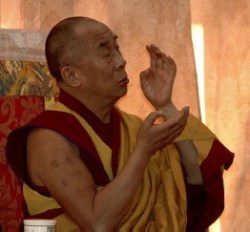 |
| The Four Noble Truths by The Dalai Lama LORD BUDDHA said: "This is true suffering; this is true cause; this is true cessation; this is the true path." He also said: "Know the sufferings; give up their causes; attain the cessation of sufferings; follow the true paths." Again, he said: "Know the sufferings although there is nothing to know; relinquish the causes of misery although there is nothing to relinquish; be earnest in cessation although there is nothing to cease; practise the means of cessation although there is nothing to practice." These are three views of the intrinsic nature, action and ultimate result of the Four Noble Truths. According to the Madhyamika theory (originally taught by Nagarjuna, a scholar of the third century of the Christian era), a theory which remains supreme among all the theories of different Buddhist schools, the explanation of these Truths is this: True suffering means Samsara (the entire round of existence, of birth and re-birth) arising from Karma (that is, action and reaction) and from delusion. True cause means Karma and delusion, which are the causes of true |
| suffering. True cessation means the complete disappearance by degrees of the preceding two truths. The true path is the method by which we arrive at true cessation. Thus the true cause of suffering leads to true suffering, but in following the true path, we arrive at the goal of true cessation. Although this is the natural sequence, Lord Buddha preached the Four Truths by placing the effects first and the causes after. The reason for this is that if the nature of suffering is determined, the cause of it may be deduced; and when this desire to eliminate the cause (of suffering) is strong, means will be found to abandon it. Disclaimer: All articles and/or images retain the original copyrights of their original owners. |
 |
 |
 |
| Visit our main Buddhism site. More information, images, and, NO pop-ups! |
| August 10, 2003 |
 |