 |
 |
| Page 22 |
| Nirvana was seen by early Buddhists as the only genuine escape from samsara (cycle of birth and death). The Sanskrit word Nirvana means "a blowing out, to become extinguished," like a flame. Although it comes from Hindu scriptures, Nirvana is primarily a Buddhist term. The purpose of the Hindu or Brahmanical saint was to purify the 'soul' of its karma until the 'soul' or self (atman) could be experienced as identical with the universal spirit (brahman) and the two could be united. The Buddha taught a different doctrine, that of "not-soul" or "not-self." In keeping with this, Nirvana was a condition |
| only to be experienced by someone who had eliminated the self and any notion of the self. While samsara is experienced by everybody all their lives, Nirvana is beyond ordinary words or concepts; in the Buddha's words, it is: "Peace. The absolute. The end of the construction of the human personality. The end of every trace that could be reborn. The death of craving. Detachment. Extinction." And just as samsara concerns continual rebirth, Nirvana is "unborn, unoriginated, uncreated, unformed. If the unborn, uncreated, unformed did not exist, escape from the world of the born, created and formed would not be possible." |
 |
| Buddhism first came to Tibet around AD650. Before the arrival of missionary monks, a native religion known as Bon (pronounced "bern") was practiced in two main forms. One was a priestly religion which served the early Tibetan kings. Because the kings were sacred rulers and their funeral rites vitally important, the Bon priests' prime responsibility was the continuity of rituals that underpinned the monarchy. The other form of Bon was a shamanistic religion based in rural communities. The shamans were religious adepts whose skills lay in the control of local deities and spirits, many of them malignant, which in huge numbers were believed to haunt every part of Tibet. Using their mastery of trance, spirit-possession and spirit-flight, most shamans of northeast Asia have traditionally empowered their rites with dance, song, drumming and personal amulets. Since misfortune was usually attributed to spirits, it was the shaman's craft through ritual and magic, to bend these powers to healing, divination and the protection of communities. Tibet was the last of the great Asian kingdoms to convert to Buddhism. Remote as it appears behind the Himalayan barrier, the "Land of Snows" was once a great power in Asia; between the 7th and 9th centuries AD, Tibetan armies pushed far into China, even taking control for a short while of the Chinese capital, Chang'an. Contact with China, Kashmir, India and Nepal during these centuries fed both Buddhist and Hindu ideas into Tibet, and this helped shape the peculiarly rich texture of Tibetan Buddhism. |
 |
|
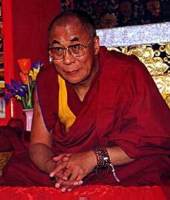
| and practice." In turn, The Dalai Lama would later say about Merton that "more striking than his outward appearance which was memorable in itself, was the inner life which he manifested. I could see that he was a truly humble and deeply spiritual man. This was the first time I had been struck by such a feeling of spirituality by anyone who professed Christianity." The Franciscan priest and author Murray Bodo relates that "The Dalai Lama credits Merton with opening his eyes to the truth that Tibetan Buddhism does not hold the world's only truth. 'As a result of meeting with him, my attitude toward Christianity was much changed. Thomas Merton is someone we can look up to. He had the qualities of being learned, disciplined and having a good heart'" At that same gathering where Merton met The Dalai Lama, Bodo also says that "The Dalai Lama (encouraged) each of us to remain faithful to our own tradition. He said, 'We need to experience more deeply the meanings and spiritual values of our own religious tradition - we need to know these teachings not only on an intellectual level but also through our own deeper experience. We must practice our own religion sincerely; it must become part of our lives.'" At this very time Merton would write in his personal journal: "Last night I dreamed I was, temporarily, back at Gethsemani. I was dressed in a Buddhist monk's habit, but with more black and red and gold, a 'Zen habit,' in color more Tibetan than Zen. I met some women in the corridor, visitors and students of Asian religion, to whom I was explaining I was a kind of Zen monk and Gelugpa together, when I woke up." After his second meeting with The Dalai Lama, Merton wrote that "most of the audience was taken up with a discussion of epistemology, then of samadhi. In other words, 'the mind.' We got back to the question of meditation and samadhi. I said it was important for monks in the world to be living examples of the freedom and transformation of consciousness which meditation can give. The Dalai Lama then talked about samadhi in the sense of controlled concentration." Merton wrote that the third and final meeting was the best of all: "He asked a lot of questions about Western monastic life, particularly the vows, the rule of silence, the as-cetic way, etc. It was a very warm and cordial discussion and at the end I felt we had become very good friends and were somehow quite close to one another. I feel a great respect and fondness for him as a person and believe, too, that there is a real spiritual bond between us. He remarked that I was a 'Catholic geshe,' which Harold said, was the highest possi-ble praise from a Gelugpa, like an honorary doctorate!" Later in November 1968, Merton was thinking about his now being in Asia: "I am still not able fully to appreciate what this exposure to Asia has meant. There has been so much and yet also so little. I have only been here a month! It seems a long time since Bangkok and even since Delhi and Dharamsala. Meeting The Dalai Lama and the various Tibetans, lamas or "Enlightened" laymen, has been the most significant thing of all, especially in the way we were able to communicate with one another and share an essentially spiri-tual experience of Buddhism which is also somehow in harmony with Christianity." Nearly a month after his meetings with The Dalai Lama in India and shortly before Merton would go to Thailand for the monastic conference which was supposed to be the reason for his journey to Asia, he was in Sri Lanka (then, Ceylon). Along with another priest, he visited the Buddhist shrine at Polonnaruwa, but unlike the other priest who did not enter the actual shrine complex because of its "paganism," Merton took off his shoes and walked barefoot towards the enormous statues of the Buddha. What was about to happen to Merton was a pivotal, dramatic turning point of his life, a mystical moment for a Christian at a Buddhist shrine. Always the paradox. Merton's own words say it best as he relives approaching the Buddhas at Polonnaruwa: "Then the silence of the extraordinary faces. The great smiles. Huge and yet subtle. Filled with every possibility, questioning nothing, knowing everything, rejecting nothing, the peace not of emotional resignation but of Madhyamika, of sunyata, that has seen through every question without trying to discredit anyone or anything. For the doctrinaire, the mind that needs well-established positions, such peace, such silence, can be frightening. Looking at these figures I was suddenly, almost forcibly, jerked clean out of the habitual, half-tied vision of things, and an inner clearness, clarity, as if exploding from the rocks themselves, became evident and obvious. All problems are resolved and everything is clear. The rock, all matter, all life, is charged with dharmakaya, everything is emptiness and everything is compassion. I don't know when in my life I have ever had such a sense of beauty and spiritual validity running together in one aesthetic illumination. Surely my Asian pilgrimage has come clear and purified itself. I mean, I know and have seen what I was obscurely looking for. I don't know what else remains, but I have now seen and have pierced through the surface and have got beyond the shadow and the disguise. The whole thing is very much a Zen garden, a span of bareness and openness and evidence a beautiful and holy vision." This experience is for Merton not only a hierophany - a breakthrough of the sacred into human experience - but also the epitome of his love of paradox and mysticism. On another side of the world from his old Kentucky home at the hermitage, at a Buddhist sacred place, Thomas Merton embodied the dialogue between Buddhism and Christianity that he had so sought. His very life was a living experience, experiment and nexus for that dialogue. Shortly after Polonnaruwa, Merton was in Thailand for the monastic conference at which Buddhists were to also attend. |
| Near the end of his life, the famous Christian monk - Thomas Merton, said he wanted "to become as good a Buddhist as I can." As Merton's 1968 trip to Asia continued in India, he met Hindu and Buddhist contemplatives with whom he shared insights gleaned from his own meditation. The very heart of his stay in India was his meeting with the exiled leader of Tibetan Buddhism, The Dalai Lama, at Dharamala in the Himalayas. They would meet for dialogue three times and they seemed to have quickly developed a warm personal relationship with each other. After the initial meeting, Merton wrote in his journal: "The Dalai Lama is most impressive as a person. He is strong and alert, a very solid, energetic, generous, and warm person, very capably trying to handle enormous problems. The whole conversation was about religion and philosophy and especially ways of meditation. In general he advised me to get a good base in Madhyami ka philosophy (Nagarjuna and other authentic Indian sources) and to consult qualified Tibetan scholars, uniting study |
 |
| contradiction and confusion in order to be transformed by what Zen calls the "Great Death" and Christianity calls "dying and rising with Christ." The anguish of the modern person, for Merton, was often based upon an addiction to a false self, one's ego-mind, that only a realization of the no-self (Buddhism) or dying to one's self (Christianity) could transform. Thus, the dialogue was not to be only an intellectual exercise, but a vital and compelling way to directly address the absence of freedom, compassion and meaning in contemporary living and society. And only people authentically free could really value and beneficially contribute to the dialogue, since the purpose of it was to free people from the wheel of causation and suffering. On December 10, 1968, at the conclusion of a talk at the conference, Merton said he was going to disappear for a while before the afternoon session. Later, he was found in his room, dead, evidently electrocuted by a faulty fan. His body was flown back "home" from his Asian "home" in a B-52 bomber, along with the bodies of American soldiers who had died in the Viet Nam War, a war he strongly opposed. (The above copyrighted article is reprinted with permission from the independent Buddhist- oriented web magazine - Hundred Mountain. A Journal of the Spirit and the Arts @ http://www.hundredmountain.com.) |
| Suffering, Unknowing, Freedom and Death - D.T. Suzuki had written that "Zen teaches nothing; it merely enables us to wake up and become aware. It does not teach, it points." Merton was able to encourage and participate in dialogue with Buddhism because he reached the point of not only accepting, but embracing a necessary ambiguity about ultimate concerns. He was able to live with what the 19th century poet, John Keats, called "negative capability," a not reaching for too easy or too ready rational answers when hard questions pressed down hard, but to live the questions and live them well. Implied here is that the Buddhist-Christian dialogue for Merton was not about arriving at decisive answers, but calmly and passionately allowing oneself to become the questions, to be breathing koans. Merton was deeply attracted to Buddhism's long and persevering tradition of compassion and nonviolence, especially in a world of persistent and profound suffering. He would say that: "Suffering, as both Christianity and Buddhism see, each in its own way, is part of our very ego-identity and empirical existence, and the only thing to do about it is to plunge right into the middle of |
|
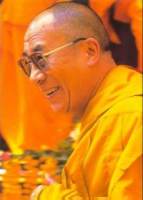
| "Look at one person who annoys you and use the opportunity to counter your own anger and cultivate compassion. But if the annoyance is too powerful if you find the person so repulsive that you cannot bear to be in his or her presence it may be better to look for the exit! Here is the principle: It is better not to avoid events or persons who annoy you, who give rise to anger, if your anger is not too strong. But if the encounter is not possible, work on your anger and develop compassion by yourself. "To stop being born in cyclic existence, meditate on the Path; even if your head is on fire, engage in practice and don't take time to put out the fire. "My opinion is that since everybody belongs to this world, we must try to adopt a good attitude worldwide, a good feeling for our fellow brothers and sisters. In my particular case, we Tibetans are carrying on a struggle for our rights. Some say that the Tibetan situation is only political but I feel it is not. We Tibetans have a unique and distinct cultural heritage just as the Chinese have. We do not hate the Chinese; we deeply respect the riches of Chinese culture which spans so many centuries. Though we have deep respect and are not anti-Chinese, we six million Tibetans have an equal right to maintain our own distinctive culture as long as we do not harm others. Materially we are backward, but in spiritual matter s- in terms of the development of the mind - we are quite rich. We Tibetans are Buddhists, and the Buddhism which we practice is a rather complete form of Buddhism. Also, we have kept it active, very much alive. "Scientific research and development should work together with meditative research and development since both are concerned with similar objects. The one proceeds through experiment by instruments and the other through inner experience and meditation. A clear distinction should be made between what is not found by science and what is found to be nonexistent, we must accept as nonexistent; but what science merely does not find is a completely different matter It is clear that there are many, many mysterious things. The Dalai Lama |
| November 10, 2004 |
 |
 |
|
| The Arhat - During the Buddha's last illness, Ananda is painfully aware that he has not achieved Enlightenment or become an Arhat (Enlightened person). The term applied to those who had rid themselves of self or any notion of "mine" and were without craving, hatred and delusion. An Arhat, like the Buddha, would not suffer rebirth. Later, Buddhists described stages on the path to Arhatship: "stream winners," who had entered the stream to Nirvana; "once-returners," who would have one more birth; "non-returners," who would be born again only among gods before entering Nirvana. Devadatta, a cousin of the Buddha who had joined the Sangha monastic community), tried late in the Master's life to take over the leadership of the community. When his bid was rejected, Devadatta, with the assent of the parricide King Ajatasattu, plotted to kill the Buddha. The story suggests tensions within both the Sangha and the kingdom of Magadha, but its other main interest lies in its supernatural content. In one murder attempt, Devadatta hurled a rock at the Buddha from the Vulture Peak, where the Buddha had frequently preached. "But two peaks came together and crushed the rock. Only a falling splinter made the Master's foot bleed." On another occasion, Devadatta set loose a man-killing elephant on the Buddha. "But the Master pervaded the elephant with loving-kindness. Taking dust from the Master's feet and sprinkling his own head, the elephant retired bowing." Devadatta eventually sank into hell. Na�ve though these stories may appear, the mountain incident illustrates how the environment of the Buddha "vibrated sympathetically" with the Buddha's Dharma. The elephant story exemplifies the healing power of loving-kindness (metta). |
 |
|
| The growth of Mahayana - Around 500 years after the death of the Buddha, in the 1st and 2nd centuries AD, a major revolution in Buddhist thought took place. The movement arose out of ideas that had been evolving over a long period in a number of sects in southern and northwestern India. The new Buddhist thinkers called their system Mahayana, the "great vehicle" or "ferryboat," and they sometimes described the older Buddhist schools, pejoratively, as the Hinayana, the "little ferryboat." Mahayana thought developed partly as a response to demands of Indian lay Buddhists. Buddhism up to this point had been largely the preserve of monks. Lay people were excluded from full participation in religious activity, and the monkish |
| Arhat (Enlightened person) came increasingly to be regarded as a spiritual aristocrat on the path to a purely personal salvation. The doctrine of "not-self" made little public sense if the practitioner seemed to be using it for self-benefit. According to Buddhist thought, no one could truly become an Arhat if they had not, with insight and compassion, burned the notion of 'self' away. None the less, 500 years of monastic endeavor seemed to have left Buddhist culture somewhat weary, and true Arhats were hard to identify. The new Mahayana constituency made its appeal to both monks and lay people - the importance of the laity being illustrated in the person of Vimalakirti, a character from Sanskrit fiction whose insight and compassion matched his involvement in civil life. Central to "great vehicle" idealism was a shift of focus from Arhat to Bodhisattva (Enlightened being.) In earlier Buddhism, Bodhisattva denoted a previous incarnation of the Buddha. The term was taken up by Mahayanists in its literal sense: a person made of, or for, Enlightenment. Bodhisattvas were those who vowed they would be Enlightened. But this Enlightenment was not for themselves alone; it was pursued for the salvation of others. The Bodhisattvas' vow went further; they would refuse entry into Nirvana until they had led all other beings there before them. The high altruism of such a person had its results in the realm of faith and belief. For to achieve their aim, Bodhisattvas would suffer rebirth over countless aeons, millions of times. But an ordinary mortal could make the vow: and this brought universal compassion to the center of Buddhist practice. |
| To love is to place our love in the happiness of another. Gottfried Wilhelm van Lubreitz There is no failure except in no longer trying. Elbert Hubbard The great tragedy of life is not that men perish, but that they cease to love. W. Somerset Maughan Every time you acquire a new interest, even more, a new accomplishment, you increase your power of life. William Phelps With so many spectacular colors in the world, it's a shame to make everything black or white. Dennis Little I am more important than my problems. Jose Ferrer If you want a love message to be heard, it must be sent out. To keep a lamp burning, we have to keep putting oil in it. Mother Teresa An optimist may see a light where there is none, but why must the pessimist always run to blow it out? Michel de Saint-Pierre There is no beautifier of complexion, or forms, or behavior, like the wish to scatter joy and not pain around us. Ralph Waldo Emerson One who lets slip by the opportunity to serve another, misses one of the richest experiences life has to offer. Pali Text When good men die, their goodness does not perish, but lives on though they are gone. Euripides Often the test of courage is not to die, but to live. Vittorio Alfieri The affirmation of one's own life, happiness, growth, freedom, - is rooted in one's capacity to love in care, respect, responsibility, and knowledge. Erich Fromm Life is full of opportunities for learning love. The world is not a playground; it is a schoolroom. Life is not a holiday but an education. And the one eternal lesson for all of us is how better we can love. Henry Drummond A loving heart is the truest wisdom. Charles Dickens You have to live with yourself at least reasonably well before you are able to live with a mate. There must be a certain self-esteem before you can expect that other people will value you highly. Theodore Reik Whoever lives true life will love true love. Elizabeth Barrett Browning As a spiritual being you always have the freedom to love. Eric Butterworth That best portion of a good man's life, his little, nameless, unremembered acts of kindness and of love. William Wordsworth "In the case of one individual or person like myself, the practice of compassion and religion coincides. But another individual, without religion, can practice spirituality without being religious. So, a secular person can be spiritual. Compassion is compulsory for everyone to practice, and if I were a dictator, I would dictate to everyone to do so." The Dalai Lama Disclaimer: All images and/or articles retain the original copyrights of their original owners. |
|
 |
| Please visit our Main Site. No pop-ups, more information and more images. |
 |