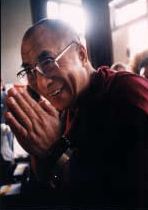
His Holiness, the Dalai Lama - Education and the Human Heart... What is the purpose of life? Of course, I believe that it is happiness. Our culture, our education, our economy, and all other human activities should be meant for that goal. Nothing else. However, although we often assume that certain activities will enable us to achieve that goal, in reality, we are often deceived by our ignorance and shortsightedness. Although everyone wants happiness and everyone is trying to achieve that goal, ignorance and shortsightedness sometimes lead us to a wrong method that ultimately causes pain and suffering both for others and oneself. Therefore, in order to eliminate ignorance, education, no doubt, becomes very important. But even as education is very helpful, I think a good heart, a warm heart, can expel the shortsightedness. If one looks at a very limited area, and says "I'm in here" and does not bother with the conse- quences of one's actions in a larger arena, that is very often where problems begin. By keeping the larger community in mind, we can eliminate the problems resulting from narrow-mindedness or short-sightedness or extreme selfishness, none of which help a person or a community achieve the goal of happiness. When you think along these lines, you will come to realize that what we call love and compassion is not necessarily a religious matter. They are basic necessities of life not only for society but also for the individual. A thousand years ago on the European continent separate education-al institutions began to arise. The Church and monasteries had a great influence on society. At that time, they (those in the Church) took the responsibility to look after "a good heart" or to develop compassion and other related human val-ues. Then, the separate educational institutions simply concentrated on the knowledge side, on intellectual develop-ment. Consequently, at that time, the responsibility carried by each of the two types of institutions was insufficient. As time went on, the influence of religious insight was reduced and more and more people took less and less interest about religious traditions and religious values. As a result, society gradually lost the realization of the importance of love and compassion and a sense of forgiveness. These things were neglected. Then, because of this and also the development of science and technology, people began to develop an attitude of increased expectation that all problems could be solved through technology. This attitude became one factor which contributed to the neglect of, and negligence about, inner values. Today, society, despite its material development and wealth of material facilities, is facing many profound prob-lems. Actually, these problems are often man-made. Clearly, there is something lacking. Of course, our educational fa-cilities are very good and also, generally speaking, the educational standards are good and the standard of living. There are some pockets of people who are materially content but inwardly longing. We can imagine that if someone were to come from, say, a very poor, underdeveloped country and he were thrown into a material affluent society like the Unit-ed States, he might actually feel puzzled. They would see a lot of material affluence and very good educational facilities and almost all of the comforts one could want. They would also find many people who are still unhappy. They would think to themselves, "Why are people still unhappy?" They actually would be puzzled. In the 1960s, about 1,000 Ti-betans immigrated to Switzerland. At the time they began to settle, some people began to say this was the land of SUK-HAVATI, Heaven. They thought that their prayers had been answered to be reborn or born in Heaven. In fact, some of them claimed that they had been able to be reborn in the pure land without having to change lives. But then, eventually, as time went on people got a clearer picture of what was underneath. These people now say that they intended to return to India, saying, "Oh, this is a nice place for making money, but not a nice place to die." I use this as an example. Ma-terial comfort alone is not sufficient. You need another identity and different human values; these are very important.
From my rough impression of the Western educational system, although it is very impressive to see the high standard of the intellectual facilities and also many other resources, and the perfection of many other aspects of intellectual de-velopment, one thing that is becoming quite apparent is that the dimension of enhancing and developing the heart is lacking. The question is, how to promote these different human values. It is necessary to make clear when we try to promote a sense of caring or compassion, forgiveness and loving kindness, that these are values carried by all the major religions of the world. It is, therefore, necessary to understand that as we promote these different human values, we are not speaking about the promotion of a specific religious belief. I believe religious faith is a matter of individual freedom. Whether you have a religion or not, it is an individual right, an individual choice. When one tries to promote a religion, it is very complicated. If say, you believe in the Buddhist perspective and propagate Buddhism, then other beliefs (those of other religious faiths) may not feel comfortable. There then arises a conflict of religious faith. In Mongolia, some Christian missionaries have started to work there and the result has not been very comfortable. When I give a lecture on Buddhism in a Western country or Christian or Judeo-Christian country, I usually feel very reluctant. I believe that it is much better to follow or to keep your own religious tradition. It is much safer. If you change your religion due to some immediate factor or for some immediate causes or conditions, you might find more confusion. That is not good. In order to respect and in order to promote these different human values for all people, the use of particular religious faiths is not very appropriate. So what is the other option? I think the best thing is to develop secular ethics. Simply make clear the human values of a warm heart, a sense of caring for one another. Basic to human nature is that we are social animals. We can't survive as single persons without the company of others. We cannot survive without them. Al-though when we find ourselves in the company of even a small group like two or three people, we end up often quarrel-ing and disagreeing, the fundamental fact of our existence is that we need these individuals who are objects of our com-plaints, quarrels, and disagreements. These individuals are necessary for our being; they are indispensable. Then, of course, modern medical science has recognized that peace of mind is a crucial factor in good health. The most important source of inner peace is an open mind and a good heart. There is no question about this. A compassionate attitude, an affectionate attitude, a sense of caring is not only of benefit to society, but for oneself. Each individual will recognize an immense benefit. On the other hand, hatred and ill-feeling not only creates pain for others, but also causes oneself to suffer. If we carry ill-feeling or hatred or jealousy in our minds or hearts, these create discomforts. We lose sleep and need to rely more and more on tranquilizers, sleeping pills, and things like alcohol or drugs. If one has lost the inner ability to sustain peace of mind, happiness, or joyfulness in life irrespective of external facility, then people usually seek refuge in alcohol or drugs or things like that. These are literally very limited remedies so that once one becomes stuck within their limitations, one has few options available. It is a mistake to rely too much on external means and to com-pletely neglect our inner life, our inner ability, our inner resources. Negative emotions are very harmful for one's self, one's body, and one's mental well-being. They will destroy or spoil all the chances for our future. On the other hand, an open heart, a warm heart, will bring more smiles, more reliable friends, and in that way a great fortune in life. If you have devoted your life to some meaningful activities motivated by a sense of caring, I think that when the last moment of your life comes, you will not have any regrets. "Now I am dying. My life is now ending here, but I have no regrets. During my lifetime, I have made every sort of activity purposeful and engaged in meaningful activities." But if my life has been spent under the influence of hatred, anger, jealousy, greed, and discontentment with the main effort being to acquire money with no hesitation to utilize mischievous methods to that end, then at that moment when dying comes, what is the use of that money? I think, at that moment one will feel great regret. Great remorse. When you look at your neighbor, one who may be poor, but in a home that is full of human feeling, full of human warmth, full of human affection, then you will see smiles on the faces of their children. Their education is good, the relationship between the parents and the relationship between the parents and children also is good. That family, although not rich, is very hap-py. Another neighbor might own a big car and occasionally hold a big party with many important persons coming in fine dress. But inside, the day is full of hatred, full of competition, full of fear, doubt, and jealousy. That family, in spite of all the fascinating possessions and good fortune, is not a happy family. Nor is the person himself or herself a happy per-son. Judging from this reality, we can conclude that our inner peace is something that is really priceless, really precious. You cannot go to a doctor to ask for a pill to give you compassion. No. You can't go to a supermarket and buy it with a big check. I think that we can explain to our brothers and sisters, especially those who are young children, that there is some secret that we have, whether educated or uneducated, or rich or poor, or this race or that race, or this culture or that culture. We are human beings. We have great potential and we can try to promote in them basic human values that I call secular ethics. Though we cannot force others to be warm hearted, we must be warm-hearted persons. It is difficult to explain, but we can say that everyone wants happiness and a successful life. Of these things there is no ques-tion. It is important to make clear what is the most basic and effective means to achieve a happy life and a successful life. I think that the most practical way is to open the mind to the awareness of the importance of our own inner poten-tials. Then people of religious faith may live according to their chosen religion. Basically, religions may be divided into two groups. One group, including Judaism, Christianity, Islam, and some ancient Indian traditions, I call God religions. Their fundamental faith is in a Creator. The other group of religious tradition, including Jainism, Buddhism, I usually call godless religions. They do not believe in a Creator. But, of course, God is a sense of infinite love. The religions are not so different in this understanding. But God in the sense of Creator, something absolute, that is difficult to accept. According to some, godless religion is more effective; according to others, God religions are more effective. The position is individual; it is a matter of choice. Once one accepts the religious faith or value, it is not sufficient just to claim one-self to be a Buddhist, a Christian or a Muslim or a Jew. Once one accepts religion, you should implement it sincerely 24 hours a day so that religious practice and religious faith are part of your life. Sometimes we treat religion as something like medicine. We need medicine when pain or illness comes. When there is no pain, we need no medicines. So also, when we experience negative emotions or see a storm coming our way, in that moment there must be religion. When things are okay, we may say a mantra or some meditation or meditate on patience. If someone uses a harsh word and one completely forgets about meditation or tolerance or simply argues, one is not a religious practitioner. So, when we begin to implement these things seriously, we should keep our focus on the transformation of our minds. This is not easy and will take time. Right from the beginning, we need a long-term plan. We should not expect that we can use a few days or a few weeks to complete the transformation. That's wrong. That's unrealistic. It requires constant effort and determination. Through mental training or training of the mind with constant effort, transformation, positive transfor-mation, certainly will take place. |