| Shakyamuni and Meditation - According to primitive Buddhist sutras, Shakyamuni participated with his father and the kingdom's ministers in an agricultural ceremony of the Shakya tribe while still a young prince. To his horror he watched small birds peck out and eat insects turned up by the plow, only to fall victim themselves to larger birds of prey. The prince began reflecting on the deplorable state of affairs in which living creatures must kill and eat one an-other to survive, and soon the reflection grew into a profound meditation. He attained the first of the dhyana stages of the form realm and passed from one to the next, achieving the highest stage, which was marked by a miracle: his body began to glow with a bright light that eliminated the shadows normally cast by trees and other objects. His father and the ministers were astonished. If this is a historical fact, it shows that Shakyamuni was not only naturally inclined to meditation but also so highly skilled in its techniques that he was able to achieve advanced stages of meditation without any instruction while still a boy. After Shakyamuni abandoned secular life for religious pursuits, he studied under two of the most outstanding mentors in meditation techniques in the northeast Indian kingdom of Magadha. One of them, Alara-Kalama, believed that the meditation of nothingness is the highest possible state. In the meditation of nothing-ness the meditator is conscious of nothing. The other master, Uddaka-Ramaputta, believed that the state in which nei-ther perception nor non-perception persists constitutes Nirvana. Both men had large followings of enthusiastic disciples. Shakyamuni studied first with Alara-Kalama and, because of his already advanced skills in meditation, soon attained the same state of concentration as his master. Still, his doubts were not removed. He found no solution to the problems of the human condition and was unable to attain absolute tranquility. Alara-Kalama requested that Shakyamuni help him in his teaching, but Shakyamuni left and began studying with Uddaka-Ramaputta. Before long, he again attained the same state of meditative concentration as his teacher. Uddaka-Ramaputta freely recognized his disciple's achieve-ment, but the attainment did not satisfy Shakyamuni. He refused a request to guide the disciples of Uddaka-Ramaputta - who offered to step down in his favor - and left that group, too. Not even the highest states of meditation, the medita-tion of nothingness and the state where neither perception nor non-perception persists, were the supreme Enlighten-ment he sought. At that time, the sixty-two heterodox schools of thought that prevailed in India postulated five ways of attaining Nirvana in this world through various states of meditation. But Shakyamuni had already experienced the highest of them and seen that they did not lead to the ideal realm or offer answers to the problems of human existence. He abandoned meditation for ascetic practices, which he hoped would help him reach his goal. Six years of asceticism in the forests failed to reveal the answers he sought, however, and he abandoned that, too - though he nearly died before doing so. Finally, after sitting in meditation under a bo tree, he reached supreme Enlightenment and became the Bud-dha. It is said that Shakyamuni was Enlightened while in the fourth dhyana of the form realm, a stage of meditation marked by equanimity, pure mindfulness, and wisdom, and in which neither joy nor sorrow, bliss nor suffering, is ex-perienced. He remained in this state for a week following his Enlightenment. According to primitive sutras, during the forty-five years of his subsequent teaching mission he engaged in seated meditation daily, sometimes remaining in dhyana for a week, two weeks, a month, or even two or three months. His disciples meditated daily, too. The Buddha is said to have died while in the fourth dhyana of the form realm. In Shakyamuni's time, a good part of each monk's day was taken up by meditation. Each twenty-four-hour period was divided into six watches of four hours each. The first of |
 |
| Page 21 |
 |
| Overcoming the past can release a lifetime of love. No matter how deep our emotional pain from childhood, our course must be the same: to find love within ourselves by directing our energies toward emotional and spiritual growth. Learn to let go. That is the key to happiness. Buddha If you are poor, live wisely. If you are rich, live wisely. It is not your station in life but your heart that brings happiness. Buddha Joy and openness come from our own contented heart. Buddha Neither fire, nor wind, birth nor death can erase our good deeds. Buddha Simply be aware of the oneness of things. Lao-Tzu |
| There is too much emphasis on what is minor and not on what is essential. And what is essential involves being able to transform the individual from within. The Dalai Lama Let us, then, be up and doing, with a heart for any fate; still achieving, still pursuing. Learn to labor and to wait. Henry Wadsworth Longfellow When we step back from perfection, we step toward humanity. Anon It is all a frame of mind, this enjoyment of living. Lin Yutang One ought, every day at least, to hear a little song, read a good poem, see a fine painting, and, if it were possible, to speak a few reasonable words. Johann Wolfgang van Goethe It is a poor thing for anyone to fear that which is inevitable. Tertullian Cherish that which is within you. Chuang Tzu |
 |
 |
 |
| should spend their time in two ways: discussion of the Law and holy silence. By the latter he meant meditation, which was so perfectly ordinary an act not only for Buddhists but also for most Indians of the time that no ancient Buddhist texts explain how seated and walking dhyana are to be conducted. Everyone knew, so there was no need to explain. The lack of instruction in no way diminishes the great importance Buddhism placed on meditation at this time. In Mahayana scriptures, for example, the Buddha is consistently said to have started teaching only after having emerged from a state of deep meditation. We have already seen that Buddhist meditation came after the yoga regimen of self-discipline wide-ly accepted in India in Shakyamuni's time. Some Western scholars claim that Buddhism has no distinctive original ele-ments but is an amalgam of elements taken from the Hindu Samkhya philosophy, represented by the theory and prac-tice of yoga set forth in the Upanishads. They claim that Alara-Kalama and Uddaka-Ramaputta were Samkhya philoso-phers. Buddhism undeniably incorporated influences from the Samkhya and yoga of the later Upanishads, and the idea of the four stages of dhyana in the form and formless realms is found in teachings predating Buddhism. But this does not mean that Buddhist meditation is no more than a combination of traditional practices borrowed from non-Buddhist religions. |
| the three watches of the night was spent in seated meditation and periods of walking to relieve fatigue. Only during the second watch did the monks lie down to sleep. In the third and final watch, they rose to meditate further in a seated position. The first division of the day was spent looking after personal hygiene and monastic chores, followed by seated meditation. At a suitable hour, the monks went out into the surrounding neighborhood to beg for food. During the second part of the day, after returning from begging, they ate their food, consuming it before noon. For a while after their meal they were free to lie in the shade of trees of sit in meditation and allow their food to digest. In the evening they once again meditated, went to hear the Buddha preach, or sat and discussed the Law among themselves. The habit of Chinese Ch'an and Japanese Zen monks of conducting four sessions of seated meditation (one in the first watch of the night, one in the last watch of the night, one in the morning, and one between three and five in the after-noon) springs from the daily regimen of primitive Buddhism. Shakyamuni said that the monks |
|
|
 |
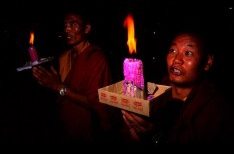
| Buddhist Meditation - Though they resemble one another outwardly, the kinds of meditation generally practiced in ancient India differed from Buddhist meditation in content. If they had not, Shakyamuni would not have rejected the goals of the meditations taught by Alara-Kalama and Uddaka-Ramaputta. He rejected them because they failed to lead to the ideal state he sought. In the Samkhya philosophy, the heterodox sects, and Buddhism alike, meditation is a means of concentrating the mind and entering a state free of thought. But non-Buddhist forms of meditation are inferi-or because they lack the distinctive wisdom of the Buddhist interpretation of the world and humankind. Even within Buddhism, varied uses of meditation are recognized. The Chinese Ch'an teaching classifies five types of meditation ac-cording to increasing degrees of wisdom: non-Buddhist meditation, meditation practiced for physical and mental health, Hinayana meditation, Mahayana meditation, and supreme meditation, or the meditation of the Buddhas. The Abhidhar-ma Storehouse Treatise also categorizes meditation and recognizes its varying content, noting three kinds of medita-tion. The first is meditation still bound by delusion and directed toward some mundane benefit, such as financial reward, honor, or respect. The meditation of non-Buddhists is of this kind. The second is meditation that is temporarily purified of mental obstructions and attachments. The third is meditation by the sage who has eliminated all obstructions. En-lightenment based on the Buddhist view of the world and humankind always belongs to this final category. Whatever the differences in the degree of wisdom it contains, all meditation aims at concentration. Buddhism recognizes many methods of preparing the meditator to achieve the four dhyana stages of the realm of form. The most desirable method is the one that makes concentration easiest for the individual practitioner. The Abhidharma Storehouse Treatise teaches five methods of calming the mind and seeing the truth, and Hinayana Buddhism, based on the Pali scriptures, teaches forty. The first of the methods taught in the Abhidharma Storehouse Treatise is contemplating the vileness of things. This is considered a good method for those of a lustful, lecherous character. Such people are to meditate on the inevitable decay of the human body. The meditator can calm physical appetites by fully realizing that even the most at-tractive, most desired sexual partner will someday rot to bones and dust. When this is truly realized, concentration be-comes possible. The second method is having pity for all beings. It is designed to fill irascible, wrathful people with com- passion, not only for those close and dear but also for strangers and hateful people. When meditators have achieved this, they are able to remain calm and achieve concentration. The third method is instruction in the law of dependent origination. The Twelve-linked Chain of Dependent Origination is taught to foolish people to help them understand how human beings and the world operate. Understanding rids them of attachments and delusions, and they are able to achieve concentration. The fourth method is right discrimination. It teaches that all beings are composed of the five ag-gregates and that physical bodies are made up of thirty-two components (ranging from hair and skin to flesh, organs, and secretions), which in turn are made up of the four elements - earth, water, fire and air. The aim of this method is to reveal to people who cling tenaciously to the idea that they possess a permanent self that nothing in the world is per-manent, since everything is an aggregate of elements subject to inevitable dissolution. Meditation on this truth enables these people to attain mental calm, free themselves of attachment to the self, and achieve concentration. Pali Buddhist texts give forty (sometimes thirty-eight) subjects on which to meditate in preparation for achieving the four dhyana stages of the realm of form. These subjects include both actual physical objects and abstract concepts. Though medita-tors may begin by concentrating on a physical object in front of them, as their powers of concentration grow they dis-pense with the actual object and meditate on a mental image of the object. Here, too, meditators select the object best suited to their own personality and spiritual needs. In conclusion, let us look at the criteria by which the meditator's level of meditation is evaluated. Two scales can be applied: the degree of concentration and the profundity of the wis-dom of the meditation. On the basis of the first scale, the meditator begins with a totally unsettled mind. Practicing a suitable preliminary meditation, the meditator attains a slightly more tranquil state within the realm of desire, from there gaining entrance to the first dhyana of the realm of form. Concentration increases through the remaining three dhyana of the realm of form and then the four dhyana of the formless realm, and finally reaches a peak in the ninth and last stage. When we evaluate meditation on the basis of the wisdom it contains, however, we see that superior wis-dom does not always result from the most profound concentration. Even a meditator who has attained the highest stage of concentration in the formless realm may achieve no more than an ordinary level of meditative wisdom. It is also possible to attain a high state of wisdom while advancing no further in concentration than the desire realm. Obviously, the most advanced meditation is one in which high levels of both concentration and Buddhist wisdom have been rea-lized. |
| A man must keep a little back shop where he can be himself without reserve. In solitude alone can he know true freedom. Michael de Montaigne Things don't give us anything except what we bring to the enjoyment of them. Lin Yutang Giving to others selflessly and anonymously, radiating light throughout the world and illuminating your own darkness, your virtue becomes a sanctuary for yourself and all beings. Lao-Tzu Your real home is in this place, at this time. The present is for action, for doing, for becoming, and for growing. David Viscott He who knows others is wise; he who knows himself is Enlightened. Lao-Tzu |
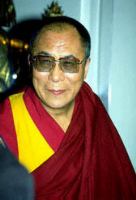
| "The essence of all spiritual life is your emotion, your attitude toward others. Once you have pure and sincere motivation, all the rest follows. You can develop this right attitude toward others on the basis of kindness, love, and respect, and on the clear realization of the oneness of all human beings. "The self-cherishing attitude makes us very uptight; we think we are extremely important, and our basic desire is for ourselves to be happy and for things to go well for us. Yet we don't know how to bring this about. In fact, acting out of self-cherishing can never make us happy. "If you go more deeply into your own spiritual practice, emphasizing wisdom and compassion, you will encounter the suffering of other sentient beings again and again, |
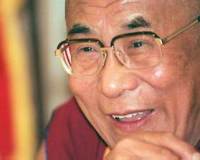
| and you will have the capacity to acknowledge it, respond to it, and feel deep compassion rather than apathy or impotence. When contemplating suffering, do not fall into the feeling of self-importance or conceit. Cultivating wisdom helps us to avoid these pitfalls. But it is hard to generalize because each person's courage and forbearance are unique. "If you know that someone is speaking badly of you behind your back, and if you react to that negativity with a feeling of hurt, then you destroy your own peace of mind. One's pain is one's own creation. One should treat such things as if they are wind behind one's ear. In other words, just brush them aside. Largely, whether or not one suffers pain depends on how one responds to a given situation. What makes a difference is whether one is too sensitive and takes things too seriously. "From one point of view we can say that we have human bodies and are practicing the Buddha's teachings and are thus much better than insects. But from another view we can say that insects are very innocent and free from guile, whereas we often lie and misrepresent ourselves in devious ways in order to achieve our ends or better ourselves. From this perspective, we are much worse than insects, who just go about their business without pretending to be anything. "If you help others with sincere motivation and sincere concern, that will bring you more fortune, more friends, more smiles, and more success. If you forget about others' rights and neglect others' welfare, ultimately you will be very lonely. "Do your best and do it according to your own inner standard (call it conscience), not just according to society's knowledge and judgement of your deeds. 'To do our best' is just a phrase of a few words, but it means that at all times in our everyday life we should check our mind so that we don't feel guilty about our mistakes, even though others don't know about it. If we do that, we are doing our best. "If we examine ourselves every day with mindfulness and mental alertness, checking our thoughts, motivations, and their manifestations in external behavior, a possibility for change and self-improvement can open within us. Although I myself cannot claim with confidence to have made any remarkable progress over the years, my desire and determination to change and improve is always firm. From early morning until I go to bed and in all situations of life, I always try to check my motivation and be mindful and present in the moment. Personally, I find this to be very helpful in my own life." The Dalai Lama |
|
| Nothing endures but change. Heraclitus A man lives by believing something, not by debating and arguing about many things. Thomas Carlyle If you keep saying that things are going to be bad, you have a chance of being a prophet. Isaac Singer Forgiveness is made easy when we can identify with others and admit to our own imperfections and an equal capacity for wrongdoing. Anon Expect trouble as an inevitable part of life and when it comes, hold your head high, look it squarely in the eye and say, "I will be bigger than you. You cannot defeat me." Anon Most of us are taught from an early age to pay far more attention to signals coming from other people than from within. We are encouraged to ignore our own needs and wants and to concentrate on living up to others' expectations. Nathaniel Brandon Love isn't the problem, we are. Anon On this earth there is no perfect love, only human love. Anon We cannot tell what may happen to us in the strange medley of life. But we can decide what happens in us.. how we can take it, what we can do with it.. and that is what really counts in the end. Joseph Newton There is, in sanest hours, a consciousness, a thought that rises, independent, lifted out from all else, calm, like the stars, shining eternal. This is the thought of identity - yours for you, whoever you are, as mine for me.. creeds, conventions, fall away and become of no account before this simple idea. Walt Whitman I know of no more encouraging fact than the unquestionable ability of man to elevate his life by conscious endeavor. Henry David Thoreau Disclaimer: All articles and/or images retain the original copyrights of their original owners. |
 |
 |
| Last update April 18, 2004 |
 |
 |
| Visit our Main Site. No pop-ups, more information and images. |
 |