 |
| Page 19A |
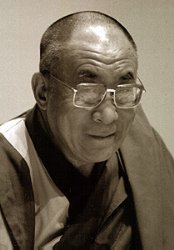 |
| "I think that every human being has an innate sense of "I." We cannot explain why that feeling is there, but it is. Along with it comes a desire for happiness and a wish to overcome suffering. This is quite justified: we have a natural right to achieve as much happiness as possible, and we also have the right to overcome suffering. The whole of human history has developed on the basis of this feeling. In fact it is not limited to human beings; from the Buddhist point of view, even the tiniest insect has this feeling and, according to its capacity, is trying to gain some happiness and avoid unhappy situations." The Dalai Lama |
| "Meditation is a 'familiarization' of the mind with an object of meditation. In terms of how the mind is familiarized with the object, there are many types of meditation. In one type, the mind is generated into the entity of a particular type of consciousness, as in meditating compassion or meditating wisdom. In such meditation you are seeking to generate your own mind into a compassionate consciousness or a wisdom consciousness - compassion and wisdom not being the object on which you are meditating, but that entity into which you are seeking to transform your consciousness through a process of familiarization." |
 |
| Shravasti - Where the Buddha performed Great Miracles When the time came for the contest, the Buddha cast a mango seed on the ground; instantly the seed took root, and a great mango tree arose to shade the hall. After defeating the six philosophers and converting them to his teaching, the Enlightened One performed the Great Miracle of the Pairs. "Standing in the air at the height of a palm tree, flames engulfed the lower part of his body, and five hundred jets of water streamed from the upper part. Then flames leapt from the upper part of his body, and five hundreds jets of water streamed from the lower part. Then by his magic power, the Blessed one transformed himself into a bull with a quivering hump. Appearing in the east, the bull vanished and reappeared in the west. Vanishing in the west, it reap-peared in the north. Vanishing in the north, it reappeared in the south. ... Several thousand kotis of beings, seeing this great miracle, became glad, joyful, and pleased." Mahavastu another of the four places common to the Buddhas of this world is Shravasti, the site regarded as their chief residence and the place where the holders of erroneous doctrines are publicly defeated. Indeed, Shakyamuni spent twenty-five rainy seasons there and also performed many great miracles. When the Buddha accepted in Rajgir the merchant Anathapindika's invitation to spend the second rainy season at Shra-vasti, it was on the condition that proper facilities for all his monks would be available. Anathapindika and Sariputra ex-amined the area and found only the park of Prince Jeta to be suitable for such a large assembly of monks. However, the prince was unwilling to part with it for less than the number of gold coins that would cover the area. Undismayed, the merchant proceeded to cover all the ground with gold coins. When but a small portion remained uncovered, the prince asked him to desist and announced that he himself would build a vihara on the spot, some say using the gold he had re-ceived for the purpose. The merchant also built a vihara, as did King Prasenajit later. These were the principal buildings used by the Buddha on his first visit to Shravasti. The park with its buildings became known as Jetavana Grove. During its most magnificent period, Jetavana had temples, meditation halls, monks' chambers, bathing places, a hospital, pleas-antly shaded tanks and a well-stocked library with reading rooms. It was altogether an ideal place for practising the Buddha's teachings, many of which were first given here. One of the first statues of Shakyamuni originated at Jetava-na. Ordered by King Prasenajit, it was made of hardwood. King Prasenajit placed it at his seat in the vihara. When Shakyamuni next visited Jetavana, the statue came out to meet him. He told it to return to its place, saying that it would serve as a model for others after his passing away. The Jetavana vihara which housed this image was once an elaborate seven-storied building. It eventually burned down but the image survived and a two-storied structure was built in its place. At that time the statue was kept in a brick shrine. Ananda once asked Buddha to allow a tree to be planted at Jetavana because when the Buddha was not present at Jetavana his followers had nowhere to place their offerings of flowers and so forth. Maudgalyayana brought a seed of the bodhi tree and when the tree grew the Buddha is said to have blessed it by spending one night meditating under it. This is now known as the Ananda bodhi tree. Pilgrims mention a number of stupas in the park commemorating various events. One marked the occasion when the Buddha found a sick monk unattended and languishing in his own filth. Shakyamuni bathed and nursed the monk himself and exhorted the other monks to care for each other similarly in the future. Another stupa marked the spot where some non-buddhists, wanting to defame the Buddha, murdered a woman and left her body behind the monastery. Others marked the places where Shakyamuni walked and sat. When Ashoka visited Jetavana he erected a great pillar on either side of the east-ern gate, the left surmounted by a wheel and the right by an ox. Near the monastery and beside the well used by the Buddha, he built a stupa enshrining a relic. It is taught that this was one of the mahavihara's most flourishing periods, after which it was somewhat neglected. However, archaeological evidence has shown a revival during the Kushan period of the first century and much reconstruction. Later, during the Gupta period, even when brahmanism was once again ascendent, Jetavana received new support. Many of the present ruins show the styles and ornaments of the Guptas. Fa Hien found decay evident but was welcomed by resident monks, who were astonished to see a brother from the land of Han. Two centuries later Hsuan Chwang found the place deserted, but soon after his visit another revival occurred, as evidenced by the traces and images from the eighth and ninth centuries that remain. As in other places, the monastic tradition persisted here well into the twelfth century, when the muslim invasions became overpowering. Records show that Vidhyadhara, a minister to King Madanapala of Kanouj, built a vihara in 1119. An inscribed copper plate dated at |
| schools had challenged the Buddha to a contest of miraculous powers many times as he wandered through the surround-ing kingdoms. Finally, in his fifty-seventh year he accepted at Shravasti. King Prasenajit built a hall especially for the event; in it seven thrones were erected. On the first day of spring, the six other teachers took their seats and Shakya-muni came to his, flying through the air. He sent forth fire and water from his body and the hall was destroyed, then reformed as a transparent palace. Planting his tooth-pick in the ground, he caused a great tree to spring up, fragrant and fully laden with flowers and ripe fruit. He multiplied his body infinitely, filling all space with Buddhas expounding the Dharma. These and many other miracles he performed and in eight days utterly defeated his opponents, whose fol-lowers adopted the Buddhist doctrines. For a further seven days he continued to show miracles and give teachings to the great assembly. Pilgrims describe a tall temple containing a statue of Buddha, which stood outside Jetavana Grove in commemoration of these events. Nearby is the place where Devadatta, failing in his attempt to scratch the Buddha with poisoned nails, finally went down to hell. Further south were various places associated with King Vaidraba, successor to Prasenajit, who destroyed Kapilavastu and killed many of the Shakyas within the Buddha's lifetime. The ruins of Shra-vasti were rediscovered in 1863 by General Cunningham near the village of Sahet Market. The city ruins lie virtually untouched and are still enclosed by ramparts. The remains of the monasteries and stupas of Jetavana have been well excavated and the many images and other findings are contained in the Lucknow Museum. A new park has been cre-ated around these ruins with flowers and trees shading the lawns. In this case restoration has regained some of the qualities that made the place attractive of old; peace and tranquility pervade it. Three new Buddhist temples have been built alongside the park, one of which was founded by two Burmese ladies and another by a Ceylonese monk. Both offer accommodation to pilgrims. A fine Tibetan stupa has recently been completed in the courtyard of this latter building. The third temple has a sad story. It was built many years ago through the efforts of a solitary Chinese monk, who, un-fortunately, died before its completion. Now the Chinese temple and a seven-storied pagoda with a number of out-build-ings are empty and locked, pending a legal decision of possession and responsibility. Apart from the intrinsic value of these constructions, it would be a fitting tribute to Fa Hien and Hsuan Chwang if they were to be restored and opened. (One of the eight places of Buddhist pilgrimage.) |
 |
| 1130 found amongst the ruins states that the former king's son Govindacauda made a gift of six villages to Buddhabhattoraka and the monks of Jetavana. The Jetavana Grove was a short distance south of the prosperous city of Shravasti, the capital of Koshala, which stood on the banks of the Achiravati River. Here Prasenajit had his palace, and close to it built a monastery. Nearby was the vihara of Mahaprajapati, who was Shakyamuni's stepmother and the first woman admitted to the Order. A short distance away is a large, ruined stupa marking the place where Angulimala the murderer attained arhantship and where his body was later cremated. Outside the city was a forest where once lived a community of 500 blind men, all of whom regained their sight when the Buddha came and preached to them. Apart from these associations, Shravasti is best remembered as the place where Shakyamuni de-feated the holders of other doctrines. Some accounts say this was accomplished by debate, others by miracles; perhaps there were both. The leaders of India's six main philosophical |
 |
 |
|
| Dalai Lama offers compromise over Tibet (22/05/2002)... The Dalai Lama says he's prepared to accept autonomy instead of full independence for Tibet, only if it includes ALL Tibetan territory prior to Chinese occupation. At present, he says, it includes only two-thirds of Tibet. He also says the mass relocation of Han Chinese to Tibet, restrictions on the study of Tibetan Buddism and a China-Tibet rail link, are threatening his country's cultural survival. DALAI LAMA: The formal contact is no longer there. Actually, since 1993, (there's been) no sort of formal contact, but some informal channels. Now at the moment, there is some contact, but no meaningful sort of dialogue. Not yet. So it seems I think some Chinese government leaders, have the feeling the better to have talk with Dalai Lama, outside Ti-bet. But some are reluctant. But basically I feel that China is changing. Now the leadership also now changing. Of course although the leadership has different sort of views from the public or from the intellectual people, but certainly the intellectual sort of views eventually I think will be reflected in the regime's mind. This is my feeling. So Chinese intellectuals and some writers, some artists, now begin to realise the Tibetan culture is something good, something worthwhile to preserve and even some Chinese are very eager to learn and eager to follow the Tibetan Buddhism. And then, among the intellectuals there are more signs who possibly realise in past that the government attitude towards Tibet is not as good as Chinese propaganda says! So these things certainly I think are positive signs. QUESTION: And you said there are informal negotiations. What sort of level and at what sort of delegates are you sending? DALAI LAMA: Now at the moment, no officials. Sometime back, I think '98, we eventually developed contact with some semi-officials, but that somehow stopped. And very recently [we entered a] new phase. Some Chinese business-men, some intellectuals are now showing some movement. QUESTION: So are they coming to meet with you in exile in India or are you sending representatives to meet with them in China? DALAI LAMA: Mainly my representative meet in some different places. Not in China, not recently. QUESTION: And you have dropped your initial call for Tibetan independence, what is your current desire for your homeland, cultural autonomy? I know there's been a five point plan which lists demilitarisation, caring for the environ-ment, human rights, what is your current desire? |
| DALAI LAMA: Now in early 1950, after some different attempts we finally dealt with the Chi-nese government directly, then the seven point agreement which was signed - although it was not like a general agreement, I mean [it was] signed under duress. Since then I feel our basic approach is dialogue. Then in 1959, of course things completely changed, over the next 20 years there was no serious sort of thing about how to deal with China, because you see China [was going through] the Cultural Revolution and in (exile in) India our main effort is resettlement, especially education - things like that. Then 1973, we begin to think how to deal with China. Our basic approach is dialogue. So the question of independence is out of the question. So we considered a middle approach, autonomy, general autonomy [which would] also include the oth-er Tibetan territory. Actually the Chinese constitution provided some form of autonomy; be-cause they said officially they recognise these are Tibetan ethnic area. At the beginning I (was-not) talking independence or autonomy during those years I just used to talk the maximum |
| happiness, maximum benefit to local people. The meaning was autonomy. [In the last] few decades, [there has been] to my way of thinking no change. I am still fully committed to the middle road approach, in spite of some sort of failure to materialise some meaningful dialogue, but still I am fully committed [to a middle approach]. QUESTION: So the fact that some of those regions are not included in the current autonomy area is a problem. Which reasons are they, would they be for example where you were born, Amdo, and which other areas are not included that would need to be? DALAI LAMA: Generally, the Tibetan population is around six million, the entire population. But in the so-called auto-nomy region of Tibet, the population is around two million. So that means the rest, about four million, are in the other four Chinese provinces - that means Yunnan, Sichuan Province, Gansu Province and Qinghai Province. So actually the Tibetan population is bigger outside the Tibet autonomous region. The whole of Tibet should have genuine autonomy as one sort of entity. Even one party member, a sincere Communist Party member, has the same view. My approach is genuine autonomy to cover all Tibetan territory and Tibetan ethnic groups area. You see I receive many supportive messages, [including] written messages. Since I'm not seeking separation, within the People's Republic of China boun-daries can (be) changed easily. Then other hand, our top most concern is preservation of Tibetan culture, Tibetan spi-rituality and Tibetan environment. So Tibetan spirituality and culture is also facing a similar threat in the areas outside the autonomous region. In some cases, it's even worse. Therefore they are also very much concerned about the preser-vation of Tibetan culture, environment and religous belief. Therefore it is much better you see to have one body for the whole Tibetan area and that give genuine satisfaction to Tibetan masses. Result, genuine unity, genuine stability - which the Chinese government is most concerned [about]. Unfortunately, up to now, they are mostly concerned about stability and unity [which they have tried] to achieve under gun. That's a very short-term temporary, short sighted pol-icy isn't it? Actually this is a very much counterproductive. QUESTION: And what about the conditions for your own return. Is there any progress in that area? What is your thinking in that area? DALAI LAMA: The question of my return is related with the basic Tibet situation. If the basis of the situation im-proves, if the Chinese government is ready to look at the Tibetan issue and then of course it's the time for my return. I can make some contribution. But I already made very clear now I'm getting older and the younger generation should take more responsibility. Therefore even we outside Tibet, we already have our political leadership through election. We have elected political leadership. It's already there. So now that there is an elected leadership there, my responsibility now becoming less. So now this is very appropriate, I'm now getting older and now [it is] time for preparation for next life. QUESTION: But as the leading role you have played, why do you believe that the talks foundered and have in fact al-most stopped? Where does the blame lie, the international community, United Nations with China's intransience, where does the problem lie? We've seen other smaller countries like East Timor for example get their independence, why not Tibet? DALAI LAMA: Of course there are so many I think factors, so many... QUESTIONS: But perhaps the most important? DALAI LAMA: But one I feel is fear and also ignorance on the Chinese side and I think that today they already make a lot of mistakes in the past 50 years, particularly the last 40 years, a lot of mistakes. So therefore they find it very dif-ficult to change that and I think actually there are some indication they completely lost faith towards Tibet. And simi-larly on the Tibetan side also, even those party members are now very much resentful of the Chinese rule, Chinese leaders, so that's the problem. Now, my feeling is we need political will and some kind of bold decision from the Chinese government side. I think [they have a] wrong policy without knowing the proper condition and also I think some poli-cies are based on their own propaganda. Den Xiaoping's slogan, "Seeking truth from fact" that's very correct. That's very scientific. But the fact must be genuine fact. What they are doing is seeking truth from false facts. This is diffi-cult. In China proper, in the economy, the amount of production estimates are always exaggerated as you know. So therefore you see the fact is not a genuine fact, just artificially made, and then some kind of policy is made according to that fact. So that I think it is a disaster. Now for example, one small example, in 1954 I went to China. At that time Tibetan people - the intellectuals [were] supporters of my decision to visit to China, but the masses were very much against. But Chinese newspapers in China presented the Tibetan masses [as being] very happy at the Dalai Lama's visit to China. This always happen. That's I think very unfortunate. QUESTION: Do you think the fear is based on religion? We've seen the persecution of say Christian, unauthorised Christian groups and Falungong (members). How much do you identify with persecution on that level or is it more of a territorial-nationhood issue for example as we've seen with Taiwan and some of the Western states of China? What's that fear really based on do you think? DALAI LAMA: I think both. After all you see in a few years ago they said that one Chinese local leader in Tibet - their party member - publicly mentioned the ultimate source of threat of separation is Tibetan culture, Tibetan Buddhism. After all Tibetans, we have our own culture, heritage and long history. Now we need some kind of open or broad policy and for the two different cultures and peoples - for the common interest - to come together, live together, work togeth-er. Now that is what we need. I think in the early '50's under the leadership of Chairman Mao, when I met him person-ally you see he clearly indicated he recognised the Tibet as a separate identity. And then you see they, the Chinese Cen-tral Government, formally or publicly considered Tibet case as something very unique, something very special. In 1956 Chou En Lai came to India. He also mentioned to the Indian Prime Minister, Jawaharlal Nehru, that the Chinese gov-ernment considered the Tibetan case as something very unique, something special. Now today, really unique means poorest, suppressed - that is now unique this thing of Tibet now today. |
| It seem [that in the] autonomous region [there are] more restrictions. The main thing is I feel the main thing is the overall population now like Lhasa, the Tibetan has become a minority. The majority of the population are Chinese, so their lifestyle is now changing, including food habit and the mentality also now changing. Less and less are singing Ti-betan songs but more and more Chinese [songs]. And the young Tibetan are compelled to speak Chinese rather than Tibetan. So there's overall - whether intentionally or unintentionally - some kind of culture genocide is taking place. This is serious. Now the railway link. The one Tibetan fear is if this is used properly, then [it's] good. Easier communica-tion, it helps economy in other fields. But if you see this as a easier communication used for different purpose then this is a very, very serious matter. You may see millions of Chinese come to Tibet and settle and the damage for environ-ment will be very serious. So those are I feel in the long run the most serious threats to the traditional Tibetan culture. Disclaimer: All images and/or articles retain the original copyrights of their original owners. |
| QUESTION: And of that the fears about the cultural denegration of Tibetan culture. What's the most worrying aspect? We've got say 260 political prisoners, physical changes being made in Lhasa and you mentioned also out in the countryside. What's the most wor-rying aspect of that cultural denegration at the moment? DALAI LAMA: Tibetan studies. [There have been] some restrictions now for the last I think two decades, you've seen little sometimes a little leniency about Tibetn studies and sometimes you see more restrictions. Nowadays, I've heard in some areas the study of Ti-betan is growing, so that's a positive sign. But in some areas, there are more restrictions. |
 |
 |
 |
 |
| December 25, 2003 |
 |
| Visit our main Buddhism site. More information, images, and, NO pop-ups! (click on flag) |