 |
| Page 19 |
 |
| have gone so far as to call it the world's only "atheist" or "agnostic" religion; certainly the Buddha never promised a man rewards in any afterlife. There are few observances and the teaching is loosely knit, for there is no central Bud-dhist authority. Each Buddhist church or temple is independent - joined together only by a common adherence to the "Four Words" and the Noble Eightfold Path. And even these are not final authorities, for they serve the Buddhist only as guides. The factor which caused Buddhism to grow so greatly since the Buddha's death is, perhaps more than any other, the vitality of the Buddhist Sangha. Unique among other religious teachings, it was established directly by the Founder himself, in that He himself collected thousands of monks and nuns about Him, giving them a mission: to preach. not to convert, but just to preach! Again, Buddhism's 2,500 years show us no evidence of anyone ever having been converted forcibly or in any way against their will. Always the monks seem to have followed the Buddha's injunc-tion to speak "moderately and full of sense;" those who rejected the Dharma, went on their way with a blessing from the monk who had tried to teach them, for the Buddha emphasized that no man may stand in another's way towards his own salvation. And so Buddhism "converted" only those who welcomed it; in a sense, each individual has had to make his own personal decision regarding the Dharma, after a personal evaluation of its central message. And because noth-ing in the teaching must be taken on faith, that which is accepted by the individual Buddhist is reasonable to his mind and thus commands his allegiance. During a visit to Kapilavastu (His home), the Buddha had His first meeting in years with Yasodhara. As soon as she saw him, she recognized Him no longer as her "husband," but as a truly different being now - a Saint. He had been trans-formed. This she saw clearly, it is said, because of her own great piety. She called Rahula, their son, who now was a sturdy young lad, and told him to go to his father and "ask for your inheritance." The boy approached his father and made that request. The Buddha let His gaze linger on his son for a while, then turned to His chief disciple and said, "Accept the boy into the Order!" It was a spiritual inheritance the father was giving to His son, a gift He knew to be far greater than mere wealth or princely position. "What now," asks the Buddha, "is Right Concentration?" - the eighth and highest step on the Noble Eightfold Path. Fixation of the mind on a single object ("one-pointedness of mind") is concentration. The following, the Buddha said, are the objects of concentration or meditation: they are called the Four Fundamentals of Attentiveness and were men-tioned as attentiveness to (a) body; (b) feeling; (c) mind, and (d) phenomena. The requisites for concentration or medi-tation are the four great efforts again, the effort to avoid, the effort to overcome, the effort to develop, and the effort to maintain. How does one develop concentration or meditation? The Buddha says that meditation is developed by prac-ticing, developing, and cultivating these four great efforts. Now the Buddha described the inner states achieved by the disciple who meditates rightly. He describes them, of course, with authority, for He has experienced them all. First, there is rapture and happiness, born of detachment, and accompanied by verbal thought and rumination (pondering). This state is achieved by the disciple who is detached from sensual objects and from demeritorious things. In this first state, a disciple is free of the Five Hindrances (lust, anger, torpor and drowsiness, restlessness and mental worry, and doubts. These are truly hindrances along man's path to peace and wisdom); what are present are verbal thought, rumin-ation, rapture, happiness, and concentration. In the second state, even verbal thoughts and rumination fade away, sub-side; the mind becomes tranquil and has achieved "oneness;" the disciple is filled with the rapture and happiness born of concentration. In the third state, even rapture fades away and the disciple dwells in equanimity, is attentive, clearly conscious, and experiences a happiness born of equanimity and an attentive mind. "And further," adds the Buddha, "after the giving up of pleasure and pain, and through the disappearance of previous joy and grief, he enters into a state beyond pleasure and pain which is purified by equanimity and attentiveness. "This," the Buddha concluded, "is the Middle Path which makes one both to see and to know, and which leads to peace, to discernment, to Enlightenment, to Nirvana. And, following upon this path, you will put an end to suffering." |
 |
| The Western student must understand that |
| the Buddhist does not take a solemn oath, when he undertakes to renounce attach-ment to a particular demeritorious way of conduct. Such an undertaking "is not a vow to God or any other Being, but a solemn undertaking to oneself." Nor is it even an |
| undertaking "never to kill or lie as the case may be, but a vow to train oneself to diminish one's attachment to the error specified. For Buddhism is at all times a reasonable Middle Way, and all that a man may usefully undertake is to wean himself with diligence from the ways of darkness (personal desire) and to set himself in the Way of Light." Buddhism is essentially an ethic; some |
| To those who bemoaned His passing, the Buddha emphasized again, "How could it be otherwise? Have I not told you that decay is inherent in all component things? His last moments were devoted to re-emphasizing the need to start on the journey now, that there was little time to waste, and that a man who is energetic in his pursuit of this goal shall find it. "Be your own lamps, your own refuge!" He told the assembled monks. "Seek refuge in nothing but yourselves! Hold to the Truth as to the lamp and a refuge and do not look for refuge outside yourselves! A monk becomes his own refuge by constantly watching over his body, feelings, perceptions, mental formations, and states of consciousness in such a way that he overcomes the cravings and depressions of ordinary men, so that he is always strenuous, self-pos-sessed, and collected in mind. Whichever among you does this, either now or after I am dead, if he is anxious to learn, he shall reach the summit." And then, just before closing His eyes, the Buddha looked about Him again. "Decay is in-herent in all component things!" He said. "Work out your salvation with diligence!" Thereafter, He closed His eyes and, it is said, passed through the various stages of consciousness which only the All-Enlightened One can know, ended His last incarnation on earth, and passed from sight. Years later, a Buddhist sage was asked by an Indian king whether the Buddha still existed. "He does, Lord!" the sage replied. "But where?" asked the king. The monk answered that the Lord Buddha has passed to complete Nirvana and could not be pointed out. There was nothing left which could lead to the formation of another being. "What do you mean?" asked the king. "This is an illustration," answered the sage. "Supposing we saw a great fire, could we point out in it an individual flame which had gone out and say it is here or there?" "No," said the king. "For the flame has gone out and its elements cannot be found." "This is just how the Lord Buddha has gone into Nirvana," said the monk. "We can detect Him only in His Teaching, for it was He who taught it." |
 |
 |
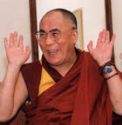
| the principle: It is better not to avoid events or persons who annoy you, who give rise to anger, if your anger is not too strong. But if the encounter is not possible, work on your anger and develop compassion by yourself. "Tranquil or calm abiding is a heightened state of awareness possessing a very single-pointed nature, accompanied by faculties of mental and physical suppleness. Your body and mind become especially flexible, receptive, and serviceable. Special insight is a heightened state of awareness, also accompanied by mental and physical suppleness, in which your faculty of analysis is immensely advanced. Thus, calm abiding is absorptive in nature, whereas special insight is analytic in nature. "Guilt, as experienced in Western culture, is connected with hopelessness and discouragement and is past-oriented. Genuine remorse, however, is a healthy state of mind it is future-oriented, connected with hope, and causes us to act, to change." The Dalai Lama |
| "The mind can and must transform itself. It can get rid of the impurities that contaminate it, and rise to the highest level. We all start off with the same capacities, but some people develop them, and others don't. We get very easily used to the mind's laziness, all the more easily because laziness hides beneath the appearance of activity: we run right and left, we make calculations and phone calls. But these activities engage only the most elementary and coarse levels of the mind. They hid the essential from us. "Look at one person who annoys you, and use the opportunity to counter your own anger and cultivate compassion. But if the annoyance is too powerful - if you find the person so repulsive that you cannot bear to be in his or her presence - it may be better to look for the exit! Here is |
|
 |
 |
|
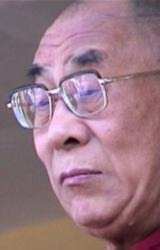
| "Nothing is more important than guarding the mind. Let us constantly keep watch over the wild elephant of the mind, curbing it with mindfulness and vigilance. This is how one can avoid being influenced by different external conditions. But even in re- treat in a very secluded place, if the mind is not kept under control, it will wander all over the place. Even when completely alone, we can have an enormous amount of negative emotions. "We have been and are still going through endless suffering without deriving any benefit whatever from it. Now that we have promised to be good-hearted, we should try not to get angry when others insult us. Being patient might not be easy. It requires considerable concentration. But the result we achieve by enduring these difficulties will be sublime. That is something to be happy about! "Samsara - our conditioned existence in the perpetual cycle of habitual tendencies - and Nirvana - genuine freedom from such an existence - are nothing but different manifestations of a basic continuum. So this continuity of consciousness is always present. This is the meaning of tantra, or continuity." The Dalai Lama You must have the belief that the Universe is a constantly evolving mystery, and that there is a universal flow towards good. |
Nirvana... it's much closer than you think! |
|
 |
 |
| May 15, 2004 |
|
| Gradual Development of the Eightfold Path in the Progress of the Disciple Insight (First Factor) But whatsoever there is of corporeality, feeling, perception, mental formations, or consciousness: all these phenomena he regards as 'impermanent', 'subject to pain.' As infirm, as an ulcer, a thorn, a misery, a burden, an enemy, a distur-bance, as empty and 'void of an Ego;' and turning away from these things, he directs his mind towards the Deathless thus; "This, truly, is Peace, this is the Highest, namely the end of all Karma formations, the forsaking of every sub-stratum of rebirth, the fading away of craving, detachment, extinction, Nirvana. And in this state he reaches the "ces-sation of passions." Confidence and Right Thought (Second Factor) Suppose a householder, or his son, or someone reborn in a good family, hears the law; and after hearing the law he is filled with confidence in the Perfect One. And filled with this confidence, he thinks: "Full of hindrances is household life, a refuse heap; but the homeless life (of a monk) is like the open air. Not easy is it, when one lives at home, to ful-fil in all points the rules of the holy life. How if now I were to cut off hair and beard, put on the yellow robe and go forth from home to the homeless life?" And in a short time, having given up his possessions, great or little, having forsaken a large or small circle of relations, he cuts off hair and beard, puts on the yellow robe, and goes forth from home to the homeless life. Morality (Third, Fourth, Fifth Factor) Having thus left the world, he fulfils the rules of the monks. He avoids the killing of living beings and abstains from it. Without stick or sword, conscientious, full of sympathy, he is desirous of the welfare of all living beings. He avoids stealing, and abstains from taking what is not given to him. Only what is given to him he takes, waiting till it is given; and he lives with a heart honest and pure. He avoids unchastity, living chaste, celibate and aloof from the vulgar prac-tice of sexual intercourse. He avoids lying and abstains from it. He speaks the truth, is devoted to the truth, reliable, worthy of confidence, no deceiver of men. He avoids tale-bearing and abstains from it. What he has heard here, he does not repeat there, so as to cause dissension there; and what he has heard there, he does not repeat here, so as to cause dissension here. Thus he unites those that are divided, and those that are united he encourages; concord gladdens him, he delights and rejoices in concord; and it is concord that he spreads by his words. He avoids harsh language and ab-stains from it. He speaks such words as are gentle, soothing to the ear, loving, such words as go to the heart, and are courteous, friendly, and agreeable to many. He avoids vain talk and abstains from it. He speaks at the right time, in accordance with facts, speaks what is useful, speaks of the law and the discipline; his speech is like a treasure, uttered at the right moment, accompanied by arguments, moderate and full of sense. He takes food only at one time of the day (forenoon), abstains from food in the evening, does not eat at improper times. He leaps aloof from dance, song, music and the visiting of shows; rejects flowers, perfumes, ointment, as well as every kind of adornment and embellishment. High and gorgeous beds he does not use. Gold and silver he does not accept. He does not accept raw corn and flesh, wo-men and girls, male and female slaves, or goats, sheep, fowls, pigs, elephants, cows or horses, or land and goods. He does not go on errands and do the duties of a messenger. He eschews buying and selling things. He has nothing to do with false measures, metals and weights. He avoids the crooked ways of bribery, deception and fraud. He has no part in stabbing, beating, chaining, attacking. Plundering and oppressing. He contents himself with the robe that protects his body, and with the alms bowl by means of which he keeps himself alive. Wherever he goes, he is provided with these two things; just as a winged bird in flying carries his wings along with him. By fulfilling this noble Domain of Morality, he feels in his heart an irreproachable happiness. Control of the Senses (Sixth Factor) Now, in perceiving a form with the eye - a sound with the ear - an odor with the nose - a taste with the tongue - an im-pression with the body - an object with the mind, he cleaves neither to the whole, nor to its details. And he tries to ward off that which should he be unguarded in his senses, might give rise to evil and unwholesome states, to greed and sor-row; he watches over his senses, keeps his senses under control. By practicing this noble 'Control of the Senses' he feels in his heart an unblemished happiness. Mindfulness and Clear Comprehension (Seventh Factor) He is mindful and acts with clear comprehension when going and coming; when looking forward and backward; when bending and stretching his limbs; when wearing his robes and alms-bowl; when eating, drinking, chewing and tasting; when discharging excrement and urine: when walking, standing, sitting, falling asleep and awakening; when speaking and keeping silent. Now being equipped with this lofty 'Morality', equipped with this noble 'Control of the Senses,' and filled with this noble, 'Mindfulness and Clear Compre hension,' he chooses a secluded dwelling in the forest, at the foot of a tree, on a mountain, in a cleft, in a rock cave, on a burial ground, on a wooded table-land, in the open air, or on a heap of straw. Having returned from his alms-round, after the meal, he seats himself with legs crossed, body erect, with mindfulness fixed before him. The Absorptions (Eighth Factor) He has put aside these five 'Hindrances,' the corruptions of the mind which paralyze wisdom. And far from sensual im-pressions, far from evil things, he enters into the Four Absorptions. Absence of the Five Hindrances He has cast away 'Lust;' he dwells with a heart free from lust; from lust he cleanses his heart. He has cast away 'Ill-will;' he dwells with a heart free from ill-will; cherishing love and compassion toward all living beings, he cleanses his heart from ill-will. He has cast away 'Torpor and Sloth;' he dwells free from torpor and sloth; loving the light, with watchful mind, with clear comprehension, he cleanses his mind from torpor and sloth. He has cast away 'Restlessness and Mental Worry;' dwelling with mind undisturbed, with heart full of peace, he cleanses his mind from restlessness and mental worry. He has cast away 'Doubt;' dwelling free from doubt, full of confidence in the good, he cleanses his heart from doubt. |
| shall be' is a vain thought; 'I shall not be' is a vain thought. Vain thoughts are a sickness, an ulcer, and a thorn. But after overcoming all vain thoughts, one is called `'a silent thinker.' And the thinker, the Silent One, does no more arise, no more pass away, no more tremble, no more desire. For there is nothing in him whereby he should arise again. And as he arises no more, how should he grow old again? And as he grows old no more how should he die again? And as he dies no more, how should he tremble? And as he trembles no more, how should he have desire? The True Goal - "Hence, the purpose of the Holy Life does not consist in acquiring alms, honor, or fame, nor in gaining morality, concentration, or the eye of knowledge. That unshakable deliverance of the heart: that, indeed, is the object of the Holy Life, that is its essence, that is its goal. And those, who in the past were Holy and Enlightened Ones, those Blessed Ones also have pointed out to their disciples this self-same goal as has been pointed out by me to my disciples. And those who in the future will be Holy and Enlightened Ones, those Blessed Ones also will point out to their disciples this self-same goal as has been pointed out by me to my disciples. However, disciples, it may be that (after my passing away) you might think: 'Gone is the doctrine of our master. We have no Master more'..But thus you should not think; for the 'Law' (Dharma) and the 'Discipline' which I have taught you, will after my death be your master. The Law be your isle! The Law be your refuge! Look for no other refuge! Therefore, disciples, the doctrines which I taught you af-ter having penetrated them myself, you should well preserve, well guard, so that this Holy life may take its course and continue for ages, for the weal and welfare of the many, as a consolation to the world, for the happiness, weal and wel-fare of heavenly beings and men." |
|
 |
| Nirvana - And his heart becomes free from sensual passion, free from the passion for existence, free from the passion of ignorance, 'Freed am I!' this knowledge arises in the liberated one; and he knows: 'Exhausted is rebirth, fulfilled the Holy Life; what was to be done, has been done; naught remains more for this world to do.' "For ever am I liberated. This is the last time that I am born, no new existence waits for me. This is, indeed, the highest, holiest wisdom: to know that all suffering has passed away. This is, indeed, the highest, holiest peace: appeasement of greed, hatred and delusion." The Silent Thinker- 'I am' is a vain thought; 'This am I' is a vain thought; 'I shall be' is a vain thought; 'I |
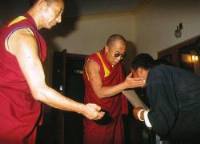
| "During conception, even the physical substance on which the self is conventionally based the egg and sperm belongs to someone else, the parents, still you can say that it belongs to the self also. The body comes from someone else, but as soon as the consciousness enters, it's that new person's body, embryo, fetus, or whatever you want to call it, even though prior to that it wasn't. So the physical constituents of the embryo come from two different people; but as soon as the consciousness enters the mixed cell, that cell now belongs to the consciousness. "Try to develop a deep conviction that the present human body has great potential and that you shall never waste even a single minute of its use. Not taking any essence of this precious human existence, but just wasting it, is almost like taking poison while being fully aware of the consequences of doing so. It is very wrong for people to feel deeply said when they lose some money, yet when they waste the precious moments of their lives, they do not have the slightest feeling of repentance." The Dalai Lama Disclaimer: All images and/or articles retain the original copyrights of their original owners. |
 |
|
|
| We suffer from seeing too much death and not enough life, too much sorrow and not enough joy, too much greed and not enough giving, too much loneliness and not enough love. Anon |
| Visit our main Buddhism site. More information, images, and, NO pop-ups! |
 |