| scuration he appeared from the right side of his mother's ribs. Instantly Indra, King of the Gods, appeared and offered the infant Buddha clothes to wear. The Buddha then took seven steps in each of the four directions and each footprint became a lotus. Then He looked East and said, "From this point on I am the arising of Enlightenment." Looking South he exclaimed, "From this point I will achieve complete knowledge, both ordinary and extraordinary." Then he looked to the West, saying, "From this point I am born to be the cure of suffering and completing this, my last lifetime, I will dissolve." Finally, he looked North and said, "From this point, in my Life I will completely purify all of my karmic ob-scurations." Then the deva realm beings appeared and offered him all auspicious substances. At this time, throughout the entire area of his birth, everyone was witness to the phenomena of clear light free from darkness and shadow. All of the people talked of this phenomena and called on a great Brahmin to give an explanation. He cast an astrology chart and said that in the country of the Shakyas a great Bodhisattva had been born that day. The infant Buddha was named Prince Ton-kun-drup. His father, King of the region, was told that according to his son's astrology chart, the prince was destined to become the greatest of Kings if he stayed home, or upon leaving his home, would become a monk and thus become Enlightened. At this point, it was observed that the palm of the child-prince possessed all the minor marks of perfection. Seven days after the Buddha's birth, his mother passed away and entered the god-realms. Everyone thought that the prince would have problems without a mother, but he proved to be a very calm and peaceful baby. The people of his kingdom called him Shakya-Tug-pa, or Great Courage of the Shakyas. During his youth, the gods and goddesses from the deva realms would often visit him and his father called him the God's god. He was given extensive training by great teachers at a very early age. As the years passed, all of his studies and physical trainings were learned to perfec-tion. When he had grown to a young man, the prince married a young Serkya princess named Sa-Tso. Up to then, the King had protected his son from observing the suffering of everyday life out of love for him. After his son's marriage an astrology chart showed that the prince would either stay and rule as a great King or leave and become a monk. The King decided to create a diversion for his son by planning an outing for him and his new wife. The Prince and his new wife then left the palace with their servants for a day's excursion. it was then that the prince first saw a very old man and then looked at his own body groaned. "This youthful body is pleasing and ripe, but it will change into an aged and de- crepit body. The hair will all turn gray and fall out. The skin will hang loose until only the veins remain between skin and bone. The body will become bent and wrinkled and will need sticks to help it walk. The teeth will rot and fall out and the mouth will drool. Soon it will not be able to hear or see and the mind will become vague and the memory will be gone. This is the impermanence of our body and why it is unreliable. I would rather be a monk in the forest and rely on meditation." Later, while on the outing, the Prince sees a sick person and further illustrates the nature of the body. "My body is flesh and the nature of flesh is to spontaneously gather sickness. This is why my body is not so precious, because it harbors sickness. Why should I trust this body and support it?" Then the prince saw a corpse and the rela-tives were surrounding it and grieving. The prince thinks that the relatives who are grieving are suffering with a de-luded mind. "Nothing is useful or meaningful in Samsara because we are all trapped by Karma. After death the mind is wandering in the bardo. The body becomes inanimate like a log or a stone, a mere piece of earth. Samsara's suffering is like a river. All karma is like a wind blowing the trees and so my life's nature is illusory. Why rely on the illusion of my life? Better I avoid this worldly idea and become a yogi. I will seek the truth." At this, the prince sees a monk wearing robes, carrying a begging bowl, and walking along smoothly. This attracts the prince and he has great joy in seeing this. Upon passing some farmers during this outing the prince is filled with extreme compassion at the burden of work both man and animals have to endure. He gives alms to them. On that day it was very hot as the prince and family made their way back to the palace. They stopped to take a break and rested under the forest trees. When the prince sat down under these trees he entered a meditative state. His father joined him and noticed that his son's shadow and the tree he is under doesn't move as the day wears on. The king was amazed and prostrated to his son. After this they passed a |
 |
| Page 18A |
 |
| A SMALL LIFE STORY OF SHAKYAMUNI BUDDHA... Homage to the living embodiment of Compassion and loving kindness to all beings. You who have worked three incal-culable aeons of time to establish the two merits of accumulation and wisdom. To you who be-come the source of all purelands. To the Buddha Shakyamuni, I prostrate. My faith is a fresh-blooming lotus, reflecting the splendor of the moon's shining rays. The lotus' ten petals close in a heart-felt prostration to you, oh Great Lord of Compassion, as I hold the spontaneous reflection of your wondrous image in the mirror of my mind. I offer you boundless praise and adoration. Even though this effort is less than a single hair on your body, by the offering of these small un-ceasing praises of your life, I ask that you grant your ceaseless blessings. In the Kingdom of the Shakyas lived King Zay-tsang and his wife Gyutrulma, daughter of Bishu-karma. In a previous life Gyutrulma had prayed to be born as the mother to a Buddha. In the deva realm , the Bodhisattva Dampatogkarpo gave his crown to theBbodhisattva Maitreya, in preparation to his descending to earth. He then emanated himself as a white elephant. As his mother, Gyutrulma lay sleeping she had a dream that a white elephant, shining with a glorious light, was within her womb and she flew through the sky and climbed mountains. Many kings and ministers bowed and prostrated to her, It was at that time that the Buddha entered her womb. Ten months later, at Lumbini, the Buddha was born in a miraculous manner. Without womb ob- |
 |
| cemetery with a corpse laying out, the prince thought, "All have to die." Vul-tures and crows were tearing at the corpses eyes. The prince then thought, "All that is born is bound to die, why should I be attached to my body, it is already a corpse and belongs to the animals." When they passed by a beautiful women who was up on the roof of a building the king noticed his son admiring her great beauty and sent for her to come to be the prince's second wife. On the last night of the crucial week after the wedding, the princess Sa-Tso has a ter-rible dream. All her ornaments were torn away, her glory decreased, the sun and moon set and the world was in darkness. At this, she became very upset and woke to tell her husband. He replied to her, "In Samsara, all dreams are unreliable. I had a dream that a great tree grew from my navel and extended throughout the sky. My pillow was Mt. Meru." That night the prince decided to leave the palace. He left his sleeping wife and woke his servant Dunpa to bring him his horse. The servant then brought him his horse Ngagdan which they |
| mounted and flew in a circle around the palace. The prince exclaimed sorrow over those to be left behind. The king placed guardians around the palace to prevent his son from leaving. As the king looked out into the night he thought he was seeing the moon but then realized it was his son escaping and cried out, "How can you leave your kingdom?" The prince gave a teaching to the guardian he encountered upon his departure: "All of ones relatives and friends are like links of a chain. If I don't cut these links, when will I be released from Samsara? My youth will soon age, my wonderful body will be dead. Then having had attachment to these objects, this kingdom, it will have been like drinking poison. Samsara is an unconscious, undisciplined realm. My wealth is like a poisonous snake rapping on my head, it will destroy my virtue. Non-virtue is like a poison, it will bear fruit and send you to a lower realm. It is like jumping into a bonfire. And so, I will choose the great path of Bodhicitta and live in a house of nectar." The prince and his servant then flew away on the horse. All of the palace awoke and plunged into a sorrowful grief. Near Bodha was the Forest of Chod-tan-nam-dak. It was here that the prince landed. He gave his servant his precious ornaments and the horse and sent them back to the palace. He then spoke, "I won't be caught up in the lasso of illusion. I remain alone in the forest with a satisfied mind. Everyone is born alone and will die alone. I renounce this world of form, and so, there is no source to fill this lake of defilement, and it will be dry. I suppress samsara and show the path to Liberation." Then he cut his hair in front of the Chod-tan-nam-dak stupa. Near the Narrajana River he entered into a state meditation. For two years he ate only seven grains of rice a day and one drop of water. The next two years only one grain of rice and one drop of water. Then for two years he took no food or drink. His mother had been reborn into the deva realm and through clairvoyance she saw the suffering of her son and his sorrows. Through her compassion, she appeared before her son. The prince told her not to be depressed because soon he was to be Enlightened at which she became very joyous. To develop his view, the prince gave up his self mortification. Two worthy girls, in fulfillment of a prediction, gave the prince the boiled milk of 500 cows. When he drank this all signs of his mortification disappeared and his body became shiny and golden-yellow. He then went to the mountain to meditate but the mountain bowed low. He felt bad when a voice from the sky said, "You are not bad, you have more merit than anyone and the mountain is too small to hold it. It cannot be contain- ed. You must go to Bodgaya to gain your Enlightenment." On the way to Bodgaya, a woman offered the prince kusha grass, which he used as his cushion at the base of the Bodhi tree. He then meditated there. When the evening came he defeated the four maras who came to distract him from his purpose. At first they frightened him with a vision of de-struction but he didn't move. Then they enticed him with extremely beautiful women but he was not distracted. Finally they shot arrows at him but instead of touching him they turned into flowers. On this same night the princess Sa-tso gave birth to Prince Ton-kun-drup's son, Dra-chand-zin. The baby had been in her womb for six years and the princess was so upset that she swaddled him and threw him into the river. The child did not sink but sat smiling in the seven point posture. After witnessing this the princess happily took him back. At midnight on the same day her husband the prince entered into Samadi. In the early morning he took the great light initiation by self-empowerment and with this clarity and radiant luminosity of light he then attained perfect Enlightenment. May the beings of this smallest of praise raise the foundation of Enlightenment for all beings and in reading this may you gain the confidence and wisdom, courage and strength to pursue your perfect Dharma path. |
 |
 |
| Please help the 20,000+ orphans at the Tibetan Children's Villages. Click above. |
| Tibet's peaceful mountains to enjoy her fresh air, study at her monastic universities, and meditate in her inspiring sol-itudes. I say this not just to complain about our ordeal but because I have noticed that people tend to adopt a sort of fatalism about the history and problem of Tibet; 'Well, it had to happen that way - otherwise Tibetans would not have come out of isolation into the world.' Thinking this way can make them slow to take action to try to improve the real Tibetan situation, to solve the Tibetan problem, the human problem of six million Tibetan human persons. Now, it is a useful practice to reflect on one's own suffering, to think of it as the 'return of one's own karma,' and thus get the ben-efit of cultivating patience with one's difficulties. But it is not useful, nor compassionate, to be patient about the suffer-ings of others. In fact, as Shantideva says, the Bodhisattva should be absolutely intolerant of the sufferings of others, should find them utterly unbearable. To give a personal example, I have said that I myself have actually benefitted from the hardships of losing my homeland and wandering in exile - and I meant it. Not having a sheltered life and hav-ing to suffer and struggle has helped me to grow. Worldly difficulty can lead to faster spiritual growth and greater strength of mind, and I personally am quite content with my lot. I have been given the inspiration to take the Buddha Dharma seriously and the opportunity to work hard to put it into practice. I cannot complain. Yet the plight of my peo-ple, the six million Tibetans who look to me to help them, is different - I cannot forget their cries. How can I pray and recite the Bodhisattva vow to save all beings from suffering and the cause of suffering, and at the same time leave any-thing undone that could actually help these suffering people who are my immediate responsibility? So I am always try-ing to do as much as I can. Perhaps my example can help other Buddhists who want to maintain their spiritual practice and also want to work for the good of society. In the past, scholars have said that Buddhism was single-minded in its focus on Nirvana, giving up the mundane world as a hopeless case. With this preconception, they thought that Buddhism made very little contribution to civilization, letting social problems go their own way. Now, it may be true that Buddhist persons and institutions could have done a better job of helping people in different periods and different countries. But I believe that from the time of Buddha until today all forms of Buddhism have been continuously trying to help people, whether in social groups or individually. It has never been the case that Buddhism did not care about the world. The freedom and happiness of all living beings have always been the ultimate ideal and the working goal. Tibetan civilization is very much a product of the socially transformative power of Buddhism. Brought from India by the great Emperor Songsten Gampo in the 7th century, Buddhist wisdom began its slow but steady work of making the people more gentle, happy and peaceful. After a few centuries, Tibetans had become so fond of the Buddha Dharma that they made great efforts to make it the center of their lives, even without the support of a royal dynasty. Finally, after one thousand years, Tibetans succeeded in expressing Buddhist ideals in the national government itself, established as the integration of the sacred and the secular by the Fifth Dalai Lama in the 17th century. We believed that the Buddha's teaching was the indispensable key to achieving national as well as individual happiness. So our whole social system - our culture, arts and life style - was centered on people's spiritual development according to the Dharma. Though we never achieved perfection, we did preserve many unique teachings and traditions, some of them long lost to other Buddhist countries. But I don't need to say too much about this, as I know many of you have come to realize the preciousness of Tibetan Buddhism, to cherish it just as we do. I have been very moved on this trip because so many people have expressed to |
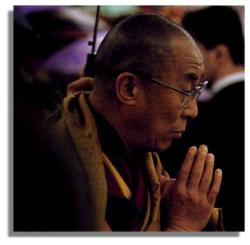
| (Rinchen Dharlo, the representative of H.H. the Dalai Lama in N. America asked to have the following article printed. It is very relevant for Westerners to consider these thoughts carefully and for all of us to do what we can.) ..."I am very happy today to communicate with all of you American Buddhists from [the Tibetan Buddhist Learning Center], the oldest of the Tibetan Buddhist monastic centers in America. It is encouraging to note the present spread of Tibetan Buddhism, some 1000 centers around the world with over 250 in the United States alone. As I often say, Buddhism has a special gift for helping people calm their minds and learn to live more happily. In the midst of what can accurately be called "the Buddhist holocaust" of the 20th century, we Tibetans were forced into exile by the Chinese invasion of our homeland. Since then, we have been privileged to share the gifts of Bud-dhism with fellow beings of other nations, who all must face the countless difficulties of life in our restless, anxious, modern world. Perhaps the only good thing that has come from our tragedy is the spread of the teaching and practice of Tibetan Buddhism. Of course, it would have been much better for everyone if it could have happened without such an unspeakable toll of human suffer-ing. Imagine, Tibetan lamas could have come out to teach in different countries, travelling with their visas stamped on Tibetan passports! Western Dharma students could have freely come into |
| their present course, it will eventually rebound upon themselves in a negative way. But I do not wish to elaborate on this, as I am basically an optimist and still have great hope that sanity will prevail and that good and truth will triumph. You might be surprised, but I think such optimism is quite practical. For, you see, everyone just wants happiness. If we investigate the human heart, not just to follow religious teaching, but to analyze carefully what is really there, we find that what everyone wants, what gives satisfaction, is the warm heart, the good heart, compassion and love. These give calmness, tranquillity, and real contentment; and that gives inner strength. On the other hand, hatred, anger, and greed simply produce uneasiness and always more dissatisfaction. Even nations need to control and minimize anger and hatred; it is the only way they can avoid suffering and bring their people happiness. So nations will eventually do the right thing, because it is in the ultimate best interest of their people. Goodness is finally the most practical, the most realistic solution. Perhaps most of you already know the importance of compassion and love. The practice of compassion is what gives me greatest satisfaction. No matter what the circumstances, no matter what kind of tragedy I am facing, I practice compassion. This gives me inner strength ad happiness. This gives me the feeling that my life is useful. So you see, up to now - I am 57 years of age (1993) going on 58 - I have tried my best to practice these things, and will continue to do so until my last breath, my last day. I myself, you see, am the devoted servent of compassion. That is the way I really feel. We need public support, the active expression of your goodwill towards us. Please keep this in mind, and whenever the occasion arises express your deep sympathy towards the Tibetan cause. As Buddhist practitioners, you should understand the necessity of preserving Tibetan Buddhism. For this the land, the physical country of Tibet, is cru-cial. We have tried our best to preserve the Tibetan traditions outside Tibet for almost thirty years, and we have been comparatively successful. But eventually, after our time, there is a real danger that they will change, that they will not survive away from the protective nurture of our homeland. So, for the sake of preserving Tibetan Buddhism, which can be seen as a complete form of the Buddha Dharma, the sacred land of Tibet is vitally important. It is very unlikely that it can survive as a cultural and spiritual entity if its physical reality is smothered under Chinese occupation. So we cannot avoid taking responsibility in trying to improve its political situation. Clearly, in this light, active support for the Tibetan cause is not just a matter of politics. It is the work of Dharma. We are not against the Chinese; we, in fact, have a deep admiration for the Chinese civilization. We are only trying to gain our rights, to save our people, and to preserve our Buddha Dharma. I dream of a new Tibet - a free land, a zone of peace - where my six million people can restore our spiritual way of life while becoming attuned to the best aspects of the modern world. I see it as a place where all people - not excluding our eastern neighbor - can visit and enjoy the fresh air and brilliant mountain light, can find inspiration in a peaceful, spiritual way of life, and perhaps can learn to understand their own worlds better by getting away for a little while to meditate at our high altitude. With your help we can return there. Now is the time when your action is practice. Thank you very much." (Dalai Lama speech given in 1993) Disclaimer: All images and/or articles retain the original copyrights of their original owners. |
 |
| me, in actions as well as words, their respect, not only for the teachings of Tibetan Buddhism, but also for their source, namely, Tibetan culture and civilization, which itself is ultimately rooted nowhere else than in the living hearts of the Tibetan people. Tibetan culture belongs to all humanity, and its extinction would not just affect Tibetans, but all humanity. We, there-fore, appeal to the members of all other cultures to help the Tibetans preserve our unique and rich cultural heritage. Our friends in the Congress of the United States have acted powerfully to express their support for our cause, urging China to cease her attempts to eliminate the Tibetan race, erase the Tibetan nation from history, and eradicate the Tibetan culture. These senators and representatives will increasingly need your help and the help of all Buddhists, all religious persons, all humanists, and all friends of Tibet, to make an even stronger push to get China to change her attitude. This push is urgent and essential to save our people and culture before it is too late. For China, too, it is an emergency because if her leaders do not change |
 |
 |
 |
| October 26, 2004 |
| Visit our main Buddhism site. More information, images, and, NO pop-ups! |
 |