 |
| Page 20 |
 |
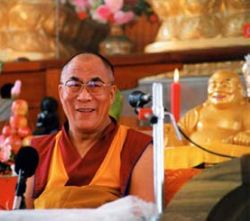
| "The fact remains that the birth cycles of all sentient beings are beginningless, and that countless times in previ- ous lives we have each fulfilled the role of a mother. The feeling of a mother for her child is a classic example of love. For the safety, protection, and welfare of her children, a mother is ready to sacrifice her very life. Recognizing this, children should be grateful to their mothers and express their gratitude by performing virtuous deeds. "One of the characteristics of karmic theory is that there is a definite, commensurate relationship between cause and effect. There is no way that negative actions or unwholesome deeds can result in joy and happiness. Joy and happiness, by definition, are the results of fruits of wholesome actions. So from that point of view, it is possible for us to admire not so much the immediate action, but the real causes of joy. "People who fight with other human beings out of anger, hatred, and strong emotion, even if they gain victory over their enemies in battle, are not in reality true heroes. What they are doing is slaying corpses, because human beings, being transient, will die. Whether or not these enemies die in the battle is another question, but they will die at some point. So, in reality, they are slaying those already destined to die. The true hero is the one who gains victory over hatred and anger. "When we consider that everything we experience results from a complex interplay of causes and conditions, we find that there is no single thing to desire or resent and it is more difficult for the afflictions of attachment and anger to arise. In this way, the view of interdependence makes our minds more relaxed and open." The Dalai Lama |
 |
 |
| dharma was not cruel to the monk; his reticence allowed the monk to ponder his question deeply, and strengthen his determination to awaken. Cutting off his arm was a sign of nonattachment to his body, and demonstrated his commit-ment to the spiritual path. However, this story does not mean we should go around mutilating ourselves to impress our teachers! As with many other Zen stories, we can regard this as a metaphor rather than an actual account. What is im- portant is not whether the story is factually true, but whether we see the truth in it. Buddha compared the expression of anger to picking up hot coals and hurling them at someone. "The only way we can find peace in our own hearts, find the pathway that leads to liberation, is by changing ourselves, not by changing the world." Ayya Khema "The way of the Buddha is to know yourself." Dogen "(In) the West we are seeing the awakening of the Buddha, and the Buddha is smiling very broadly, with the wisdom of Tibet, India, Japan, Thailand, Burma, and America all joined in. We have been given the treasury of Buddhist practice, a cornucopia of compassion and wisdom to nourish and awaken us to our True Nature" Jack Kornfield "... the ultimate aim of Buddhist practice is to engineer mystical experience: to penetrate the great mystery at the heart of life and find the answers to the knotty problems that have perennially engaged the most developed minds of the human race." John Snelling Buddhism is something to practice, to do, not just the usual religious consolations. We can see this from the last Noble Truth, which is a set of guidelines for action. We must make an effort; salvation likes in our own hands but we have to work toward it. Buddha dedicated his life to helping others and did not simply rest content in Nirvana. So thinking of others and seeking that their needs are just as important as our own is also a part of the Buddhist path. When the Bud-dha decided to help other beings because they were suffering, he did not lose the qualities of Enlightenment characteri-zed by Nirvana. How he lived his life was an example to others. Buddha was compassionate and wise but behind these qualities was inner peace. The Dalai Lama says, "If you have inner peace, the external problems do not affect your deep sense of peace and tranquility. In that state of mind you can deal with situations with calmness and reason, while keep-ing your inner happiness." We can find inner peace in our lives by meditating and following the Buddha's guidelines. Buddha's message is timeless and universal, unconditioned by age, culture, or any other factors. It says that for all those with the precious gift of life there is an opportunity to awaken to our Buddha nature. The classic Buddhist texts tell us it often takes many lifetimes to reach this state of awareness but they also say that it is possible in this life, be-cause our essential nature is potential Buddhahood. And in this way, there is nothing to attain, merely to awaken to this potential in the present moment. Our Buddha nature lies dormant within us and all we need to do is discover our true self by waking up to our Buddha nature. Padmapani Avalokiteshvara, is also known as Chenrezig in Tibet, is the Bodhisattva of compassion. His female counter-part is Tara, who corresponds to Kwan Yin in Chinese Buddhism. The Dalai Lama is said to be the embodiment of Chenrezig. "By gradually developing our mind, our present limited compassion will grow and expand to become great compassion. This is made possible by reflecting again and again on the suffering of others." Geshe Rabten "Although today I am healthy, well nourished and unafflicted, life is momentary and deceptive: the body is like an ob-ject on loan for but a minute." Shantideva "Meditation is not a matter of trying to achieve ecstasy, spiritual bliss, or tranquility; nor is it attempting to become a better person. It is simply the creation of a space in which we are able to expose and undo our neurotic games, our self-deceptions, our hidden hopes and fears." Chogyam Trungpa Bodhicitta - the altruistic mind that aspires to attain Enlightenment in order to help all beings find happiness. Geshe is an honorary title for a monk in the Gelugpa tradition of Tibetan Buddhism. Lama is a Tibetan spiritual teacher or guru. Guru is a Tibetan spiritual teacher or master. Samsara - literally, cyclic existence; continuously being born and dying and being reborn again before a person achieves Enlightenment and enters Nirvana. Sunyata - literally, emptiness or voidness; a philosophy believing all things are empty of inherent existence, i.e. they cannot exist alone but depend upon their constituent parts and environment. Buddhanature - the inherent potential in all beings to become a Buddha. Gelugpa - one of the four main schools of Tibetan Buddhism. Kagyu - one of the four main schools of Tibetan Buddhism. Nyingma - one of the four main schools of Tibetan Buddhism. Sakya - one of the four main schools of Tibetan Buddhism. |
| Bodhidharma - Bodhidharma is a legendary Zen figure, and is credited with being the First Pa-triarch, great teacher of Chinese Ch'an or Zen, arriving in China in the sixth century from South India. The following story shows how his severe approach was ultimately of benefit to his students, helping them to attain Enlightenment. Bodhidharma had been meditating for nine years in the Shaolin Temple, facing the wall according to the traditional way of Ch'an medita- tion. A monk arrived and requested teaching, but Bodhidharma refused. Desperate to gain the master's attention, the monk eventually took a sword in his right hand and chopped off his left arm as a sign of his sincerity. This dramatic act caught Bodhidharma's attention, and he at once agreed to talk with the monk, who made an earnest request. "My 'soul is not at peace. Please, Master, pacify it for me." "Bring your 'soul' here and I'll pacify it," replied Bodhidhar-ma. After a pause the monk admitted, "I've been looking for it for ages, but have found not trace of it." "There you are!" the Master exclaimed, "it's pacified once and for all." Bodhi- |
| The Prayer of Refuge - The Prayer of Refuge can be repeated three times, in Tibetan or English, according to preference, at the beginning of a meditation session: Sang.gyay.cho.dang tsog.kyi chog.nam.la Jang.chub bar.du dag.ni kyab.su.chi Dag.gi jin.sog gyi.pay so.nam.gyi Dro.la pen.chir sang.gyay drub.par.shog I take refuge until I am Enlightened in the Buddhas, the Dharma, and the Sangya. Through the merit I create by practicing giving and the other perfections, May I attain Buddhahood for the sake of all sentient beings. Dedication of Merit and Bodhicitta The Dedication of Merit and the Bodhicitta Prayer can be said, in Tibetan or English, once each at the end of a meditation session: Ga.wa di.yi nyur.du.dag La.ma sang.gyay drub.gyur.nay Dro.wa chig.kyang ma.lu.pa De.yi sa.la go.par.shog Through this virtuous action May I quickly attain the state of a guru-Buddha And lead every living being without exception in that pure world. Jang.chub sem.chog rin.po.che Ma.kye pa.nam kye.gyur.chig Kye.pa nyam.pa may.pa.yi Gong.nay gong.du pel.war.shog May the supreme jewel Bodhicitta That has not arisen, arise and grow, And may that which has arisen not diminish But increase more and more. |
|
|
| If you would be loved, love and be lovable. Benjamin Franklin We cannot live only for ourselves. A thousand fibers connect us with our fellow men; and along those fibers, as sympathetic threads, our actions run as causes, and they come back as effects. Herman Melville There is no more hunger for love and appreciation in this world than for bread. Mother Teresa If you haven't forgiven yourself something, how can you forgive others? Dolores Huerta A life lived in love will never be dull. Anon What generally saps us and poisons our happiness is that we feel that we shall soon exhaust and reach the end of whatever attracts us. Pierre Teilhard de Cahrdin Love alone is capable of uniting living beings in such a way as to complete and fulfill them, for it alone takes them and joins them by what is deepest in themselves. Pierre Teilhard de Chardin It is impossible to solve our problems while remaining the same person who brought them on. Anon We have two ears and only one tongue in order that we may hear more and speak less. Diogenes When you have nothing left but love, then for the first time you become aware that love is enough. Anon Many of us get our emotional exercise by jumping to negative conclusions. Anon Love is not a private affair. Anon We can only learn to love by loving. Iris Murdoch Possessiveness always ends by destroying what it tries to protect. Anon It isn't that they can't see the solution. It is that they can't see the problem. G.K. Chesterton Life lived for tomorrow will always be just a day away from being realized. Anon As long as one can admire and love, then one is young forever. Pablo Casals One is never too old for love. Anon The mind of the bigot is like the pupil of the eye, the more light you pour upon it, the more it will contract. Oliver Wendell Holmes, Jr. |
|
 |
| "Discipline is a supreme ornament and, whether worn by the old, young, or middle-aged, it gives birth only to happiness. It is perfume par excellence and, unlike ordinary perfumes that travel only with the wind, its refreshing aroma travels spontaneously in all directions. A peerless ointment, it brings relief from the hot pains of delusion. "In the meditation of mental quiescence, in the nine states of mind, there is a state where striving must be abandoned; an effortless concentration is necessary at a certain stage. It is effortless: that means your mind becomes very tranquil with good qualities and its character complete. At that moment, if you make an effort it will disturb the tranquility. So in order to maintain that pure tranquility, effortless effort must be used. "In the case of making bombs, the people involved are specialists. They are focusing on something very narrow and becoming extremely expert in that area, without seeing the broader consequences of their acts. It is a kind of tunnel vision. As long as they focus on that, the self-deception is supported. From the exploitist's viewpoint, this is a great achievement. In their own right, in their own domain, they are doing something extraordinary. "Regarding my daily practice, I spend, at the very least, five and a half-hours per day in prayer, meditation, and study. On top of this, I also pray whenever I can during odd moments of the day; for example, over meals and while traveling. In this last case, I have three main reasons for doing so: first, it contributes toward fulfillment of my daily duty; second, it helps to pass the time productively; third, it assuages fear! I see no distinction between religious practice and daily life. "While one possesses the facilities of wealth, position, education, and so on, it is crucial that there be some internal restraining factor that constantly keeps one in check so one is not spoiled by these facilities and never loses the fundamental insight into the underlying unsatisfactory nature of cyclic existence. The proper perspective is to utilize this as an aid in the Path, and in working for the benefit of other sentient beings. There is always the need to maintain balance, not to go to any extremes, and to have full knowledge of how to proceed along the Path in the best and most effective way." The Dalai Lama |
| "I am sometimes asked whether this vow of celibacy is really desirable and indeed whether it is really possible. Suffice it to say that its practice is not simply a matter of suppressing sexual desires. On the contrary, it is necessary to fully accept the existence of these desires and to transcend them by the power of reasoning. When successful, the result on the mind can be very beneficial. The trouble with sexual desire is that it is a blind desire and can only give temporary satisfaction. Thus, as Nagarjuna said: "When you have an itch, you scratch. But not to itch at all is better than any amount of scratching. |
| Confidence - True confidence has nothing to do with what is happening in your outer life. True confidence isn't created because of what you do, but because of your belief in the ability you have within to do anything you want to. When you base your confidence on who you are, instead of what you accomplish, you have created something that no one or no circumstance can ever take away from you. The point at which you stop going forward with a dream is the point at which you have a break in confidence. It's the place where you don't trust yourself. If you wait until you feel confident to do something new or go after a dream, you'll wait forever. The longer you wait to go after your dreams, the less con-fidence you will have, and the fear that you'll never get what you want will become more intense. When you only set out to do what you already know you can do, you never develop a true sense of confidence. Being confident is not the same thing as having an over-inflated ego. Being confident means believing in yourself. Ego means having to prove you are better than others. Ego is always a way for people to compensate for feelings of low self-esteem. When people have to constantly advertise how wonderful they are, they are actually demonstrating how "not wonderful" they feel. Re-member: emotional confidence is something you can only develop on the inside. The more you connect with and honor what is inside your heart, the more emotionally confident you will feel, and the more powerfully you'll be able to relate to others. |
|
|
| How to Prostrate - 1. We usually prostrate three times in front of the altar when we first enter a shrine room. We make prostrations not only with our body but also with our speech by silently reciting a prayer praising the three Objects of Refuge - Buddha, Dharma, and Sangha - and with our mind by cultivating respect and faith in the Three Refuges. 2. The three traditions each have their own form of prostrations, which differ slightly. To perform the prostrations in the Tibetan way, we start in a standing position. We then raise our hands, palms together in salutation above our head, and move our hands in turn to our forehead, our throat and our heart. Then we fall to our hands and knees and touch our forehead to the floor. We stand up and repeat the process until we have done three prostrations in total. The Benefits of Mindfulness - 1. If we practice mindfulness, we will begin to gain some distance from our thoughts. This standing back allows us to notice that we have habitual thought patterns as certain thoughts and reactions arise regularly. 2. We might observe that we tend to be pessimistic. This might be quite a shock; often when we start meditating and practicing mindfulness, we see a less idealized aspect of ourselves. This does not mean we are worse than we thought, simply that we had not noticed before! 3. By seeing our thought patterns just as thoughts that arise and pass, and realizing they are not integral to ourselves, we have a chance to change them. This is unlikely to happen quickly. We have probably spent our lives up until now following our thoughts uncritically and developing habitual ways of thinking. So it will take time and effort to change this. We can see practicing mindfulness as training our mind. It takes years of hard study to be a doctor, but if this what we want, we are happy to undertake it. The benefits of practicing mindfulness are immeasurable; we can wake up from our usual daydreams and live more in the present. |
| "Reverently I prostrate with my body, speech, and mind, and present clouds of every type of offering, actual and mentally transformed" (Tibetan prayer) Disclaimer: All images and articles retain the original copyrights of their original owners. |
 |
 |
| November 11, 2004 |
 |
| Visit our Main Site. No pop-ups, more information and images. |
 |