 |
| Page 15 |
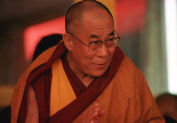 |
| the aim of scientific progress itself is to benefit humankind. If scientific development goes wrong and brings more suffering and more tragedy on humankind, this is unfortunate. I believe that mental development and material development must go side by side." The Dalai Lama |
| "I believe that Western science will develop towards a more synthetic view of its different branches... psychology, biology and physics. It will find a connecting link, a relation between these areas of experience. In the past the scientific and the spiritual or mental development have been regarded as separate from each other, as two different paths leading in opposite directions. But now, in the late twentieth century, this view is beginning to change. "If we only concentrate on scientific development, without concerning ourselves with spiritual development - if we lose a sense of human value - it will be dangerous. After all, |
 |
| In our search for truth there are certain questions that are unimportant. Of what material is the universe constructed? Is the universe eternal? Are there limits or not to the universe? In what way is this human society put together? What is the ideal form of organization for human society? If a man were to postpone his searching and practicing for Enlight-enment until such questions were solved, he would die before he found the path. Suppose a man were pierced by a poi-soned arrow, and his relatives and friends got together to call a surgeon to have the arrow pulled out and the wound treated. If the wounded man objects, saying, "Wait a little, before you pull it out. I want to know who shot this arrow. Was it a man or a woman? Was it someone of noble birth, or was it a peasant? What was the bow made of? Was it a big bow, or a small bow, that shot the arrow? Was it made of wood or bamboo? What was the bowstring made of? Was it made of fiber, or of gut? Was the arrow made of rattan, or of reed? What feathers were used? Before you extract the arrow, I want to know all about these things." Then what will happen? Before all this information can be secured, no doubt, the poison will have time to circulate all through the system and the man may die. The first duty is to remove the arrow, and prevent its poison from spreading. When a fire of passion is endangering the world, the composition of the universe matters little; what is the ideal form for the human community is not so important to deal with. The ques-tion of whether the universe has limits or is eternal can wait until some way is found to extinguish the fires of birth, old age, sickness and death; in the presence of misery, sorrow, suffering and agony, one should first search for a way to solve these problems and devote oneself to the practice of that way. The Buddha's teaching contains what is important to know and not what is unimportant. That is, it teaches people that they must learn what they should learn, remove what they should remove, train for what they should become Enlightened about. Therefore, people should first discern what is the most important, what problem should be solved first and what is the most pressing issue for them. To do all this, they must first undertake to train their minds; that is, they must first seek mind-control. Suppose a man goes to the forest to get some of the pith that grows in the center of a tree and returns with a burden of branches and leaves, thinking that he has secured what he went after; would he not be foolish, if he is satisfied with the bark, wood, for the pith which he was after? But that is what many people are doing. A person seeks a path that will lead him away from birth, old age, sickness and death, or from misery, sorrow, suffering and agony; and yet, he follows the path a little way, notices some little advance, and immediately becomes proud and conceited and domineering. He is like the man who sought pith and went away satisfied with a burden of branches and leaves. Another man becoming satisfied with the progress he has made by a little effort, relaxes his effort and becomes proud and conceited; he is carrying away only a load of branches instead of the pith he was seeking. Still another man finding that his mind is becoming calmer and his thoughts clearer, he, too, relaxes his effort and becomes proud and conceited; he has a burden of the bark in- stead of the pith he was looking for. Then again, another man becomes proud and conceited because he notices that he has gained a measure of intuitive insight; he has a load of the woody fiber of the tree instead of the pith. All of these seekers, who become easily satisfied by their insufficient effort and become proud and over-bearing, relax their efforts and easily fall into idleness. All these people will inevitably face suffering again. Those who seek the true path to En-lightenment must not expect any offer of respect, honor or devotion. And further, they must not aim with a slight ef-fort, at a trifling advance in calmness or knowledge or insight. First of all, one should get clearly in mind the basic and essential nature of this world of life and death. The world has no substance of its own. It is simply a vast concordance of causes and conditions that have had their origin, solely and exclusively, in the activities of the mind that has been stim-ulated by ignorance, false imagination, desires and infatuation. It is not something external about which the mind has false conceptions; it has no substance whatever. It has come into appearance by the processes of the mind itself, mani-festing its own delusions. It is founded and built up out of the desires of the mind, out of its sufferings and struggles in-cidental to the pain caused by its own greed, anger and foolishness. Men who seek the way to Enlightenment should be ready to fight such a mind to attain their goal. |
|
| Who is your neighbor? The Samaritan? The outcast? The enemy? Yes, yes, of course. But it is also the whale, the dolphin and the rainforest. Our neighbor is the entire community of life, the entire universe. We must love it all as our self. Brian Patric I don't know what your destiny will be, but one thing I do know: the only ones among you who will be really happy are those who have sought and found how to serve. Albert Schweitzer All things and all men, so to speak, call on us with small or loud voices. They want us to listen. They want us to understand their intrinsic claims, their justice of being. But we can give it to them only through the love that listens. -Paul Tillich The spiritual life is impossible without a generous heart. -Buddha |
| The love we give away is the only love we keep. Anon It's easy to criticize others and make them feel unwanted. Anyone can do it. What takes effort and skill is picking them up and making them feel good. Rebbe Nachman Whenever you see an image of Buddha, he is always smiling. That smile reflects inner peace and joy. Anon To find joy in another's joy, that is the secret of happiness. Anon She gives most who gives with joy. Mother Teresa If instead of a gem, or even a flower, we should cast the gift of a loving thought into the heart of a friend, that would be giving as the angels give. George MacDonald Everybody can be great.. because anybody can serve. You don't have to have a college degree to serve. |
 |
 |
 |
 |
| May I become at all times, both now and forever A protector for those without protection A guide for those who have lost their way A ship for those with oceans to cross A sanctuary for those in danger A lamp for those in need of light A refuge for those in need of shelter And a servant to all those in need. |
| You don't have to make your subject and verb agree to serve. You only need a heart full of grace. A soul generated by love. Martin Luther King, Jr. Smile at each other, smile at your wife, smile at your husband, smile at your children, smile at each other - it doesn't matter who it is - and that will help you to grow up in greater love for each other. Mother Teresa |
|
| Once there was a king who loved his people and his country and ruled them with wisdom and kindness and, because of it, his country was prosperous and peaceful. He was always seeking for greater wisdom and Enlightenment; he even offered rewards to anyone who could lead him to worthy teachings. His devotion and wisdom finally came to the atten-tion of the gods, but they determined to test him. A god in disguise as a demon appeared before the gates of the king's palace and asked to be brought before the king as he had a holy teaching for him. The king who was pleased to hear the message courteously received him and asked for instruction. The demon took on a dreadful form and demanded food, saying that he could not teach until he had the food he liked. Choice food was offered the demon, but he insisted that he must have warm human flesh and blood. The crown prince gave his body and the queen also gave her body, but still the demon was unsatisfied and so demanded the body of the king. The king expressed his willingness to give his body, but asked that he might first hear the teaching before he would offer his body. The god uttered the following wise teaching: "Misery rises from lust and fear rises from lust. Those who remove lust have no misery or fear." Suddenly the god resumed his true form and the prince and the queen also reappeared in their original bodies. |
|
| Craving - The desire of a thoughtlessly living man grows like a creeper. He drifts from one life to another like a monkey looking for fruit in the forest. When one is overcome by this wretched, clinging desire in the world, one's sor-rows increase like grass growing up after a lot of rain. But when one masters this wretched desire, which is so hard to overcome, then one's sorrows just drop off, like a drop of water off a lotus. This is what I say to you - Good luck be with you, gathered here. Dig up the root of craving, as one does a weed for its fragrant root. Don't let Mara destroy you again and again, like a stream does its reeds. In the same way that even a felled tree will grow again if its root is strong and undamaged, so if latent desire has not been rooted out, then suffering shoots up again and again. When the thirty six pleasure-bound streams of craving are strong in a man, then numerous desire-based thoughts pull the deluded man along. The streams (of craving) flow everywhere, and the creeper hoots up and establishes itself, so when you see the creeper shooting up, cut away its root with your understanding. The recollection and attraction of pleasures occur to a man, and those who are attached to the agreeable and seeking enjoyment, they are the people subject to birth and aging. People beset by desire run here and there, like a snared rabbit, and those trapped in the bonds of attachments keep returning for a long time to suffering. People beset by desire run here and there, like a snared rabbit, so one should get rid of one's craving if it is freedom from desire that one wants. When a man out of the forest of desire is drawn back into the forest, then free from the forest as he is, he runs back into it. Look at him - free, he is running back to chains. The wise say that it is not an iron, wooden or fibre fetter which is a strong one, but the besotted hanker-ing after trinkets, children and wives, that, say the wise, is the strongest fetter. It drags one down, and loose as it feels, it is hard to break. Breaking this fetter, people renounce the world, free from longing and abandoning sensuality. Those on fire with desire follow the stream of their desires, like a spider follows the strands of its self-made web. Breaking the bond, the wise walk on free from longing, and leaving all suffering behind. Let go the past, let go the fu-ture, and let go what is in between, transcending the things of time. With your mind free in every direction, you will not return to birth and aging. When a man is stimulated by his own thoughts, full of desire and dwelling on what is attrac-tive, his craving increases even more. He is making the fetter even stronger. But he who takes pleasure in stilling his thoughts, practising the contemplation of what is repulsive, and remaining recollected, now he will make an end of crav-ing, he will snap the bonds of Mara. His aim is accomplished, he is without fear, rid of craving and without stain. He has removed the arrows of changing existence. This is his last body. Rid of craving and without clinging, an expert in the study of texts, and understanding the right sequence of the words, he may indeed be called "In his last body," "Great in wisdom" and a "Great man." All-conquering and all-knowing am I. Amidst all states of mind, unaffected am I. By abandoning everything, I am liberated by the cessation of desire. Having achieved Realisation by myself, who should I point to as my teacher? The gift of the Truth beats all other gifts. The flavor of the Truth beats all other tastes. The joy of the Truth beats all other joys, and the cessation of desire conquers all suffering. Riches destroy a fool, but not those who are seeking the other shore. The fool destroys himself by his craving for riches, as he destroys others too. Weeds are the blight of fields. Desire is the blight of mankind. Consequently offerings to those free from desire are of great fruit. Weeds are the blight of fields. Anger is the blight of mankind. Consequently offerings to those free from anger are of great fruit. Weeds are the blight of fields. Delusion is the blight of mankind. Consequently offerings to those free from delusion are of great fruit. Weeds are the blight of fields. Self-seeking is the blight of mankind. Consequent-ly offerings to those free from self-seeking are of great fruit. |
|
|
| "I urge my fellow Tibetans to continue to resist violent acts of frustration and desperation as a means to protest against injustice and repression. If we give in to hatred, desperation and violence, we would debase ourselves to the level of the oppressors. The way of the oppressors is intimidation, coercion and the use of force. Ours is a belief in and reliance on truth, justice and reason. This distinction is our most effective weapon. "When it comes to dealing with greed, one thing which is quite characteristic is that although it arises from the desire to obtain something, it is not satisfied by obtaining it. Therefore, it becomes limitless or boundless, and that leads to trouble. The interesting thing about greed is that although the underlying motive is to seek satisfaction, as I pointed out, even after obtaining the object of one's desire, one is still not satisfied. On the other hand, if one has a strong sense of contentment, it doesn't matter whether one obtains the object or not; either way, one is still content. "Shantideva states that if we respond to harm or injury inflicted upon us by retaliating against the other person, then not only will that act be of no use to the other person - in fact it will be harmful to him or her - it will also be destructive so far as our own interests are |
| concerned. This is because if one is a practitioner of bodhicitta, it will deteriorate ones bodhicitta practice. Additionally, it will weaken the fortitude that one has built through the practice of tolerance and patience. So it is destructive both for the other and for oneself. "If you think only of yourself, if you forget the rights and well-being of others, or, worse still, if you exploit others, ultimately you will lose. You will have no friends who will show concern for your well-being. Moreover, if a tragedy befalls you, instead of feeling concerned, others might even secretly rejoice. By contrast, if an individual is compassionate and altruistic, and has the interests of others in mind, then irrespective of whether that person knows a lot of people, wherever that person moves, he or she will immediately make friends. And when that person faces a tragedy, there will be plenty of people who will come to help. "Another kind of love and compassion is not based on something appearing beautiful or nice, but based on the fact that the other person, just like oneself, wants happiness and does not want suffering and indeed has every right to be happy and to overcome suffering. On such a basis, we feel a sense of responsibility, a sense of closeness toward that being. That is true compassion. This is because the compassion is based on reason, not just on emotional feeling. As a consequence, it does not matter what the other's attitude is, whether negative, or positive. What matters is that it is a human being, a sentient being that has the experience of pain and pleasure. There is no reason not to feel compassion so long as it is a sentient being." The Dalai Lama Disclaimer: All articles and/or images retain the original copyrights or their original owners. |
| January 10, 2004 |
 |
 |
| Visit our main Buddhism site. More information, images, and, NO pop-ups! |
 |
 |