| Page 13 |
 |
 |
| elder said. "But why ever not?" the disciple asked. "Because to look you must be here. You're mostly somewhere else," the elder said. "Sometimes people get the mistaken notion that spirituality is a separate department of life, the penthouse of our existence. But rightly understood, it is a vital awareness that pervades all realms of our being. Someone will say, 'I come alive when I listen to music,' or 'I come to life when I garden,' or 'I come alive when I play golf.' Wherever we come alive, that is the area in which we are spiritual. And then we can say, 'I know at least how one is spiritual in that area.' To be vital, awake, aware, in all areas of our lives, is the task that is never accomplished, but it remains the goal." Brother David Steindl-Rast (Benedictine monk) Ryutan Shin stayed with Tenno (748-807) for three years, but having no instructions in Zen, as he expected, he asked, "It is some time since my arrival here, but I have yet had no words from you, master, in the way of spiritual teaching." Said the master, "Ever since your arrival here I have been teaching you in matters of spiritual Enlightenment." Ryutan did not understand this and asked again, "When were such matters ever imparted to me?" The master's reply was: "When you bring me tea to drink, do I not take it? When you bring me food to eat, do I not accept it? When you bow to me, do I not acknowledge it by nodding? When was I ever at fault in instructing you in matters spiritual?" Ryutan stood still for a while thinking about it. The master said, "If you want to see into the matter, see it at once; deliberation makes you miss the point forever." This is said to have awakened the disciple to the truth of Zen. |
 |
| "Where shall I look for Enlightenment?" the disciple asked. "Here," the elder said. "When will it happen?" the disciple asked. "It is happening right now," the elder answered. "Then why don't I experience it?" the disciple persisted. "Because you do not look," the elder said. "But what should I look for?" the disciple continued. "Nothing. Just look," the elder said. "But at what?" the disciple asked again. "At anything your eyes alight upon," the elder answered. "But must I look in a special kind of way?" the disciple went on. "No. The ordinary way will do," the elder said. "But don't I always look the ordinary way?" the disciple said. "No, you don't," the |
| THREE ASPECTS OF BUDDHA'S BODY Do not seek to know Buddha by His form or attributes; for neither the form nor the attributes are the real Buddha. The true Buddha is Enlightenment itself. The true way to know Buddha is to realize Enlightenment. If someone sees some excellent features of Buddha and then thinks he knows Buddha, his is the mistake of an ignorant eye, for the true Buddha can not be embodied in a form or seen by human eyes. Neither can one know Buddha by a faultless de-scrition of His attributes. It is not possible to describe His attributes in human words. Though we speak of His form, the Eternal Buddha has no set form, but can manifest Himself in any form. Though we describe His attributes, yet the Eter-nal Buddha has no set attributes, but can manifest in any and all excellent attributes. So, if one sees distinctly the form of Buddha, or perceives His attributes clearly, and yet does not become attached to His form or to His attributes, he has the capacity to see and know Buddha. Buddha's body is Enlightenment itself. Being formless and without substance, it always has been and always will be. It is not a physical body that must be nourished by food. It is an eternal body whose substance is Wisdom. Buddha, therefore, has neither fear nor disease; He is eternally changeless. Therefore, Buddha will never disappear as long as Enlightenment exists. Enlightenment appears as the light of Wisdom that awakens peo-ple into a newness of life and causes them to be born into the world of Buddha. Those who realize this become the chil-dren of Buddha; they keep His Dharma, honor His teachings and pass them on to posterity. Nothing can be more mira-culous than the power of Buddha. Buddha has a three-fold body. There is an aspect of Essence or Dharma-kaya; there is an aspect of Potentiality or Sambhoga-kaya; and there is an aspect of Manifestation or Nirmana-kaya. Dharma-kaya is the substance of the Dharma; that is, it is the substance of Truth itself. In the aspect of Essence, Buddha has no shape or color, and since Buddha has no shape or color, He comes from nowhere and there is nowhere for Him to go. Like the blue sky, He arches over everything, and since He is all things, He lacks nothing. He does not exist because people think He exists; neither does He disappear because people forget Him. He is under no particular compulsion to appear when people are happy and comfortable, neither is it necessary for Him to disappear when people are inattentive and idle. Buddha transcends every conceivable direction of human thought. Buddha's body in this aspect fills every corner of the universe; it reaches everywhere, it exists forever, regardless of whether people believe in Him or doubt His exis-tence. Sambhoga-kaya signifies that the nature of Buddha, the merging of both Compassion and Wisdom, which is imageless spirit, manifests itself through the symbols of birth and death, through the symbols of vow-making, training and revealing His sacred name, in order to lead all people to salvation. Compassion is the Essence of this body and in its spirit, Buddha uses all devices to emancipate all those who are ready for emancipation. Like a fire that, once kindled, never dies until the fuel is exhausted, so the Compassion of Buddha will never falter until all worldly passions are ex-hausted. Just as the wind blows away the dust, so the Compassion of Buddha in this body blows away the dust of human suffering. Nirmana-kaya signifies that, in order to complete the relief of Buddha of Potentiality, Buddha appeared in the world in bodily form and showed the people, according to their natures and capacities, the aspects of the birth, re-nunciation of this world and attainment of Enlightenment. In order to lead the people, Buddha in this body uses every means such as illness and death. The form of Buddha is originally one Dharma-kaya, but as the nature of people varies, Buddha's form appears differently. Although the form of Buddha varies according to the different desires, deeds and abilities of people, Buddha is concerned only with the truth of the Dharma. Though Buddha has a three-fold body, His spirit and purpose are one - to save all people. In all circumstances, Buddha is manifest in His purity, yet this manifes-tation is not Buddha, because Buddha is not a form. Buddhahood fills everything; it makes Enlightenment its body and, as Enlightenment, it appears before all those capable of realizing the Truth. |
 |
|
 |
| Pay attention. Stay awake and totally alert. See with receptive eyes and discover a world of ceaseless wonders. Walk the path of beauty. Relish and encourage its inward and outward expressions. Acknowledge the radiance of the creation. Spell out your days with a grammar of gratitude. Be thankful for all the blessings in your life. Be playful. Express your creative spirit in spontaneity. Hurrah the pleasures of being, and let loose your laughter. |
| In both your private and public lives, discover the sweet release that comes from forgiving others. Feel the healing balm of being forgiven and of forgiving yourself. Live in the present moment. Don't obsess about the past or worry about the future. All you need is right here now. Open your heart, mind, soul to the pain and suffering in the world. Reach out to others and discover the rewards and obligations of deep feeling. |
| Practice hospitality in a world where too often strangers are feared, enemies are hated, and the "other" is shunned. Welcome guests and alien ideas with graciousness. Cultivate a vibrant curiosity and welcome the reports of your senses. The world is alive and moving toward you with rare epiphanies and wonderful surprises. Remember you are standing on holy ground. Protect the earth's future by promoting peace every day. Your small steps will link you with others who are combating violence in the world. |
| Practice reverence for life. The sacred is in, with, and under all the things of the world. Respond with appropriate respect and awe. |
| Pindola, a disciple of Buddha, after gaining Enlightenment, returned to his native place of Kausambi to repay the peo-ple there for the kindness they had shown him. In so doing, he prepared the field for the sowing of Buddha-seeds. On the outskirts of Kausambi, there is a small park that runs along the bank of the Ganges River shaded by endless rows of coconut trees and where a cool wind continually blows. One hot summer day, Pindola sat in meditation in the cool shade of a tree when King Udayana came to this park with his consorts for recreation and, after music and pleasure, he took a nap in the shade of another tree. While their king was asleep, his wives and ladies-in-waiting took a walk and suddenly came upon Pindola sitting in meditation. They recognized him as a holy-man and asked him to teach them, and they listened to his sermon. When the king awoke from his nap, he went in search of his ladies and found them surrounding this man and listening to his teaching. Being of a jealous and lascivious mind, the king became angry and abused Pindola, saying: "It is inexcusable that you, a holy-man should be in the midst of women and enjoy idle talking with them." Pindola quietly closed his eyes and remained silent. The angry king drew his sword and threatened Pindola, but the holy-man remained silent and was as firm as a rock. This made the king still more angry so he broke open an anthill and threw some of the ant-filled dirt upon him, but still Pindola remained sitting in meditation, quietly enduring the insult and pain. Thereupon, the king became ashamed of his ferocious conduct and begged Pindola's pardon. As a result of this incident, the Buddha's teaching found its way into the king's castle and from there it spread all over the country. A few days later, King Udayana visited Pindola in the forest retreat where he lived and asked him, "Honored teacher, how is it that the disciples of Buddha can keep their bodies and minds pure and untempted by lust, although they are mostly young men?" Pindola replied: "Noble Lord, Buddha has taught us to respect women. He has taught us to look upon all old women as our mothers, upon those of our own age as our sisters, and upon younger ones as our daughters. Because of this teaching, the disciples of Buddha are able to keep their bodies and minds pure and untempt-ed by lust although they are youthful." "But, Honored teacher, one may have impure thoughts of a woman the age of a mother or a sister or a daughter. How do the disciples of Buddha control their desires?" "Noble Lord, the Blessed One taught us to think of our bodies as secreting impurities of all kinds such as blood, pus, sweat and oils; by thinking thus, we, though young, are able to keep our minds pure." "Honored teacher," still pressed the king, "It may be easy for you to do this for you have trained your body and mind, and polished your wisdom, but it would be difficult for those who have not yet had such training. They may try to remember the impurities but their eyes will follow beautiful forms. They may try to see the ugliness but they will be tempted by the beautiful figures just the same. There must be some other reason that the young men among the Buddha's disciples are able to keep their actions pure." "Noble Lord," replied Pindola, "the Blessed One teaches us to guard the doors of the five senses. When we see beautiful fig-ures and colors with our eyes, when we hear pleasant sounds with our ears, when we smell fragrance with our nose, or when we taste sweet things with our tongue or touch soft things with our hands, we are not to become attached to these attractive things, neither are we to be repulsed by unattractive things. We are taught to carefully guard the doors of these five senses. It is by this teaching of the Blessed One that even young disciples are able to keep their minds and bodies pure." "The teaching of Buddha is truly marvelous. From my own experience, I know that if I confront any-thing beautiful or pleasing, without being on my guard, I am disturbed by the sense impressions. It is of vital impor-tance that we be on guard at the doors of the five senses at all times to keep our deeds pure." Whenever a person ex-presses the thought of his mind in action, there is always a reaction that follows. If one abuses you, there is a tempta-tion to answer back, or to be revenged. One should be on guard against this natural reaction. It is like spitting against the wind, it harms no one but oneself. It is like sweeping dust against the wind, it does not get rid of the dust but de-files oneself. Misfortune always dogs the steps of one who gives way to the desire for revenge. It is a very good deed to cast away greed and to cherish a mind of charity. It is still better to keep one's mind intent on respecting the Noble Path. One should get rid of a selfish mind and replace it with a mind that is earnest to help others. An act to make an-other happy inspires the other to make still another happy, and so happiness is born from such an act. Thousands of candles can be lighted from a single candle, and the life of the candle will not be shortened. Happiness never decreases by being shared. Those who seek Enlightenment must be careful of their every step. No matter how high one's aspira-tion may be, it must be attained step by step. The steps of the path to Enlightenment must be taken in our everyday life. |
|
 |
 |
|
 |
| "Burned in the daytime" represents the fact that during the day people turn into acts the things they thought about the previous night. "Smoked at night" indicates the fact that people during the night recall with pleasure or regret the things they did the previous day. In the same fable, "a man" means a person who seeks Enlightenment. "A wise man" means the Buddha. "A sword" means pure wisdom. "Dig into it" refers to the effort he must make to gain Enlighten-ment. Further in the fable, "gate-bar" represents ignorance; "bubbles" are puffs of suffering and anger; "pitchfork" suggests hesitation and uneasiness; "box" suggests the storage of greed, anger, laziness, fickleness, repentance and delusion; "tortoise" means the body and the mind; "butcher-knife" means the synthesis of the five sensory desires, and "a piece of meat" means the resulting desire that causes a man to covet after satisfaction. These things are all harmful to man and so Buddha said, "Throw away everything." Still further, "dragon" indicates a mind that has elim-inated all worldly passions. If a man digs into the things about him with the sword of wisdom, he will finally come to his dragon. "Leave the dragon alone and do not disturb him" means to go after and dig up a mind free of worldly desires. |
| There is a fable told of a man who found an anthill which burned in the daytime and smoked at night. He went to a wise man and asked his advice as to what he should do about it. The wise man told him to dig into it with a sword. This the man did. He found in succession a gate-bar, some bubbles of water, a pitchfork, a box, a tortoise, a butcher-knife, a piece of meat and, finally, a dragon which came out. The man re-ported to the wise man what he had found. The wise man explained the significance of it and said, "Throw away everything but the dragon; leave the dragon alone and do not disturb him." This is a fable in which "anthill" represents the human body. |
|
| COMPASSION Compassion is a foundation for sharing our aliveness and building a more human world. Martin Lowenthal "Oh, that my monk's robes were wide enough to gather up all the people in this floating world." Ryokan (Zen monk) The Buddha of Compassion is represented as having a thousand eyes that see the pain in all corners of the universe and a thousand arms to reach out to all corners of the universe to extend his help. Compassion is the sometimes fatal capacity for feeling what it is like inside somebody else's skin. It is the knowledge that there can never really be any peace and joy for me until there is peace and joy finally for you too. Frederick Buechner Compassion for me is just what the word says: it is 'suffering with.' It is an immediate participation in the suffering of another to such a degree that you forget yourself and your own safety and spontaneously do what is necessary. Joseph Campbell The quivering of the pure heart - when we have allowed ourselves to be touched by the pain of life. Jack Kornfield JOY Rejoice and be exceedingly glad. Find this divine energy in your daily life and share it with others. Seek liberty and justice for all. Work for a free and fair world where oppression and inequality no longer exist. Let Spirit flow through you in little acts of kindness, brief words of encouragement, and manifold expressions of courtesy. These deeds will add to the planet's fund of good will. Cultivate the art of deep listening in which you lean toward the world in love. All things in the universe want to be heard, as do the many voices inside us. Fall in love over and over again every day. Love your family, your neighbors, your enemies, and yourself. And don't stop with humans. Love animals, plants, stones, even the galaxies. Constantly try to discover the significance of your experiences. Seek further understanding from sacred texts and spiritual teachers. Take good care of the best that is within you. Self-exploration and personal growth continue throughout our lifetimes and equip us to tend to the needs of others. Hold an open house in your heart for all people and all things. Practice empathy with others and receptiveness toward the universe. HOPE Let this positive and potent emotion fuel your dreams and support your service of others. Through your attitudes and actions, encourage others never to lose hope. Practice hospitality in a world where too often strangers are feared, enemies are hated, and the "other" is shunned. Welcome guests and alien ideas with graciousness. Give imagination free rein in your life. Explore its images and ponder its meaning-making moments, and it will always present you with something new to be seen, felt, or made known. |
| Cultivate the art of making connections. See how your life is intimately related to all life on the planet. Express your feelings of praise and adoration through devotional practices. Pray with words and pray through actions. Enthusiasm - Celebrate life with this intoxicating passion. It adds zest to everything and helps build community. Hold nothing back. Give up trying to hide, deny, or escape from your imperfections. Listen to what your demons have to say. Be willing to learn from spiritual teachers all around you, however unlikely or unlike you they may be. Always be a sensitive student. Welcome the positive changes that are taking place in your life. Open up the windows and let in some fresh air. Wholeness and healing are waiting in the wings. |
 |
|
| Practice the art of seeing the invisible. Use the wisdom of your personal visions to renew yourself and your community. Follow your heart's boundless desire. It takes you out of yourself and fosters an appreciation for the multidimensional pleasures of life. Be passionately aroused by life. Cherish every moment, honor your commitments and treasure your kinship with all. |
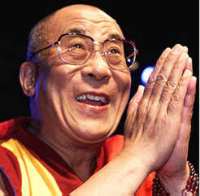
| "My opinion is that since everybody belongs to this world, we must try to adopt a good attitude worldwide, a good feeling for our fellow brothers and sisters. In my particular case, we Tibetans are carrying on a struggle for our rights. Some say that the Tibetan situation is only political but I feel it is not. We Tibetans have a unique and distinct cultural heritage just as the Chinese have. We do not hate the Chinese; we deeply respect the riches of Chinese culture which spans so many centuries. Though we have deep respect and are not anti-Chinese, we six million Tibetans have an equal right to maintain our own distinctive culture as long as we do not harm others. Materially we are backward, but in spiritual matters - in terms of the development of the mind - we are quite rich. We Tibetans are Buddhists, and the Buddhism which we practice is a rather complete form of Buddhism. Also, we have kept it active, very much alive. "The basic fact is that all sentient beings, particularly human beings, want happiness and do not want pain and suffering. On those grounds, we have every right to be happy and to use different methods or means to overcome suffering and to achieve happier lives. It is worthwhile to think seriously about the positive and negative consequences of these methods. You should be aware that there are differences between short-term interest and long-term interest and consequences - and the long-term interest is more important. Buddhists usually say that there is no absolute and that everything is relative. So we must judge according to the circumstances. "Anger and hatred cannot bring harmony. The noble task of arms control and disarmament cannot be accomplished by confrontation and condemnation. Hostile attitudes only serve to heat up the situation, whereas a true sense of respect gradually cools down what otherwise could become explosive. We must recognize the frequent contradictions between short-term benefit and long-term harm. "When we are young and again when we are old, we depend heavily on the affection of others. Between these stages we usually feel that we can do everything without help from others and that other people's affection is simply not important. But at this stage I think it is very important to keep deep human affection. "Although in every religion there is an emphasis on compassion and love, from the viewpoint of philosophy, of course there are differences, and that is all right. Philosophical teachings are not the end, not the aim, not what you serve. The aim is to help and benefit others, and philosophical teachings to support those ideas are valuable. If we go into the differences in philosophy and argue with and criticize each other, it is useless. There will be endless argument; the result will mainly be that we irritate each other - accomplishing nothing. Better to look at the purpose of the philosophies and to see what is shared - an emphasis on love, compassion, and respect for a higher force." The Dalai Lama Disclaimer: All articles and/or images retain the original copyrights of their original owners. |
|
| May 8, 2003 |
 |
 |
| Visit our main Buddhism site. More information, images, and, NO pop-ups! Click image at left. |