 |
| Page 12A |
 |
| May I experience whatever sufferings sentient beings have, and they experience whatever happiness and virtue I have. May the glorious Spiritual Masters live long, and may all beings throughout limitless space have happiness. By purifying our defilements and accumulating positive potential, may I and all others be blessed (inspired) to attain Buddhahood quickly. May I never develop for even a moment wrong views towards the deeds of my glorious Spiritual Masters. By seeing whatever actions they do as pure with respect and devotion, may the Spiritual Masters' inspiration flow into my mind. In whatever way you appear, O glorious Guru, whatever your retinue, lifespan and pureland, whatever your name most noble and holy, may I and all others attain only these. In order to follow the excellent examples set by the wisdom of the Bodhisattva Manjushri and the always sublime Samantabhadra, I dedicate all virtues to their peerless ideals. All Conquerors passed into the three times have praised as supreme this peerless dedication. Therefore, I also surrender all roots of my activities to the sublime goals of a Bodhisattva. In all our lives, through the Victorious One, Lama Tsong Khapa acting as the actual Mahayana Spritual Master, may I never turn aside for even an instant from the excellent path praised by the Victorious Ones. May I and others be able to live in pure moral conduct, train our minds in bodhicitta, and develop pure view and conduct. In this way, may we complete our lives without corrupting the pure wisdom of Lama Tsong Khapa, (who is like) the second Buddha. Dedication Prayer of the Gradual Path to Enlightenment From my two collections, vast as space, that I have amassed from working with effort at this practice for a great length of time, may I become the chief leading Buddha for all those whose mind's wisdom eye is blinded by ignorance. Even if I do not reach this state, may I be held in your loving-compassion for all my lives, Manjushri. May I find the best of complete graded paths of the teachings, and may I please all the Buddhas by practicing well. Using skilful means drawn by the strong force of compassion, may I clear the darkness from the minds of all beings with the points of the path as I have discerned them; may I uphold Buddha's teachings for a very long time. With my heart going out with great compassion in whatever directions the most precious teachings have not yet spread, or once spread have declined, may I expose this treasure of happiness and aid. May the minds of those who wish for liberation be granted bounteous peace, and the Buddhas' deeds be nourished for a long time by this gradual path to Enlightenment completed due to the wondrous virtuous conduct of the Buddhas and their spiritual children. May all human and non-human beings who eliminate adversity and make things conducive for practicing the excellent paths never be parted in any of their lives from the purest path praised by the Buddhas. Whenever someone makes effort to act in accordance with the ten-fold Mahayana virtuous practices, may he/she always be assisted by the mighty ones; and may oceans of prosperity spread everywhere. Avalokiteshvara, great treasure of objectless compassion, Manjushri, master of flawless wisdom, Tsong Khapa, crown jewel of the Snowy Lands' sages, Lobsang Drakpa, I make request at your holy feet. (3x) |
| Dedicating our positive potential is important in order to prevent it from being destroyed by our anger or wrong views. Just as a steering wheel guides a car, dedication guides how our positive potential ripens. |
| Due to this merit may I soon attain the Enlightened state of Guru-Buddha, that I may be able to liberate all sentient beings from their sufferings. May the precious bodhi mind not yet born arise and grow. May that born have no decline, but increase forever more. In all my rebirths may I never be separated from perfect Spiritual Masters and enjoy the magnificent Dharma. Completing all qualities of the stages and paths, may I quickly achieve the state of Nirvana. May anyone who merely sees, hears, remembers, touches or talks to me be freed in that very instant from all sufferings and abide in happiness forever. It is only from the kindness of my Spiritual Masters that I have met the peerless teachings of the Buddha. |
| Thus, I dedicate all positive potentials so that all migrating beings may be guided in the future by kind and holy Spiritual Masters. Until cyclic existence ends, may the beneficial teachings not be blown away by the wind of superstitions. May the entire world be filled with people who have understood and found firm faith in the true teachings. Day and night, may I pass the time thinking and examining by what means these teachings can spread in the minds of myself and others. May sentient beings, who have all been my mother and father, be completely happy, and may the lower realms be forever empty. May all the prayers of bodhisattvas, in whatever places they live, be immediately fulfilled. |
 |
|
| Je Tsong Khapa (1357-1419) - Tibetan Thinker, Philosopher, Tibetan Buddhist Born in Amdo eastern Tibet, Je Tsong Khapa (1357-1419) (the name means 'he born in the onion (Tsong) place') is widely regarded in Tibet as a second Buddha and the main teacher of the first Dalai Lama, Gendun Drub (1391-1474). His name is almost a Buddhist joke, as onions are forbidden food to strict followers. He was an eminent scholar who reformed the old Kadampa sect, creating the new Gelugpa sect (the Yellow Hats), which was to become the most powerful in the entire region, eventually converting Mongolia and all other Himalayan kingdoms to Tibetan Buddhism. He also founded in 1409 the massive Ganden Monastic University, east of Lhasa, and one of the largest monasteries in the entire Himalayan region with, at its height with many thousands of monks. It has been in ruins since the excesses of the Cultural Revolution of the 1960's. Since 1986 some of it has been restored. He also founded the two other big Yellow Hat monasteries of central Tibet, Drepung in 1416, to the west of Lhasa and Sera-Je in 1419 to the north of the capital. Both have so far survived Chinese rule more or less intact. Taught from early childhood by numerous lamas of different traditions, Tsong Khapa travelled widely in Tibet collecting teachings, lineages and empowerments until he had thoroughly mastered all aspects of Buddhist logic and practice. He is revered by Tibetans as an emanation of the Buddhist god of wisdom, Manjushri. Just as William Blake had persistent visions of angels, so Tsong Khapa is reported to have regularly seen and conversed with Manjushri from an early age. He wrote extensively on every aspect of Buddhism, his main work being 'The Great Exposition of the Path of Secret Mantra' (Tib: Lam rim chen mo) which presents the main features of all the Buddhist tantra systems as well as the difference between sutra and tantra, the two divisions of Buddha's word. It provided perhaps the clearest and most inclusive analysis of the Buddhist path that had yet been written. His voluminous commentaries on every imaginable topic, provided the largest and most integrated corpus of scripture written by a Tibetan mind. His 'Three Principal Aspects of the Path,' presented here, is a highly compressed piece of writing which has attracted numerous commentaries since it first appeared. The Three Principal Aspects of the Path by Je Tsong Khapa - I will explain as well as I can the essential meaning of all the Conqueror's scriptures, the path praised by the excellent Conqueror children, the port for the fortunate wishing liberation. Whoever are not attached to the pleasures of mundane existence, whoever strive in order to make leisure and fortune worthwhile, whoever are inclined to the path pleasing the Conqueror Buddha, those fortunate ones should listen with a clear mind. Without a complete thought definitely to leave cyclic existence there is no way to stop seeking pleasurable effects in the ocean of existence. Also, craving cyclic existence thoroughly binds the embodied. Therefore, in the beginning, determination to leave cyclic existence should be sought. Leisure and fortune are difficult to find and life has no duration. Through familiarity with this, emphasis on the appearances of this life is reversed. If you think again and again about deeds and their inevitable effects and the sufferings of cyclic existence, the emphasis on the appearances of future lives will be reversed. If, having meditated thus, you do not generate admiration even for an instant for the prosperity of cyclic existence, and if an attitude seeking liberation arises day and night, then the thought definitely to leave cyclic existence has been generated. Also, if this thought definitely to leave cyclic existence is not conjoined with generation of a complete aspiration to highest Enlightenment, it does not become a cause of the marvellous bliss of unsurpassed Enlightenment. Thus, the intelligent should generate the supreme altruistic intention to become Enlightened. All ordinary beings are carried by the continuum of the four powerful currents, are tied with the tight bonds of actions difficult to oppose, have entered into the iron cage of apprehending self (inherent existence), are completely beclouded with the thick darkness of ignorance, are born into cyclic existence limitlessly, and in their births are tortured ceaselessly by the three sufferings. Thinking thus of the condition of mothers who have come to |
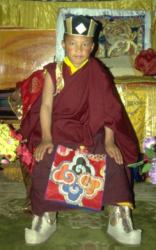
| News about His Holiness the 17th Gyalwa Karmapa, Ugyen Drodul Trinley Dorje A Spontaneous Teaching on Sunyata or Emptiness given by H.H. 17th Gyalwa Karmapa, head of the Kagjupa Lineage of Tibetan Buddhism, to Richard Gere and friends at a private audience with Karmapa, March 24, 2000. Sogyal Rinpoche was translating, with Tsoknyi Rinpoche and Minjur Tulku in attendance. H.H. the Karmapa's Spontaneous teaching.... Benefactors, Rinpoches and all friends that are interested in the Tibetan cause, I would like to offer my greetings, facilitation. I thank you for your efforts to come here and greet me and that you have an interest in the study of the Buddhist Dharma. There is a fundamental Buddha nature in all of us. As far as I know about Sunyata and emptiness, I don't recognize them but I hope they recognize me! Sunyata is the basis of Buddha Nature, luminous clarity and uncreated. The Noble truth of all phenomena both existing and non-existing at the same time, is that ultimate truth that an ordinary mind cannot fathom. Tong-pa-nyi (Tib. for Emptiness) bars any support of the existence or non-existence of Samsara and Nirvana and is beyond the conceptual mind. It is something within the domain of the wisdom-mind of the Buddha. Compassion and wisdom are limitless and fathomless. One should strive to always develop compassion for all sentient beings. We may have a powerful compassion that may arise but we might also have a moment of anger that also arises that can destroy it all. All the Buddhas and Bodhisattvas practice compassion and Bodhicitta. We also have to train ourselves in the practice of the six paramitas. Whether we call it compassion or Bodhicitta it has two categories. We want to actually take the journey and then we must actualize it by entering the actual aspiration and application. It would be like giving a feast and bringing empty plates and offering the feast of nothing. To just aspire is not enough. In encountering a very poor person and feeling pity and compassion is not enough. To not actually give a gift, it won't help that person. Regarding emptiness and compassion, if the Buddhas did not speak like that about these subjects I apologize. In the Nyingmapa texts it speaks of Bodhicitta and Faith that these must be of the purest motivation. The power of our pure motivation and a complete understanding of the truth of inter-dependency will bring our Dharma practice to fruition. Enjoying this result, beings may then enjoy the feast of the actualization of the Dharmakaya, the source of happiness and well being free from suffering. Some Lamas and Tulkus want and then go after lots of money and this then brings them lots of difficulties. This approach will ultimately not bring happness and is in fact a source of misery. To all of you learned people that have come here |
 |
 |
| such a state, generate the supreme altruistic intention to become Enlightened. If you do not have the wisdom realising the way things are, even though you have developed the thought definitely to leave cyclic existence and the altruistic intention, the root of cyclic existence cannot be cut. Therefore, work at the means of realising dependent-arising. Whoever, seeing the cause and effect of all phenomena of cyclic existence and Nirvana infallible, thoroughly destroys the mode of misapprehension of those objects [as inherently existent] has entered on a path that is pleasing to Buddha. As long as the two, realisation of appearances - the infallibility of dependent-arising - and the realisation of emptiness - the non-assertion [of inherent existence] - seem to be separate, there is still no realisation of the thought of Shakyamuni Buddha. When [the two realisations exist] simultaneously without alternation And when from only seeing dependent-arising as infallible, definite knowledge entirely destroys the mode of apprehension [of the conception of inherent existence], then the analysis of the view [of reality] is complete. Further, the extreme of [inherent] existence is excluded [by knowledge of the nature] of appearances [existing only as nominal designations], and the extreme of [total] non-existence is excluded [by knowledge of the nature] of emptiness [as the complete absence of inherent existence and |
| not the absence of nominal existence]. If within emptiness the appearance of cause and effect is known you will not be captivated by extreme views. When you have realised thus just as they are the essentials of the three principal aspects of the path, resort to solitude and generate the power of effort. Accomplish quickly your final aim, my child. SUMMARY: The 3 principal aspects of the path are: the definite thought to leave cyclic existence and the abandonment of pleasure; the cultivation of an altru-istic intention (strong compassion) by viewing all beings as precious as our own mother; the correct view of emptiness. Tsong Khapa suggests that possessing one or two of these alone is not enough - all three must be thoroughly and com-pletey developed to create a true Buddhist path. KEY TERMS: ALTRUISTIC INTENTION - desire to attain Enlighten-ment in order solely to be of help to others; the Bodhisattva ideal of the Mahayana school of Buddhism. DEEDS AND THEIR EFFECTS - karma, the view that all our actions, thoughts and words attract negative or positive seeds which remain with us, acting as causes of future happiness or misery. DEFINITE KNOWLEDGE - knowledge about how things are; realisations, correct views; Buddhist wisdom, especially about the empty nature of all phenomena. DEPENDENT ARISING - objects which arise dependent upon component parts or upon other objects; ie. most things. EMPTINESS - the quality which all things possess; they are empty of inherent existence; their emptiness is the real solid and lasting nature we cannot find in anything through sustained conceptual analysis; thus things are viewed as being fundamentally empty of true existence; a view begun by Buddha, but later elucidated in detail by the Indian sage Nagarjuna (c100-c200 AD). ENLIGHTENMENT - release from samsara and wrong views; attainment of realisation, wisdom, etc. EXTREME VIEWS - the extreme philosophical positions of eternalism or nihilism regarding the nature of mind. FOUR POWERFUL CURRENTS - birth, aging, sickness and death. INHERENT EXISTENCE - something which has inherent existence from its own side and is not a dependent arising. SAMSARA - cyclic existence - the physical world, the world we are re-peatedly born and reborn into. SHAKYAMUNI BUDDHA, CONQUEROR - the historical Buddha, king of the Shakya tribe, (c563-483BC). SUTRA - a general term for all Buddhist texts, especially those which claim to be the actual word of Buddha; as opposed to 'shastras' or Buddhist commentaries. TANTRA - a specific form of meditation manual for use in the tantric system of Buddhism, almost exclusive to the Tibetan region; also called Secret Mantra or Vajrayana - the 'diamond vehicle;' any one of a number of secret Buddhist texts. THREE SUFFERINGS - desire, hatred and delusion. |
|
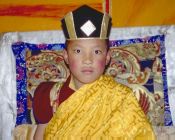 |
| today to visit me I offer my deepest and profound respect. I offer you my respect in the spirit, that all of you in your past pure motivation and intentions have become learned in your respective professional fields and have contributed to the Tibetan cause and to the wishes of His Holiness the Dalai Lama - I congratulate you for this. A question was asked if He would relate to all of us a little of what His life was like in Tibet. I came out of my mothers womb and then till about eight years of age I lived with my parents and then I stayed at Tsurphu Monastery until I escaped here. I have a great hope that the necessary permission to remain here in India will be granted, others are currently applying for this for me. Permission was granted after this article was written for Karmapa to remain in India. (This interesting article printed elsewhere on this site.) |
|
| A Marriage Blessing - (I was asked by a couple in the USA to lead a marriage blessing (this is different from a marriage ceremony, which monastics are not allowed to perform) and prepared the following. Others may use or borrow from it according to their needs. Thubten Chodron, Seattle; June, 1995) Do the Seven Limb Prayer from "The King of Prayers" or the Chenreisg practice, and then lead people in a meditation on loving-kindness. Then the partners say to each other and to their friends and family: We are happy today not only because we can share the joy of our love for each other with friends and family, but also because we have the opportunity to voice our aspirations for the future. We aspire to make our spiritual path the core of our life together. We will help each other on the path to Enlightenment, watering the seeds of love, compassion, generosity, ethics, patience, joyous effort, concentration and wisdom in each other. As we age and undergo the various ups and downs of cyclic existence, we aspire to transform them into the path of love, compassion, joy and equanimity. We recognize that external conditions in life will not always be smooth and that internally our own minds and emotions sometimes get stuck in negative ways of thinking. When this happens we aspire to see all these circumstances as a challenge to help us grow, to open our hearts, to accept ourselves, others and life itself; and to generate compassion for all others who are also un-happy or suffering at that moment. We aspire to avoid becoming narrow, closed or opinionated, and will help each other see all the various sides of a situation and to bring acceptance, flexibility and equanimity to it. We aspire to continuously remember our own Buddha nature, that of each other as well as the Buddha nature of all living beings. In this way we will always be aware that there is hope, that all of us can eventually arrive at a state of lasting happiness, and that whatever misfortunes occur are temporary. We recognize that just as we are a mystery to ourselves, the other person is also a mystery to us. We aspire to understand ourselves, each other, and all living beings, and to regard all the mysteries of life with curiosity and joy. We aspire to preserve and enrich our affection for each other, and as it does to share it with all beings. We will take the feelings we have for each other of care, consideration, affection for each other, and our vision of other's potential and inner beauty as an example and will try to open our hearts to feel this way impartially for all beings. Rather than spiraling inwards due to our love for each other, we aspire to radiate this love outwards to all beings. We will examine our own minds and continually discuss with each other so that this vision remains alive in our hearts. When it comes time to part - be it through death or another fluctuation of cyclic existence, we aspire to look back at our time together with joy - joy that we met and shared what we did - and acceptance that we cannot hold on to each other forever. We will wish each other well from the depths of our hearts and help each other and we both go on to new lives. We aspire to remember the disadvantages of ignorance, anger and clinging attachment and to apply Dharma antidotes when these arise in our minds and to help each other do so also. We aspire to remember that we are deeply connected with all living beings, and that all of them have been kind to us in this and previous lives. We aspire to be-come fully Enlightened in order to benefit them most effectively, with all of our compassion, wisdom and skill. We aspire to develop the wisdom of understanding the relative functioning nature of things and the wisdom knowing their deeper way of existence - that they are empty of inherent existence. Day to day, as we progress along the path, we aspire to be patient with ourselves and others, knowing that change comes slowly and gradually, and that our inner re-sources and the help of the Buddhas and Bodhisattvas are always accessible to us. |
|
 |
| 5. Power of the truth - By the power of the truth of the Three Jewels, the power of the inspiration of all the Buddhas and Bodhisattvas, the power of the great might of the completed two collections, and the power of the intrinsically pure and inconceivable sphere of reality, may (these offerings) become suchness. 6. Invocation - Protector of all beings without exception, divine subduer of innumerable negative forces, deity, perfect knower of all things, Bhagavan and attendants, please come here. 7. Homage to the Buddha - To the Guru and Founder, the Endowed Transcendent Destroyer, the One Gone Beyond, the Foe Destroyer, the Completely Perfected, Fully-awakened Being, the Glorious Conqueror, the Subduer from the Shakya Clan, I prostrate, go for refuge and make offerings. Please inspire me. (3x) Notes: There are three objects of refuge: the Buddha, Dharma and Sangha. The Guru is not a fourth refuge. Guru refers to the blissful omniscient minds of all the Buddhas, and thus emcompasses all three refuges. The blissful omniscient mind, which is purified of all obscurations and has developed its good qualities completely, is the Buddha. By being the true path and true cessation, it is the Dharma. By directly realizing emptiness, it is the Sangha. Disclaimer: All images and/or articles retain the original copyrights of their original owners. |
| MORNING PRAYERS: 1. Refuge - Guru is Buddha, Guru is Dharma. Guru is Sangha also. Guru is the source of all (goodness and happiness.) To all Gurus, I go for refuge). (3x) 2. Generating the altruistic intention - To accomplish my own and others' aims, I generate the altruistic intention to attain Enlightenment for the benefit of all sentient beings. (3)x 3. Purifying the place - Everywhere may the ground be pure, free of the roughness of pebbles and so forth. May it be the nature of lapis and as smooth as the palm of one's hand. 4. Offering prayer - May offering substances human and divine, those actual and those which are emanated, unsurpassed Samantabhadra clouds of offerings fill the entire space. |
| April 29, 2004 |
 |
 |
 |
 |
| Visit our main Buddhism site. More information and images and, NO pop-ups! |
 |