| Page 12 |
 |
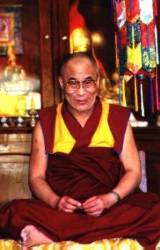 |
| Muted defiance from Tibet monks (LUSHAER, China) -- From a courtyard doorway of a Tibetan Buddhist monastery, a monk in maroon robes cautiously beck-oned, beginning an illicit conversation about the frustrations and sorrows of being a religious man in communist China. The government controls the monastery, he said, forcing monks to denounce their exiled Tibetan spiritual leader, the Dalai Lama, and punishing them with several months of political re-education classes after the former abbot, Arjia Rin-poche, fled the monastery to the United States in 1998. "I don't know much about politics," the monk said, looking downcast and sounding afraid, "but as a Buddhist we believe the Dalai Lama is the spiritual leader of Tibet and we re-spect him very much." These words of defiance were spoken at Kumbum Monastery in western Qinghai province. Here, a visit by foreign journalists on Saturday - organized by China's foreign ministry to highlight the government's respect for religion - was turned on its head by monks who gave every impression they are fighting a quiet battle for control of their spiritual lives. At a press briefing overseen by the Chinese government, the chief abbots appeared to panic, ner-vously deflecting questions about the Dalai Lama by trying to end the meeting after a few short minutes, while monks in private boldly spoke of the photographs of the Dalai Lama they hide in their rooms. The tension at Kumbum Monas-tery, unmistakable despite attempts by the government and the monks' leadership to deny it, reflects the overall state of religious repression in China, where the Communist Party leadership views organized religion as a challenge to its authority that must be controlled or eliminated. A threat to Beijing - Tibetan Buddhists seem especially dangerous to the government because their movement - and their high-profile exiled leader, the Dalai Lama - represents a theoreti-cal challenge to China's control of Tibet. Since 1951, when the newly empowered communist government seized Tibet after claiming it was part of China, the government has used periods of repression and violence to maintain rule, mur-dering monks and closing temples in the 1950s, and destroying more temples and forcing monks to marry during the Cultural Revolution. In recent decades, the temples have been restored and Tibet's religious culture has been revived to a point and officially supported by the government, but the monks continue to live under a cloud of restrictions and suspicion that prevents them from practicing freely. Arjia Rinpoche, Kumbum Monastery's exiled abbot, said he fled China in 1998 because of the government's delays and interference in the ceremonies to name a new Panchen lama, Tibetan Buddhism's second-highest position. After a search committee, in consultation with the Dalai Lama, identified the new Panchen lama, China took control of the process, oversaw the recognition of a competing candidate and was preparing to bring its choice to Kumbum Monestary for a ceremony. Had he remained at the monastery, Arjia Rinpoche said in a telephone interview from California on Tuesday, he would have been forced to oversee the ceremony. By leav-ing, he said, he thwarted the government's attempt to legitimize its choice. "I would have been forced to denounce the Dalai Lama and my religion and to serve the Chinese government," he said in a public statement last year. Critics of the government say these sorts of controls represent the slow suffocation of Tibetan religion and society, with the aim of maintaining temples as tourist attractions while crushing its independent culture. Dennis Cusack, president of the California-based Tibet Justice Center, said monks are forced to retire early, that the operation of a vibrant Tibetan Buddhist school recently was curtailed and the government has introduced "democratic management committees" at temples to make it easier for local officials to control the purse strings. 'Slow deprivation' denounced - "It's an attempt to desecrate Tibetan Buddhism through slow deprivation," Cusack said. China claims that it is a protector of Tibetan culture but that it is challenged by the "Dalai Lama clique" that is pressing for independence. Since 1996, the People's Daily newspaper said last month, it has improved religious order in Tibet through the management committees and the political education of monks, or lamas. "Previously, many lamas lacked understanding of the reality and history of Ti-betan society," a Tibet government official was quoted as saying. "An overwhelming majority of the lamas have now re-alized that Dalai Lama is not their spokesman, nor their spiritual leader but the head of a clique which always seeks to split up China and hinder construction of a normal order in Tibetan Buddhism or Lamaism." At Kumbum Monastery, there are no outward signs of repression, but the monks seem to have only a tenuous hold on their traditional way of life. There are temples, schools and prayers. But the mountainside complex is overrun with tourists and ethnic Chinese workers doing construction. 'Too many tourists' - "There are too many tourists and too many Chinese here," one monk said. At the press briefing, several high-ranking monks, including two with the title of "living Buddhas," seemed un-clear whether a head abbot or the management committee was in charge. They whispered nervously to each other in response to questions. They tried three times to end the briefing. When asked to describe the balance in their lives be-tween devotion to religion and to government, one of the monks answered after a long, uncomfortable hesitation: "It's very normal. There is nothing else to say." A government spokesman present at the briefing took issue with the char-acterization that the monks seemed afraid to speak their mind, saying it was the monks' right to speak or not speak. But in private, a much clearer picture emerged of unhappy monks who accede to the government when they must, and defy it when they can. Escorting two reporters to his quarters, one monk said he kept his photographs of the Dalai La-ma hidden, that every two years or so police had searched his room for contraband and that he was forced to denounce the Dalai Lama to the Chinese news media. He said the monks are not allowed to discuss controversial issues, but they secretly listen to Tibetan shortwave radio broadcasts. "If they heard me talking about these things," the monk said, "I would get in big trouble." The monk in the doorway, meanwhile, asked about Arjia Rinpoche, the abbot who fled. "Have you met him?" he asked. "We miss him from the bottom of our hearts." (By Michael A. Lev Tribune foreign correspondent July 24, 2001) |
| "He who joyfully marches to music in rank and file has already earned my contempt. He has been given a large brain by mistake, since for him the spinal cord would fully suffice. This disgrace to civilization should be done away with at once. Heroism at command, senseless brutality, deplorable love-of-country stance, how violently I hate all this, how despicable and ignoble war is; I would rather be torn to shreds than be a part of so base an action! It is my conviction that killing under the cloak of war is nothing but an act of murder. "Peace cannot be achieved through violence, it can only be attained through understanding. "True religion is real living; living with all one's soul, with all one's goodness and righteousness. "All religions, arts and sciences are branches of the same tree. All their aspirations are directed toward ennobling man's life, lifting it from the sphere of mere physical existence and leading the individual towards freedom. "The true value of a human being is determined primarily by the measure and the sense in which he has attained liberation from the self. "Few are those who see with their own eyes and feel with their own hearts." Albert Einstein |
 |
|
 |
| What you are is what you have been, and what you will be is what you do now. Buddha |
| Thoughts of harmlessness which are opposed to cruelty. These tend to purify the mind. 3. Right Speech deals with re-fraining from falsehood, stealing, slandering, harsh words and frivolous talks. 4. Right Action deals with refraining from killing, stealing and unchastity. It helps one to develop a character that is self-controlled and mindful of right of others. 5. Right Livelihood deals with the five kinds of trades which should be avoided by a lay disciple. They are: trade in deadly weapons, trade in animals for slaughter, trade in slavery, trade in intoxicants, trade in poisons. Right Liveli-hood means earning ones living in a way that is not harmful to others. 6. Right Effort is fourfold, namely: the endeavor to discard evil that has already arisen, the endeavor to prevent the arising of unrisen evil, the endeavour to develop that good which has already arisen, the endeavour to promote that good which has not already arisen. Effort is needed to cultivate Good Conduct or develop one's mind, because one is often distracted or tempted to take the easy way out of things. The Buddha teaches that attaining happiness and Enlightenment depends upon one's own efforts. Effort is the root of all achievement. If one wants to get to the top of a mountain, just sitting at the foot thinking about it will not bring one there. It is by making the effort of climbing up the mountain, step by step, that one eventually reaches the summit. Thus, no matter how great the Buddha's achievement may be, or how excellent His Teaching is, one must put the Teaching into practice before one can expect to obtain the desired result. 7. Right Mindfulness is also fourfold: mindfulness with regard to body, mindfulness with regard to feeling, mindfulness with regard to mind, mindfulness with regard to mental objects. Right Mindfulness is the awareness of one's deeds, words and thoughts. 8. Right Meditation Meditation means the gradual process of training the mind to focus on a single object and to remain fixed upon the ob-ject without wavering. The constant practice of meditation helps one to develop a calm and concentrated mind and helps to prepare one for the attainment of Wisdom and Enlightenment ultimately. |
| The Noble Eightfold Path, discovered by the Buddha Himself, is the only way to Nirvana. It avoids the extreme of self-torture that weakens ones intellect and the extreme of self-indulgence that retards ones spiritual progress. It consists of the following eight factors: |
| Right Understanding, Right Thoughts, Right Speech, Right Action, Right Livelihood, Right Effort, Right Mindfulness, Right Concentration 1. Right Understanding is the knowledge of the Four Noble Truths. In other words, it is the understanding of oneself as one really is. The keynote of Buddhism is this Right Understanding. Buddhism is based on knowledge and not on unreasonable belief. 2. Right Thoughts are threefold. They are: 1) The thoughts of renuncia-tion which are opposed to sense-pleasures. 2) Kind Thoughts which are opposed to ill-will. 3) |
|
 |
 |
|
| Truth of the End of Suffering The end of suffering is the final goal of the Buddha's Teaching. It can be experienced by anyone here and now. For ex-ample, when greed and anger arise in one's mind, one experiences unhappiness and when thoughts of greed and anger cease, one's mind becomes happy and peaceful. To end suffering completely, one must remove desire, ill will and ignor-ance. This is the Third Noble Truth of the End of Suffering. Happiness - The Buddha taught that the end of suffering is supreme happiness. Every step towards the end of suffering is accompanied by ever-increasing joy. Those who follow the Teaching of the Buddha live happily without greed among those who are overwhelmed by desire. They live happily with-out anger among those who harbor ill will. The more people free themselves from desire, ill will and ignorance, the greater will be their happiness. When they have completely overcome desire, ill will and ignorance, they will know the supreme happiness as experienced by the Buddha. Enlightenment - By putting the Buddha's Teaching into practice, peo-ple too can achieve supreme Enlightenment. Enlightenment has countless qualities, of which perfect wisdom and great compassion are the most important. Through perfect wisdom, the great compassion, He is able to help countless beings to overcome their suffering. Experiencing Nirvana for Oneself - The end of suffering has been described as supreme happiness and Enlightenment. However, these terms do not fully express the real nature of the end of suffering, or Nir-vana. Nirvana cannot be exactly put into words. Attempting to describe Nirvana is like saying that a mango is sweet, and that it is not like banana or an apple. One has to eat a mango in order to know for oneself what the taste is really like. Similarly Nirvana has to experienced for oneself. Therefore, if people have confidence in the Buddha's Teaching and put it into practice, they can achieve happiness peace and Enlightenment. The Middle Path - As a youth, Prince Siddhartha enjoyed the indulgent life of pleasure in his father's palace. Later, when he renounced the worldly life and become an ascetic, he experienced the hardship of torturing his mind and body. Finally, not long before attaining Enlightenment, he realized the fruitlessness of these two extreme ways of life. He realized that the way to happiness and Enlightenment was to lead a life that avoids these extremes. He described this life as the Middle Path. These three ways of life may be compared to the the strings of different tensions on a lute. The loose string, which is like a life of indulgence, produces a poor sound when struck. The overly tight string, which is like a life of extreme asceticism, similarly produces a poor sound when struck and is moreover, likely to break at any moment. Only the middle string which is neither too loose nor too tight, and is like the Middle Path, produces a pleasant and harmonious sound when stuck. So those who follow the Middle Path, which avoids the extreme of indulging one's desires and opposite extreme of torturing one's mind and body unreasonably, will find happiness, peace of mind and Enlightenment. This is the Fourth Noble Truth of the path leading to the end of suffering. |
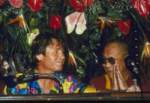 |
| The Dalai Lama and (the late) John Denver |
|
| Our body is precious. It is a vehicle for awakening. Treat it with care. Buddha See the world as your self. Have faith in the way things are. Love the world as your self; then you can care for all things. Tao Te Ching If you wish to know the Divine, feel the wind on your face and the warm sun on your hand. Buddha Slow down. Be calm. Find a place where you can regularly practice silence. There you will find the resources to revitalize your body, mind, and soul. |
|
| If you love peace, then hate injustice, hate tyranny, hate greed - but hate these things inside yourself, not in another". Mahatma Gandhi "Polonnaruwa... (Buddhist site in Sri Lanka) a low outcrop of rock, with a cave cut into it, and beside the cave a big seated Buddha on the right, and Ananda, I guess, standing by the head of the reclining Buddha... I am able to approach the Buddhas barefoot and undisturbed, my feet in wet grass, wet sand. Then the silence of the extraordinary face. The great smiles. Huge and yet subtle. Filled with every possibility, questioning nothing, knowing everything, rejecting nothing, the peace not of emotional resignation but of sunyata (emptiness) that has seen through every question without trying to discredit anyone or anything - without refutation - without establishing some other argument... Looking at the figures I was suddenly, almost forcibly jerked clean out of the habitual, half-tied vision of things, and an inner clearness, clarity, as if exploding from the rocks themselves, became evident and obvious. The queer evidence of the reclining figure, the smile, the sad smile of Ananda standing with arms folded... The thing about all this is that there is no puzzle, no problem, and really no 'mystery.' All problems are resolved and everything is clear, simply because what matters is clear. The rock, all matter, all life, is charged with dharmakaya (invisible essence)... everything is emptiness and everything is compassion. I don't know when in my life I have ever had such a sense of beauty and spiritual validity running together in one aesthetic illumination... I know and have seen what I was obscurely looking for. I don't know what else remains but I have now seen and have pierced through the surface and have got beyond the shadow and the disguise... It says everything, it needs nothing. And because it needs nothing, it can afford to be silent, unnoticed, undiscovered. It does not need to be discovered. It is we who need to discover it." Thomas Merton (Trappist Monk) First, one should carefully contemplate the equality of the other and the self: all suffer the same sorrow and the same happiness. I must protect them all like myself. Thus the Bodhisattva resolves: 'I must remove the others' suffering, because it is suffering, like my own. And so I must come to the aid of others, because they are beings like myself. Having recognized one's self as sinful and others as full of virtue, one should practice the abandonment of self and the acceptance of others. He who wishes to save himself and others quickly, should devote himself to this supreme mystery: the exchange of the other and the self. Immeasurable aeons have passed while you have been looking for your own gain. Through all this toil you have gained nothing but pain. Turn then to this practice without hesitation. You will come to see its benefits, for the Buddha's words are true. |
| among the doctrines handed down, but there arose within me the eye, there arose in me the knowledge, there arose in me the understanding, there arose within me the wisdom, there arose within me the light:" they constitute the very essence of His Enlightenment. 1. "This is the Noble Truth concerning suffering: birth is suffering, decay is suffering, disease is suffering, death is suffering. Union with the unpleasant is suffering; separation from the pleasant is suffer-ing; any desire that is not satisfied is suffering." 2. "This is the Noble Truth concerning the origin of suffering: it is that craving that causes the entering into a new birth, accompanied by sensual delight which seeks satisfaction here and there, craving for the gratification of passions, craving for a future life, craving for success." 3. "This is the Noble Truth concerning the end of suffering: this is the end, where no passion remains, no craving; the getting rid of crav-ing." 4. "This is the Noble Truth concerning the way which leads to the end of suffering: it is the Noble Eightfold Path." |
| All that we are is the result of what we have thought: it is founded on our thoughts, it is made up of our thoughts. If a man speaks or acts with an evil thought, pain follows him, as the wheel follows the foot of the ox that draws the cariage. All that that we are is the result of what we have thought: it is founded on our thoughts, it is made up of our thoughts. If a man speaks or acts with a pure thought, happiness follows him, like a shadow that never leaves him. |
|
 |
| There are two extremes, the Buddha says, which a person who has renounced the world, is not to follow: the ways of the 'world', i.e. seeking sense gratification, following the passions, and the way of 'self-torture' both these ways are 'painful, unworthy and unprofitable.' "There is the Middle Way," the Buddha says, "avoiding these two extremes, discovered by the Tathagata (a title for a Buddha) a path that opens the eyes and bestows understanding, which leads to peace of mind, to the higher wisdom, to full Enlightenment, to Nirvana." And what is that middle way? It is the Noble Eightfold Path (see above) which consists of: right views, right aspirations, right speech, right conduct, right livelihood, right effort, right mindfulness and right contemplation. The Buddha em-phasized repeatedly that what he announced to the world as the 'Four Noble Truths,' was "not |
|
|
| To control the eye is good; to control the ear is good; to control the nose is good; to control the tongue is good; to control the body is good; to control speech is good; to control the mind is good; good is control on every side. A bhikkhu (monk) who is thus controlled on every side is freed from all suffering. Disclaimer: All images and/or articles retain the original copyrights of their original owners. |
| April 18, 2004 |
 |
 |
| Visit our main Buddhism site. More information, images, and, NO pop-ups! |
 |