 |
| Page 11A |
 |
 |
| Rebirth... In the process of becoming Enlightened, the Buddha is said to have recognised all his previous lives. At the same time, he also said that nothing from one life goes on to the next. Quite a paradox really! Buddhists understand life as samsara, meaning perpetual wandering, and describe the transition like a billiard ball hitting another billiard ball. While nothing physical transfers, the speed and direction of the second ball relate directly to the first. So the term most often used is rebirth, rather than reincarnation. Reincarnation implies the transfer of an essence, or a soul, while rebirth follows the law of causality, or dependant origination, where this arises because of circumstances which happened before. A primary aim of Buddhism is to break free of the wheel of samsara, and to reach a new level called Nirvana. Nirvana is the most misunderstood term in Buddhism. Those in the West recognise the term as meaning Heaven, or a Heaven on Earth, or perhaps a famous rock band. The Buddha described Nirvana as the ultimate goal, and he reached that state during his Enlightenment. At this point, he chose to teach others so that they might also experience this realisation, |
| and so when he died, forty-five years later, he then passed through pari Nirvana, meaning completed Nirvana. Nirvana literally means extinguishing or unbinding. The implication is that it is freedom from what ever binds you, from the burning passion of desire, jealousy, and ignorance. Once these are totally overcome, a state of bliss is achieved, and there is no longer the need the cycle of birth and death. All karmic debts are settled. The Buddha refused to be drawn on what occurred then, but implied that it was beyond word and without boundaries. Certainly, he saw it in a much different state than our current existence, and not a simple parallel to the process of individual rebirth. |
 |
| Silk Road... A most significant development happened at the same time as the Buddhist movement began to spread and that was the opening of a new way from India to China. Today, we call this way "the Silk Road," and we associate it with famous travellers like Marco Polo, whose journeys to China astounded the Europeans of his day. The route was first established by the Chinese, venturing out in search of horses and trade, and it dates back to the second century BC. From that time, it became a regular journey for traders seeking to make a small fortune. In the following centur-ies, the route fell under control of different political groups, but was always well used until the 15th century AD when sea trade dominated. From early days, silk was exported from China to Italy where it became immensely popular. Grapes and wine-making were soon introduced to the East as well as perfumes, spices, unknown animals and birds such as peacocks. From China, we first encountered roses, oranges and pears. There was considerable cost to transport all these items, but the profits were huge for successful traders. The Silk Road began near Iran and India, went south of the Caspian Sea, and then took one of two routes, along the borders of the Taklamakan desert. The two routes joined in North Western China. The route was treacherous and crossed huge deserts, as well as difficult mountain passes and steep valleys. A well organised expedition relied on camels and good knowledge of local watering holes. Bandits were common and many traders perished on the journey. From about the first century BC, Buddhism began its spread along the Silk Road. As it travelled and was accepted, whole communities took the message on board and monks lived along the way. Many ruins exist in the desert regions where numerous finely decorated caves formed the centre of whole monasteries. Some areas have up to a thousand caves in a single group. Many of these caves had beautiful wall paint-ings and Buddha images which often were sponsored by travellers who sought protection for their journey ahead or gave thanks for having made it that far.. In the middle of the first century AD, a Han Chinese Emperor became inter-ested in Buddhism. He sent envoys to India and in 67AD they returned with Buddhist writings. He then proceeded to have these texts translated into Chinese. According to legend, the Han Emperor Mingti, who had already heard of Bud-dhism, dreamt of a golden figure floating in a halo of light - that was interpreted by the Emperor�s wise men to be the Buddha himself. Consequently, an envoy was sent to India to learn about the new religion, returning with sacred Bud-dhist texts and paintings as well as Indian priests to explain the teaching of the Buddha to the Emperor. Monks, mis-sionaries and pilgrims began travelling from India to Central Asia and then on to China, bringing Buddhist writings and paintings, while converts followed the Silk Road West. In the north western part of China the majority of the popula-tion was Buddhist by the late fourth century and Buddhism was well supported by the ruling classes. Buddhist monks also travelled with the traders along the way and soon Buddhist monasteries were everywhere along the route between India and China. The monasteries were used by travellers as safe places to rest overnight, and sometimes for longer periods to recuperate from an illness. Donations were generously given and the monasteries flourished. In Western countries, the skill of producing silk remained largely unknown until the 12th century however once this changed, the route began to lose its major significance. With the spread of Islam into the regions around the Silk Road, many of the stupas and temples were destroyed or left abandoned in the desert. Spread of Buddhism... After spreading to China, the Ch�an school of Buddhism developed and this later became the Zen School of Japan. This intrepretation of Buddhism is today almost non-existent in its founding country. The need to spread texts contributed to the development of block printing techniques in China. The Pure Land School also began in China before moving into Japan and Korea. In 845, foreign religions were banned in China and a persecution of Buddhist groups greatly reduced numbers. This was followed by the political climate of the 20th Century which discouraged most religious activities. Although China passed on the Buddhist message, the Buddhist philosophy almost disappeared in China and was to be found in small pockets often around existing temples, and only recently has there been a reversal of this trend. From China, Buddhism spread into Korea in the fourth century AD and soon after into Japan. Tibet was one of the last countries to accept the Bud-dhist message. While it was introduced there in about 609AD, it was not widely accepted until the 11th century AD. Further Spread of Theravada Buddhism... While the Mahayana school of Buddhism spread north, along the Silk Road to China, Korea, Japan and Tibet, the Theravada school lost ground in the early years because the main fi-nancial support was for the Mahayana expeditions. From India, Buddhism first went to Bengal and then Sri Lanka early in the third Century BC. Sri Lanka became strongly Buddhist and followed the Theravada model. It was here that many of the early teachings were finally written down. From Sri Lanka, monks went to Burma in the 5th Century but it was not until the 12th Century AD that Buddhism became widely established. Thailand took on Buddhism in the 13th Century AD, with Laos and Cambodia also taking on the teaching soon after, all following the Theravada school. At the same time, by the 15th Century, Buddhism had virtually disappeared from India, and has never been a major influence there ever since, although there have been some revival in particular areas. (Any of the material on this site may be used by students or for teaching on a not-for-profit basis provided that, where material from this site is used on a web page, a link to www.buddha101.com must be included; otherwise (except where indi-cated), copyright � 2000 to Idofilm Pty Limited.) |
|
| Question: Your Holiness, in your opinion, is death a biological and medical event, or is it simply personal and spiritual? Is it right that we do everything in our power to save or at least prolong for a few years the life and human being? Or conversely, is it unfair to impose the risk that death will occur in a highly technical medical context, where the patient is cut off from family and friends? Do you think death is good or bad? And finally, do the efforts of western medicine to thwart death seem questionable to you? If, on the contrary, death be-longs to the dying and their close friends and family, at what point should the physician with-draw? Under what conditions must we inform the patient that death can no longer be avoided? Answer: First of all, we should realise that death is truly part of life and that it is not bad in itself. In the Tibetan book of the dead, it says "what we call death is merely a concept." In other words, death represents the end of the gross consciousness and its support, the gross body. This happens at the gross level of the mind. But neither death nor birth exist at the sub-tle level of consciousness that we call "clear light." Of course, generally speaking, death is |
 |
| something we dread. However, death, which we want nothing to do with, is unavoidable. This is why it is important that during our lifetime we become familiar with the idea of death, so that it will not be a real shock to us at the moment it comes. We do not meditate regularly on death in order to die more quickly; on the contrary, like everyone, we wish to live a long time. However, since death is inevitable, we believe that if we begin to prepare for it at an earlier point in time, on the day of our death it will be easier to accept it. I think that there is no general rule with regard to the inten-sive care often given to patients in order to prolong their lives. It is a complex problem, and in examining it we must take numerous elements into account, according to each set of circumstances, each particular case. For example, if we prolong the life of person who is critically ill but whose mind remains very lucid, we are giving him or her the opportun-ity to continue to think in the way only a human being can think. We must also consider whether the person will bene-fit from prolonged life or whether, on the contrary, he will experience great physical and mental suffering, physical pain, or extreme fear. If the person is in a deep coma, that is yet another problem. The wishes of the patients family must also be taken into account, as well as the immense financial problems that prolonged care can create. I think the most important thing is to try and do our best to ensure that the dying person may depart quietly, with serenity and in peace. There is also a distinction to be made between those dying people who practise a religion and those who do not. Whatever the case, whether one is religious or not, I believe it is better to die in peace. Question: Just as one often asks a doctor if the day will come when there will no longer be any disease, do you think that the day will come when the world will truly be at peace? Answer: I do believe and continue to hope that we can attain universal peace on earth. But, of course, there will always be minor problems here and there. Question: You have often stated that you would like to achieve a synthesis between Buddhism and Marxism. What is the appeal of Marxism for you? Answer: Of all the modern economic theories, the economic system of Marxism is founded on moral principles, while capitalism is concerned only with gain and profitability. Marxism is concerned with the distribution of wealth on an equal basis and the equitable utilization of the means of production. It is also concerned with the fate of the working classes - that is, the majority - as well as with the fate of those who are underprivileged and in need, and Marxism cares about the vic-tims of minority-imposed exploitation. For those reasons the system appeals to me, and it seems fair. I just recently read an article in a paper where His Holiness the Pope also pointed out some positive aspects of Marxism. As for the failure of the Marxist regimes, first of all I do not consider the former USSR, or China, or even Vietnam, to have been true Marxist regimes, for they were far more concerned with their narrow national interests than with the Workers' International; this is why there were conflicts, for example, between China and the USSR, or between China and Viet-nam. If those three regimes had truly been based upon Marxist principles, those conflicts would never have occurred. I think the major flaw of the Marxist regimes is that they have placed too much emphasis on the need to destroy the rul-ing class, on class struggle, and this causes them to encourage hatred and to neglect compassion. Although their initial aim might have been to serve the cause of the majority, when they try to implement it all their energy is deflected into destructive activities. Once the revolution is over and the ruling class is destroyed, there is not much left to offer the people; at this point the entire country is impoverished and unfortunately it is almost as if the initial aim were to be-come poor. I think that this is due to the lack of human solidarity and compassion. The principal disadvantage of such a regime is the insistence placed on hatred to the detriment of compassion. The failure of the re-gime in the former Sovi-et Union was, for me, not the failure of Marxism but the failure of totalitarianism. For this reason I still think of my-self as half-Marxist, half-Buddhist. Question: You have called for the repatriation of the Chinese who now live in Tibet. Might there be a place for a Chinese population in a democratic, open Tibet? Answer: I think we should differ-entiate the various groups of Chinese living in Tibet. There are, on the one hand, those who were already there in 1949; then all those who went there or were sent in compliance with official plans; and, finally, those who have been coming since the so-called "liberal economic policy," and who come on their own initiative, as individuals. We should also dis-tinguish the Chinese who speak Tibetan and respect Tibetan culture - for, after all, Buddhist culture is not so foreign to them - from all those who come to Tibet merely in search of material wealth and not spiritual wealth. Those who re-spect Tibetan spirituality could prove themselves to be very beneficial if they stay. If there are not too many of them I see no reason why we could not work it out so that they can remain in Tibet. But as for all those who think that Tibet-ans are backward and barbarian, that they are dirty and smell bad (we think in turn that the Chinese smell bad, that they eat too much garlic), it would be better if they went home. Why should they stay in a place if they think it is dirty? Question: Your Holiness, in your struggle to liberate Tibet, do you absolutely refuse the use of violence, or is nonvio-lence for you simply the best way to attain your goal? Answer: Yes, I absolutely refuse the use of violence. For sever-al years now I have been asked on several occasions what I would do if the despair of certain Tibetans drove them to violence, and I have always replied that if that were to happen I would give up and step back. I have reasons for think-ing in this way; it is not merely a blind belief. First of all, I believe that the basic nature of human beings is gentle and compassionate. It is therefore in our own interest to encourage that nature, to make it live within us, to leave room for it to develop. If on the contrary we use violence, it is as if we voluntarily obstruct the positive side of human nature and prevent its evolution. The First World War ended with the defeat of Germany, and this defeat left a deep trauma in the German people. That is how the seeds of the Second World War were sown. Once violence gains the upper hand in a situation, emotions can no longer be controlled. This is dangerous and leads to tragedy. This is exactly what is happen-ing in the world at the moment. Violent methods merely create new problems. In our case, what is most important is the fact that we Tibetans and our Chinese brothers and sisters have always been neighbours and must remain so. The only alternative for the future is to learn to get along and live in harmony with our neighbours. We must seek a solu-tion between the Chinese and Tibetans that will offer mutual benefits. Because of our non-violent attitude, Chinese people both within China and abroad have already expressed sympathy and concern for our cause; some have even said they greatly appreciate our nonviolent attitude. Question: Do you think it is possible to be both Christian and Bud-dhist at the same time? Answer: I previoiusly replied to this question indirectly when I said that belief in a Creator could be associated with the understanding of emptiness. I believe it is possible to progress along a spiritual path and reconcile Christianity with Buddhism. But once a certain degree of realization has been reached, a choice between the two paths will become necessary. I recently gave a series of teachings in the United States and one of these teachings was about patience and tolerance. At the end there was a ceremony for taking the Bodhisattva Vows. A Christian priest who was in the audience wanted to take these vows. I asked him if he could (permitted to) do this, and he replied that yes, of course, he could take these vows and still remain a Christian. Question: Christ's words "Love thy neighbour" embody for us the Christian religion. What is your message to humanity when you meet another human being? Answer: Love of one's neighbour, kindness, and compassion - these are, I believe, the essential and universal ele-ments preached by all religions. In spite of divergent philosophical views, we can establish harmony among all spiritual traditions on the basis of these common traits of love, kindness, and forgiveness. I always insist on this point and de-vote a great deal of energy to it. Most difficulties between religions come about because of people who, having failed to transform and bring peace to their own minds, not only apply their own beliefs yet are all the while imposing them on others. This unfortunate behaviour can provoke serious conflicts, although I have noticed a considerable reconciliation between the different religions, more particularly between Tibetan Buddhism and Christianity. We have actually set up a very constructive programme of exchanges between monks and nuns of our two traditions. Question: You have said |
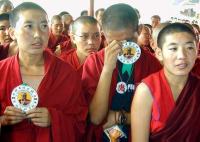 |
| Nuns at celebration of 67 birthday of the Dalai Lama in July 2002. |
|
| tion came to the conclusion that the "state of rest" of a practitioner of the Great Yoga (Great Yoga implies here the state of the practitioner who has reached a stage in meditation where the most subtle ex-perience of clear light has been realized) that for as long as the practitioner remains in this ultimate sphere he or she remains totally free of any sort of veil obscuring the mind, and is immersed in a state of great bliss. We can say, therefore, that this ultimate source, clear light, is close to the notion of a Creator, since all phenomena, whether they belong to samsara or Nirvana, originate therein. But we must be careful in speaking of this source, we must not be led into error. I do not mean that there exists somewhere, a sort of collective clear light, analogous to the non-Buddhist concept of Brahma as a substra-tum. We must not be inclined to deify this luminous space. We must understand that when we speak of ultimate or inherent clear light, we are speaking on an individual level. Likewise, when we speak of karma as the cause of the uni-verse we eliminate the notion of a unique entity called karma existing totally independently. Rather, collective karmic impressions, accumulated individually, are at the origin of the creation of a world. When, in the tantric context, we say that all worlds appear out of clear light, we do not visualize this source as a unique entity, but as the ultimate clear light of each being. We can also, on the basis of its pure essence, understand this clear light to be the Primordial Buddha. All the stages which make up the life of each living being - death, the intermediate state, and rebirth - represent nothing more than the various manifestations of the potential of clear light. It is both the most subtle consciousness and ener-gy. The more clear light loses its subtlety, the more your experiences take shape. In this way, death and the intermedi-ate state are moments where the gross manifestations emanating from clear light are reabsorbed. At death we return to that original source, and from there a slightly more gross state emerges to form the intermediate state preceding rebirth. At the stage of rebirth, clear light is apparent in a physical incarnation. At death we return to this source. And so on. The ability to recognize subtle clear light, also called the Primordial Buddha, is equivalent to realizing Nirvana, whereas ignorance of the nature of clear light leaves us to wander in the different realms of samsaric existence. This is how I understand the concept of the Primordial Buddha. It would be a grave error to conceive of it as an independent and autonomous existence from beginningless time. If we had to accept the idea of an independent creator, the explan-ations given in the Pramanavartika, the "Compendium of Valid Knowledge" written by Dharmakirti, and in the ninth chapter of the text by Shantideva, which completely refutes the existence per se of all phenomena, would be negated. This, in turn, would refute the notion of the Primordial Buddha. The Buddhist point of view does not accept the validity of affirmations which do not stand up to logical examination. If a sutra describes the Primordial Buddha as an autono-mous entity, we must be able to interpret this assertion without taking it literally. We call this type of sutra an "inter-pretable" sutra. Question: If we have committed a serious negative act, how can we let go of the feeling of guilt that may follow? Answer: In such situations, where there is a danger of feeling guilty and therefore depressed, the Bud-dhist point of view advises adopting certain ways of thinking and behaving which will enable you to recover your self-confidence. A Buddhist may reflect on the nature of the mind of a Buddha, on its essential purity, and in what way dis-turbing thoughts and their subsequent emotions are of an entirely different nature. Because such disturbing emotions are adventitious, they can be eliminated. To think of the immense well of potential hidden deep within our being, to un-derstand that the nature of the mind is fundamental purity and kindness and to meditate on its luminosity, will enable you to develop self-confidence and courage. The Buddha says in the Sutras that fully Enlightened and omniscient be-ings, whom we consider to be superior, did not spring from the bowels of the earth, nor did they fall from the sky; they are the result of spiritual purification. Such beings were once as troubled as we are now, with the same weaknesses and flaws of ordinary beings. Shakyamuni Buddha himself, prior to his Enlightenment, lived in other incarnations that were far more difficult than our present lives. To recognize, in all its majesty, our own potential for spiritual perfection is an antidote to guilt, disgust, and hopelessness. Nagarjuna says in "The Precious Garland of Advice for the King" that pes-simism and depression never help in finding a good solution to any problem. On the other hand, arrogance is just as negative. But to present as an antidote to it a posture of extreme humility may tend to foster a lack of self-confidence and open the door to depression and discouragement. We would only go from one extreme to the other. I would like to point out that to set out on a retreat for three years full of hope and expectations, thinking that without the slightest difficulty you will come out of it fully Enlightened, can turn into a disaster, unless you undertake it with the most seri-ous intentions. If you overestimate your expectations and have too much self-confidence, you will be headed for dissat-ifaction and disillusionment. When you think of what the Buddha said - that perfect Enlightenment is the result of spi-ritual purification and an accumulation of virtues and wisdom for eons and eons - it is certain that courage and perse-verance will arise to accompany you on the path. |
| that according to Buddhist philosophy there is no Creator, no God of creation, and this may initially put off many people who believe in a divine principle. Can you explain the difference between the Vajrayana Primordial Buddha and a Creator God? Answer: I understand the Primordial Buddha, also known as Buddha Samantabhadra, to be the ultimate reality, the realm of the Dharmakaya - the space of emptiness - where all phenomena, pure and impure, are dissolved. This is the explanation taught by the Su-tras and Tantras. However, in the context of your question, the tantric tradition is the only one which explains the Dharmakaya in terms of Inherent clear light, the essen-tial nature of the mind; this would seem to imply that all phenomena, samsara and Nirvana, arise from this clear and luminous source. Even the New School of Transla- |
 |
| nently touring the world's festivals. "Music in Tibet is already written in Chinese key," says TIPA Director Jamyang Dorjee. "But here we even make our own instruments to keep the music authentic." Bhuddist Centre - But more importantly, McLeod Ganj is the centre of Tibetan Bhuddism. At 2 o'clock, every after-noon, monks wearing their characteristically coloured habits can be seen in the courtyard of the Dialectic School of Buddhism, discussing Dharmas while clapping their hands. One of the monasteries even houses an oracle, a deity who is consulted by the lamas when a Dalai Lama dies. The lamas believe that the oracle can tell them where to look for his reincarnation. In Tibet such beliefs are banned by the Chinese authorities. Anyone who fights the Chinese is either jailed or has to undergo `re-education.� Every year 3500 to 4000 Tibetans flee their homeland and most of them go to McLeod Ganj. Some of them hope for a better future in a non-communist society, others leave for political reasons, like 22-year-old Nahwang Senghe. He arrived recently in McLeod Ganj where he lives in the Reception Centre, home for most of the new arrivals. Torture - Naweng walked for 25 days across the snow-capped Himalayas until he reached the Nepal border and came to Dharamsala via the Tibetan Refugee Centre in Kathmandu. The marks of torture from a Chinese prison are still vis-ible on his chest and legs. "They also tried to hit my testicles with an electric stick," he says, smiling softly, "but I managed to avoid that." Three years ago he wrote a pamphlet asking his fellow monks to keep their faith in the Dalai Lama and the Tibetan Panchen Lama. This was enough to have him imprisoned for three years and be subjected to reg-ular torture. He now hopes to be admitted as a student to one of the monasteries in India. Education - The Tibetan government-in-exile is also based in Dharamsala and has set up various education programs and housing projects for the refugees. One of the most prestigious projects are the Tibetan Childrens Villages (TCV), which are sponsored by non-governmental organisations such as SOS Kinderdorp International. There are four of them in India, and one in Nepal. 3000 people are living in the one in McLeod Ganj, 2500 children and 500 staff. Parents send their children to McLeon Ganj to have a proper Tibetan education, which they cannot have under Chinese occupation. The children live in groups of around 40 with foster parents in special buildings on the grounds of TCV. As well as these study programs there is also the Transit School for teenagers. But for them it is more difficult to adjust to a new cul- ture. And in most cases they return to Tibet. (Note: See our main site for additional information on the TCV).. Government-in-exile - The Dalai Lama, now 65 years old (2000), travels the world pleading extensively for support for a free Tibet. He would be satisfied with self-governance under the wings of China. China can be responsible for the de-fence and foreign policy, but the Dalai Lama wants Tibet to be a non-nuclear and environmentally friendly nation. The exiled government has great confidence in the future. "Of course we will have our state back," explains Tashi Wangdu, a cabinet-minister in the Kashag, as the government is officially called. "It is only a matter of time. Things are chang-ing in China. When the younger generation is in charge, they will come to speak with us." But not everybody has as much patience. The most important political group among the exiled Tibetans is the Tibetan Youth Congress. They have stated recently that "at this moment we are supporting His Holiness, the Dalai Lama, but when he dies, and if Tibet is still not free, then we will take up arms." (By Rob Hessing) |
| A Nation in Exile (13 October 2000) For travellers in search of the real Tibet, the best place to go these days is northern India. The town of Dharamsala, situated in the Hima-layan mountain range, is where the spiritual and temporal leader of Tibet, the Dalai La-ma, fled to in 1959, after the Chinese occupying forces cracked down on growing unrest in the country's capital Lhasa. The red army went on to destroy 6000 monasteries and historical buildings and killed more than one million Tibetans. The Tibetan community of Dharamsala lives in the upper part of town, a village known locally as McLeod Ganj. This is the heart of Tibetan culture. In the Tibetan Institute of Performing Arts (TIPA) young people are trained as dancers, classical singers and musicians with two groups perma- |
|
| "If you want to change the world, first try to improve and bring about change within yourself. That will help change your family. From there it just gets bigger and bigger. Everything we do has some effect, some impact. "Non-violence and peace do not mean that we remain indifferent, passive. Problems and contradictions always remain. I believe that as long as human beings remain, as long as human intelligence is present, some kind of conflict, some kind of contradiction always remains. If we look at contradictory or different ideas, they are not necessarily negative. Even if we consider our body, many elements co-exist. These elements oppose one another - they are contradictory. Forces that contradict one another are the basis of further development; things stay more balanced and that is healthy. Therefore, as long as this smart human brain remains, some kind of contradiction is always there. Even within one single person - because of the power of imagination, the power of vision, you get different ideas: in the morning something different, and in the evening something different. There are big differences, contradictions. Sometimes they are so great that, if one lacks the ability to overcome them, even suicide sometimes can occur. What we need is a method, a technique, to overcome these contradictions. That is compromise. In today's reality the only way to solve a problem is compromise. Since your interest is very much related with others' interest, you can't sacrifice others' interests. Therefore compromise, 50-50. Realistically speaking, there is no possibility of 100 percent victory for oneself." The Dalai Lama Disclaimer: All images and/or articles retain the original copyrights of therr original owners. |
 |
 |
 |
| March 15, 2003 |
 |
|
| death penalty. It is used to punish offenders, to prevent them ever repeating their misdeed and to deter others. However, if we examine the situation more carefully, we will find that these are not the real solutions. Harmful actions and their tragic consequences all have their origin in disturbing emotions and negative thoughts, and these are a state of mind, whose potential we find within all human beings. From this point of view, every one of us has the potential to commit crimes, because we are all subject to negative disturbing emotions and negative mental qualities. And we will not overcome these by executing other people. What is deemed criminal can vary greatly from country to country. In some countries, for example, speaking out for human rights is considered criminal, whereas in other countries preventing free speech is a crime. The punishments for crimes are also very different, but usually include various forms of imprisonment or hardship, financial penalties and, in a number of countries, physical pain. In some countries, crimes that the government considers very serious are punished by executing the person who committed the crime. The death penalty fulfills a preventive function, but it is also very clearly a form of revenge. It is an especially severe form of punishment because it is so final. The human life is ended and the executed person is deprived of the opportunity to change, to restore the harm done or compensate for it. Before advocating execution we should consider whether criminals are intrinsically negative and harmful people or whether they will remain perpetually in the same state of mind in which they committed their crime or not. The answer, I believe, is definitely not. However horrible the act they have committed, I believe that everyone has the potential to improve and correct themselves. Therefore, I am optimistic that it remains possible to deter criminal activity, and prevent such harmful consequences of such acts in society, without having to resort to the death penalty. My overriding belief is that it is always possible for criminals to improve and that by its very finality the death penalty contradicts this. Therefore, I support those organizations and individuals who are trying to bring an end to the use of the death penalty.Today, in many societies very little importance is placed on education or the development of human values through social programs and entertainment. In fact, if we take television programming as an example, violence, including killing, is regarded as having a high entertainment value. This is indicative of how misguided we have become.I believe human beings are not violent by nature. Unlike lions and tigers, we are not naturally equipped to kill with sharp teeth and claws. From a Buddhist viewpoint, I believe that the basic nature of every sentient being is pure, that the deeper nature of mind is something pure. Human beings become violent because of negative thoughts which arise as a result of their environment and circumstances. I wholeheartedly support an appeal to those countries who at present employ the death penalty to observe an unconditional moratorium. At the same time we should give more support to education and encourage a greater sense of universal responsibility. We need to explain the importance of the practice of love and compassion for our own survival and to try to minimize those conditions which foster murderous tendencies, such as the proliferation of weapons in our societies. These are things even private individuals can work towards. Tenzin Gyatso |
| MESSAGE SUPPORTING THE MORATORIUM ON THE DEATH PENALTY (by His Holiness The Dalai Lama) In general, death is something none of us wants, in fact it is something we don't even like to think about. When death takes place naturally, it is a process beyond our control to stop, but where death is willfully and deliberately brought about, it is very unfortunate. Of course, within our legal systems there are said to be certain reasons and purposes for employing the |
| Visit our main Buddhism site. More information, images, and, NO pop-ups! |
 |