

p. 1
September, 2005 - Page 3

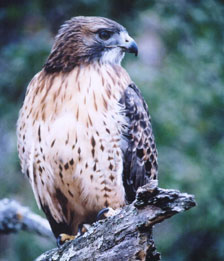
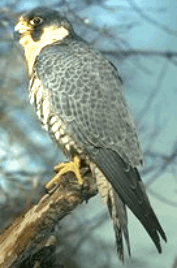
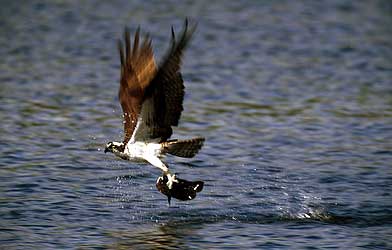
Raptors are birds that use their sharp talons to catch and kill their prey. Like all birds, they have hollow bones which make them light enough to fly. Raptors also have excellent eyesight because their eyes are closer together than most other birds so they can see in three dimensions. They have hooked beaks for tearing flesh from their prey. They can use their wings for soaring, flapping and diving.
There are diurnal and nocturnal raptors. The order Falconiforms (Hawks and Falcons) are diurnal, and Strigiforms (Owls) are nocturnal. Falconiforms are divided into three families: Accipitridae, Falconidae, and Pandionidae.
Hawks and Eagles are part of the Accipitridae family. They have feathered legs and jointed feet with three forward-facing toes and one backward-facingtow. Falcons make up the Falconidae family. They have long pointed wings for high-speed flight. Falcons use their notched beads to bite the neck of their prey! The Pandionidae family is made up of Osprey. They have longs legs, strong toes and rough skin on the toes to help catch fish.
Owls are in the order, Strigiforms. They have eyes facing forward and very strong vision so that they can determine the exact location of their prey. Owls also have very sensitive hearing. Their ears on an owl are usually at slightly different heights on each side of its head. Owl's feathers are fringed so that some air passes through the edges. This makes their flapping nearly silent, but they decreases their speed.
Raptors are amazing birds. I hope you have a chance to see one up close.

In an effort to help, many times people want to send clothing, blankets, toiletries and other supplies. I ask you: Please do not send any items to them. Right now they do not have the volunteers to sort out things and they know best what is really needed. What they need most is money to purchase the supplies that are in demand. This is the most efficient way to gather supplies. The Red Cross and Red Crescent societies use your money to purchase the supplies they need as close to the disaster area as possible. This cuts down on shipping costs and helps give money to the local economy.
There are lots of ways to raise money for them. If you have lots of almost new or gently used items, you could have a sale and donate all of the money to the Red Cross/ Red Crescent society. You could organize a bake sale, craft sale, carnival or used book sale and give the money to them. You could decide as a family to cut back on something (like a dinner or movie night) and give the savings to the Red Cross / Red Crescent society.
If you haven't donated yet, talk to your parents and come up with a plan for your family to help! No matter what the size of your donation, it will always help someone!

(p. 1)