

Sharks
When I got home I identified which sharks the teeth had come from using a poster I got in Florida. Each species of shark has its own unique shape of tooth. I also found out that sharks have a row of working teeth. Behind the working teeth are spare teeth that lay flat against the gums. When the working tooth breaks, the spare tooth moves up and upright to start working. Sharks can use thousands of teeth in a lifetime.
I had lots of teeth from Lemon Sharks, Mako Sharks and Sand Sharks. I did some research and gathered information about these species.
Scientific Name: Negaprion brevirostris
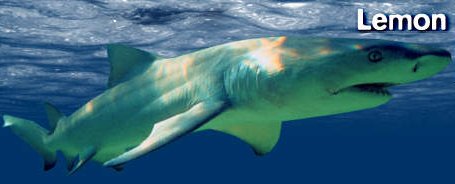
A Lemon Shark grows from about 7 to 11 feet long.
Eating:
A Lemon Shark feeds during the night. It eats fish, rays, shrimps, crabs, and even seabirds!
Habitat:
During the daytime a Lemon Shark is found in moderate depth water. At night it comes up into warm, shallow water or mouths of rivers. They always swim close to the bottom. Lemon Sharks live on both coasts of North America, in the Gulf of Mexico, and off the coasts of South America and West Africa.
Reproduction:
When the female shark's litter is born it can have between 4 - 18 young. The shark pups are 18-24 inches long.
Interesting Facts:
The Lemon Shark's two dorsal fins are just about the same size.
The shark's back is a yellow-brown or olive gray and its stomach is a yellowish color.
Scientific Names: Isurus paucus & Isurus oxyrinchus
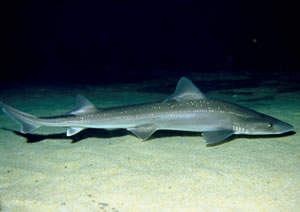
There are two kinds of Mako Sharks. Longfin Mako Sharks (Isurus paucus) and Shortfin Mako Sharks (Isurus oxyrinchus).
Size:
Mako Sharks are 10 - 13 feet long.
Eating:
Mako Sharks swallow their food whole and they eat any kind of fish.
Habitat:
Mako Sharks live from the surface to relatively deep warm or cool water. They prefer water about 65 degrees Fahrenheit. They are found world wide.
Reproduction:
The eggs hatch inside the womb. The pups eat each other while in the womb. On average, 10 - 12 pups are born in each litter and are about 2 feet long at birth.
Interesting Facts:
Mako Sharks are the fastest swimmers and highest leapers of all sharks. They can swim up to 60 m.p.h.
They are considered very dangerous!
Scientific Name: Carcharias taurus
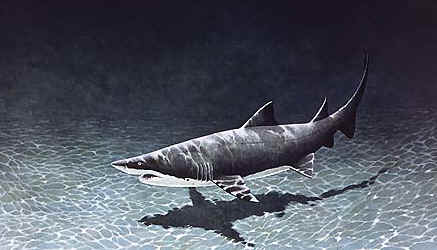
There are possibly six species of Sand Sharks. There has been debate about how many different species of Sand Shark there are. They have also had many scientific name changes!
Size:
Sand Sharks are 8 - 10 feet long with a flattened snout and stocky body.
Eating:
Sand Sharks eat all kinds of fish and they swallow their food whole!
Habitat:
Sand Sharks live in cool waters around the world. They lie in underwater caves or lie still on the bottom of the ocean floor.
Reproduction:
After 9 - 12 months, 2 baby sharks are born. One shark comes from each uterus (the mother shark has 2 uteruses) Many eggs hatch in each uterus, but the largest and strongest of the hatchlings eat the others so that only two pups survive, one from each uterus! The newborns are about 3 feet long and weigh about 13 pounds.
Interesting Facts:
Sand Sharks have spike-like teeth that hang out of their mouths, making them look fierce.Their front teeth have one large point in the middle and a smaller point on each side. Their first dorsal find is placed far back on the top of their body. These sharks are not considered very dangerous!