Breed-Specific problems
Through selective breeding for desirable traits, potentially harmful genes can also be pooled. Failure to screen for these problems before breeding often results in the "doubling up" of unfavorable genes, and the results can be very distressing for all involved.
Hip dysplasia
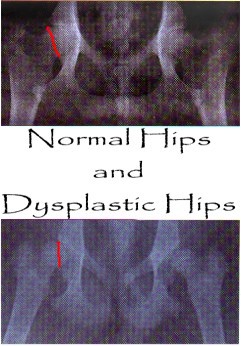
The term hip dysplasia means poor formation of the hip joint. Hip dysplasia is a defect found in large breeds. The condition is partly inherited and partly related to excessive weight, or overstrenuous activity during puppyhood. Signs of dysplastic hips are wasting and discomfort in the thigh muscles and in severe cases, "bunny hopping" to reduce pain. To reduce the prevalence in the breed responsible breeders will not breed a dog that does not have hip clearances. The Orthopedic Foundation for Animals (OFA) accepts X-rays from veterinarians for examination. All the X-rays sent in (with AKC documents) are studied and given a rating. only if the socket reaches more than half way around the ball will a clearance be issued. Breedable hips are excellent, good, and fair but dogs with some signs of hip dysplasia can still live long, happy, active lives. Goldens with hip dysplasia often show no outward signs, until 7 or 8 years of age when muscle tone decreases and arthritis and wear and tear on the joint become more noticeable. There are surgical procedures that are available to alleviate the pain of the dysplastic animal but the cost can be restrictive. While an X-ray shows the hip conformation, it does not always show you how your dog feels, as many dysplastic Goldens are completely unaware that they have a problem!
Eye diseases
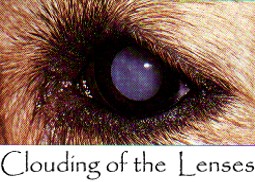
Goldens carry the risk of developing two inherited eye diseases that may eventually lead to blindness: cataracts and progressive retinal atrophy. Cataracts are any opacity within the lens of the eye. There are hereditary and non-hereditary cataracts which can occur ,and examination by a board-certified veterinary ophthalmologist is necessary to determine if the cataract is or is not a concern from a genetic standpoint. Goldens can carry genes for Central Progressive Retinal Atrophy (CPRA) which is a progressive deterioration of the light-receptive area (retina) of the eye, and may result in complete blindness at a fairly young age. Goldens who are used for breeding should be examined annually until at least eight years of age. When a golden has been examined by a board-certified veterinary ophthalmologist and found to be free of hereditary eye disease it can be registered with the Canine Eye Registration Foundation (CERF).
Heart disease
Introduction History The Standard
Conclusion
Links
