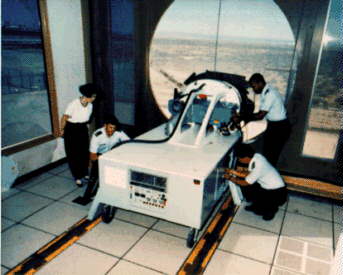
The F-16 Radar Test System (RTS), is co-located with INATS in IFAST Test Bay No. 1. Using the AN/APG-68 Radar, it provides a radar ground test facility that is reconfigurable to any one of several versions of flight test avionics. Specific activities supported include: line replaceable unit level testing; radar system level testing; core avionics integration testing; Electronic Counter-Countermeasures (ECCM) testing; internal high-speed digital bus monitoring and recording; Electronic Countermeasures (ECM) pod checks; and radar jamming. Click here for more information. The F-15 Avionics Laboratory in IFAST provides the F-15 Program with a core avionics and radar ground test facility reconfigurable to support avionic flight tests. This support includes APG-70 radar software development and test support, an Interactive Data Reduction and Analysis System (IDRAS), F-15 avionics integration support, an Avionics Intermediate Shop (AIS) maintenance capability, and ECM pod preflight test capability. Specific activities include: line Replaceable Unit testing; core F-15C Avionics Suite Integration testing; radar systems level testing including jamming; sensor integration; weapons simulation, integration, and testing; electronic warfare integration and testing; and Electronic Countermeasures (ECM) pod preflight testing. Click here for more information. The B-1B Offensive Avionics Laboratory (OAL) in IFAST test bay No. 4 contains the entire B-1B Offensive Avionics System (OAS) and is used to test and evaluate B-1B avionics flight software, weapons integration with core avionics, flight simulation, and integration with defensive avionic systems. Test support systems include the following: Vehicle System Simulator (VSS), Weapons System Simulator (WSS), Radar System Simulator (RSS), Integrated Test Station (ITS) and Test Mission Data Preparation System(TMPDS). Click here for more information. The B-1B Defensive Avionics Laboratory also located in IFAST test bay No. 4 provides the B-1B flight test program with a reconfigurable, defensive avionic system test station and line replaceable unit (LRU) repair and test capability. The defensive avionic system test station is fully integrated with B-1B OAS. Specific activities include: LRU testing and repair; defensive and offensive systems integration testing; digital bus and video data retrieval and processing; aircrew familiarization/training; mission verification testing; real-time interface with offensive systems controls and displays; and dynamic signal simulation. Click here for more information.
|