Art and Archictecture
The Greek developed three architectural system, called orders, each with their own distinctive proportions and details.The Doric style is rather sturdy and the top (this capital), is plain. The Ionic style is thinner and more elegant. This style was found in eastern Greece and the Island.The corinthian style is seidom used in the Greek world, but often seen on Roman Temples.It's decorated with acanthus leaves.Greek life was dominated by religion and so its not surprising that the temples of acient Greece were the baggest and most beutiful.Partheno is a temple of Athena Parthenos Greek Goddess of wisdom, on the Acrapolis in Athens. The Parthenon was build in the 5th Century BC.
Erechtheum
Temple from the Middle Classic period the temple was build on the the Achicture of Athens between 421 and 405 BC. The Temple of Athena Nike
part of the Acropolis in the city of Athens. The Greeks built the temple of Apollo Didyma. Turkey (about 300 BC) The desing of the temple wqas known as dipteral, a term that refers to the two sets of columns sorrunding the interior section. With Ionic columns reaching 19.5m (64ft) high.
Art
Greek Jewerly
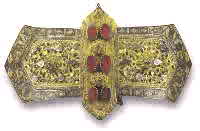 Ancient Greek jewerly constitusa characteristic example of this process. Greece emphasis was placed on modelled decoration. The jewellers used gold and silver, as well baser metals such as copper lead and iron, to fashion diadems, necklaces, bracelets, earrings and rings of unrivalled artistry(jewerlly decoration depended on the charecteristic traits of each period.) The ancient craftman first drew the decorative motif on the sheet of gold , which was the placed on a bed of yielding material(piece of leather layer of sand pitch)and worked with appropriate hammers and punches, usually from the back. The tools used by the ancient craftsmen were similar to modern ones. In order to imprint repeated desings special dies of wood, stoneor metal were made.
Jewellery-making in Byzantium
Byzantine art is charecterized by the same love of luxury and precious materials as that of ancient times. Gold, silver, precious stones and enmel were a 11 used for making opulent objects and typical of the metalworking of this era is the jewellery. One of the distinctive traits of Byzantine jewerllery is the lavish use of precious stones Pearls from the Persian Gulf, emeralds from Egypt and Indian, sapphires from Ceylon were brought to the Empire to embelish valuable objects. Another method of decoration which is of oriental origin and was frequently used by Byzantine jewellers is niello. Throgh niello was known in the Mycenaean period it was subsequently forgotten, to reappear on Roman objects. The decoartive effect is based on the constrast created between the colour of the ground metal and the dark motifs. It can be applied to gold, silver and bronze.
Neohellenic jewellery-making
From the late seventeenth century enslaved Hellenism began to organized itself, to develop an economy and to turn towards its roots. This renaissance in the flourishing of folk art, an art which is the natural heir to that of Byzatinum.
Jewerly was made in permanent workshops. Renowned centres were Stemnistsa, Lamia, Yannina and, above all, two large villages in Pindos, Syrrako and Kalarrytes. On account of the special conditions prevailing in Greece at this time it is essential to distinguish between the jewellery of the Greek mainland and that of the Greek island.The islands, both in the Ionian and the Aegean Sea, experienced a long period of Frankish occupations and so their jewerlley does not constitute genuine examplesof Greek folk art but rather copies western models. Island jewellery was frequently made of an alloy of gold, while its decoration was executed in a 11 the known methods (filigree, granulation etc.), very often enriched with gemstones, pearls and enamel. In mainland Greece however, whichwas under the Ottoman yoke, precious matals were only produced for use by the state and the folk jewellery was made of humbler metals. The community of Mademochoria that exploited that exploited the silver mines of the region, paying an annual tax in pure silver to the Sublime Porte, constituted an expection. The raw materials were usually obtained through illicit mining or the recycling of coins, older jewellery and other precious objects. Thse were melted down and then a complex process was followed in which the various ingredients, that is the gold, silver, copper, etc., were separated out (lagarisma)Neohellenic jewellery was usually made from an alloy of silver which only rarely had a high silver content(lagara), and usually low-grade (ayari).Another metal used in jewellery-making was copper. Very often the folk jewellery was excuted in all the familiar techniques. Repouses decoration occurs mainly on belt buckles. Various linking plaques with relief decorations and small bucklets were made by casting in metal moulds.
NEXT
PREVIOUS
Back to the index page