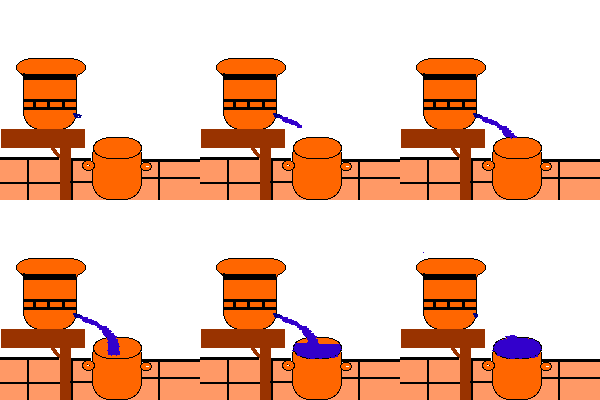
Ancient Greeks used basic measuremants. They used a finger as their basic unit. Sixteen fingers equaled one foot and twenty -four fingers eqaled one foot and a half.Twenty four fingers also equaled one Olypic cubit and so did 16 palms. The Roman later toodk the Greeks measurementrs and used them. In ancient Greece there were men that were sent to walk around an agora1 . They went around the agora to make sure that trading was fair. The men helped in trading because they made sure no one traded a valuable thing for a worthless thing.The trades had to own there own official set of weights.
The Greeks invented many things. One of them was the fire engine 2. It was redesigned by the Greeks.Another invention was very first computer. It was made of bronze and copper and showed how the planets moved.Longitude and latitude was one of them and we still use it today. Another thging that the Greeks thogh up was that the suns light reflects off the moon.At first the Greeks thought the the earth was a cylinder and that everything in space orbited around the earth. But later a philosopher found out that the earth rotates around the sun.Democritus though up atoms and that everything was made of them.
The ancient Greeks got mathematics from the Egyptians. Pathogoras is said to discover the angles of a triangle. Later in Ancient Greece they came up with coins for each city-state. Each coin had a different weght, apperance, and value.A Greek doctor made an oath 4 that every doctor still takes today. It says that they will help and not hurt any of their patients.Hippotamus came from two Greek words.Hippos means horse and potomos means river so hippopotamus means river horse.
The art of astrology, the study of the stars in order to predict future events, and to interpret people's characters, was already very advanced before the Greeks began to interest themselves in the stars. The Egyptians and especially the Mesopotamians had done a lot of scientific observations and had named the
constellati constellation of stars, and many individual stars.The Greek contribution to astronomy was not so much in observation as it was in applying logical thinking and geometry to these observations. That is how Greek scientists figured out that the earth went around the sun, calculated the size of the earth, and understood that the moon went around the earth, so that they could understand what caused an eclipse.Early Greeks thought of the Earth as the goddess Gaia, the mother of everything. By the Classical period, however, at least educated Greeks knew that the earth was a round ball, and by the Hellenistic period Greek scientists were able to use astronomy and geometry to measure the circumference
1 of the earth . The Greeks were very interested in science as a way of organizing the world and making order out of chaos, and having power over some very powerful things like oceans and weather. From about 600 BC, a lot of Greek men spent time observing the planets and the sun and trying to figure out how astronomy worked. They must have gotten their first lessons from the Babylonians, who were very good at astronomy and also very interested in it. By the 400
th's BC, Pythagoras was interested in finding the patterns and rules in mathematics and music, and invented the idea of a mathematical proof. Although Greek women usually were not allowed to study science, Pythagoras did have some women among his students. Socrates, a little bit later, developed logical methods for deciding whether something was true or not. In the 300
th'sBC, Aristotle and other philosophers at the Lyceum and the Academy in Athens worked on observing plants and animals, and organizing the different kinds of plants and animals into types. Again, this is a way of creating order out of chaos.